”As one follows the lines drawn at the map, across the light blue surfaces, further north, twists and turns, further north, straight lines, still north. This is where I see myself, at the island furthest north, at the North End, standing at the northernmost cliff, facing the North Sea.” (Tonje Bøe Birkeland/Lumiére, from Papa Westray in Orkney Isles, 1900)
Darkness & Light contemporary Nordic photography –exhibition just opened on February 22nd at the Scandinavia House in New York City. Norwegian Tonje Bøe Birkeland’s photograph, displayed above, is part of her project that reflects how she takes on the role of fictional photographer Luelle Magdalon Lumiére (1873-1973), and recreates an imaginary journey to the Orkney Islands.Birkeland’sproject travels back in time. Her art combines photographs and texts, and she is also writing letters to Lumiére who as a traveler explored ie. western parts of Norway and New York. The artwork is an interesting dialogue between past and present, that is encompassing two life stories. Yet the images appear dreamlike hovering between fiction and reality.
Two captivating photographers in the exhibit are from Iceland. Bára Kristinsdóttir’s‘Hot Spots’ photography-series portray Iceland’s geothermally heated greenhouses. Her style owes to Dutch Golden Age still lifes. Her photographs play with opposites, such as light and dark, cold and hot, indoor and outdoor, natural and artificial. Kristinsdóttir shows interest in nature photography, and so does Pétur Thomsen, another Icelandic photographer. He takes, yet, a more critically environmental stance with his works. His ‘Imported Landscape’ project is based on his visits (since 2003) to a Kárahnjúkar Hydropower Plant, a construction site on the east coast of Iceland. The artificial lake and the construction project have spoiled the biggest wild nature in Europe. Environmentalists have been fighting for the preservation of the wild nature. The voices supporting the project discuss about the need to use the energy from the nature. Thomsen’s photographic project has explored this debate, as he has documented the transformation of the landscape.
(above: Bára Kristinsdóttir ‘Hot Spots’ 4, 2004 From the series Hot Spots R print, 47 1/5 x 39 1/3 in. (120 x 100 cm), courtesy of the artist)
(above: Pétur Thomsen ‘Imported Landscape AL3_9a’, Kárahnjúkar, Iceland, 2003 Pigment print, 43 1/3 x 55 in. (110 x 140 cm) Courtesy of the artist)
Darkness & Light: Contemporary Nordic Photography will run through April 26, 2014. The exhibition focuses on a diverse selection of recent photographic works displaying a selection of over 30 works by 10 emerging and established photographers. The artists from Denmark, Finland, Iceland, Norway, and Sweden, (two from each Nordic country) are:
The exhibition aims to display ”the ways in which light—and the lack thereof—informs the practice of contemporary Nordic photographers. The exhibit demonstrates the breadth and strength of Nordic photography today.”
The exhibition is organized by leading figures in the world of Nordic photographic art.
More information found on the Scandinavia House: The Nordic Center in America’s website
photo: Wilma Hurskainen: “He Doesn’t Like Water”, 2012
The book Training artist for innovation: Competencies for new Contexts was published in 2013, (the Theatre Academy of the University of the Arts in Helsinki in Finland). It discusses the topic of artists who are trained for creating innovation in various contexts outside their own artistic practice. The book is based on a project, which gathers together different agents in European countries, who are leading artistic innovation. Kai Lehikoinen and Joost Heinsius are the editors of the book.
The book-project brought together artists, companies, organizations, universities and cities, which have experienced artists working with them. The idea for the publication came from the challenge that both society and businesses need new solutions and interventions, as they face changes. Professional artists with artistic interventions can respond to challenges of today, bringing in new questions and ways of thinking. Artists “offer contradiction, as well as confrontation and friction, and they provoke new ideas.”
Training Artists for Innovation: Competencies for New Contextsargues that artists who take the challenge for artistic interventions need specific training to establish their artistic know-how for new contexts. Artistic competencies can be trained, so to speak. Innovation can occur where artists, with their own practice and methods, contribute to the arts sectors and organizations, to the business world and sectors, where societal policies are made. The book responses to a framework of European context, but the idea can be shifted to other parts of the world.
A very basic question; are artists not innovative by nature, opens up a dialogue between artists and new contexts. According to editors Heinsius and Lehikoinen, “A gap has risen between the arts and society that needs to be bridged and closed” .
Art can intervene not only on the walls of office spaces, but it can come to peoples’ working life as well. This statement is inspired by models learned from community art, and by the experience coming from social and health sectors, where art has always been respected as part of human life. The new innovation comes in the intersection, where businesses and organizations want to raise their creativity, and understand their creator capacity in conjunction to human-based factors. As the book shows, the arts can add value, for example, by bringing in emotional and aesthetic dimensions. Artistic interventions can boost creativity and raise energy, bring in new ways of listening, managing, and interacting with others. The book emphasizes that the term artistic intervention is understood as “interdisciplinary professional practice that takes places in business settings and involve professional art-making and creative arts practices”.
What are, then, the issues that interventions can tackle? Topics and issues of course vary, and depend on each context. Artistic interventions can be connected to strategy and concept development, to work processes, to team-building and social interactions, and to public relations, for instance. In the level of cultural policy, the arts have a key role, together with other creative sectors, to add into the diversity of society. In a larger societal (European) policy level, the following seems very relevant and welcomed, when thinking of the creative economy:
“At the national level, the starting points differ from country to country. In some countries, it is the perceived gap between the arts sector and the rest of society that needs to be acknowledged – that is, the need for the arts to appear as relevant to other sectors in society. In other countries, innovation development welcomes the arts as the perception of shifting from technological innovations to social innovations and creativity.”
Training Artists for Innovation: Competencies for New Contexts is a book that asks a relevant question of, how to do it with the arts. It gives several examples of the relevant competencies that artists can embody for their interventions. Gerda Hempel and Lisbeth Rysgaard, from Danish Artlab, write in their chapter Competencies – in real life, about their own model of working with artists and businesses. What they suggest is that artists need to manage a variety of specific tasks that relate to understanding the culture of the organization: such as developing and describing the concept, knowing how to sell and negotiate, and,“how to engage and conduct the process, how to extract learning and evaluate, and how to support the implementation within the organization.”
Their chapter reveals that when artists share a common denominator, the artistic base, methods and tools vary in different art forms. For example, a violinist in the opera house has a different approach than an avant-garde performer who works in an experimental performance space.
Artlab founders and consultantsGerda Hempel and Lisbeth Rysgaard bring in the artist perspective of working with businesses. They open their Artlab Entrepreneurial Model (that is based on their 12-year experience in the field) and reflect this in relation to real artists, who they interviewed. This shows how artistic interventions function from the artists point of view. The model itself is like a metaphoric artistic house, which includes 4 interactive work spaces and a storage. Its aim has been to help professional artist who want to go entrepreneurial and find new job opportunities, or look for new management skills for their career. The house allegory with 4 spaces includes: The Shop/Back office, The Workshop/Development, The Scene/Artistic intervention, The Shop/Front office, and Storage/place for new ideas. Artlab’s model functions as a visual guideline to see parallel tracks. It offers artists a tool to plan and prioritize their work.
Training Artists for Innovation: Competencies for New Contexts has a message for everybody working in creative industries. It offers chapters with real examples, and discusses how real artists have solved their tasks, approached different organizations and worked with businesses. The book is a guideline to discussing competencies that artists need in order to work with various sectors. It clearly opens a discussion, which goes to two directions. 1. Artists need more than ‘just’ their own artistic skills and competencies to go outside their craft. 2. Yet, artist have special skills and innovative qualities that (only) come from their artistic work and expertise. To bring these two to meet; some common ways can be created.
In summary, artists need special qualities to work with organizations and companies; this includes knowledge of those cultures. They should have pedagogic competencies to set up methods and approaches for intervention. Artists also benefit from research competencies to find information, and to critically view the information and other collected material. What artists also should learn about, are skills in project management and marketing.
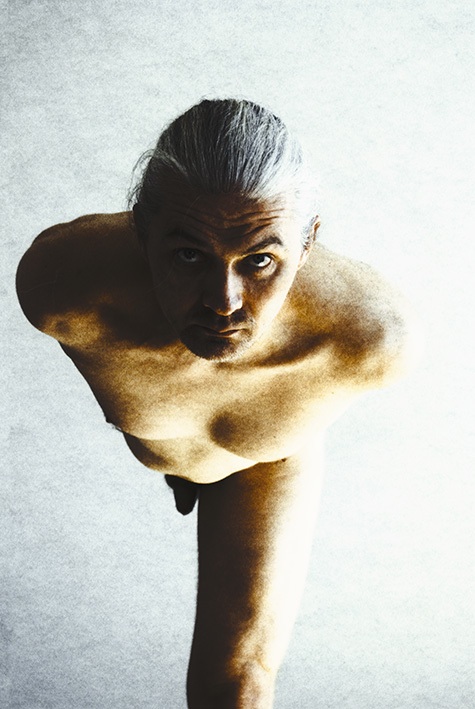
In his photographic portraiture of the male body, Kari Soinio studies masculine corporeality, body language, sexuality and identity and looks at the ways perception and recognition operate through visual representations. His auto-portraiture-based work takes a critical look into masculinity and femininity in maleness, showing ambiguous bodies with traits of both and in doing so addresses and challenges masculine complacency and self-importance.
Kari Soinio, Athletic Hero #1, digital C-print, 2012
When looking at Kari Soinio’smale portraits, it feels relevant to ask, how do we actually portray the male bodies in general? Soinio’sportraits offer answers that are more subtle than loud. His work is more questioning than giving answers, more provoking than seducing, and more aiming to challenge than trying to frame simple answers. The presence in his photography is strong. The body in the images becomes the one, which is both looking at you as a viewer, and simultaneously makes its own subject the mysterious one. The portraits are saying, you can look at me now, but here is the movement, which does not create passivity of an object. The entire question could be played around the underlying theme of a ’hero’. I am a male as a subject for photography, and, therefore, when you label me, I’m aware of the multiplicity of the ways you are looking at me.
Generally, one can suppose, a man who is portrayed, stands for a cultural hero, often a superhero. We can imagine man and his sports, man in the wilderness, man in action, man doing his duty, man and the muscular body, man and a celebrity status, man and nature, man and the urban life, man and his gadgets, man in his clothing, man in his business suits. The list is endless when we think about it. In the Western art world, we tend to think a man of modernism is someone who is portrayed as part of the bourgeoisie. While he was posing, he came out as a dandy, as a flâneur, being mostly comfortable in his position of posing, being able to pose and gain gaze through a masculinity with substance (think of Oscar Wilde, for instance). Now, self-portraiture is an interesting sport itself, how to present your own body, how to create the gaze, how to, simply, pose?
How about a naked man? Is there a controversy regarding the subject? Seeing naked men in portraits is still quite a taboo outside the art-context. Perhaps, even photography and male nudity still have a quite fresh relationship. Even when the history of performance art and some theatrical traditions of avant-garde have exposed naked bodies as sites of performance throughout the past century, the subject matter still has the power to startle us. The human body and its performativity is a powerful tool enabling us to discuss society, gender, sexuality, identity, culture, power, class, race, beauty and aesthetics.
Kari Soinio, Athletic Hero #13, C-print, 2012
Body representations and questions relating to them, and to our ways of posing are without argument more often associated with women’s bodies. However, whether it is our bodies in advertising, in media, in television, in art, in fashion, in sports, in health and nutrition, we have opinions about our physicality. Our skin is reality. It is the window to our selves rather than what we aim to say, or how we wish to act. Our visually overexposed cultures tend to invite us to look at, to evaluate, to be seduced, to judge, to react to the lens. Yet, that is a very human characteristic. We are bodies, and we need to focus the conversation on what is our relationship to ourselves.
Kari Soinio says that his source of inspiration is the complexity of the male ’self-consciousness and body image’. This opens into many interpretations of the masculine essence in our culture, showing maleness through icons of male heroes. Soinio’s portraits discuss with these cultural images, yet they offer ways to look at the masculinity as a more vulnerable entity, which nudity already poses. Is his posing creating classic male bodies? In the ways the torso, arms, head, shoulders etc. are presenting shape and balance, yes. When it comes to mixing the color palette into the image, some of the more toned ones are definitely blurring the lines of the self. The rigid becomes more soft and round.
Is nudity a surface where naked male body transforms into something else than naked female body, because of the culture they impose? The latter is often a territory for many cultural signs, which note male gaze, voyeurism, sexism and pornography. Therefore, portraying women’s bodies differently is a constant challenge in the art of photography. The iconography of a male posing in pictures might offer a surface to investigate our bodies as sites for many identities, which are necessarily not just male. This play is of course available for ‘any-body’ regardless of gender. In Soinio’s photographs, the viewer can see a body that is in and out of balance. The portraits do not fit inside their frames, they want to step out. From this viewpoint, the naked heroism is within our acceptance of our body as a spirituality. We might see the human body as part of nature, part of yoga-culture, part of wellness and balance. The nature-body communicates across the simple boundaries of gender. Our bodies are aiming to balance and be off-balance. The experience as the viewer is to kinesthetically feel together with the portraits, and move outside the frames.
…Kari Soinio is a New York based artist working mainly with photography. He received his BA from the Lahti Polytechnic in his native Finland and his MFA from University of Art and Design in Helsinki. He has also studied at the International Center of Photography in New York…
Kari Soinio has recently shown at Storefront Bushwick in NYC (2013), at Heino Gallery (2012) and Korjaamo Gallery (2011) in Helsinki, at Northern Photographic Center in Oulu (2011) and at several galleries and museums in Finland, including numerous shows at the Museum of Contemporary Art Kiasma and Finnish Museum of Photography in Helsinki. His monograph “From Landscape to Place” was published in 2009 in conjunction with shows at Heino Gallery and a mid career survey at Kerava Art Museum. His show at the Institut Finlandais in Paris was part of Mois de la Photo in 2010 and received significant attention from the French art press. His work has been shown internationally in the US and in Europe: at Mappin Art Gallery, Sheffield, England, NGBK gallery, Berlin, Germany, Arthouse, Sofia, Bulgaria, Ludvig Museum, Budapest, Hungary, Signe Vad gallerie, Copenhagen, Denmark, Peer Gallery, New York, USA, Gallery Papatzikou – Photobiennale Thessaloniki, Veroia, Greece, Ingrid Hansen Gallery, Washington DC, Municipality of Neapolis Gallery, Thessaloniki, Greece, and Kakelhallen, Mariehamn, Åland. Soinio’s work has appeared in NY Arts Magazine, Connaissance des Arts, l’Humanite, Réponses Photo, Art Actuel, La Tribune, Next Level and in numerous books, newspapers and TV programs in Finland.
Gallery Information:
Station Independent Projects organizes exhibitions and events with a focus on artist advocacy. It is located in Lower East Side.


 (above: Bára Kristinsdóttir ‘Hot Spots’ 4, 2004 From the series Hot Spots R print, 47 1/5 x 39 1/3 in. (120 x 100 cm), courtesy of the artist)
 (above: Pétur Thomsen ‘Imported Landscape AL3_9a’, Kárahnjúkar, Iceland, 2003 Pigment print, 43 1/3 x 55 in. (110 x 140 cm) Courtesy of the artist)


 Firstindigo&Lifestyle