Category: art review&curating

  • Fashion Curating: Unsustainability, gender and class readdressed

    Fashion Curating: Unsustainability, gender and class readdressed

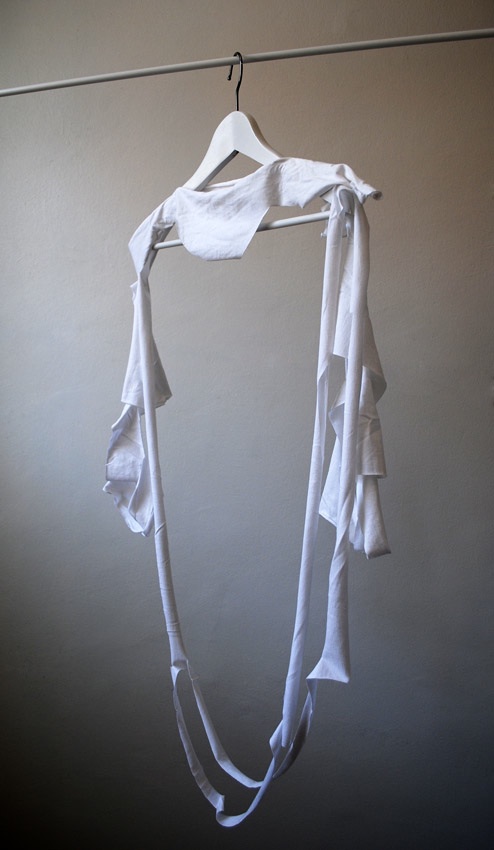
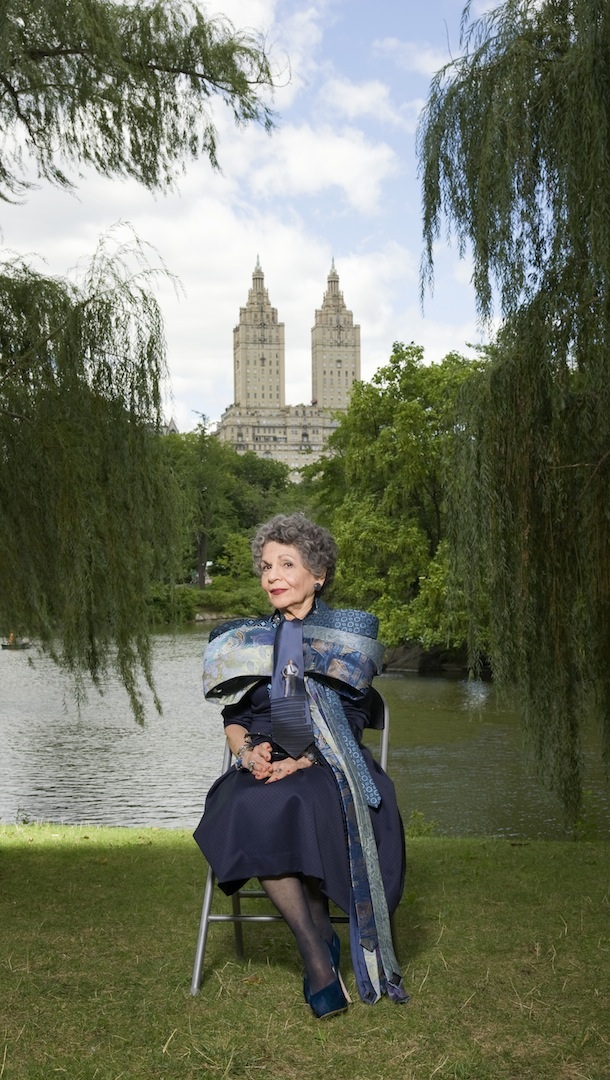
    Fashion Interactions is a multidisciplinary exhibition that explores fashion culture by means of contemporary art, design and media. The exhibited works comment, on the unsustainability of the fashion industry, analyze the relationship of fashion and corporeality, and investigate how people use clothing as a tool for building identities. The exhibition is Curated by Annamari Vänskä & Hazel Clark and it presents works from: Federico Cabrera, Heidi Lunabba, Jasmin Mishima, Anna Mustonen, Nutty Tarts, Timo Rissanen, Salla Salin, Heidi Soidinsalo, Saara Töyrylä and Timo Wright. This exhibition opens on Friday November 15, 2013 in New York City. It is a collaboration with Parsons The New School for Design and the SheilaC. Johnson Design Center, Finnish Cultural Institute in New York, and the Centre for Fashion Studies (Stockholm University).

    Image 

    (Fashion Interactions-exhibition, Timo Wright-‘un fit’ video still)

    FASHION CURATING NOW is a daylong symposium at Parsons The New School for Design on Saturday November 16 9:30 am-5 pm. The symposium reflects the subjects around the Fashion Interactions exhibition focusing on the possibilities and challenges of contemporary fashion curating on a global scale. Critical points of view are stressed, as is contemplation of fashion’s kinship with art, design, industry, performance, and self-presentation. I asked a few questions from Leena-Maija Rossi, who is the Executive Director of Finnish Cultural Institute in New York, about the seminar and other related topics. 

    Firstindigo&Lifestyle: Can you explain the background of the seminar?

    L-M Rossi: The background of the Fashion Curating Now is in the exhibition project Fashion Interactions. It has its origins in the show Boutique, curated by Annamari Vänskä, which was part of Helsinki’s World Design Capital year in 2012. Finnish Cultural Institute wanted to bring a new edition of the show to New York and partnered with Parsons New School for Design in order to do that. The process of “re-curating” an already existing exhibition made us think of curating fashion at large: how to present fashion in an interesting way “outside the  market”? How to make engaging exhibitions on fashion, how to show its entwinement with fine art, how to find new fora for curating, e. g., in the new media? How to make visible the political aspects of fashion?

    Firstindigo&Lifestyle: Finnish fashion and design have gained more international visibility, creating their own trends as well, how do you see current research field is following trends from the industry?

    L-M Rossi: I see fashion research as a developing and dynamic field, especially when it connects with studies on class and consumerism, and, of course, studies of gender and sexuality. I do not know if the task for the research is to follow the trends, I rather see research as a field for critical interventions.

    Firstindigo&Lifestyle: In Finland, it seems that industries have also been able to point to cultural questions, what do you see as current research themes coming from the field/industries themselves?

    L-M Rossi: Sustainability is of course a timely research theme, and the way it intersects with the issue of class. I am also really interested in the potentiality of queer fashion research, and I would really like to see more analysis on gender nonconformity, not so much of equaling queer with identity categories.

    Firstindigo&Lifestyle: Yourself, you have written about advertising, media, gender representations/performance-related, in the contemporary visual culture. What do you see this global exchange is giving to these themes?

    L-M Rossi: I think fashion is a crucial part of visual culture at large, especially because of its border-crossing nature. Gender is being profoundly done by people’s choices of dressing up and wearing their clothes, and these choices are, again, influenced by advertising. So one could say that the fields of fashion and advertising are constantly participating in the global processes of doing and undoing gender.

    Firstindigo&Lifestyle: How well or how do Finnish fashion industries communicate globally? How do you see the branding, would it be more individual voices than a canon etc.?

    L-M Rossi: It seems that many Finnish designers communicate quite naturally in the international field of fashion. Like visual artists, I think they first and foremost present their individual voices; it is very difficult to build a uniform “brand.” But then again, many seem to be thinking of such issues as high quality materials and sustainability. 

     Firstindigo&Lifestyle: Art, fashion, design: How would you speed-describe these together?

     L-M Rossi: Fashion and design are artforms, fashion is an interesting field within design. All of them make difference in everyday life.  
     Image

    (Fashion Interactions-exhibition, Nutty Tarts & Heidi Lunabba) 

    /// INFO: FASHION INTERACTIONS ///

    Fashion Interactions-Exhibition

    Opening: Friday November 15, 6pm – 9pm

    November 11 – December 13, 2013

    Open daily 12pm – 6pm

    Arnold and Sheila Aronson Galleries

    Sheila C. Johnson Design Center

    Parsons The New School for Design

    66 Fifth Avenue at 13th Street, New York

    The exhibition is supported by the Finnish Ministry of Education and Culture, Frame Visual Art Finland and Consulate General of Finland in New York.

       /// FASHION CURATING NOW ///
    Symposium, Saturday November 16, 9:30am – 5:00pm

    David Schwartz Fashion Education
    Parsons The New School for Design
    560 Seventh Avenue at 40th Street
    New York

    Finnish Cultural Institute in New York Facebook.

    http://www.ficultureny.org/node/330

    http://www.newschool.edu/sjdc

  • 2 reasons to visit Stockholm soon

    2 reasons to visit Stockholm soon

    Stockholm is one of the Scandinavian top top places to visit. It can be always surprising. Here are two reasons why to travel there this summer.

    1)
    The Wild Wonders of Europe outdoor photo exhibition is in Stockholm all summer, and it takes place in Raoul Wallenbergs Torg at Nybroplan. ‘After 135 missions by 69 of Europe’s Top Nature Photographers to 48 European countries and more than 1,100 days in the field..

    2)MAGAZIN 3 Stockholm Konsthall exhibits ON THE TIP OF MY TONGUE that is curated by Richard Julin and Tessa Praun. It is a series of events and unique projects (and an exhibition) taking place July 1, Aug 8 and Sep 13. Part of this is a project by MIRANDA JULY called WE THINK ALONE, starting July 1 until Nov 11 2013.  As the curators say, this ‘includes artworks that point away from the site of the exhibition itself, towards other virtual or parallel existences and experiences.’


  • VOLTA edition #2 Derrick Velasquez

    VOLTA edition #2 Derrick Velasquez

    Artist Derrick Velasquez was presented at VOLTA by Philadelphia-based pentimenti Gallery. His marine vinyl and plywood wall pieces are sculptures, if you like, and at the same time they possess some qualities that are decorative, or design. Yet, this is not entirely summing up what he is doing with the ingredients. The art made by Derrick Velasquez is very physical. The layers of meaning, which come to your mind begins with words, like arts and crafts, ancient, poetics, mechanics, physics, installation, historical play with objects, and the body-art. He says in VOLTA NY 2013 introduction to his work, that his attempt is to ‘construct a language of structure that questions our physical and psychological interactions with industrially manufactured materials that exits in the spaces we inhabit’. Velasquez works with plywood to investigate the gravity or tension on the wood together with the materials of marine vinyl, acrylic and hardwoods. He adds into these the human body dimension. When the body is part of the picture; questions, how the wood can be stretched to measure our physicality, and what is a relationship between the space, the materials used and the body, are relevant. All these questions are also important in design. While his art looks very organic and natural, it also comprises qualities of forced, structured and compressed; so the tension is created.

    The Untitled (draped body) wall pieces series has come out from a meditation process, in which Velasquez discovered  his direct connection and interaction with the large sheets of vinyl. In order to cut the sheets of material, he carried the textile material over his own body that became a table and cutting surface for the work. He tried to think and imagine the visuality of the vinyl draping over his body, when he could not see what it would actually look like from the outside. Overall, his intention has been to take away the ‘consumer use’  of the materials, and let his body create the form for the objects. So this way, the image and spatialization of the form is a continuation of his body, it is an embodiment of the craft, and the weight of his own body, which has shaped and layered the form.

    For his series Untitled, which was on display at VOLTA, Delasquez did meticulous hand cutting of individual strips of marine vinyl placing and accumulating them onto precut wooden forms.

    Derrick Velasquez, Untitled 63, 36 x 24 x 1.5 inches, Marine vinyl, oak, 2013. Courtesy of Pentimenti Gallery, Philadelphia, PA.

    As a bookbinder the vinyl is a material I used as covers for hand bound soft cover journals. The form and process of the formalized wall pieces came from an every day practice of precutting enclosure straps for the journals and placing them on a screw on the wall. As these began to accumulate, I realized I was denying the intended surface of the vinyl and exposing the innards of the synthetic fabric. This creates a new flat surface that lacks the continuity of a sheet of fabric and becomes a construction of sophisticated and subtle color harmonies by way of hundreds of hand cut and layered strips.  As number of the vinyl strips grows, the relationship of the visual structure slowly shifts – the vinyl no longer conforms to the shape of the wood form, but instead rounds out to a gentle curve.


    Untitled (draped structure 2) is a piece inspired by images I’ve taken while driving over bridges. By taking the language of structure that exists within a bridge, I’m referencing the mechanical aspects engineering and physics of a form that has a different set of parameters than the human body.  By draping the vinyl over this invented structure, I aim for an indirect narrative and association between edifice and drapery.  Ideas of gravity, force, tension and repose come to mind as one might observe and think about the relationship between buildings or bridges and the colors placed on them. (Derrick Velasquez, 2013)


    (See also his installation art (Knitting movie) on his website here. Derrick Velasquez was born in Lodi, California, He currently lives in Denver, Colorado. He received his MA of Fine Arts  from The Ohio State University in 2008, and his BA of Studio Arts and Art History degrees from University of California, Santa Barbara in 2004.)