Bettina Pousttchi is a Berlin-based artist working in photography, video, and sculpture. German-Iranian artist studied at the Kunstackademie Düsseldorf, and participated in the Independent Study Program at the Whitney Museum of American Art in New York from 1999–2000. Pousttchi has exhibited throughout Europe, including Amsterdam, Berlin, Köln, and London, and participated in the Venice Biennale in 2003 and 2009. She held her first U.S. solo exhibition in 2014 at the Nasher Sculpture Center in Dallas, Texas.
Through photography and sculpture, BettinaPousttchi is interested in altering architectural buildings and monuments as indicators of the past and media of remembrance. Currently, the artist exhibits in two different museum spaces in Washington D.C. First exhibition titled Bettina Pousttchi: World Time Clock is on view until May 29, 2017, at the Smithsonian’s Hirshhorn Museum and Sculpture Garden filling the museum’s third-level inner-ring galleries. Concurrently with the World Time Clock series, The Phillips Collection presents her second D.C. appearance with the works titled Double Monuments. This exhibition by Bettina Pousttchi ison view until October 2, 2016.
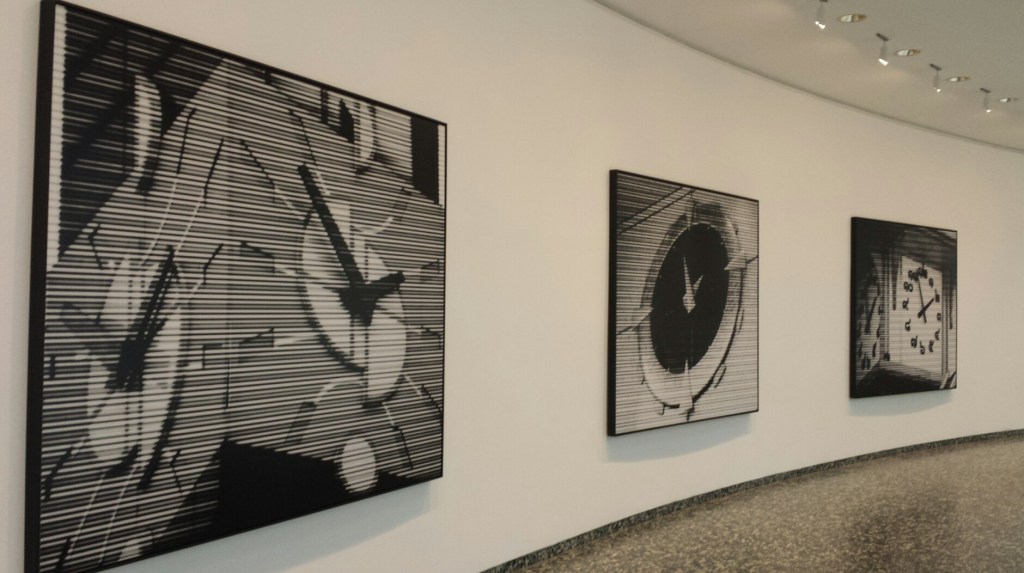
Pousttchi’s exhibition at the Hirshorn is a premiere of her World Time Clock series, a project the artist began in 2008 and recently completed. The installation consists of a group of photographs that she created in 24 time zones around the globe over the last eight years. The artist has often contemplated systems of time and space in her art. To accomplish the World Time Clock photography, she traveled the globe capturing a portrait of a public clock in each time zones. In the final production, represented are locales far apart from each other, such as Bangkok, Moscow, Los Angeles and Tashkent, Uzbekistan. The circular format of the Hirshhorn’sinner-ring galleries on third floor works well with the theme of this exhibition.
Bettina Pousttchi’s World Time Clock at the Hirshorn’s third floor is on view until May 29, 2017.
Bettina Pousttchi’s World Time Clock.
Bettina Pousttchi’s clocks come from 24 different time zones.
The photographs each show a clock displaying the same local time: five minutes before two. Together the images suggest a sense of suspended time and what the artist calls “imaginary synchronism.” Seen in close-up, the clocks are united in a single scheme that calls to mind the historic role of Washington as the site of the International Meridian Conference in 1884. It was here that the Greenwich Meridian was adopted as a universal standard, determining a zero point for the measurement of both longitude and time.
Bettina Pousttchi’s second display, on view at the Phillips Collection until October 2, takes on from the notion of history and memory of architecture. The exhibition is part of the Phillips’s ongoing series Intersections, which interestingly highlights contemporary art and artists in conjunction to the museum’s permanent collection, history, and architecture. With her works Double Monuments for Flavin and Tatlin (2013), Pousttchi is in conversation with art and architectural histories, addressing the historic works of Russian Constructivist sculptor and architect Vladimir Tatlin from the 1920s, and American minimalist artist Dan Flavin from the 1960s. Pousttchi’s sculptural installation is composed of materials deriving from street barricades, and metal crowd barriers, which the artist transformed into sculptural forms. The objects create contrast and volume with neon that grows inside the powder-coated abstract forms. The sculptures include spiraling neon light tubes reminiscing those fluorescent light works created by Dan Flavin. The five sculptures range from 5 to 12 feet creating dramatic presence and enhancing both sculptural form and architectural setting at the Phillips. Their tower-like shape is a homage to Tatlin’s sculptural works, yet they have a theme and form of their own. Pousttchi’s works carry an idea of mystery of bringing in outdoor elements into the white gallery space. The white paint creates sophistication out of the raw urban elements while neon makes them settle somewhere in between the indoors-outdoors -scale.
Bettina Pousttchi with Double Monuments on view at the Phillips Collection.
Dalaeja Foreman is a curator, community organizer, first generation Caribbean-American and Brooklyn native. Her curatorial practice seeks to combat misconceptions of oppressed people and resistance through direct action, cultural esteem and the arts. She is a graduate from the Visual Presentation and Exhibition Design program at the Fashion Institute of Technology. Dalaeja is also alumni of No Longer Empty Curatorial Lab 2015. In January-February 2016, she co-curated a show ‘Speak Out’ for theBronxArtSpace. The exhibition addressed legacies of injustice and practices of institutional racism, offering alternative views and acts of empowerment for the artist in their communities, creating realities that affirm that #BlackLivesMatter.
Firstindigo&Lifestyle: You co-curated a show ‘Speak Out’ for The Bronx Art Space. Could you tell about the roots for establishing that collaboration?
Dalaeja Foreman: That I have! Alongside Linda Cunningham and Eva Mayhabal Davis.
After working with her on a No Longer Empty curatorial fellowship exhibition, Linda (Director of BronxArtSpace) asked me if I would be interested in co-curating an exhibition she was conceptualizing. An exhibition about institutionalized racism, as a white woman, Linda did not feel as though this was an exhibition she should be curating without the voice of a person of color (A decision I respected and cherished deeply, giving me the assurance of her allyship ). After meeting with one another and having a long conversation about the significance of this discourse she told me she would give me curatorial license over the exhibition and asked if I would want to work with anyone. I suggested we work with another No Longer Empty fellow, Eva Mayhabal Davis.
Firstindigo&Lifestyle: The concept had several outcomes as art works, performances, and community events. Could you tell how it all came together and succeed?
Dalaeja: The exhibition was submission based, inspired by the Respond exhibition at Smack Mellon Gallery. Linda selected a panel of artists (including Eva and I) to review the 80+ submissions. Once we selected the works, Eva and I thought very thoroughly about the themes and counter themes in each selected work and put them in conversations with one another accordingly. We decided it would be best to give extended labels to the works to give our audience as much contextual knowledge as possible. Since the Mott Haven area of the Bronx is heavily Spanish speaking, we also provided the labels in Spanish.
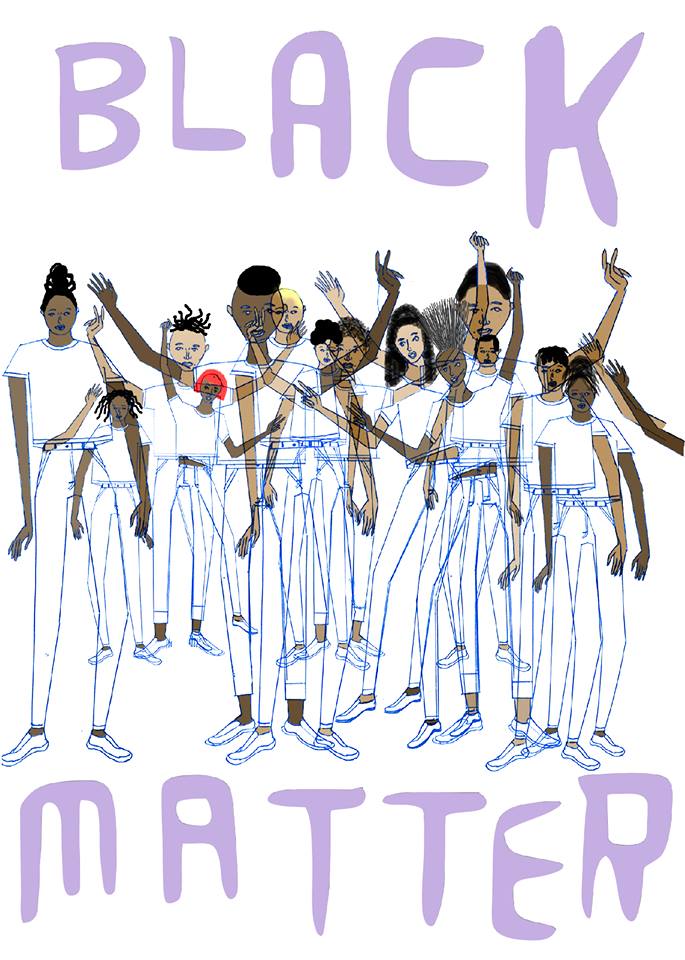
As a strong believer in activating art spaces for radical acts, I wanted to be sure the exhibition had as many programs that responded to the many intersections of racism in our society as our capacity could handle. These themes varied from the criminalization of black and brown youth to the celebration and use of black love and Black Girl Magic as a radical acts.
Illustration by Rafael Melendez
Firstindigo&Lifestyle: How was your experience in Bronx, in comparison to Brooklyn, where you are from?
Dalaeja: Aside from being a Curator and Arts administrator, I am a first generation Caribbean-American, community organizer and Brooklyn Native. As an organizer, I have done a considerable amount of work around the mass-displacement of working-class communities (most often communities of color) in Brooklyn. Sadly, Art has been used as as a catalyst for what I consider the cultural erasure of my native borough.
I see the arts as yet another tool for social change, and art has been used historically to work as ancillary support for communities of color. Whether it be thru healing or practical solutions for community issues. Although this is a truth for Brooklyn’s artistic history, I feel as though this concept has been stronger in Bronx history due to the many ways State and city institutions have historically neglected Bronx county.
Artists can use their talents for exposing truth for the benefit of their communities and this seems to be particularly weaved into the fabric of the artistic history of the Bronx. A history I have incredible respect for, that continues on.
Firstindigo&Lifestyle: How important was the role of social media in creating networks, and establishing new audiences?
Dalaeja: Eva is more of the social media wiz. I was more concerned about the ways in which we could ensure the community members knew about the exhibition and we’re involved in our programming. This outreach included, working with the BronxArtSpace interns to outreach to local high schools, doing physical flying for the exhibition, dropping flyers off at local bodegas and restaurants. As well as dropping information of at local libraries and speaking/building relationships with community members. Some of whom were artists in the exhibition, which made me soon happy!
Firstindigo&Lifestyle: What is your ideal audience for the art?
Dalaeja: Since I truly see art as a tool for inspiring radical action, my ideal audience is always working-class people (some of whom also happen to be artists and art enthusiast). Especially in the case of the ‘Speak Out’ exhibition because, it took place in a working class community. If these spaces aren’t intended for their own communities, why should they exist there? This is a concept Linda truly understands which is yet another reason I LOVE working with her.
Firstindigo&Lifestyle: What is your background in coming to curating arts?
Dalaeja: I began working in the arts as a part-time Gallery Assistant at the Milk Gallery then began working as an exhibition manager for a small gallery that specialized in 20th and 21st century counter-cultural ephemera (say that 10 times fast. bahaha). This experience helped me realize the significance the arts have had on social movements of the past and inspired me to pursue curation. I began taking online course with Node Center to learn more. After the gallery lost funding and I lost my job I decided to use the little bit of money I had saved to invest in my interest and started applying for fellowship programs. After my incredible experience with the No Longer Empty fellowship, I decided this is surly a way I could use my interest in the arts pragmatically to help plant the psychological seeds for social change. I still have so much to learn to pursue my practice as radically and community-collaboratively as I can, and am currently a Create Change Fellow with the INCREDIBLE Laundromat Project.
Firstindigo&Lifestyle: How did you education support your current directions and help you to develop your vision?
Dalaeja: I studied Visual Presentation and Exhibition design at The Fashion Institute of Technology, this experience helped me truly understand my love of space and it’s possibilities. I minored in International politics which further introduced me to the ways in which politics (on a community level) and exhibitions/display can merge. Most of my curatorial focused knowledge has been from lived experience, work experience and continuing education programs. As a lover of knowledge, I am interested in perusing a Masters degree in Contemporary Art and Art Theory of Africa and Asia.
Firstindigo&Lifestyle: How do you develop your curatorial concepts, is there a phase of writing or visualizing things in a specific manner, or talking?
Dalaeja: It is a bit of all of those things. I am a ranter by nature so that really helps with getting concepts across that I believe are worth exploring.
Often I am inspired by the political education meetings with the organization I am a part of (The People Power Movement) as well as my friends and family members. Or I may have a design concept in mind that I think is worth collaborating with artists one. BUT most importantly, I am inspired by the Art work and the concepts that artist is exploring.
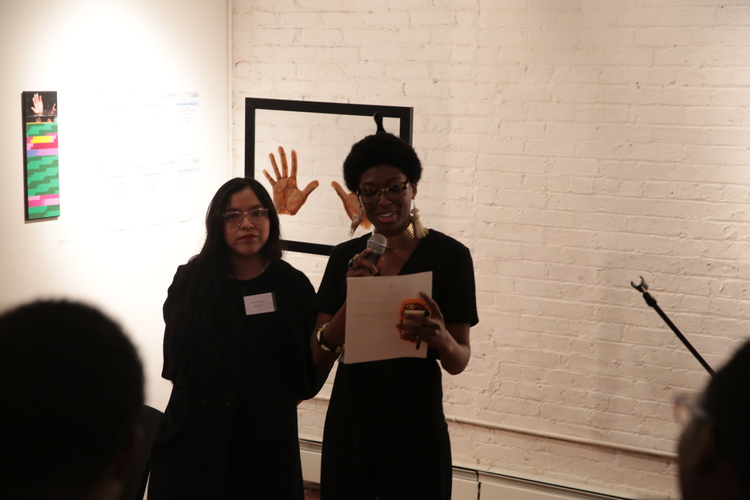
Dalaeja Foreman (right), at the ‘Speak Out’ -exhibition. Photos: Alex Seel. Courtesy of Order Vision Productions for Bronx Art Space.
Firstindigo&Lifestyle: What do you think is a role of a curator in society in large, in other words, how do you think the micro ideas meet the macro levels?
I believe Curators have a powerful platform, giving us the ability to work with artists and communities to push narratives into the mainstream consciousness. These narratives can help people critically think and sympathize deeply about concepts in which they weren’t even aware of. This is a responsibility of utmost importance, one with the opportunity to empower a community, a people and a generation. -Dalaeja Foreman
Firstindigo&Lifestyle: Your political activism has a mind of a movement, in which people power takes a different stance. Does New York City represent a special place for activism to you?
Dalaeja: New York City means a great deal to me in regards to activism, but that is because it is the only place I’ve ever known as home. Although a wide array of injustices are happening in my city, they are also happening everywhere in the country. A political revolution could be sparked anywhere at anytime, the important thing is that we support one another’s actions and grow together using people power and a thirst or justice as our binding force toward a political system that works for the majority.
Firstindigo&Lifestyle: Do you have favorite art forms, or is the medium secondary to other things that matter?
Dalaeja: I do, I love sculpture and painting, textured art objects and photographs. I’m trying to challenge myself to work more with performing artists since it’s not my go-to. However, content that compliments aesthetics and artistic merit (according to my opinion of those concepts) are of most importance.
Firstindigo&Lifestyle: How do you identify and experience yourself as a black woman art professional in NYC art community, or does that resonate in a professional level to you personally?
Dalaeja: My Black woman experience is at the forefront of all of my experiences because it is the only lens in which I can see the world and is often the most determining lens in which the world sees me. With that being said, as a young arts professional I believe it is my duty to ensure that people who are marginalized (like myself) demand their voices heard in institution that effect our lived experiences. Whether they be our schools, museums or workplaces. And MOST IMPORTANTLY create our own institutions that work for us from conception onward.
Firstindigo&Lifestyle: What is your next dream of consciousness, where are you heading to collaborate next?
Dalaeja: As an Art Administrator in the Bronx, I am really excited to learn more about what artists are and have been doing in the borough and figuring out how I can best support them and the communities they collaborate with. As well as, continuing and improving my organizing and hopefully trying to figure out some more schooling while doing all of that (inside and outside the education institutions).
Painter Teresa Dunn has her new exhibition Motherload on view until June 18 at the First Street Gallery in New York. Her current show depicts recent oil paintings and mixed media works on paper and canvas. For this exhibition, the artist who masters the Renaissance school of nature and human portraiture to the fullest forms has adopted new richness of palette. Her repertoire has gotten fuller, perhaps partially due to the size of the panels, paper and the use of triptychs, which allow larger developments and almost surgical dimensionality. Now the center is the body as tissues and palpable beats. In these new works, the body is joined with the amounts of vegetation, which makes the skin appear as fruitful foliage. Painter Teresa Dunn is making serious rising; she is represented by the Hooks-Epstein Galleries in Houston, Texas, and by Galerie l’Échaudé in Paris in France.
Teresa Dunn at her Motherload show in First Street Gallery.
Teresa Dunn, Birth of the Pink, Oil on paper, 60×45, 2016.
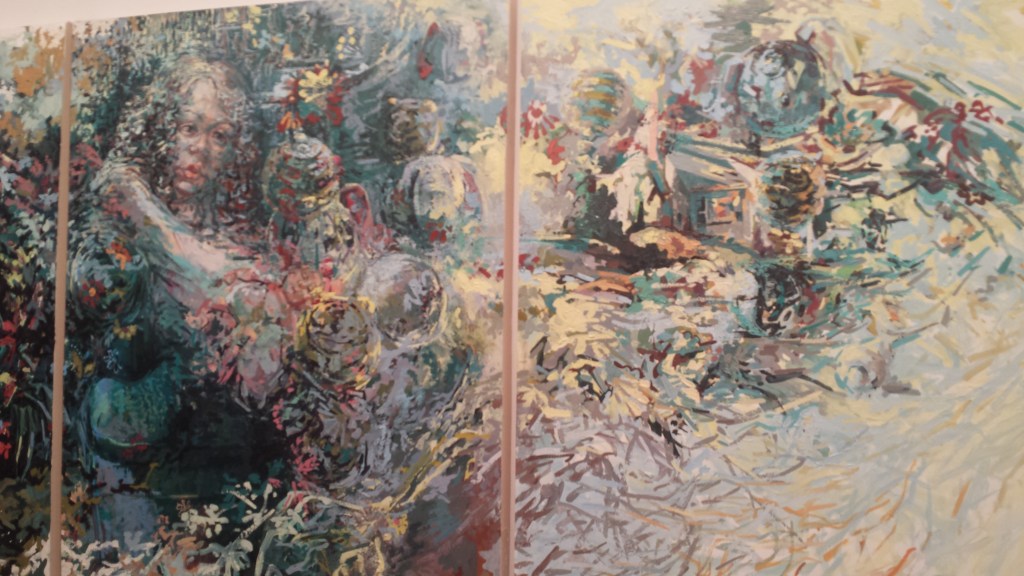
Teresa Dunn, Interlaced, Oil on paper mounted on canvas (triptych), 60 x 120, 2015.
In an action packed painting there was a pause, when Teresa Dunn imagined communities within narrative landscapes full of thick Renaissance color and light. The water rose through the images, leaving behind people on their isolated islands, together, alone, breathing air, figuring the scenes of us existing on the planet. The scenes were almost apocalyptic, borrowing from Biblical and mythological imageries of human drama and emotion. And it all made sense, as her paintings were influenced by the Venetian school, especially by the works of its great master Titian. Drama and poesia in the same theme, when color and light create unparalleled resonance.
Now, the next pause was different. Teresa became a mother. From artistic point of view, the dreaming in her works became increasingly about the simultaneously occurring events. These happenings were seemingly not relating, but arbitrarily meeting in the same future. This time the fragments of narration made sense as islands of vegetation. The theme of water from previous paintings had changed into the vegetation. Or the water had become an overflow, which got mixed into and within the vegetation becoming moisture, as palpable like a touch of mist on the skin. An underpinning, a reflection on canvas. Like her inspiration of the magical realism, Colombian novelist Gabriel García Márquezimagined fog. Can you see distances through the fog. Or how a distant place somewhere far resonates here in this place. How everything connects and makes a reason, but not as univocality. The story is about bringing together universal fragility of existence and our mortality.
In the new works, the colors have become evidentially subtler with more visible brushstrokes, with circular patterns of movement. The palette is lighter, and the narration seems to be settled in the background in the midst of a natural flow and overgrow of things; more than objects. The natural life and still life has found a lingering attachment inside the palette, showing that humans as actors play no longer the central role. In a triptych ‘Interlaced’ (2015), a loose tire rolls through the canvas, as if being a sign of an uncontrolled human motion. In another triptych, ‘Slippage’ (2015), a woman is growing out of a bush representing the nature herself and our origin. In this triptych, the panels together seem to be cumulating as a force, which becomes a wave. A water splash is running from one panel to the other in ‘Slippage’. Teresa Dunn’s triptych form borrows from the Renaissance art. In her paintings, the occurring shapes are creating new terms to reinvent the classic.





 Firstindigo&Lifestyle