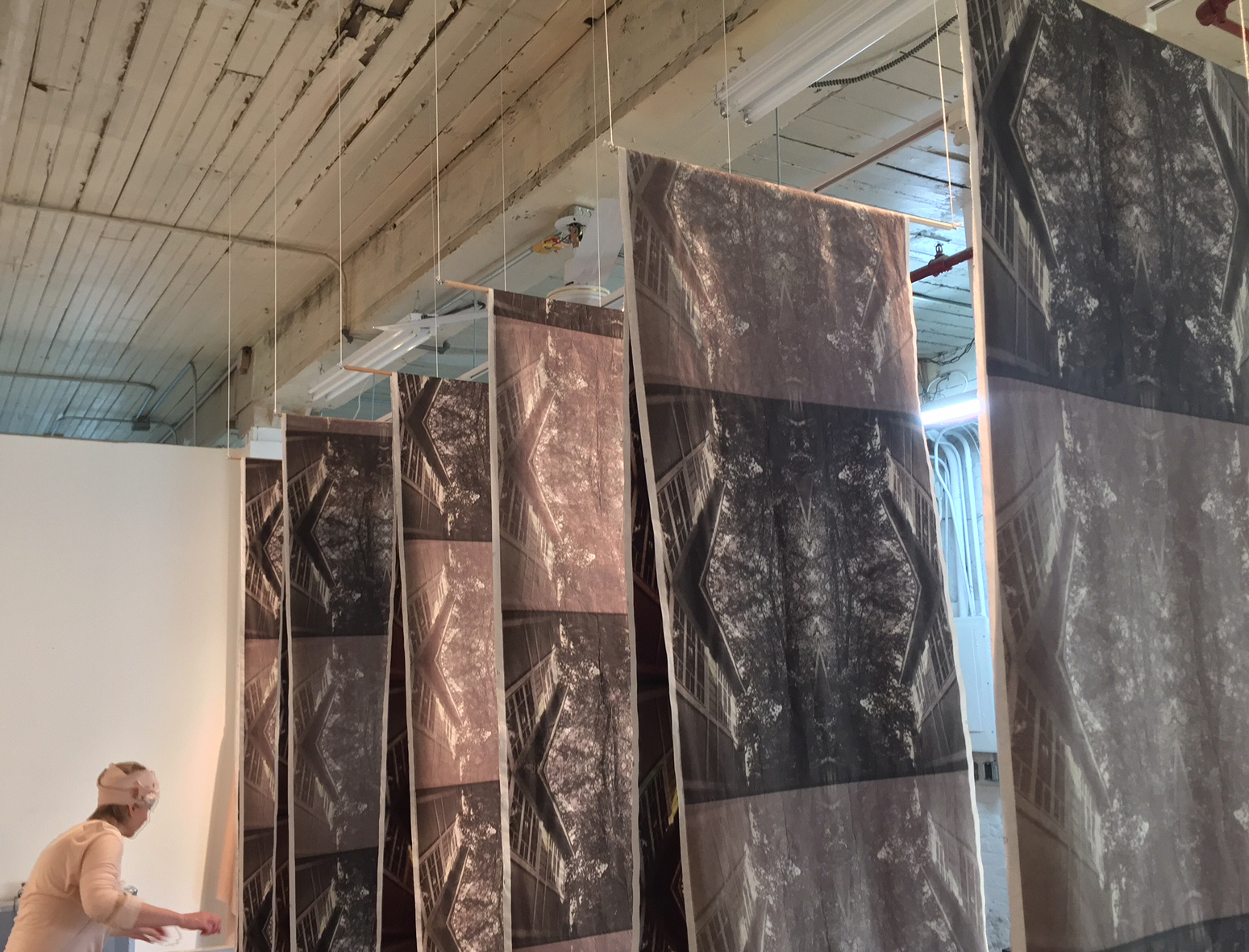
Category: artistic process

  • Stephanie A Lindquist about philosophy of plants and art

    Stephanie A Lindquist about philosophy of plants and art


    Stephanie A Lindquist is a New York based artist and photographer, whose photo collages gather ideas of plants with world-wide origins.  Her works bring forth anscestral memories from diasporic places, and create meaning mapping our global existence as travelers and settlers. Food has always played enormous role in peoples adaptation to new places, creating and sustaining cultures. Art can have as much to say about this subject too. 

    Firstindigo&Lifestyle: I have understood your recent photography art is based on your research on plants that are native, local  or indigenous to areas. How did you start this art project?

    Stephanie A Lindquist: I started gardening and reading about plants and how to grow them. I was especially inspired by farmer, philosopher Masanobu Fukuoka. He is the father of natural farming and a proponent of natural dieting–both of which he believed to be beneficial for the environment and human health. According to Fukuoka, a natural diet consisted of local and preferably ancient plants–something nearly impossible for any urban dweller like me to accomplish.

    This sparked my interest in identifying and promoting many little-known indigenous food plants from my ancestors in Africa and Europe, to where I currently live in the Americas.

    Firstindigo&Lifestyle: Where did you grow up, and live prior to New York City?

    Stephanie A Lindquist: I grew up in Los Angeles. I’ve also had opportunities to travel abroad to Europe and Central America.

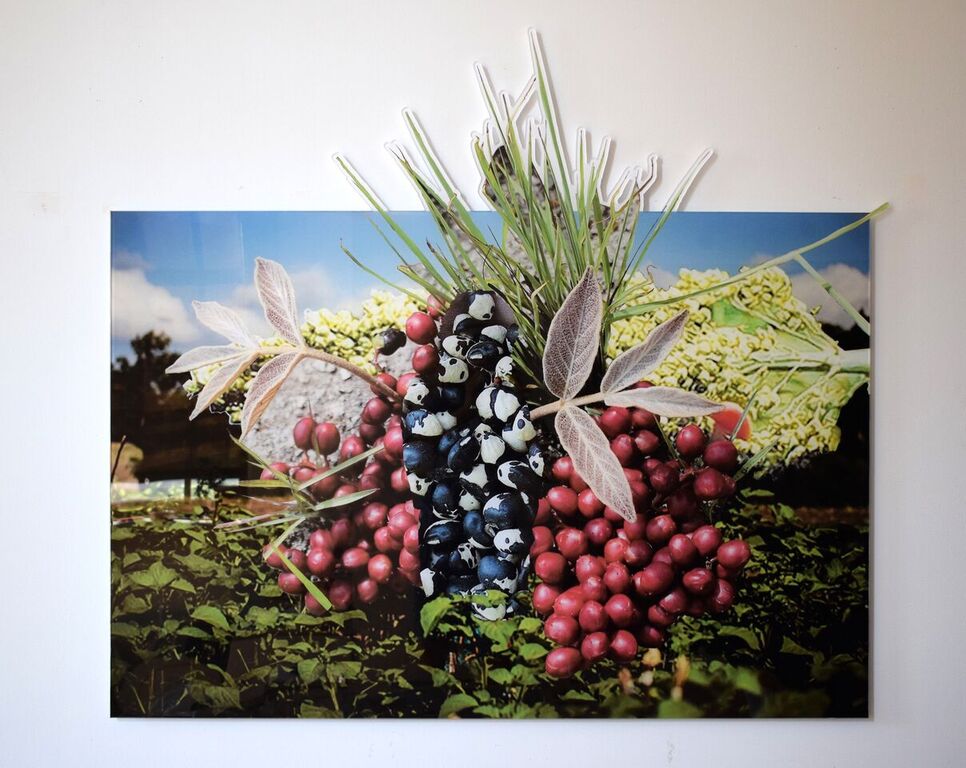
    Stephanie Lindquist, Lablab oryza glaberrima celosia, 2017, Digital print on aluminum diode, Edition of 3, 4’ x 4’ in.
    Stephanie Lindquist, Lablab oryza glaberrima celosia, 2017, Digital print on aluminum diode, Edition of 3, 4’ x 4’ ft.


    Firstindigo&Lifestyle: As one major inspiration behind your art making are the plants, do you cultivate or grow plants yourself and have your own garden?

    Stephanie A Lindquist: I garden regularly in East Harlem and the South Bronx. It is an essential part of my practice and life. Gardening allows me to cultivate, consume and appreciate some of the plants I study first-hand. It is a way to immediately begin creating a more reciprocal relationship with nature.
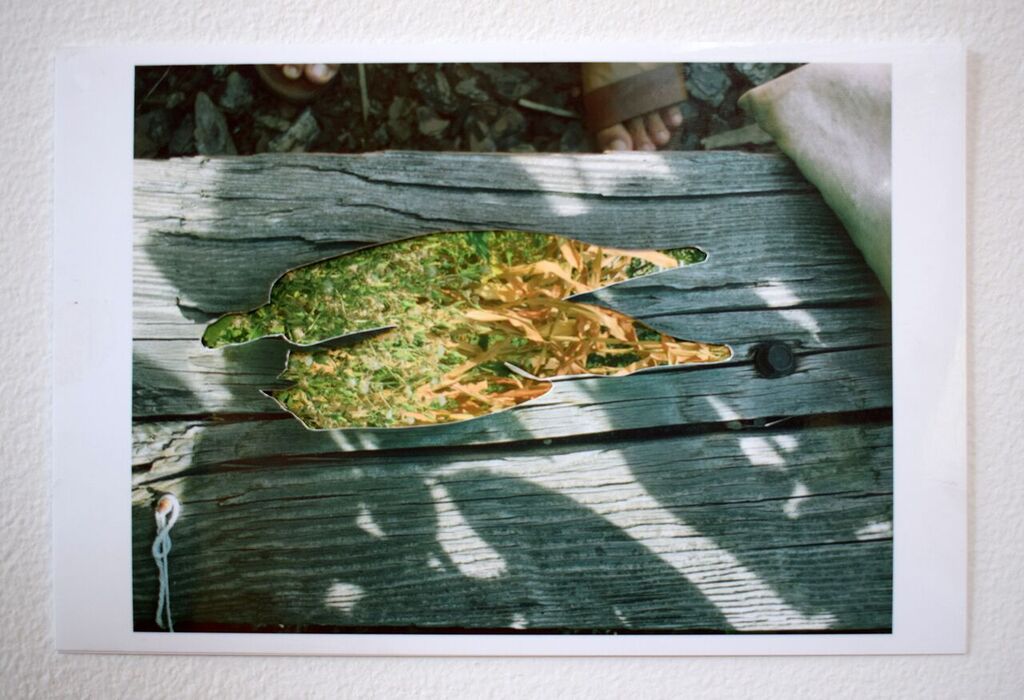
     

    Stephanie A Lindquist, Okra at 103rd 2018 Photo collage, Edition of 5, 7.5” x 10” in.
    Stephanie A Lindquist, Okra at 103rd 2018 Photo collage, Edition of 5, 7.5″ x 10″.


    Firstindigo&Lifestyle: Do you think that flowers, fruits and vegetables, etc. as subjects of art carry ideas about sustainability and environmental philosophical concepts?

    Stephanie A Lindquist: Definitely. Potawatomi scientist Robin Wall Kimmerer writes about our need to listen, observe and learn from plants as our teachers–rather than only learn about plants. I truly believe that plants can teach us how to lead sustainable lives if we listen. 

    Cultures close to nature have the benefit of accumulating indigenous knowledge of a diverse number of plants and their uses than city-dwelling folks. To see, recognize and know thousands of local, indigenous food plants is a powerful way to live in communion with the world. By taking care of widely diverse plants within our local ecosystem, we begin to take care of ourselves too–physically and spiritually.

    It is my aim to heighten our awareness and appreciation of indigenous food plants and to collectively reimagine the local cuisine of specific regions.

    Firstindigo&Lifestyle: Are there other concepts and philosophies attached to your art?

    Stephanie A Lindquist: My work is inspired by the work of many scientists including Mary Abukutsu-OnyangoSince the 90s she has been promoting the cultivation and sustainable consumption of African indigenous vegetables and fruits. On a continent plentiful with plants, it is surprising that most do not eat a sufficient amount of vegetables.

    The promotion of these plants have commercial and cultural implications as well as physical and spiritual effects on our health. Most of these plants have been purposefully displaced by genetically engineered cash crops and changing tastes. To rekindle our relationship with the oldest, local plants is also to remember the unique history of the land and how we arrived here.

    Stephanie A Lindquist, Cowpea Lannea Edulis Sorghum African Nightshade (East Africa) part of Founded series 2018 Digital print on acrylic 44“ x 50” in.
    Stephanie A Lindquist, Cowpea Lannea Edulis Sorghum African Nightshade (East Africa) part of Founded series 2018 Digital print on acrylic 44“ x 50”.

    Firstindigo&Lifestyle: Do people act amazed when seeing and hearing about  your work?

    Stephanie A Lindquist: It has been very satisfying to hear people’s reactions to my work. Even urbanites like me are full of surprising information about plants and their uses, which I happily add to my arsenal of knowledge.

    As the daughter of a Liberian-American immigrant and descendant of Swedish and Irish immigrants, I have been invested in reclaiming ancestral knowledge for a long time. Conversing with others about indigenous plants has been a very satisfying way of piecing together our ancestral knowledge of the natural world around us.


    Firstindigo&Lifestyle: Who inspires you to do your art?

    Stephanie A Lindquist:  I admire many artists including Julie Mehretu and Wangechi Mutu. I am also inspired by the authors I read and the emerging artists I meet everyday.


    Firstindigo&Lifestyle: How do you design your collages and what is the process like in making photographic prints?

    Stephanie A Lindquist:  I begin by researching a number of indigenous plants to a specific region and learning about their history, uses, and the people who cultivate them. Next I collect images of them, and if accessible take original photographs of the plants.

    I cut the prints by hand and arrange the composition on a smaller scale until satisfied. Next, I digitally produce and print the collage at a larger scale or sometimes hand-cut a larger collage on fine paper.

    Firstindigo&Lifestyle: Tell a little more about yourself, where did you study art?

    Stephanie A Lindquist:  I have studied art since I was little. I received by BA in Urban Studies and Visual Arts from Columbia University. Since then, I’ve had the opportunity to participate in residencies in Rome, Berlin and Staten Island, and to exhibit my work in museums and alternative spaces in New York and California. I also work as an arts administrator.


    Firstindigo&Lifestyle: Your objects and prints seem to carry domestic ideas in them, or it gets transmitted as a feeling with the coffee cup on a table, or with  the flowers. Does this resonate with your intentions?

    Stephanie A Lindquist: Yes, my previous body of work in photo collage was concerned with capturing colorful, jarring, domestic still lives. I often chose the materials used to create the stage in memory of family and friends in my life, like my mother, my partner, or a particular place like the Kitchen Floor. Through collage I bring new meanings to these objects, in this case now where an okra blossoms and fruits. Their patterns are playful, somewhat minimal, abstract, full of textile, and tactile.


    Stephanie A Lindquist, Kitchen Floor 2017 Photo collage 14.5“ x 17.5” in.Stephanie A Lindquist, Kitchen Floor 2017 Photo collage 14.5“ x 17.5”.


    Firstindigo&Lifestyle: Some collages of yours are really colorful. Do you find that colors have significance and carry meaning?

    Stephanie A Lindquist:  The colors reflect my mother’s textiles, family photographs, and the landscape around me.

    Firstindigo&Lifestyle: Do you consider yourself similar to feminist art practices in which domestic life and the everyday gives to details and form in the art?

    Stephanie A Lindquist: Yes, in many ways I make my art to create space for feminism and equality among humans and all that lives in the world. I treasure these often feminized spaces of the home and garden. And I enjoy propagating this image into my viewer’s subconscious of a plentiful, sustainable earth.


    Firstindigo&Lifestyle: Also your knitted objects would signify not only sculptural dimension as objects that hang on the wall, but also about art-historical connection to the women artists?

    Stephanie A Lindquist: The knitted objects Needles and String and Rosary for me were living sculpture–something I could create and disassemble again and again as a public performance and private meditation.


    Firstindigo&Lifestyle: How do you separate your own artistic practice from curating, and working with other artists in your work?

    Stephanie A Lindquist: I make time for it. I also let it bleed into my research interests and writing. My practice gains a lot from being in such close contact with artists and curators on a daily basis. I am constantly listening to and collaborating with other visually creative minds.

    Firstindigo&Lifestyle: Can you describe what art projects are you planning for the future?

    Stephanie A Lindquist:  I am thrilled to show recent work around indigenous food plants at Smack Mellon as a part of AFRICA’S OUT! inaugural benefit exhibition, Carry Over: New Voices from the Global African Diaspora curated by Kalia Brooks Nelson. To have my work in the context of Firelei Báez, Layo Bright, Melissa Calderón, Baseera Khan, Jasmine Murrell, Anna Parisi, Keisha Scarville, Pamela Phatsimo Sunstrum and Saya Woolfalk is a joy!

    The exhibition is on view June 2-30. More information about the s  how in Brooklyn http://africasout.com/exhibition-carry-over

    I am also looking forward to presenting work at CTRL+SHFT Collective in Oakland this summer. Other than that, I’m excited to spend part of the summer camping and learning more about plants indigenous to the eastern seaboard.

    I treasure these often feminized spaces of the home and garden. And I enjoy propagating this image into my viewer’s subconscious of a plentiful, sustainable earth.
  • Eyes as Big as Plates arrives in Brooklyn

    Eyes as Big as Plates arrives in Brooklyn

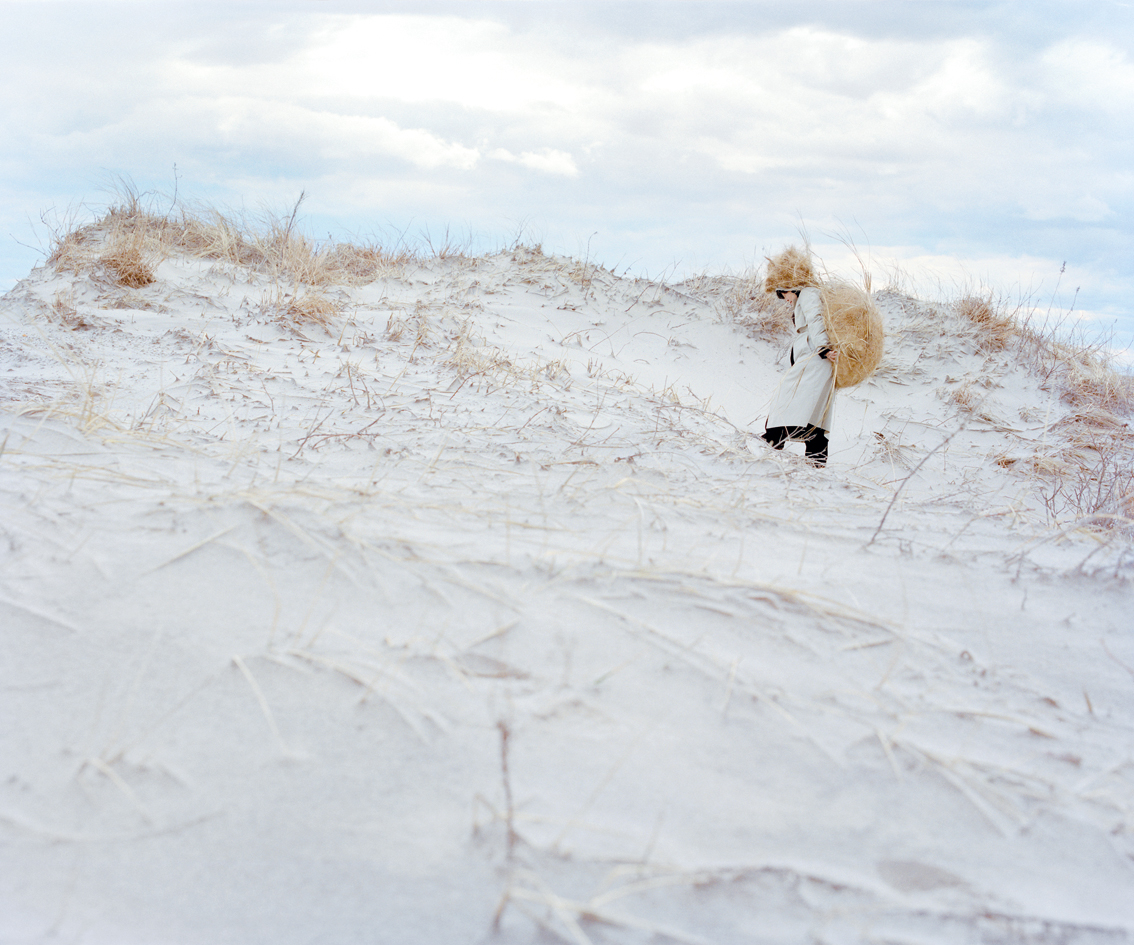
    “Eyes as Big as Plates” is an ongoing collaborative photographic project between the Finnish-Norwegian artist duo Riitta Ikonen and Karoline Hjorth. This unique collaboration is now presented as a solo exhibition in New York City at the Brooklyn based Chimney Gallery. In the exhibition, 12 photographs are installed in the gallery space so that they form a visual unity in a column-like formation. This way the solitary portraits emerge naturally from the gallery space, which itself is raw and original.  Eyes as Big as Plates presents solitary humans standing meditatively in their favored setting.  What makes them special is their organic attire made of leaves, branches, pine needles, rocks, or flowers. The models are senior citizens.  Ikonen’s & Hjorth’s photographs have another layer in them. The wearable sculptures connect the humans into their stages organically, making them part of the world they inhabit.  The Chimney exhibition features newer works from Greenland, South Korea, NY, Iceland, Japan, Finland and Norway.

    Eyes as Big as Plates # Mr Otsubo (Iceland 2013) © Karoline Hjorth & Riitta Ikonen.
    Eyes as Big as Plates # Mr Otsubo (Japan 2015) © Karoline Hjorth & Riitta Ikonen.

    Firstindigo&Lifestyle: Karoline and Riitta, can you tell more about the idea behind the elderly portraits. Where did the idea to do the series originate?

    Karoline and Riitta: The series is produced in collaboration with retired farmers, fishermen, zoologists, plumbers, opera singers, housewives, artists, academics and ninety-year-old parachutists. These are people we meet through friends, relatives and newspaper ads, in hardware stores, noodle bars, indoor gardening society meetings, swimming pools, senior centers, on the city streets etc. Our creative point of departure lies in the collaboration with these contributors, who we consider as co-creators. As we started our investigation into local folktales we reasoned that the older the local interviewee we would work with, the closer we would be to the tellers of the tales and the talking rocks of the stories. Those Nordic hills hadn’t changed since the tales, but the people sure had. So far it doesn’t seem to us that the answer can be predicted by the age of the answerer. Thinking of older people as a unit that operates in a certain manner is rather lazy with much of the western society unnecessarily confused when it comes to the ‘usefulness’ of older people. Attitude with knowledge, life experience and stamina are some of the main traits we have found amongst all our collaborators, as well as a formidable curiosity for new experiences. As Eyes as Big as Plates continues to cross borders, it also aims to rediscover a demographic group too often labeled as marginalized and generate new perspectives on who we are and where we belong.

    Firstindigo&Lifestyle: You shoot the portraits in the nature, so it seems that thoughts about environment, and people’s relationship to it is really part of the visual narrative?

    Karoline and Riitta: Each image presents a solitary figure in a landscape, dressed in elements from surroundings that indicate neither time nor place. Nature acts as both content and context and the characters literally inhabit the landscape wearing sculptures. In the beginning of the project we were curious and on a mission to find out what kind of connection the Norwegians had with their rocks, fjords and hills and especially keen on looking at the folktales where nature or natural phenomenons were personified.

    Folktales often made complex natural and sociological issues understandable and accessible, with phenomena taking on forms and characteristics that even a mere mortal could have a dialogue with. Perhaps our Eyes as Big as Plates images aim to discuss the contemporary human in the nature in a similarly approachable language. As the project started crossing borders, our quest soon turned more towards investigating universal questions about imagination and curiosity, and evolved more into a search for modern human’s belonging to nature.

    Eyes as Big as Plates # Edda (Iceland 2013) © Karoline Hjorth & Riitta Ikonen.
    Eyes as Big as Plates # Edda (Iceland 2013) © Karoline Hjorth & Riitta Ikonen.

    The location is chosen based on conversations with each collaborator, who might have a special connection with a certain landscape or a specific plant in the area. Sometimes we spend days finding the perfect location, sometimes we discover it within minutes. Most often the best collaborators and locations are found through chance encounters and lucky coincidences, which is also some of the main reasons why the project is still ongoing – the unpredictability is highly addictive.

    Each image always starts with a conversation with the contributors. Most often, and ideally, we meet our model before the actual shoot day to chit chat about the world, life, interests, neighbourhood, relationship with nature, opera, moss, fishing, weather…, and see if there is something there that we can just magnify a little. We try to find out as much as possible about who our model and collaborator is beforehand in order to best present them and their relationship with their surroundings. The ‘costumes’ are just a primal response to real people in their settings. We always start from scratch with each contributor. Some of them are eager to participate in all stages of the process, from collecting the materials to deciding on the location and even putting together the sculpture, while others prefer that we make the choices that best reflects them.


    Firstindigo&Lifestyle: I recall that Karoline found Riitta, or was it visa versa, as collaborator in a fun and memorable way?

    Karoline and Riitta: Eyes as Big as Plates started life on the southwest coast of Norway in 2011. When Riitta was searching for a collaborator online, the three words ‘Norway + grannies + photographer’ found Karoline as the top search result, as she had just finished a book on Norwegian grandmothers. Karoline loved Riitta’s work and sense of humour, and one email and two months later, they met for the first time on the doorstep of a little white wooden house in Sandnes.

    It was a very natural marriage of our complementing skills, where we come up with one image from two heads. Part sculpture, part installation and part photography, we work together from beginning to the end of the process. Karoline is the photographer in the duo while Riitta works mainly with the creation of the wearable sculptures in the images, but most importantly we operate with one mindset and vision, to the extent that we barely need to talk during the shoots, as we both know exactly what we are aiming for.

    Firstindigo&Lifestyle: How many countries have you embedded in these portraits, and how many people?

    Karoline and Riitta: Over 60 people from 12 countries (Norway, Finland, Sweden, Iceland, Faroe Islands, Greenland, UK, France, US, South Korea, Czech Republic and Japan.)

    Firstindigo&Lifestyle: Do you remember the most memorable portrait ever in the making of it, perhaps related to the how the situation or process evolved?

    Karoline and Riitta: It is quite impossible to pick one portrait as the most memorable, especially since so many of them feels more and more precious as time passes and our dear collaborators (and us) grow older. There are so many incredible encounters over the years, many that have turned into long-lasting friendships and we feel like we are the luckiest artist duo alive. One day the most memorable portrait is the very first one made together with Halvar in Norway, another day it is the memory of Riitta’s mum midnight swimming back and forth in lake Kalvä side by side with beavers on a freezing Midsummer’s Eve in North Karelia, or the very magical double shoot with Karoline’s grandparents last summer, some days we remember the intense weather conditions, other days we treasure the silence we all experienced, or the eagle that flew past us, the fog that landed just perfectly in time or the ruthless sun that never left the scene, it all depends on the time of year, season and mode of the day what comes into mind.

    Firstindigo&Lifestyle: Your recently published a book about the project, and it bears the title “Eyes as Big as Plates”. What do you want to tell about the book tour?

    Karoline and Riitta: The book is a culmination of the first six years of this ongoing project, and each book is hand-finished, unique with thinly pressed vegetation veiled underneath the cover cloth to honour each of the 60 collaborators in the project. We teamed up with Swedish designer Greger Ulf Nilson and the independent, Oslo based Press Publishing. For the release tour we returned to many of the countries we had visited to produced the works, and enjoyed a fantastic, fun and intense book launch tour to New York, Paris, Helsinki, Oslo, Landskrona, Nuuk, Seoul, Tokyo and London all over the course of 4 months. The book was also shortlisted for the Paris Photo- Aperture PhotoBook awards in the ‘First Photobook’ category, as a finalist from nearly 1000 submissions.

    Eyes as Big as Plates # Marie (US 2013) © Karoline Hjorth & Riitta Ikonen.
    Eyes as Big as Plates # Marie (US 2013) © Karoline Hjorth & Riitta Ikonen.

    Firstindigo&Lifestyle: The book also initiated a Kickstarter fundraising process. Do you want to share some tips, or ideas for this kind of succesful outcome?

    Karoline and Riitta: Our Kickstarter experience was a true rollercoaster and the outcome was just quite unbelievable. We spent weeks preparing, researching and gathering material, editing texts, having the material reviewed, putting together the video piece, sourcing the perfect soundtrack etc. Obviously we already had quite a lot of material from our 6 years of production and process material, and even an established audience that we could reach out to. We took day and night shifts between New York and Oslo emailing people non stop with personal emails, and our magic bullet in the campaign came in the form of Kickstarter’s weekly newsletter where we were recommended amongst 3 other projects to their whole worldwide community. Until this moment, we fought for each and every pledge and it was a slow start. We were lucky to be picked up – and in 24 hours went from 29% to 120% funded…

    Hot tip: Make sure you set aside enough time to babysit and nurture the project and campaign while it is live, throughout the duration of the campaign. Then, once the campaign is successful, starts the aftermath of following up with delivering the rewards. We spent probably nearly a month sending emails, packages, postcards, printing, resending, chasing post etc. It was hard, but mainly exciting and definitely worth it.

    Firstindigo&Lifestyle: Karoline, since you are Norwegian, and I haven’t asked this previously from you, I’m kind of curious what do you want to say about Norwegian art scene and support?

    Karoline: The Norwegian art scene is small, but it has got quite a unique support and funding system in place for artists. There are many different opportunities when it comes to project funding, stipends, grants etc and recently some exhibition venues have slowly started to get used to the thought that artists might also deserve payment for the exhibitions they produce, instead of paying for renting a space, which I understand is more common in for example Finland. Norway still has a long way to go in terms of the gender gap though, both in terms of the most-selling artists, the most represented artists and the movers and shakers of the gallery world.

    Firstindigo&Lifestyle: Do you think that the art education is exceptional in Norway?

    Karoline: I studied abroad, so I cannot speak from my own experience here, but after hearing from my colleagues who did study in Norway, my impression is that there are many other countries with much more progressive art education.

    Firstindigo&Lifestyle: Riitta, you are Finnish, what does ‘Nordic’ collaboration mean to you, do you find that you both share similar ideas or mindset because of the Nordic factor?

    Riitta: We both grew up with an understanding of the outdoors as something intermixable with the indoors. It is part of everyday and the awareness and interaction with our surroundings still drives our practices strongly. Both of us live in big cities so there is a definite need to roll in the leaves regularly.

    Firstindigo&Lifestyle: Where do you see that this project could be developing on its next phase, have you figured out the ‘after’ yet since the book came out?

    Karoline and Riitta: We are taking part in a public art project in Seoul, South Korea this winter with newly produced work made in collaboration with seniors living in and around the Olympic village in the PyeongChang area, these will be on display on the Seoullo 7017, a newly renovated former highway turned into a pedestrian walkway that connects the eastern and western sides of Seoul. We are also taking part in a group exhibition in Germany (The Museum Schloss Moyland) this winter and spring, followed by a solo show in Finland in the summer (Pielisen Museo in Lieksa), and more exhibitions in Detroit in the autumn. We have promised each other that we will continue the project as long as it’s fun and we are still very much enjoying ourselves. In the continuation of the project our focus might shift more to investigating the impact of climate change on people living in different parts of the world. We feel compelled to use our voice and platform to discuss the things we find important and urgent.

    ***
    Karoline Hjorth completed her BA Photographic Arts and MA International Journalism from the University of Westminster (London) in 2009 and Riitta Ikonen graduated from the Royal College of Art in 2008, with an MA in Communication Art.

    RIITTA IKONEN & KAROLINE HJORTH:
    EYES AS BIG AS PLATES
    JANUARY 19 – FEBRUARY 18, 2018
    OPENING FRIDAY JANUARY 19TH, 6:30-9:30PM

    THE CHIMNEY NYC
    200 MORGAN AVENUE
    BROOKLYN, NY 11237

    The Chimney is open on Saturday & Sunday, 2pm-6pm.
    Other days by appointment:
    contact@TheChimneyNYC.com

  • Sirkku Ketola: The artistic process of performing Paula

    Sirkku Ketola: The artistic process of performing Paula

    Finnish artist Sirkku Ketola had her performance project A Body Called Paula at the NARS Foundation Gallery in Brooklyn in November. In Finnish the word paula means a ribbon, something to tie or to be enchanted with. It is also a synonym for a trap. Globally Paula is known as a female name, originating from the Greek word ‘Paulus’, which means small.

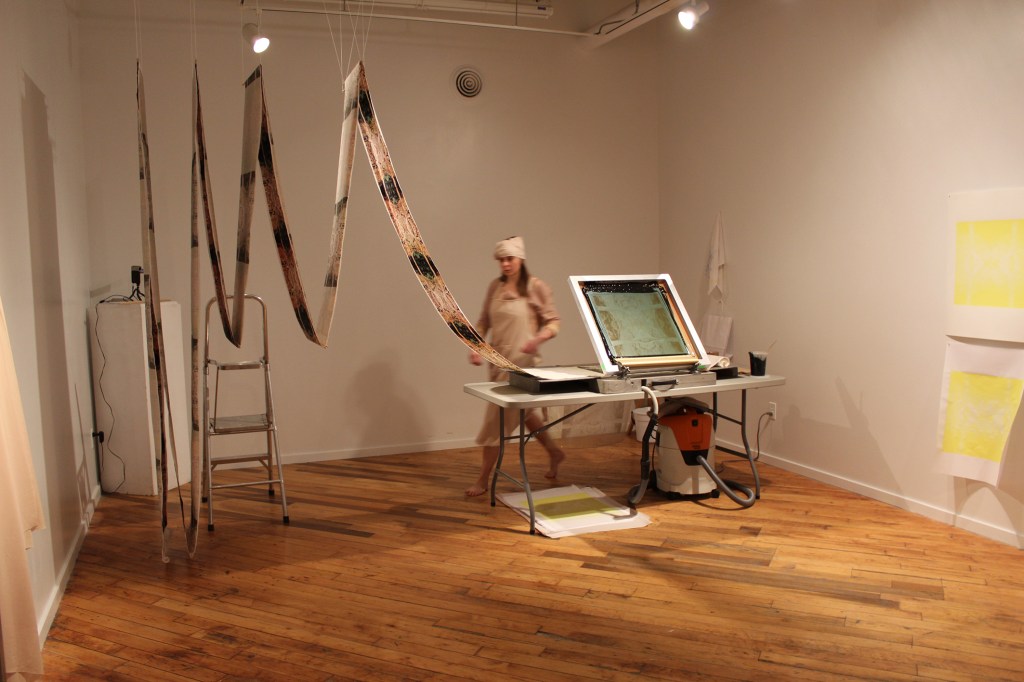
    In her current project of ten years, Ketola creates an installation that mixes screenprinting with performance. Part installation, part performance, A Body Called Paula is a piece that develops over the days of the installation through long-duration printing sessions. The movements and their soundtrack create an enchanting, sensual machine with the main themes of time and temporality, pleasure, and the meditative process of working.

    The narrative story behind the performance hunts beauty through the themes of light, passion, knowledge, reality, and depth, finally balanced out by darkness. What is the measure of time? Ornament is a universal form of visual art in every culture. The installation at NARS is part of Sirkku Ketola’s long-term project. For the duration of ten years ‘A Body Called Paula’ produces hand printed ornaments, or ribbons.


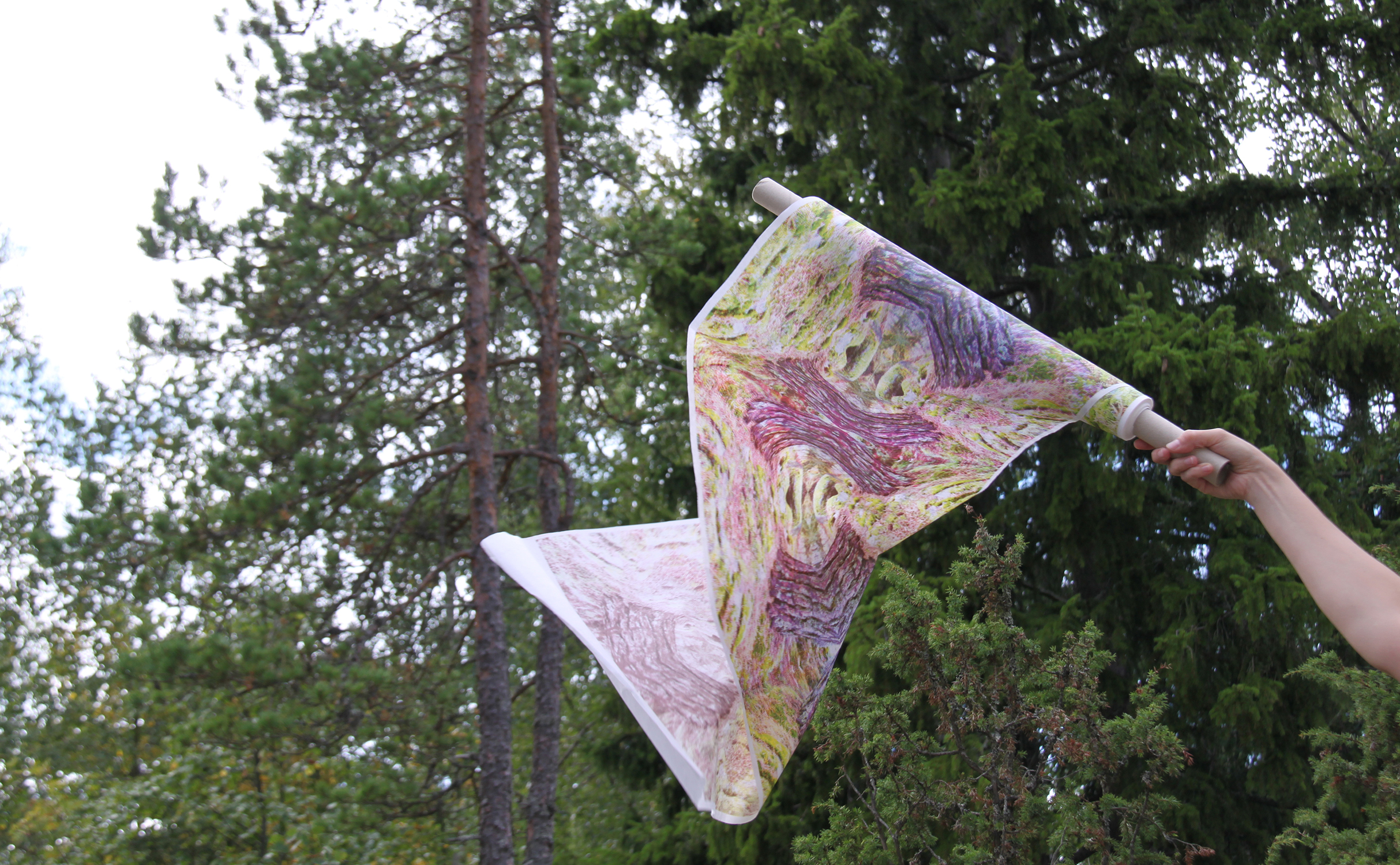
    Paula prints by Sirkku Ketola.
    Paula prints by Sirkku Ketola.

    Firstindigo&Lifestyle: What comes to mind, when you think about your project Paula is that it is so clearly beyond the visual practice, or enhances the physicality of the practice. What is so intriguing is how you dive into the embodiment and stretching of the paper. Is it that the body becomes a continuation of the paper in the printing process, as if being one with the paper? What kind of metaphors would you like to highlight, or are being evoked in the process?

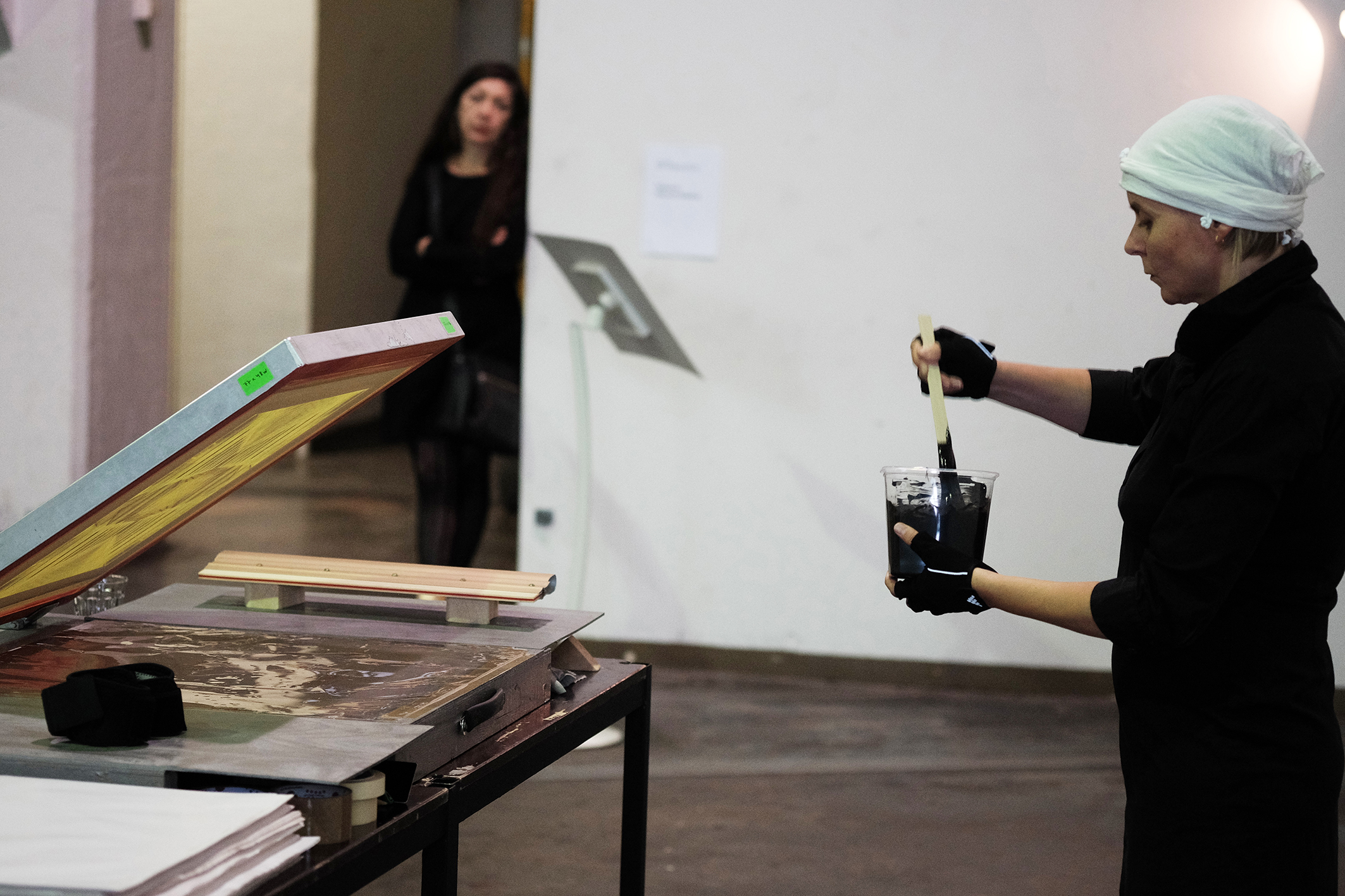
    Sirkku Ketola: I guess I need touchable material to support thinking and understanding. In this case the handling of color and paper together with challenging technical crafting, tune us as one organism, where the tempo is being set in the cohesion of the qualities of the all included matters. The strength of the body, the sensitivity of the hands and the exactness of the eyes, are sensing constantly the fragility, stretching, moistening and drying of the paper, and the consistency and volume of the ink. The local, or should I say site-specific humidity and temperature effect strongly to the functioning of this paper/colour/body formed sensual machine. Also the instant substance of the body, the general vitality, the emotional ambiance, and for example the daytime, give all some special marks, first to the performance, and second to the visual appearance of the ribbon in progress. Imprint is different during mornings and evenings, also in the beginnings and the ends of the ribbons. I have chosen the long and fragile paper to be forced to lose control. The process is too tiring to hold on it. During the series of the performance the same paper roll goes by my hands 12 times so it is impossible to dominate the quality or the crossing effects of different layers. I just must be humble, and let the ribbon teach me. Maybe the greatest thing is that the ribbons still surprise me even though I’ve been working with the same materials for years. The major errors have been avoided, but the danger of errors are constantly present – everything can be irreversibly spoiled even in the last round of printing.

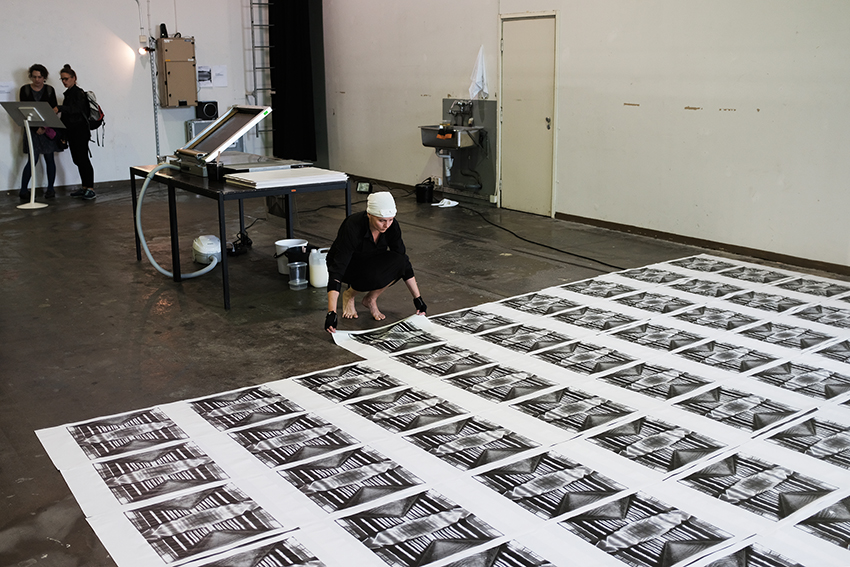
    Sirkku Ketola performing Paula.
    Sirkku Ketola performing Paula in Cable Factory, Helsinki, August 2017.

    Sirkku Ketola: The ornament arises on paper in stages from light to darkness. The colours (yellow/magenta/cyan/black), except being common from every home printer symbolize light, passion, knowledge, reality, depth and darkness. Step by step these colour layers, as named the elements of beauty, while mixing and uniting approach the truth, the code of life or would I say the mystery.

    The hand printed ornament reminds somehow of the DNA. Basically with the repetition of same patterns, the motif is being affected continuously by the changes of the circumstances. All the variations show together endless amount of visual possibilities and diversity. At the same moment the so-called mistakes come part of the entirety and open up routes for the new beginnings.

    Today we talk a lot about unmaterialized art, light and it’s different digitalized reflections. I am blown away by it also, the transfer of energy from one equipment to another accomplishes wonderful outcomes. In my own work process the need of touch, the acception of the tardiness of the body as the part of the thinking self, in other words handling with hands, have so far helped me to the deeper knowledge. I choose to cherish this special bodily tempo – it might be good for human species. When one forces oneself to stop by the slow repetition, one might also have time to understand something essential.

    Sirkku Ketola performing Paula in New York, November 2017.
    Sirkku Ketola performing Paula in Helsinki, August 2017.


    Sirkku Ketola: To be able to do the metamorphosis to become a sensual machine I had to create a role. My character Paula is simultaneously enraptured and trapped (in Finnish there is a sentence with both meanings, derived from the word ‘paula’ which also is a ribbon). She is a metaphor of a small human in cosmos. The name Paula comes originally from the Greek name Paulus which means small. So my Paula works with paula, with her special ribbon. Her job is to communicate visually by printing this repeating and overwhelmingly beautiful ornament. She wanders globally and communicates of the seen beauty. The previous place sets the next pattern, for example the New York effects to Paula will be seen next spring in Helsinki, Finland.

    The machine is slow and time bending. It is a factory that is able to work without problems approximately four times per year. The doctor’s order has set the limit. I forget the rules always in the beginning of the new project, but now, when the Brooklyn ribbon has been finished, the pain in my hands is there and that makes calming down easy. By respecting this manual of the project, it will be possible to enjoy after ten years from now about the yet unknown massive installation, which is made of these forty different and international printed ornament ribbons.

    I feel extremely privileged to be able to define the speed of the assembly line. For that reason the pleasure is an important part of the performance. Paula enjoys her movements and the choreography set by the printing process. The ink flows and the paper glides with the hands accepting to follow the weight of the body. The touch varies from strong to gentle and the rhythm beats with the working steps. The birth of the image feeds the will to come along to the anonymous destination. The possibility for sudden challenges forces the printer into the extreme concentration and to overcome difficulties and accept the errors. With the physicality, the mental part is also reacting all the time to the present. The chosen repetition grows thinking and developes strong pleasure.

    Sirkku Ketola: Feedback, 2016. Handprinted silkscreen on wood. 81 x 105 cm. Process picture.
    Sirkku Ketola: Feedback, 2016. Handprinted silkscreen on wood. 81 x 105 cm. Process picture.

    Firsindindigo&Lifestyle: How do you prepare for the performance of this scale, which is almost a marathon? What is the preparatory phase like, and what happens during the performance aftermath?

    Sirkku Ketola: During the performing period I take specially good care of myself. I try to do the outdoor activities daily, sleep enough and eat healthier. I try also to avoid the evening happenings and alcohol. The preparation for the performance takes mentally the whole day, but the most intense are the two hours before the show. The soundtrack of the performance follows me since morning. I’d like to highlight, the sound scape of my music and the noise of the printing table are essential elements of the performance. When arriving to the show space I tend to eat lightly and drink a lot of water. After it is time to check all the technical equipments and to mix the printing inks, the hue and the saturation needs to be done carefully. I have a special ritual order to do this. After this, I isolate myself, warm up and slowly become my transformation to the role. Thirty minutes before the show it is time to change the costume and become Paula. She doesn’t speak. The aftermath of the show is quick, washing the make up and changing the clothes are rapid, so I’m soon ready to communicate with the world again as myself. Before leaving I clean the colours and check all the technical details for the next day. When arriving home I stretch well and take a warm shower, except in Finland my choice is sauna.

    Paula performance in Nars foundation Photo Nov 17, 3 38 57 PM
    Ketola performing at the NARS Foundation in New York, November 2017.

    Firstindigo&Lifestyle: How is New York as a place different, and this performance venue special, in terms of what is their impact on the quality and outcome of the work? How is the location different from the rest, say, Canada or Finland where you also created this performance piece?

    Sirkku Ketola: The place impacts mainly how the performance is being installed. I like different spaces because they challenge the art work and keep it impossible to predict. The space in NARS in Sunset Park in Brooklyn is many ways special. First, it is near the Finntown, where there was a strong community of Finnish emigrants. During today’s new emigrations flow it felt important to mark the difficult roots of my own country. Second, the size of the gallery was perfect for the project. It fit there well, both visually and functionally. Third, the space is in the building, which is full of working artists, situated in the middle of the industrial Brooklyn. Where else should the sensual machine be? I came to New York as a visiting artist-in-residence of Finnish Cultural Institute for two months. My main goal was to research the structures of the money and power in the contemporary art scene. Beyond A Body Called Paula –project I started to sketch the new large-scale print installation referring to this research theme. The work will be produced during next three years. My colleagues in Brooklyn taught me a lot about independent artists’ living at the capital of contemporary art (NYC).

    Paula, NARS foundation.
    Paula performance, NARS Foundation in New York, November 2017.

    The physical dimensions and the quality of the NARS space gave the rhythm for the installation when growing during the performances. The intimate gallery of the Sunset Park made possible to the paper ribbon to take a shape of a visually fine zig zag when it landed to dry to the perches I mounted. Also the rest of the visual elements of the performance found their places to create a dynamic composition. There was space for Paula to move and the audience was able to have several standpoints. The space was also photogenic with A Body Called Paula – and that’s important in our social media time.

    This was the fourth time and the fourth place for Paula. In Toronto it was seen in a gallery with the long hallway. There the magic of Paula worked like in the story of the Pied Piper, when people saw the action from far, they just had to reach to the space. In Helsinki Paula measured the huge hall in Cable Factory during the five hours marathon performance. And in Turku, Finland she worked behind the lightened window in the darkness of the first autumn evenings by the riverside. And in Brooklyn she captured the industrial space around the other artists. I believe that during the next ten years, Paula can capture many different structures and spaces as rich as she has done in her first year of the process. The big scale quality will be seen in the end of the whole process. All in all, these places are valuable treasures for me, and will affect the final installation.


    — — —
    Next time A Body Called Paula will be seen in Helsinki in March 2018. After that Sirkku Ketola travels mostly in Central Europe. She will be back in New York City during autumn 2019.

    — — —

    The screenprints made in New York have been prepared at the Robert Blackburn Printmaking Workshop: http://www.efanyc.org
    More information:

    Introduction: http://sirkkuketola.com
    Previous exhibitions: http://www.la-bas.fi/ketolaeng.html