Category: design

  • ‘New Nordic Oddity”?…and other design definitions

    ‘New Nordic Oddity”?…and other design definitions

    What I find very intriguing in the current design-discussion, is the questions of how we signify the things, and how we see the world-object -relations from different points of view. What now seems timely, is to define and differentiate ourselves as consumers with more softer values. We are ‘humans’ after all, meaning that we are responsible of the planet, therefore, what kinds of significations we give to the things and objects in the era of mass-production is crucial. How we consume, how we define what we consume, how we differentiate things, adds value to the objects. The meaning-systems behind the branding of products are referential, but they are also truthful from the point of view that they engage our participation in the entire definition-game. As it is also true that what kinds of nouns and adjectives we give to the objects, puts them on the market more.

    Where comes a need to define the objects, which we use, which surround us, and so on? A question is relevant in relation to design, since we incorporate the objects in our daily lives. That is the pre-value of the design. ‘National’, or should we say ‘regional’ or ‘geographical’ instead of a national as we share a global world, is attached to the design-products, and calls for several attributes. This is strongly the case in the branding of Finnish design. Let’s look back to 2008.

    The summer of 2008 generated an exhibition of Finnish design in the Helsinki Design Museum. The exhibition was called Fennofolk-New Nordic Oddity. One of the exhibit curators, professor Timo Salli from the University of Art and Design in Finland, told the newspaper Helsingin Sanomat that the Fennofolk-New Nordic Oddity -exhibition aimed at honoring the local Finnish culture. It tried to find “weapons” from the Finnish culture. Additionally, Salli mentioned that the show was not trying to bring in the latest trends from Paris to be shown “too late” in Finland, but when viewed from the “Slavic-urban” perspective, the contents were precisely that of the “national romanticism” (Pöppönen/HS 11.6.2008).

    In the interview, it became evident that the fennofolk idea had been invented couple of years prior to the show together with Salli and co-artists Jari Leinonen and Paola Suhonen (founder of Ivana Helsinki brand). Fennofolk-New Nordic Oddity displayed works from 80 different artists, who deployed a great variety of media in their works, not just birch and birch bark, which are the traditional folk art materials that Salli himself used in his exhibition designs.

    What inspired me immensely about the show itself, and what also captured my curiosity when I read Salli’s interview,  was the idea of design branding; the core idea of how we choose to define the objects and things, give them certain value. And look at them in respect to our own pasts, weather it is local histories or our own experiences in Finnish forests, for example. The beauty of the Fennofolk-New Nordic Oddity is hidden in the paradox. Finland is, first, a culture of the ‘fenno’, what ever that means. At least it comes with the traditional methods of designing the birch. Second, Finland seems to represent in the design imaginings some kind of New Nordic or Northern Oddity, which could mean something Nordic (as it is part of the Nordic countries) and then something New (as exiting?). What remains is the definition of Oddity. A question remains, what would that be? How do we define Oddity in relation to Finland and its designs?

    Helsinki World Design Capital might come up with some answers…

    See also Paloni Designers on this blog

  • Eero Saarinen’s TWA in Open House New York

    Eero Saarinen’s TWA in Open House New York

    (TWA-terminal)

    I am proud to be Finnish appreciating our architectural roots. Finnish-American Eero Saarinen’s father Eliel Saarinen was an architect visioning Finland’s future together with the architect partners Herman Gesellius and Armas Lindgren (the firm was established 1896). Architect-trio designed Finnish Pavilion for the World Expo in Paris is 1900s (Exposition Universelle). Finland, The Grand Duchy of Russia at that time, was first time exhibiting its designs in the own pavillion, so appearance in the expo was creating a strong sense of new future (Finland gained independence from Russia in 1917). Architects Gesellius, Lindgren and Eliel Saarinen designed Hvitträsk in Kirkkonummi (near Helsinki). Constructed in 1902, It was first the firm’s studio and became then Saarinen’s private home. The house was named after Lake Vitträsk, [H]vitträsk meaning White Lake. The striving National Romanticism and Jugend/Art Nouveau of the late 19th and early 20th century opened up the way to the modernism and futuristic agendas in the arts and design.  Finland’s national epic The Kalevala (Finland’s poems), which had been published in 1849, inspired the designers and architects with mythologies and epic poetry in the earlier times, the mythical characters might still enter the modernism in new abstract forms.

    In New York, Eero Saarinen designed TWA-terinal. It opened in 1962 (another wing was added in 1969). TWA inspires with the natural organic forms and continues to be a timeless piece that shows the essence of environment in the architectural structure?  The monument does not threaten people with massive interiors, but organically pads and holds. TWA should be open for public and it should be site for great artistic works, a surrounding for innovations and discussions, as the design echoes sustainability and continuation. When TWA terminal opened it paraded modernism with red-colored seats and swanlike arches. Curvy white lines of modernism speak in the Flight Center, and it pays homage to the era in architectural history.  A question is timely today as the terminal is open to public for visit as part of the Open House New York weekend.

    (below: Hvitträsk in Kirkkonummi)

  • Forest echoes

    Forest echoes

    I have recently been thinking the forest in the aesthetics. Patterns and wood structures are back in current interior design. The recent trends have been bringing the nature into our living spaces. This updated, seemingly nostalgic approach can be retrieved into decades of design innovation where arts and crafts were not that far from the  ideas of industrialism and mass-production. Nature, fall colors, flowing trees in the wind, curved themselves into airy designs.

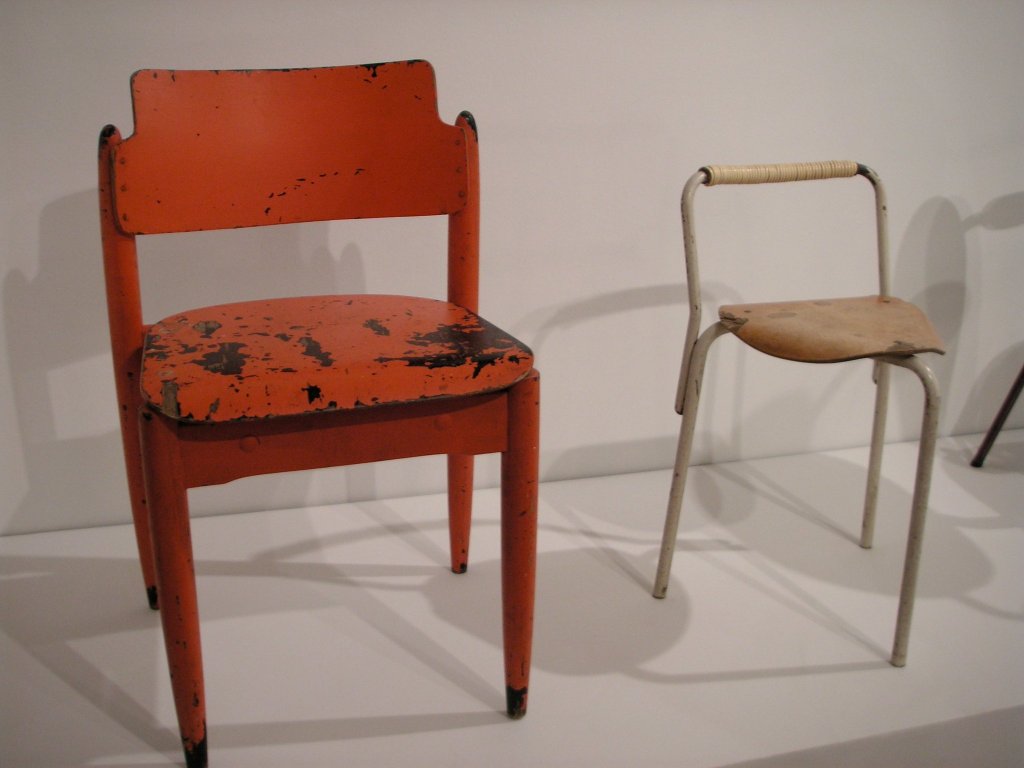
    This chair tro is by Finnish Interior architect Ilmari Tapiovaara (1914-1999), exhibited as part of his chair collection in R GALLERY, in New York’s Franklin street in the Spring of 2011. I loved to see the chairs which were so familiar from my own childhood.  Did that red chair ever get to ‘mass-production’, or how do we define ‘mass-production’? The individual craft is still speaking to us its simple organic language.

    The R GALLERY’s approach to research and innovation behind their design curating (for 10 years now) is an achievement. They have been picking trends, which have value for the future developments in the industry, giving priority to individual craftsmanship in the design and supporting innovation, which stands for sustainability, form and aesthetics in the works.

    (Tapiovaara’s exhibition catalog is available in here)