
During the opening week of the Venice Biennale, there are multiple programs of artist talks and performances taking place. This is also true in the Ocean Space-an art and scholarship incubator that was established in 2011. It has supported artistic production and environmental advocacy, bringing together collaboration and creating knowledge that is often missing in mainstream science.
In the decade of ocean, while many conservation efforts are taking place across the world’s oceans, it is timely that Biennale in 2024 will have a program around the ocean. Playfully coined in the program’s title “Re-stor(y)ing Oceania“, the new exhibition and performance series in Ocean Space may just do that, restoring and mending broken practices. In a multidisciplinary artistic way, two new site-specific commissions by indigenous artists who come from the Pacific worked with a curator Taloi Havini, who is herself an indigenous artist from the Pacific. The new commissions by artists Latai Taumoepeau and Elisapeta Hinemoa Heta combine performance, sculpture, poetry, and movement. Bougainville-born curator Taloi Havini returns to Ocean Space after her own 2021 solo exhibition there.
Ocean Space is part of TBA21–Academy, which as an educational branch of TBA21 (Thyssen-Bornemisza Art Contemporary) is a center for research initiatives. Ocean Space fosters a deeper relationship with the ocean and waterways, using art to inspire action. The center has been bringing art, science, policy and conservation around the same table.
TBA21–Academy’s Ocean Space reopened “doors of the Church of San Lorenzo” when inaugurating their home in Venice few years ago. It has become a global incubator presenting and creating action and literacy about the ocean, creating programs and events around different artistic practices, design, architecture and research. Education programs, exhibitions and performances, also open the season of Ocean Space during the 60th Biennale Arte.
Curator Havini’s vision is guided by an ancestral ‘call-and-response method’. She uses the concept as a vehicle to find solidarity and kinship in times of uncertainty. When exploring knowledge, she is focused on production, transmission, inheritance, mapping, and representation. Havini examines these in relation to land, architecture, and place. “Re-stor(y)ing Oceania” opened in Ocean Space on March 23, 2024, and will be on view through October 13, 2024, during the Venice Biennale.
Real threats to life call for the need to slow down the clock on extraction and counter this with reverence for life of the Oceans.
The Pacific Islands are one of the regions most impacted by the damaging effects of climate change. The area has many Indigenous leaders and entire communities who have participated in the call for action on the rising sea levels, and have advocated for the climate emergency that the planet is facing. There is more study of the crisis now, and there is a greater awareness of what is going on in terms of urgency, risk mitigation, and what it means to be vulnerable when it comes to the future of ocean-front communities. The indigenous artists have a voice in this continuum-their perspectives from across Oceania, Australia, and the Asia-Pacific, including the Diaspora, bring exchange and conversation. These voices create the meeting point around which the performances and exhibitions take place.
The conversations and happenings in Ocean Space include three days of live performances held over the Venice Biennale vernissage week (April 16–20, 2024). These will also remain accessible online after the events. There will be a new archive of stories, including voices from the First Nations artists, curators, writers, community leaders, poets and musicians. Additionally, collaborators include navigators, sailors, fisherfolk and scholars, who will navigate the world’s oceanic spheres, and create further understanding about ocean’s existence.
For the new commissions, curator Havini invited artist Latai Taumoepeau, who uses faivā (performing art) grounded in Tongan philosophies of relational vā (space) and tā (time). Taumoepeau is 2022 ‘ANTI Festival Live Art’ (Finland) Prize winner.
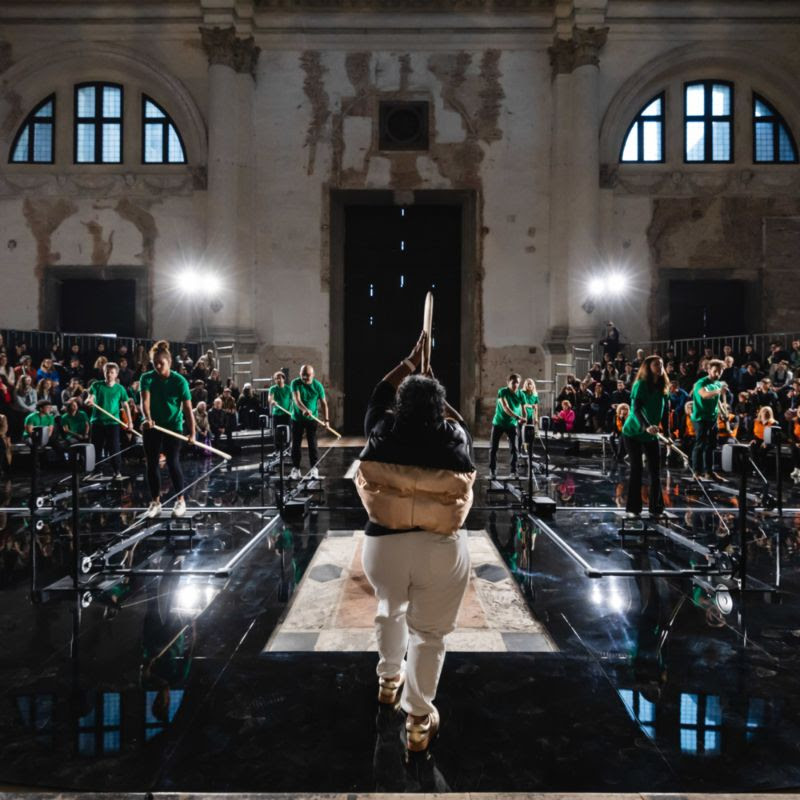
Centered in the body, faivā cross-pollinates ancient and everyday temporal practices to make visible the impact of the climate crisis in the Pacific. In the artist’s own words, ‘The more ancient I am, the more contemporary my work is’. The artist’s commission addresses deep-sea mining in a new choral work. Her resistance is shown in a poetic way, using songs that share a power to store histories and carry values and knowledge in Taumoepeau’s homeland of Tonga. The newly commissioned work, Deep Communion sung in minor , “ArchipelaGO, THIS IS NOT A DRILL”, engages audiences in the process of giving Pacific islanders an opportunity to be heard in front of diverse audiences.
There are sculptural and interactive machines installed in Ocean Space, which provide audiences with opportunities to engage with the Deep Communion sung in minor. Participants can either activate the installation – which will trigger part of the musical score – or take a seat in the surrounding bleachers to witness the performance. The work is being perfomed by local sports teams in live performance events.
In response to Taumoepeau‘s new solo commission, a live project space has emerged at Ocean Space that was created in collaboration with architect Elisapeta Heta, a Māori, Samoan, and Tokelauan leader and advocate for change. Her imagination has provided Maori and Pasifika perspectives on the importance of place to design and cultural identity, and brought that knowledge to Ocean Space.
As her response to the exhibition, the architect includes a new installation that uses a multisensory embodiment of ‘The Body of Wainuiātea‘. This title of the work means a ceremony combining ritual and a ceremony guided by the Māori concept of tikanga. She comes from Aotearoa, New Zealand, using the concepts from her ancestral lands alongside those from across the Te Moana-nui-a-kiwa.
Tikanga is derived from the Māori word ‘tika’, which means ‘right’ or ‘correct’, so to act in accordance with tikanga is to behave in a way that is culturally proper or appropriate.
The space is welcoming visitors and audiences, as it is also designed for exchange and collaboration. The space is formed around the ancient way of knowing and relating through story, and waiata (song). The goal is to connect to a greater awareness of atua (the gods’) connections to the Ocean. The tapu (sacred) is very much needed by current environmental and scientific campaigns, which seek to protect the life of the planets’ largest bodies of water.
Hosting guests through various forms of storytelling, is a common practice in the Pacific communities. Heta’s work, The Body of Wainuiātea, is a safe space for a network of artists, curators, writers, community leaders, poets, musicians, as well as ocean-professionals and scholars to come together. Collaborators include Dr Albert Refiti, Hiramarie Moewaka, and Rhonda Tibble.
The program is commissioned by TBA21–Academy and Artspace, Sydney, and produced in partnership with OGR Torino culture and innovation hub.
— — —
Curator Taloi Havini (Nakas Tribe, Hakö people) was born in Arawa, Autonomous Region of Bougainville and is currently based in Brisbane, Australia. She employs a research practice informed by her matrilineal ties to her land and communities in Bougainville. This manifests in works created using a range of media, including photography, audio – video, sculpture, immersive installation, and print. She curates and collaborates across multi-art platforms using archives, working with communities, and developing commissions locally and internationally.
Latai Taumoepeau (b:1972 Gadigal Ngura (Sydney), Australia) makes live-art-work. Her faiva (body-centred practice) is from her homelands, the Island Kingdom of Tonga and her birthplace, the Eora Nation. She mimicked, trained, and un-learned dance in multiple institutions of learning, beginning with her village, a suburban church hall, the club, and a university. Latai engages in the socio-political landscape of Australia with sensibilities of race, class & the female body politic; committed to bringing the voice of unseen communities to the frangipani-less foreground. Latai has presented and exhibited across borders, countries, and coastlines. Her works are held in private and public collections, including written publications. Latai is the 2023 recipient of The Creative Australia Emerging and Experimental Arts Award following her win of the 2022 ‘ANTI Festival Live Art’ Prize in Finland.
Elisapeta Hinemoa Heta (Ngātiwai, Ngāpuhi, Waikato Tainui, Sāmoan, Tokelauan) is a multidisciplinary artist, designer, and mother, living and working in Tāmaki Makaurau, Auckland, Aotearoa New Zealand. Elisapeta’s career has spanned architecture, art, writing, film and performance, teaching and research and has resulted in a rich tapestry of collaborative works and projects that are centered on indigenous mātauranga (knowledge and ways of knowing) and tikanga (protocols and ceremony). In working through multidisciplinary practice, Elisapeta creates experiences that make visible our stories, many of which have been hidden, with a focus on indigenous and wāhine (women) centered story-telling. Through her art practice, Elisapeta, in collaboration with photographer John Miller (Ngāpuhi), took the exhibition Pouwātū: Active Presence to the 22nd Biennale of Sydney: NIRIN 2020, and brought it home to Objectspace Gallery in Tāmaki Makaurau (March – May 2021)
Program in Ocean Space: March 23-October 13, 2024.
Address: Chiesa di San Lorenzo
Castello 5069, Venezia
Photo: Latai Taumoepeau performing her work ArchipelaGO, THIS IS NOT A DRILL with local sports team in Ocean Space.

 Firstindigo&Lifestyle