Olena Jennings, New York City based poet and designer, escapes to the trainin her latest work. During COVID-19, social distancing has been in place. For Jennings, new kind of creative process has evolved during this time, when thinking of poetry and design together.
Firstindigo&Lifestyle: Would you like to name some inspirational poets?
Olena Jennings: Inspirational poets include Alice Notley, Don Mee Choi, Galina Rymbu, Queens poet Micah Zevin, Cladia Rankine, Simone Kearney, and Gala Mukulomova.
Firstindigo&Lifestyle: Your artistry has evolved from poetry to textile art, and dress making. Hows is this combination working? OJ: My thoughts become free as I sew and this process helps me to release words that I catch for the page. It can be meditative. I like the idea of connecting textile works with poetry. It’s fun to force the words into a visual shape. It’s become an important part of my process even if I never share the textile work. It helps me think of the words in a different way. It helps me to give them shape.
Firstindigo&Lifestyle: Do you feel that your cultural identity is in a process or evolving in the making of your new textile art?
OJ: My cultural identity is linked with memory. When I go into the past I explore my culture. It makes my culture more personal and different than it might be for other people.
Firstindigo&Lifestyle: Did COVID-19 change your practice and plans a lot, how have you coped during this time?
OJ: COVID gave me the solitude that is necessary to be creative on almost a full time basis. Even when I’m working, I am thinking about projects.
Firstindigo&Lifestyle: When looking at this dress and the design of it, is there anything special about making the ‘rails’ of the dress?
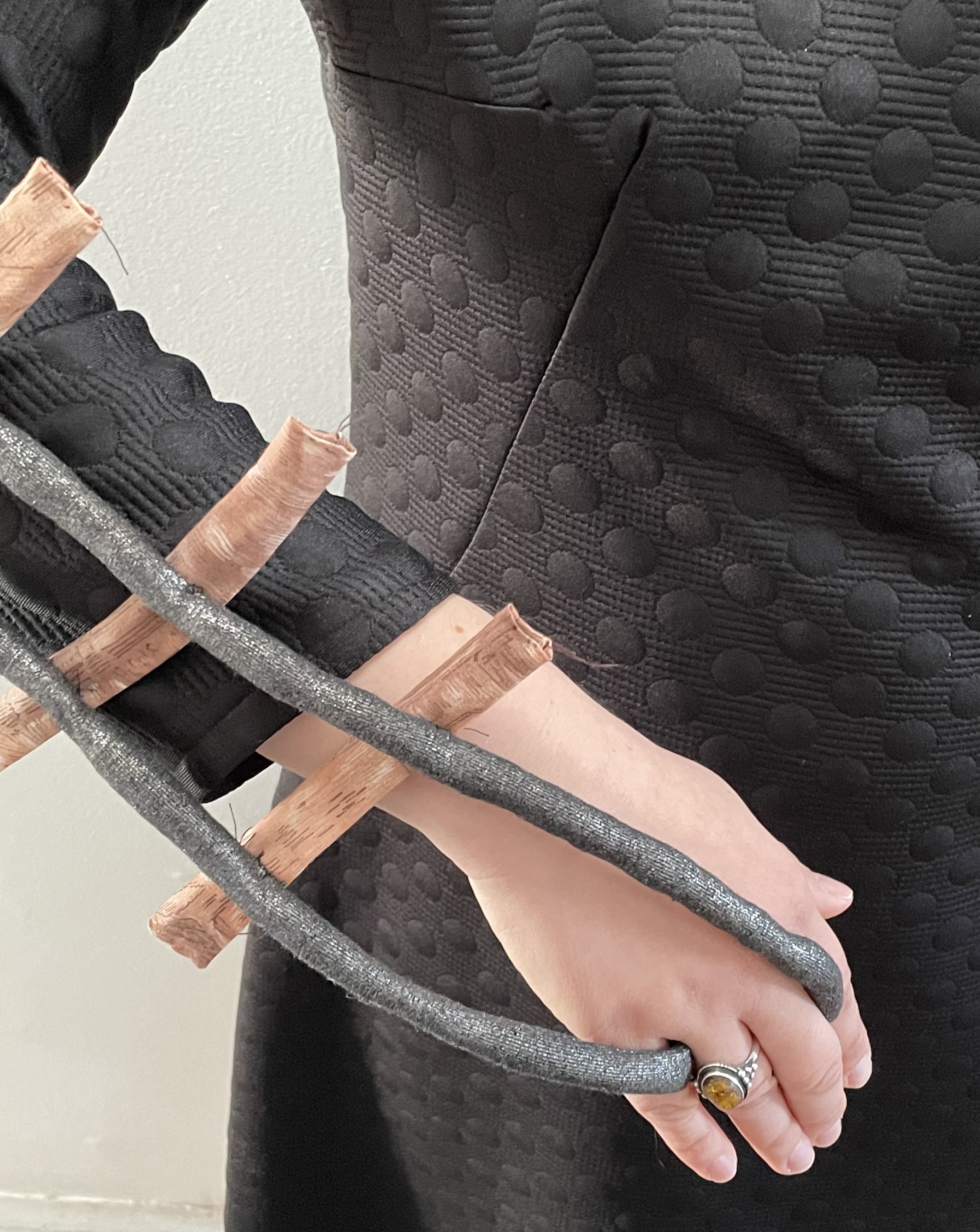
OJ: The fabric of this railroad dress, which I made, is polyfil and wood. It was inspired by the poem “Social Distancing” by Christine Turczyn published in Lightwood 4.
Firstindigo&Lifestyle:The dress is essentially echoing the poem, and the theme of it. There is a special rhythm in Christina Turczyn‘s poem that stimulates this design?
OJ: The specific line from Christina Turczyn‘s poem is “Anna painted a railroad tie that stretched across her hand.” The fabric that looks like wood came from scraps of the previous dress I made, so everything is connected.
Firstindigo&Lifestyle: This is fascinating. So eventually, you wrote your own poem “Escape to the Train”. Did the poem by Christina, and making the dress inspired by the poem, end up in your own poem?
OJ: First came Christina’s poem, then the dress, then my poem came (without thinking of Christina’s at that point.)
Railroad dress by Olena Jennings.
ESCAPE TO THE TRAIN
By Olena Jennings
They took the photo with the fire escape in the background. They would sit outside among the plants in terra cotta pots and smoke cigarettes. Sometimes it was the highlight of their night until they started to plan the train rides. They couldn’t speak French well and bought a ticket to the wrong city that they decided to go with because it was much closer: their Strasbourg.
She was the third, sat on her own next to a stranger who kept pulling his cardigan around him as if he had something to hide. Her friends’ voices sounded like whispers the row behind her. Everyone was keeping secrets.
The journey was captured in her arteries. The movement tugged at her from within. She followed the rhythm, getting off a stop early, leaving the giggling of her friends behind.
Anne Raudaskoski is a Finnish enterpreneur who wishes to create new connection to nature. Her approach can change the game of sustainability. With a background in dance, she has faith on the power of the arts:
“Arts provide a holistic approach to existence, and this is what we need to change the current linear system. Human beings are part of the nature; nature isn’t something that is “out there” to be exploited, but rather, we need to re-establish our connection with the nature to realise that we can create sustainable growth and well-being with far better rules than what we presently have”. (Anne Raudaskoski)
Firstindigo&Lifestyle: When and how did you start Ethica consulting company?
Anne Raudaskoski: I started Ethica in 2013 with my business partner Paula Fontell. We actually didn’t know each other at the time, but we both had been talking to our mutual friend of having a dream to set up a company focused on sustainability and the circular economy. This friend of ours suggested we should meet and share our ideas. We had our first meeting over lunch and we realised we shared the same vision. Three months later Ethica was formally established.
Firstindigo&Lifestyle: How did you get interested in the circular economy?
AR: My approach to CSR (corporate social responsibility) and sustainability has always been very business oriented. It means that there has to be a solid business case for sustainability and it should be embedded in strategy and R&D in such a way that sustainability works as a spring-board for the strategy instead of being an add-on or philanthropy. I wrote about the circular economy (CE) in early 2012 on my blog site after reading some articles on the Ellen McArthur Foundation (the global driver for the CE) site. I felt that some of the questions and pain points that CSR could not resolve – especially the intersection around environmental, strategic and economic issues – were inherently part of the circular economy. So when we started Ethica, it was very clear to us that the circular economy would be part of our service portfolio.
Firstindigo&Lifestyle: Is it possible to define, what circular economy actually changes?
AR: Circular economy is an economic model, so it affects all sectors and organisations in some way. I always say that the biggest hurdle in transition from a linear to a circular economy is our current mindset. All our processes, decision-making, governance and actions are based on linear thinking. In a nutshell, this means that we keep overusing natural resources, we accept the concept of waste as de facto, design processes are not based on biological and technical cycles and we haven’t figured out yet how to do business within the planetary boundaries. All this is changing as part of the transition towards the circular economy.
Firstindigo&Lifestyle: What are the basic principles that define the circular economy?
AR: The below list of six principles offers a good starting point to explore CE more in detail.
1 Circular economy is a resource wise economic model that is restorative and regenerative by nature. It operates within the planetary boundaries.
2. Materials cycle endlessly in technical and biological loops in society. Materials are safe & non-toxic.
3. The value of products, components and materials is maintained and increased through refinement.
4. All energy is renewable and is used efficiently.
5. Solutions are systemic and based on designing life cycles, ecosystems and multiple purposes.
6. Equal distribution of resources and well-being is in the heart of the circular economy.
Firstindigo&Lifestyle: How would you describe the ‘ethical’ core of Ethica?
AR: We want to create a circular future. To us this definition also entails equality, social well-being and in fact, a more just and transparent economic model than what we currently have as the result of the linear economy.
Firstindigo&Lifestyle: Finland seems to be a forerunner for ethical solutions when it comes to consumption, and the country is also involved in introducing new clean practices. What aspects in Finnish culture support these kind of thinking?
Indeed, there are quite a few aspects supporting this and I’d say it’s the unique combination of culture, history and welfare state: high number of clean tech innovations; excellent education system that educates children and young people about sustainability topics; frugal manners that our grandparents and parents had to adopt during the war, which then were passed on to younger generations; good recycling infrastructure with incentives…and of course ambitious policies and action plans in place. For example, circular and bio economy are one of the five flagship programmes of the current government. Finland was also the first country in the world to publish a national circular economy roadmap in 2016.
Firstindigo&Lifestyle: What in your mind defines good consumption?
AR: Understanding your own impact and power as a consumer. Exploring your own values; what kind of world I want to be building, do I want to be part of the solution or part of the problem? Questioning your own consumption habits: is there something that I could do and choose differently? Being your own leader when it comes to adopting new, sustainable solutions.
Firstindigo&Lifestyle: Tell more about your Relooping Fashion project?
AR:Relooping Fashion was about creating circular fashion. We piloted a circular ecosystem consisting of seven business partners ranging from waste management company to fashion retailer and packaging service. So the goal was to build, test and learn how a closed loop fashion ecosystem could work. Another important goal was to test VTT’s (Technical Research Centre of Finland) new technology for cotton dissolution that replaces the use of virgin cotton. Ethica’s role in the project was to model the business ecosystem as well as research the consumer interface. i.e. how to create demand for circular clothing.
Anne Raudaskoski, photo: Janne Häkkinen, JFramesPhotography.
Firstindigo&Lifestyle: Where do you find your daily inspiration from?
AR: No matter how cliché it may sound, I simply and truly enjoy my work, so the work itself coupled with the opportunity learn new things is my source of inspiration. Every project is different, we have great clients and collaboration partners to work with and of course our own team is brilliant.
Firstindigo&Lifestyle: What can the world learn from Finnish innovation in clean practices?
AR: Great education and innovation support system are essential enablers. I also think that the Finnish way of living and thinking inherently has a fairly good level of social and environmental responsibility, and when these aspects are combined with innovation, you get the solutions that the world needs.
Firstindigo&Lifestyle: How do you like to influence and motivate people in their everyday life to incorporate more sustainable solutions and choices?
AR: There are a number of different players who all have a role to play. Of course we need businesses to develop solutions that are not only sustainable, but they’re also the best solutions available. Legislation can speed up the development and help mainstreaming new solutions. Education and the media also play a hugely important role in making sustainable choices the “new normal”.
Firstindigo&Lifestyle: Do you think that your background as a dancer helped you in your career path?
AR: It did in many ways. Working as a freelance dancer requires endless curiosity, self-discipline, perseverance and ambitious attitude. You’re always seeking new opportunities and you need to welcome constant change. You need to be a good team player, but at the same time you’re 100% in charge of your own development. There are hardly any permanent vacancies available, so you have to build your own career and make sure you are sufficiently networked just to be even considered to be one of the many candidates. Basically, you work as an entrepreneur without the formal status of entrepreneur.
Also my dance teacher background has been an asset when running workshops and giving presentations.
Firstindigo&Lifestyle: In what ways can arts support circular economy?
Arts can create connections and mental horizons that escape the typical business environment. It can bridge rational and emotional in a way that enables eureka moment, which is a prerequisite for willingness to change the status quo.
Firstindigo&Lifestyle: How many countries have you visited to lecture and share about your business?
AR: A few so far: China, the Netherlands, Estonia and Reunion Island (France). We also exhibited in Austin (US) at the EcoExhibition a couple of years ago. Next month I’m going to Sweden.
Firstindigo&Lifestyle: Is it easy to name clients that are best for your brand?
AR: The ones who want to work ambitiously, are truly interested in raising the bar and finding new opportunities through the circular economy thinking, no matter the size or sector of the organisation. From the circular economy perspective, we are still at the dawn of the new era and endless opportunities that this new approach can provide us with.
Firstindigo&Lifestyle: Is the questions of climate change significant and embedded in your models?
AR: Absolutely. To start with, all energy should be renewable, this is one of the basic tenets of the circular economy. Decoupling growth from the use of virgin raw materials and resources is another key principle. In short, it means doing more with less and designing our products, systems and societies in a circular way so that emissions can be decreased significantly.
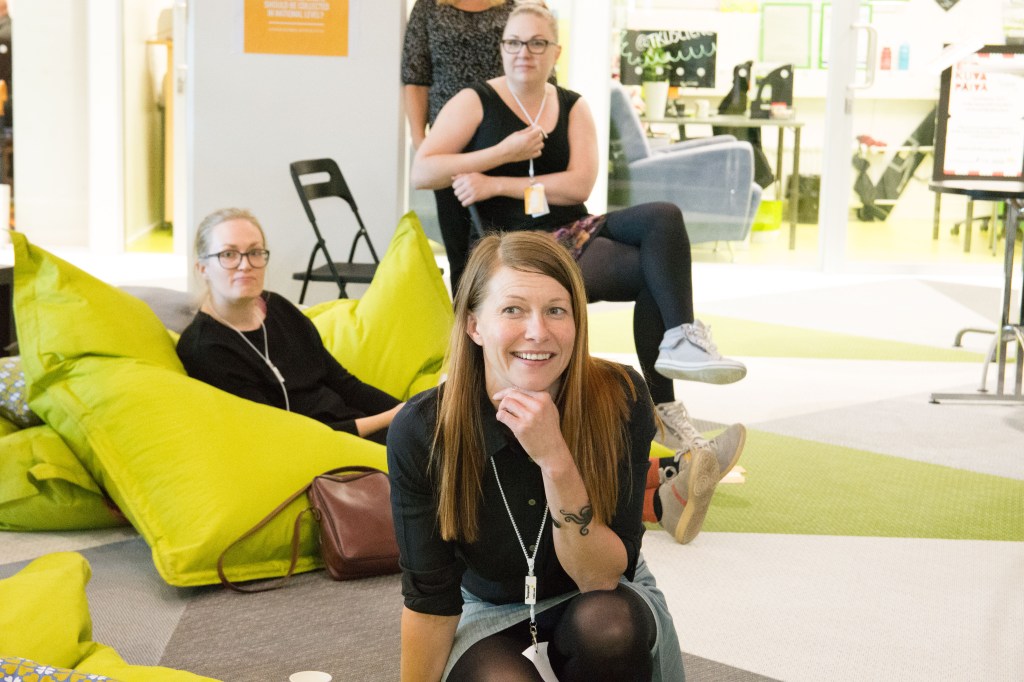
Featured image credit: textile hackathon, Sara Malve-Ahlroth.
On September 8, 2013, avant-garde fashion collective threeASFOURdebuted their spring/summer 2014 line at The Jewish Museumas part of threeASFOUR: MER KA BA – exhibition. The collective’s fashion and art is inspired by the geometric patterns found in synagogues, churches and mosques throughout the world. For the nine sculptural dresses featured in MER KA BA, they use laser-cut lace, origami pleats, and 3D-printed textiles to unite symbolic patterns from diverse religions.
(Video by Brian Gonzalez)
The collectives 3 designers were born in different cultures:
Gabriel Asfour is from Lebanon, Adi Gilfrom Israel, and Angela Donhauser from Tajikistan. Their approach to fashion is poetic and socially conscious. For threeASFOUR, couture is about more than just beautiful clothes; ‘it is both wearable art and a platform for their free-spirited philosophy.’
— — —
threeASFOUR’s MER KA BA installation exhibition is on view until February 2, 2014, at the Jewish Museum in New York. Check the exhibition site.




 Firstindigo&Lifestyle