Category: fashion

  • Anna Zaigraeva rocks her beadwork design

    Anna Zaigraeva rocks her beadwork design


    Anna Zaigraeva lives in New York City and works as a Russian to English translator. She designs beadwork jewelry in her spare time.
    -Anna, tell us how you started doing these and when? 

    – I learned beadwork from my best childhood friend back in Moscow. We were both ten. Since I moved to the States, I’ve mostly just continued to learn by trial and error – I don’t subscribe to magazines or beading clubs or anything like that. So I’m not a hot-shot technique-savvy beader by any stretch of the imagination.
    -How long did it take to learn?
    – Not very long. They are difficult to make, but not because the stitches are tricky. It just takes a lot of time to pick and choose the right bead. I use high-quality Japanese Miyuki size 15/0 beads, which are pretty uniform compared to other brands, but even they are not uniform enough to simply string them at random and hope the pattern comes out. I have to constantly compare the fringe I’m working on against the previous one, to see if the next bead needs to be thinner or fatter to make the pattern work best. When beads are marketed as being the same size, it just means they have the same width and hole diameter – thickness varies quite a bit. But this is what sets my necklaces apart from others that use patterned fringes: I hand-pick each of the 7000 beads specifically for its place in the necklace, and I also make sure the fringe is not too loose or too taut. So the pattern comes out as close to perfect as possible.
    – Are the supplies easy to get?
    – There are a lot of bead suppliers out there, so the main problem is price shopping. My best purchases usually come from the discount bins of the Toho Shoji store on 37th street.
    – What inspired you to make these necklaces?
    – My very first fringe necklace was inspired, as far as I recall, by a coral reef. The design I first chose was symmetric but extremely difficult – the necklace took me probably upwards of forty or fifty hours to finish, and I made a ton of mistakes. I’d like to try making it again at some point – it was different and interesting. Unfortunately, given how long it takes, it’d probably be too expensive to unload afterwards. But that’s all right. I might just end up giving it away to a friend.
     
    – So the first one took fifty hours, what about the ones that you made after that?
    – After that, I adjusted the pattern slightly, and they now usually take between 20 and 30 hours, depending on how many colors I use. The simplest pattern I make is solid diamonds – four colors and a border. It always takes several hours just to pick out the colors and make a sample. I usually end up trying out several combinations until I find the one that works best.
    – Are they heavy?
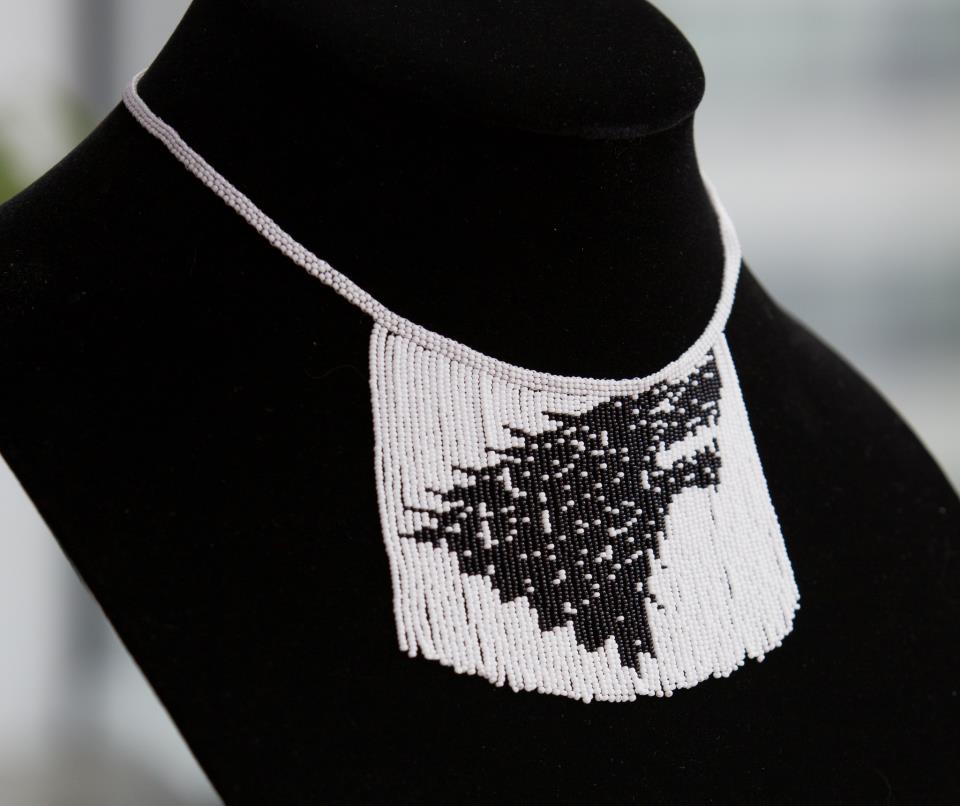
    – No, they’re actually super light. People are always surprised by this, since each necklace has about 7000 beads. But miyuki seed beads are very lightweight. So the necklaces rarely weigh in over 25 grams. And I recently started using even smaller beads – Czech size 15/0 rather than Japanese, so they’ve gotten even lighter. My new House Stark necklace with a direwolf head weighs only 13 grams, and that’s only because it has a rather big toggle clasp.
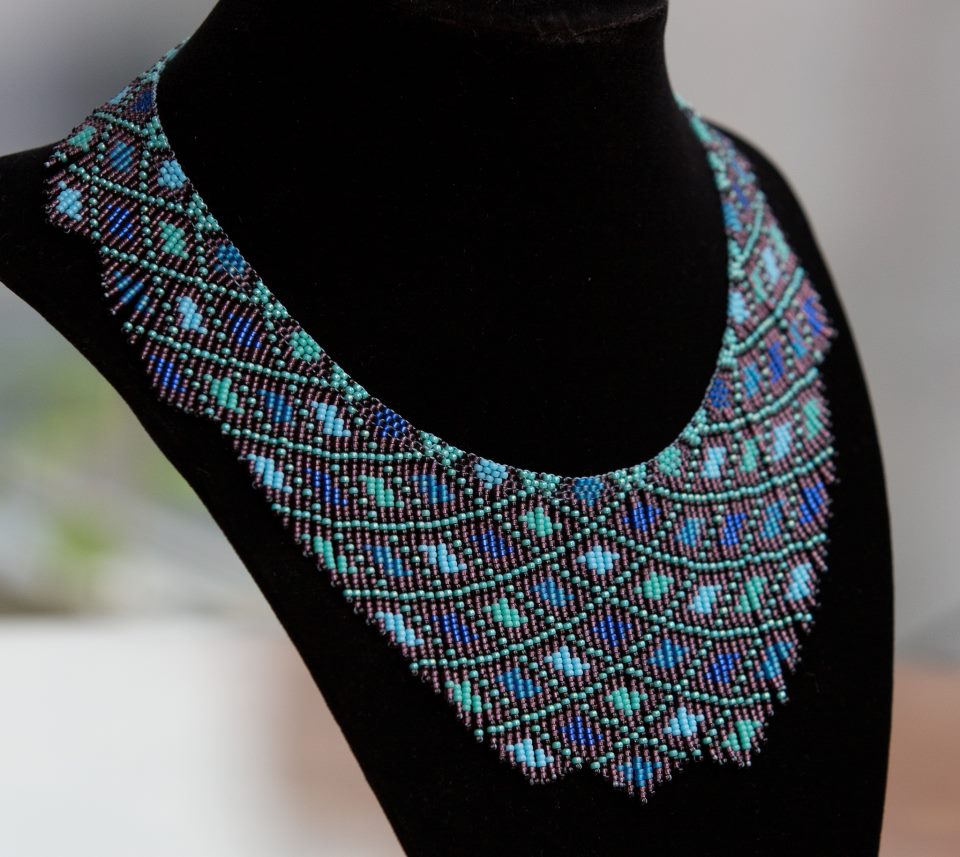
    {ALL the above designs are found inAnna’s Etsy-storehttp://www.etsy.com/shop/AxmxZ. Anna shows here how to make jewelry with cool pictures.}    
  • Fashioning ‘eco’ concepts

    Fashioning ‘eco’ concepts

    If fashion is now promoted with both ecological values and celebrity cultures, a question of who is wearing what and whose designs, includes a new kind of conceptual thinking.  Historically, fashion is the clothes that we are wearing. Then, a questions of social class plays an important role, since we are making the clothes our own by wearing them. Traditionally, women have been thought to be the ideal consumers of fashion, so fashion magazines have also created platforms where to discuss and make fashion as part of the women’s lives. In the circulation of fashion, clothes become fashionable again when the trends come back as new combination, and also next to new concepts and ideas. The historical, futuristic, and the near-past fashion are re-produced together with popular cultural icons. The cultural references of fashion keep also changing so that they are able to maintain the ‘hype’ status attached to classical designs. New technologies used in the fabrics, as well as green values are  important factors, which also reflect the moment. More importantly, ecological aspects that promote global awareness and respect the local traditions are now a necessity.

    When in previous decades, the fashion products (and other products) did not take into consideration the ecological dimension of production, today’s processes are very different. The economics behind the change is pricing, as the prices in materials have been rising. Then, today’s consumers cannot be entirely responsible for paying the high cost, so the companies and designers have to be able to reduce the amount in production, and reconsider the materials, which they use.

    When we are making our choices as consumers of fashion, more important to us than who is showing up in the shows is to be a conscious consumer. We should be asking, what is the ecological dimension behind the clothes that we buy. In addition, a cultural and geographical referent can become a conscious factor in our decision making; when in the making of the products this means emphasizing the local craftsmanship. One example of this type of local fashioning is a collective Contept Korea that has utilized an idea of Korean fashion culture in their global marketing. Designers who are participating in the collective aim at making Korean cultural image and national competitiveness as their goal. The Korean fashion, which has been promoted overseas has been sponsored by the Korean Ministry of Culture. With that governmental aspect, Concept Korea has been looking for new forums to promote Korean fashion and culture together, and to interact with new technologies. I participated in their showing in Mercedes-Benz Fashion Week in New York in February 2011.

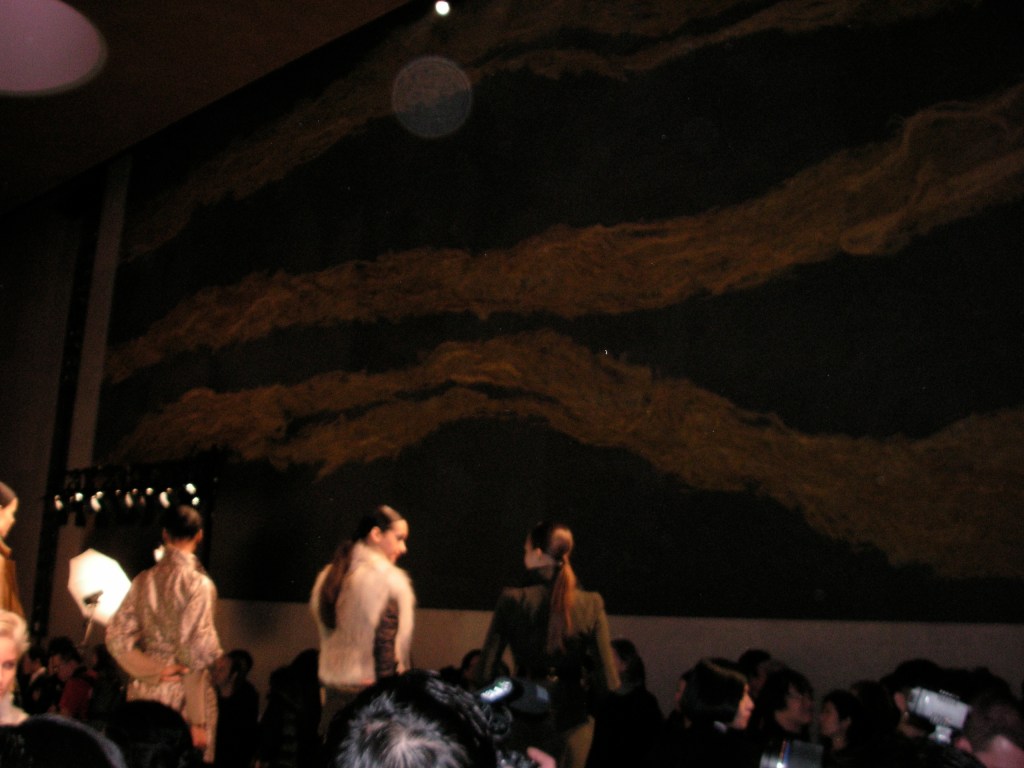
    One of the designers Lie Sang Bong (based in Paris), has been drawing inspiration from Korean folk painting, from the black and white graphic designs which have drops of bright color like red in them. He has also created fashion sculpture and a bauhaus-architecture inspired collection, which both show sculptural dimensionality in clothing. Then, a Korean woman designer Doho impresses with work that has a feminine and flowy touch (see picture from Mercedes-Benz Fashion Week in February 2011). Concept Korea perhaps comes as a continuation of the collective creativity that started with Seoul being the World Design Capital in 2010.

    In today’s economical climate, the design world is thinking alternative solutions. When European countries struggle with economical difficulties, a good news could be that the countries are re-thinking the carbon limits in the production processes.  Only a few decades ago, environmental problems were thought to be part of the policy making of the governments. Now the industrial processes are considering the environmental questions as part of their designing of products.

    Designer Lie Sang Bong with his crew at NY fashion week.
  • Would I buy a ‘poisonous’ handbag…

    Would I buy a ‘poisonous’ handbag…

    Marketing strategies are sometimes tricky, and techniques of seduction are part of the contemporary branding of products. Putting products out on displays, is then of course part of the entire strategy. We are sensuous beings. Consuming today means taking seriously the product differentiations. We should be paying attention to, how the different products feel, taste, smell, etc… In other words, a questions is, how we as humans experience and imagine objects and things.

    What is the tricky point is that we are after all quite childlike beings when we make our choices to buy something. Hopefully our product differentiation is more in line with the future aspect; what would be good for us in the long run and what would be a more sustainable aspect in our buying of new things. This relates to, what is good for the environment and does not poison our bodies.

    It is important to emphasize couple of questions: how much of the seduction in the advertisements, and in the product differentiation is based on the use of different color-combinations? How do the various techniques of branding speak to our sense of nostalgia aiming at reminding us of our childhood experiences, the shapes, designs, colors and patterns? I noticed something based on this idea.

    There was a handbag, which was on display on a ‘poisonous mushroom’. Think of the red-white spotted Amanita. The color combination would be just so inviting, so deliciously right. The color and shape is full of associations, which can be traced to children’s books and other childhood designs…Just imagine Alice’s Adventures in Wonderland  (by Lewis Carroll). What actually happened to Alice? She was growing tall, shrinking…The image appears as both fascinating and scary. We do not necessarily need to know what happened to Alice in the story. Yet we should think about the poisonous as a metaphor for things that work in the level of seduction… An important question would be, as I see a beautiful handbag on display, would I buy it as it is on a top of a poisonous mushroom? What else does ‘the poisonous’ stand for in the contemporary consumption imaginings, what are the materials used in the products; do they harm the environment and so on?