Category: fine and contemporary art

  • Chinese Watersleeves

    Chinese Watersleeves

    Shuixiu is Chinese. The word can be translated literally to ‘water sleeves’. The sleeves are amazing part of the costume, or dress, which a Chinese stage performer wears. Not only are they made of fabric and is part of the costume, but the word refers to performer’s extraordinary skills to perform various movements with the sleeves.

    Water sleeves are ‘double white-silk sleeves attached to the cuffs of a costume’. The long sleeves can express performers’ mood. Overall, the gesture variation that one can perform with the sleeves, are hundreds. These include movements of ‘quivering, throwing, wigwagging, casting, raising, swinging, tossing, whisking, rolling, folding, crossing and so on’.

    Water sleeves can be used for many functions. For example, the sleeves wigwagging in front of face means a fun; one hand pulling another water sleeve sidewards indicates politeness or bowing; sadness and shyness are expressed by one hand pulling another water sleeve to cover the face; wiping tears and whisking dirt on costumes by water sleeves; raising and put up two persons’ water sleeves to embrace each other; water sleeves also indicates the music band when the singing performance starts (cultural-china.com).

    Here is a Female Dancer, a sculpture from Metropolitan Museum’s collection. It depicts fine water sleeves being a fine example of dance in the Chinese sculpture. This model is earthenware with pigments, and it is from the Western Han dynasty (206 b.c.–9 a.d.), 2nd century b.c. China. More information about the sculpture on the museum website here.

    Female Dancer, the Western Han dynasty (206 b.c.–9 a.d.), Metropolitan Museum of Art.
  • Galleria Saima brings Italian art influence to Helsinki

    Galleria Saima brings Italian art influence to Helsinki

    Gallerist Lea Karttunen founded her art gallery Galleria Saima in the heart of Helsinki in 2012. She is a graduate from the Graphic Design program at the Institute of Design and Fine Arts in Lahti Finland. Lea has worked in the graphic industry for decades, and painted in her free time in Italy where she is inspired by the ancient Etruscans.

    LeaKarttunen, Saniaisen olemus, Akvarell painting, 37×27 cm, 2012

    Lea, How did you start your Saima Galleria?

    LK: The art gallery has been my long term dream. My idea is basically to create a platform for young talent. Then I want to work with different artistic genres, I want to mix forms and overall be very interdisciplinary. In my opinion, this is the way to create a new type of artistic space. And it is situated in the heart of Helsinki.

    What is your background in the arts?

    I have always worked with painting myself, but I love and respect all the other art forms as well, for example music and theater. I studied visual communication, Russian classical portrait painting, and akvarell painting with many prominent artist-mentors. I find that this is truly a life-long learning process, to acquire techniques takes a long time. In addition, I have been involved in the business world for decades so I have that experience as well.

    I visited Saima after it had opened in August 2012. I was impressed by Mari Vuolanto’s huge black-and-white works on paper, which you presented for the opening without frames. She has lived and worked in Italy too. I understood that your dream is to bring Italian art world closer to our Finnish one. How do these two places meet in your gallery?

    I love Italy, its culture and nature, and the ‘Etruscan influence’ in Mazzano Romano is a constant source of inspiration. Perhaps this is the reason why Italy has been part of my vision from the very beginning. I personally think that Italian artists are more expressive or courageous, and more multiple in their approach than we often are here in the North.

    What is your curating principle and the set of goals?

    By combining different art forms and using interdisciplinary means, I want to bring something new to the art field. I want to be taking part in the current trends, or what is timely, both locally and internationally.

    This is what we have planned for the near future in the gallery. We will have very interesting event coming up, when we are working together and in conjunction with another show taking place in London. On April 20th 2013, one artist paints here at Saima Galleria and the ’other part’ paints simultaneously in London. These two artists are making portraits of each other. The project examines memories, discovers distance and  longing. We will use internet in the process of making the portraits.

    Then we will have an exhibition coming up, which will be based on music, and focuses on the musical and the sound experience. I believe that when wecombine different art forms we promote new kind of art-loving participation and we create new opportunities for audiences.

    Tell me about your current exhibition with artist Valentina Toma?

    Valentina comes from Italy, she has lived two years in Helsinki, and this is her first exhibition in Finland. Most of her works, now on view at our gallery, are from 2011-2012, and her show is named as E´IL TEMPO DEI COLORI BRILLANTI (Its time for brilliant colors). During the 1990s and 2000s, Valentina had exhibitions all around the world, including in New York, in Hong Kong, in Mexico City, as well as in numerous European cities. Her paintings are combining pop surrealism with neo-realism. These paintings are very strong and powerful. The colors are strong, and her technique is very detailed and expressively disciplined. Valentina is a graduate from the Florence Academy of Art.

    Galleria Saima is open during the exhibitions: Wednesday-Friday 11 am –5 pm, Saturday-Sunday12-4 pm.Adress: Neitsytpolku 9,00140 Helsinki. (Valentina Toma’s exhibition in on view until 10.2.2013.)

    www.galleriasaima.fi

    Artist Valentina Toma’s webpage on Artbreak/Greenpoison.

    Artist Mari Vuolanto’s webpage.

  • The Event of A Thread, a photojourney

    The Event of A Thread, a photojourney

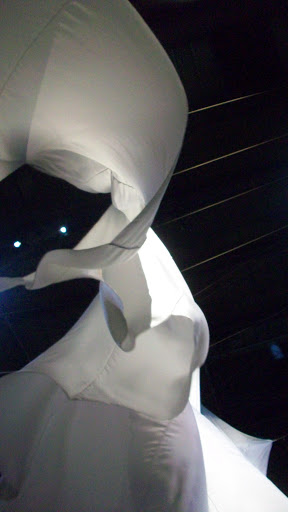
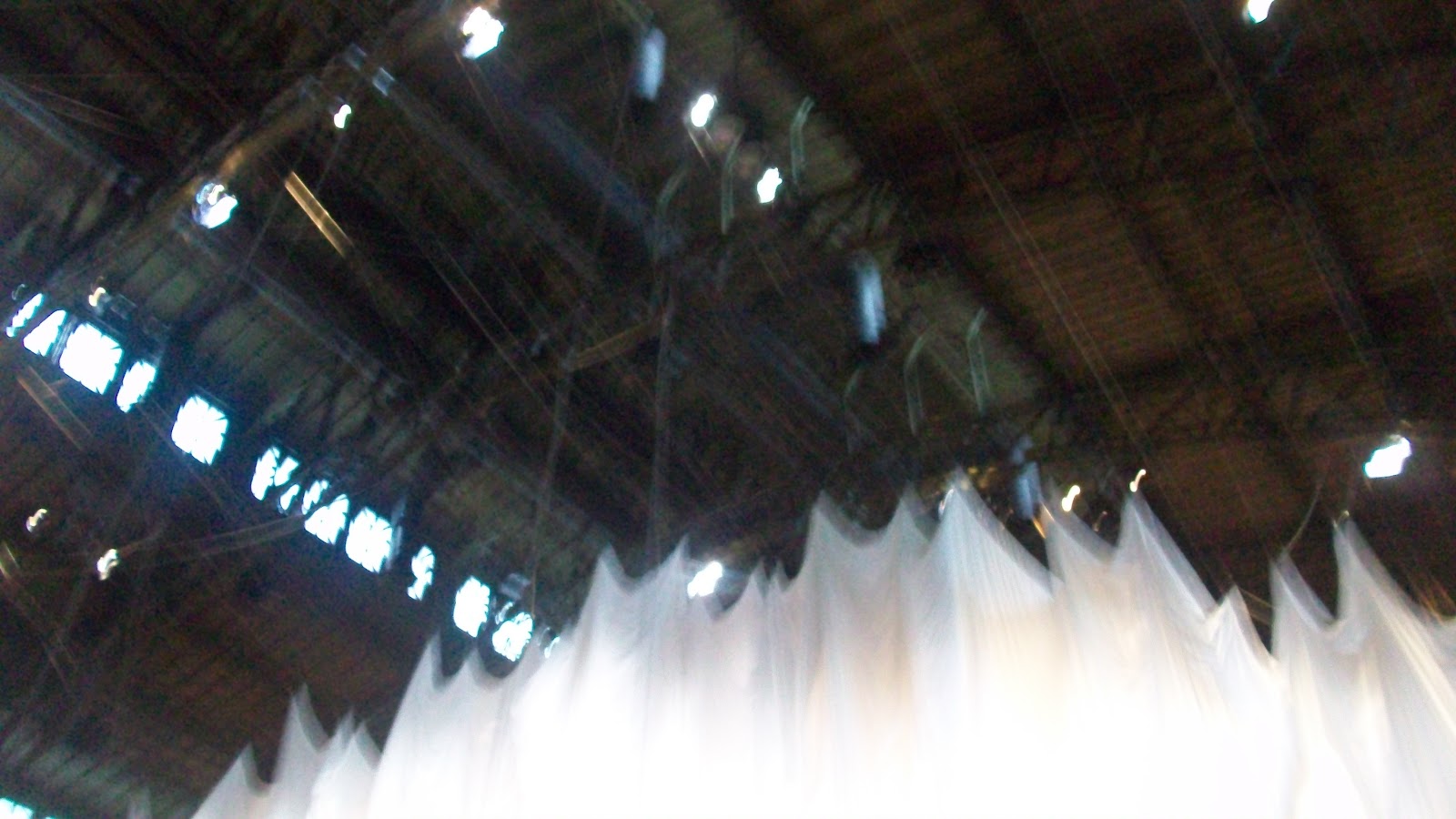
    Ann Hamilton’s The Event of A thread is commissioned by the Park Avenue Armory in New York City. The work communicates with the building’s architecture, and proposes individual encounters and congregational gatherings. Entering the Armory, I’m amazed by the space itself. The white fabric looks inviting, and the lighting design really emphasizes the beautiful floor. What I personally do not like, are the carrier pigeons in the cages.


    Then there are paper bags, which are passed around randomly. These bags are talking to us. 

    I get to hold a paper bag. All it talks to me is very refined. The tone of the voice is calming. The voice talks about desire, but it is the spiritual desire that encores light. The threads that connect to the fabric from the swings, and the fabric itself create the airy feeling of the space. I want to lie down. I want to get in touch with the magnificent floor. Is the white fabric like the cloud of the digitalized age? Our shared consciousness, which is now transformed by individual threads that are anti- modern. Or are they the same as the virtual world? While listening to the paper bag, I connect the story to the philosophy of Gilles Deleuze, whose concept of the virtual now starts occupying my thoughts.  


    The paper bags with recorded voices are the ‘impersonalized spirits’ talking in the space. The bag I hold becomes the intimate link between the abstract and the embodied. Next, I get on a swing, and let it move me through the space. Its movements become time. Perhaps this space makes us visit the concept of the non-technological of our lives, like the play and flow would be. Trying to be outside the industrial nonsense. I try to let my body feel the space. We are like in a rock concert, trusting each other collectively, letting ourselves experiment this play together. A collective play.

    I have a problem with the pigeons, what are those weird birds in their cages? Are they confirmations of the past, the architectural plans, messages carried in-between? They are silent and obedient, so we observe them.  They are on the table right next to the  ‘ceremonial masters’ who are sitting on their chairs, looking at their dry papers and uttering almost silently. The readers are performing a performance, where the birds are their backdrop, an element to show the human mind. The birds are the messengers waiting for a task to deliver a letter across, a message of a carrier

     We, their audience are worshipers of the mechanics. What is a better place to show it off than in this hall, which is not empty at all. If we thought it was empty, we would claim that false in an instant. The windows themselves, the interior of the hall, and the exterior daylight or nightlight intruding and coloring the space is in a constant motion. Now the light paths are carving the space underneath, front and back of the swings.  


    We consider our world as virtual, and this event becomes one like it. My suggestion is that do not try to make your visit only a communal. The white cloud fabric is making a point to be there, to breathe with it, and allow it to stop you or change the patterns of your movements.

    I take the stairs up to the balcony. This itself gives me a different meaning, the perspective of randomness of this event. The experience is structured for us to play, and the play has a spiritual or metaphysical dimension. According to the paper bag, it connects us to desire. Desire for life? Movements of the ocean, clouds, vehicles, eternity, the movement of the cells of our bodies?


    5b0fd-linnut