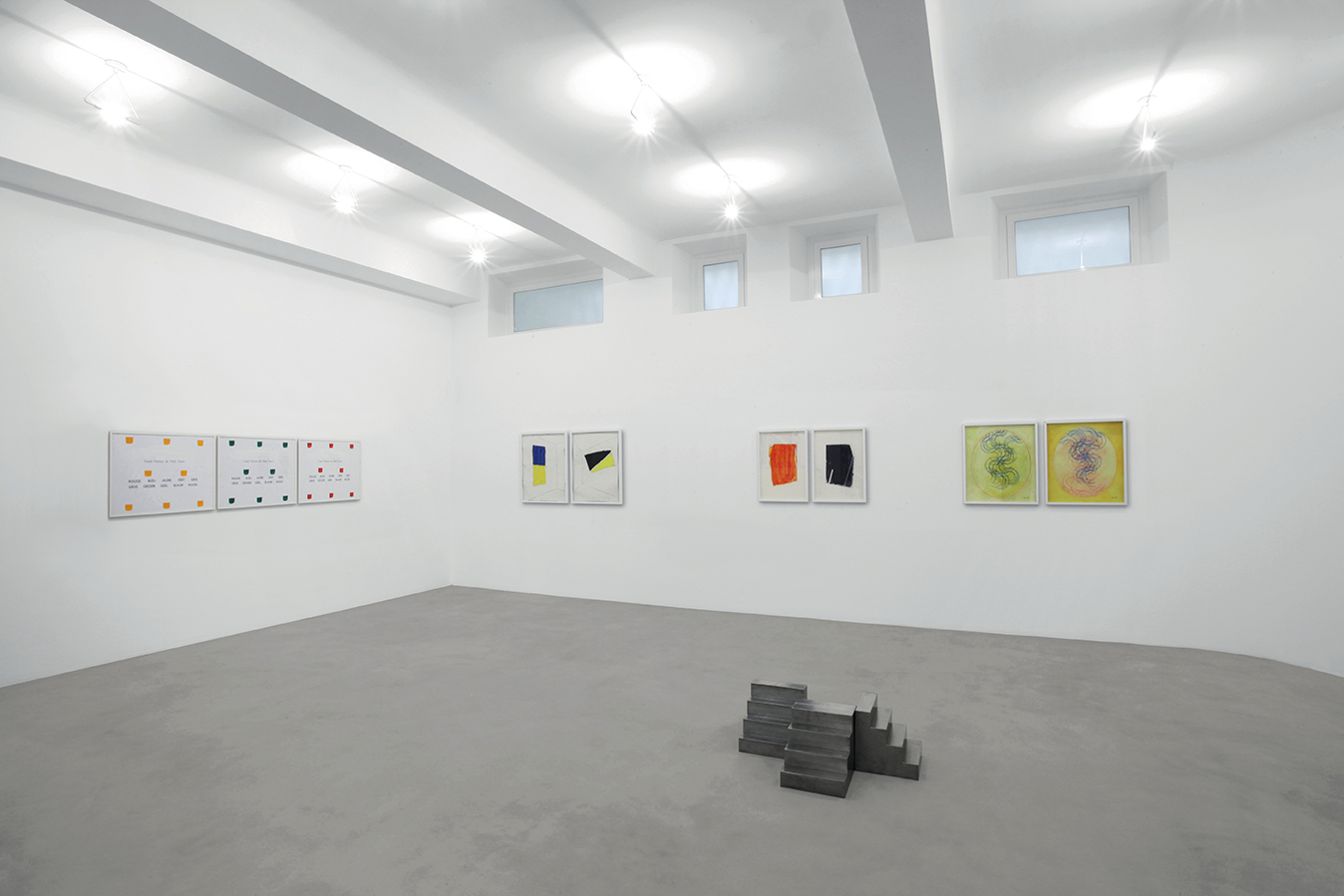
Milanese gallery will run their current exhibition SUL MARGINE, ON THE EDGE, until February 24th, 2021
“After the exhibition Close Up in 2016, which examined aspects of closeness and intimacy of vision, the meditations on small-format works continues here, highlighting another crucial aspect, which is that of their extreme, liminal intensity and bodily materiality.
SulMargine/OntheEdge -exhibition, offers a possibility to experience the art works as an intimate and proximate event, which pushes the viewer to the very limits of our tactile world. While examining the shape and color, light and dark shades, we get to reconsider, what are the boundaries of our conscious world, and how our knowledge can go beyond the every day perception.
The timespan of the presented, Italian and international artists, creates a great sense of wonder. A continuation, a thread between generation of artists. View that does not limit art work only into its material box, but offers it as a habitual dwelling, a tangible sense of the movement, and transformation, showing an image of art as a living body. Curated exhibition with juxtaposed ideas, where living artists enter into the realm of works created by artists who are no longer in this world.
Discussion about the terms of the art work in a realm of meaning beyond material form, is not new. Dadamaino, a Milanese painter exploring spatio-temporal approach to painting, was a pioneer in the avant-garde of 1950s. She was looking for the immaterial, when her ‘holes’ were detesting matter. And like with some other pioneers of avant-garde, measured the intervals and pauses of time in the context of art.
We can say that the catastrophic effect of the World War II, was creating a void, having power to influence both the avant-garde of art and theory. Perhaps now, in 2020- 2021, the historic moment of the global pandemic creates a reiteration of the question of a similar void. In the art-world, it affected change, shattering meaning of the physical space and the virtual world. The COVID-19 restrictions, social distancing protocols, safety measures; have all demanded different applications for contact, and applauded new exhibition modes.
In the new “reality”, or very present, we can echo historic references and find similarities between the two. The patterns of “now” are recreated with more of what is sensed and sentient. The pioneering works can take us to a liminal treshold, on the borderline between here and there, the time of past and now. In both cases, it is the experienced and the unknown. When facing the global pandemic, we still see the limits of our understanding, questioning our very existence and being. What comes, when we die.
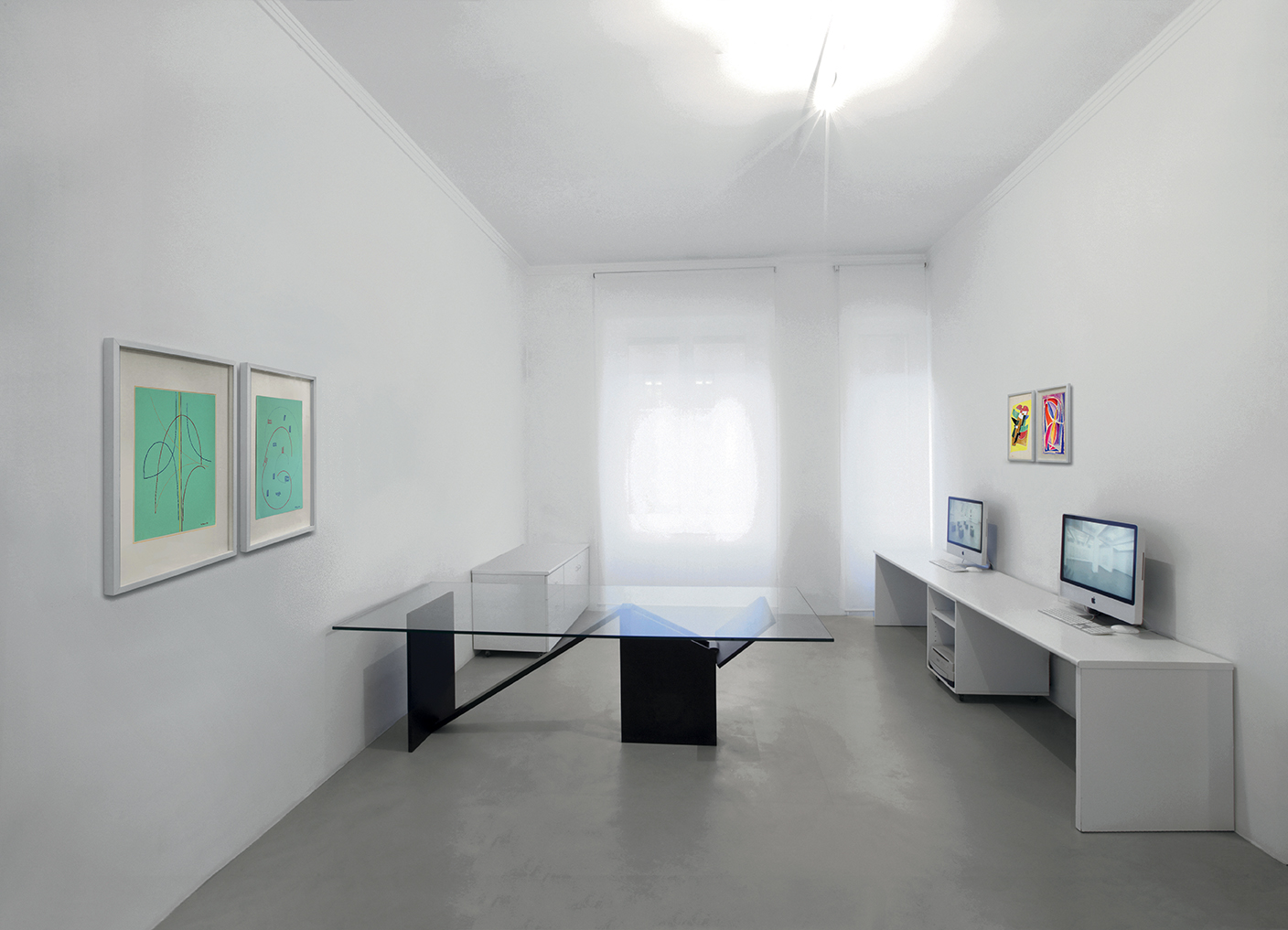
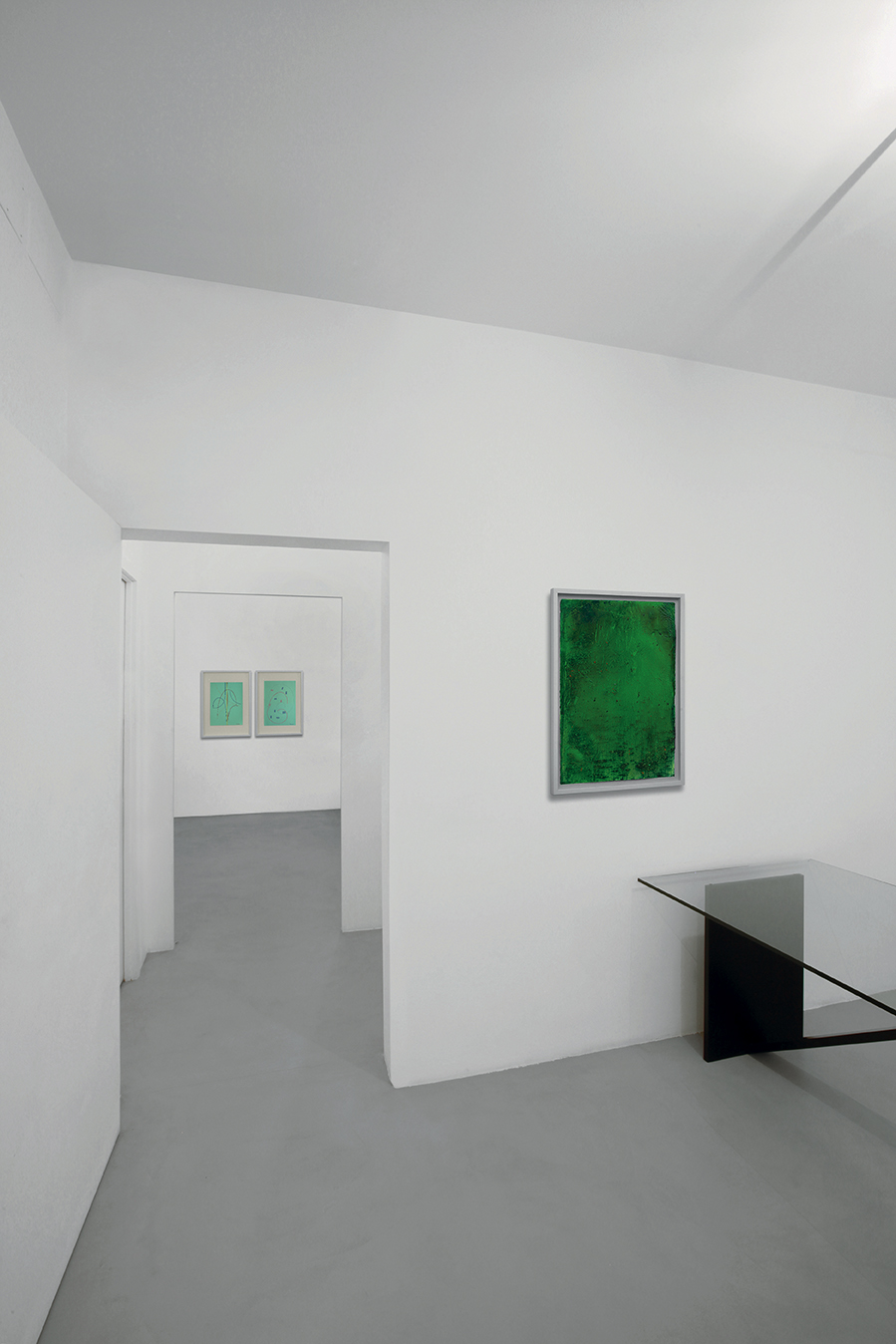
Partial views of the exhibition On the Edge. Courtesy A arte Invernizzi, Milan. Photos: Bruno Bani, Milan.
We thus find ourselves in the midst of these images, which are like places of the mind: a constellation of metaphysical entities on the ridge that separates life from death, the striving for knowledge from a truth of an unattainable absolute that, on the threshold of existence, allows us to perceive the correspondence between the individual and the cosmos.” (Francesca Pola)
Featured yellow image: Carlo Ciussi, Untitled 1989. Mixed media on paper, 70×60 cm/ Courtesy A arte Invernizzi, Milan. Photo Mattia Mognetti, Milan.
— — — — — A bilingual catalogue of the exhibition has been published with an introductory text by Francesca Pola, contributions from Giuseppe Cristian Bonanomi, Angela Faravelli, Daria Ghirardini and Davide Mogetta, with reproductions of the works on display.
EXHIBITED ARTISTS: RODOLFO ARICÒ, GIANNI ASDRUBALI, FRANCESCO CANDELORO, NICOLA CARRINO, ALAN CHARLTON, CARLO CIUSSI, GIANNI COLOMBO, DADAMAINO, PHILIPPE DECRAUZAT, RICCARDO DE MARCHI, PIERO DORAZIO, LESLEY FOXCROFT, IGINO LEGNAGHI, FRANÇOIS MORELLET, MARIO NIGRO, PINO PINELLI, BRUNO QUERCI, ULRICH RÜCKRIEM, ANGELO SAVELLI, SALVATORE SCARPITTA, NELIO SONEGO, MAURO STACCIOLI, NIELE TORONI, DAVID TREMLETT, GÜNTER UMBERG, GRAZIA VARISCO, ELISABETH VARY, MICHEL VERJUX, RUDI WACH
Almost thought, that I wouldn’t visit The Armory Show, which took place in the first week of March. The art fair’s tiredless self-promotion worked, however, and the show on Piers 92 and 94 didn’t disappoint. Next time, The Armory will move to a new location, providing also different dates. New York’s Javits Center will host the show in September 2021.
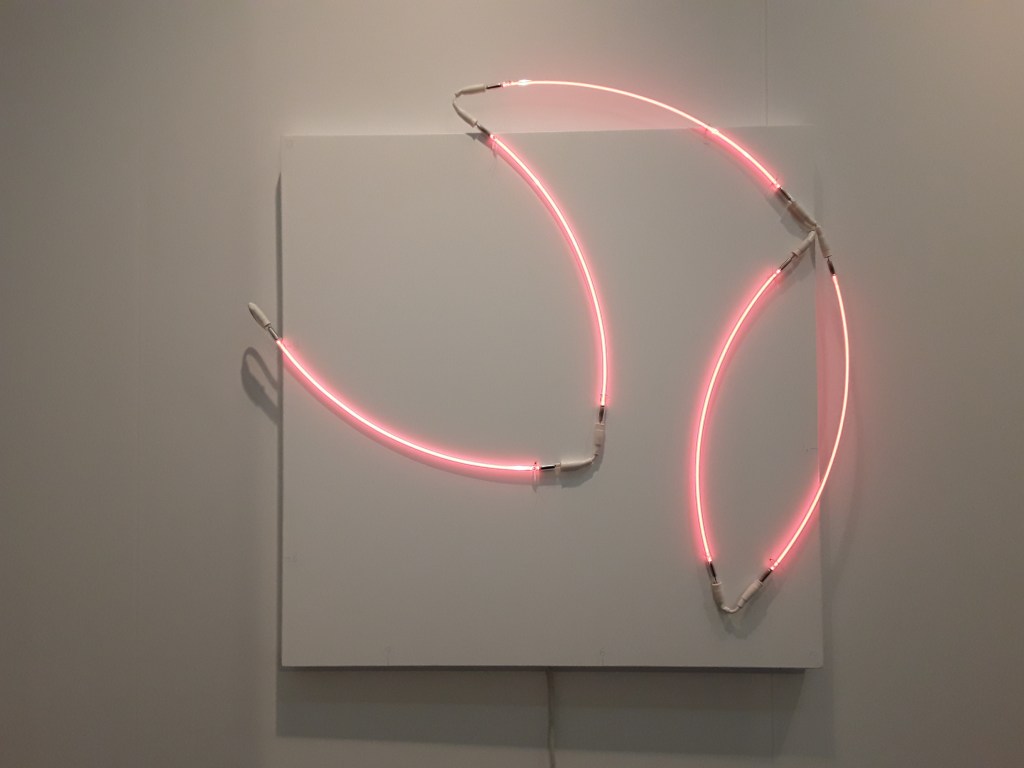
Exhibitions of delicate, poetic, musical, and folding works, that create beauty in a world full of turmoils, took a center stage. One could pick the art with rose colored glasses. The Women’s History Month approved to be relevant. I immediately fell in love with Francois Morellet’s red neon work “Contorsions” (2007), at a Milanese gallery A Arte Invernizzi’s beautiful and minimalist booth.
Shahzia Sikander, Double Sight, 2018, glass mosaic with patinated brass frame mosaic. Sean Kelly, NY.
Shahzia Sikander’s“Double Sight” (2018), is a mosaic work that draws from classical miniature painting traditions of Indo-Persian origins. The Pakistani-born international artist has experimented with the medium, and employs multiple perspectives to her works, including those of South Asian, American, Feminist and Muslim. The topics the artist explores are globalisation, languages, trade, empire, and migration.
Kim Jones, Untitled, 2003-2009, acrylic and ink on colour photograph. Zeno x Gallery, Antwerp.
Artist Kim Jones’photograph has texture. In the one above, the hair is covering a face, while his other works on display were installations made out of wigs. The life of an artist includes time spent in Vietnam War, making his world appear as creating asymmetry, or holding a point of view that is more hidden.
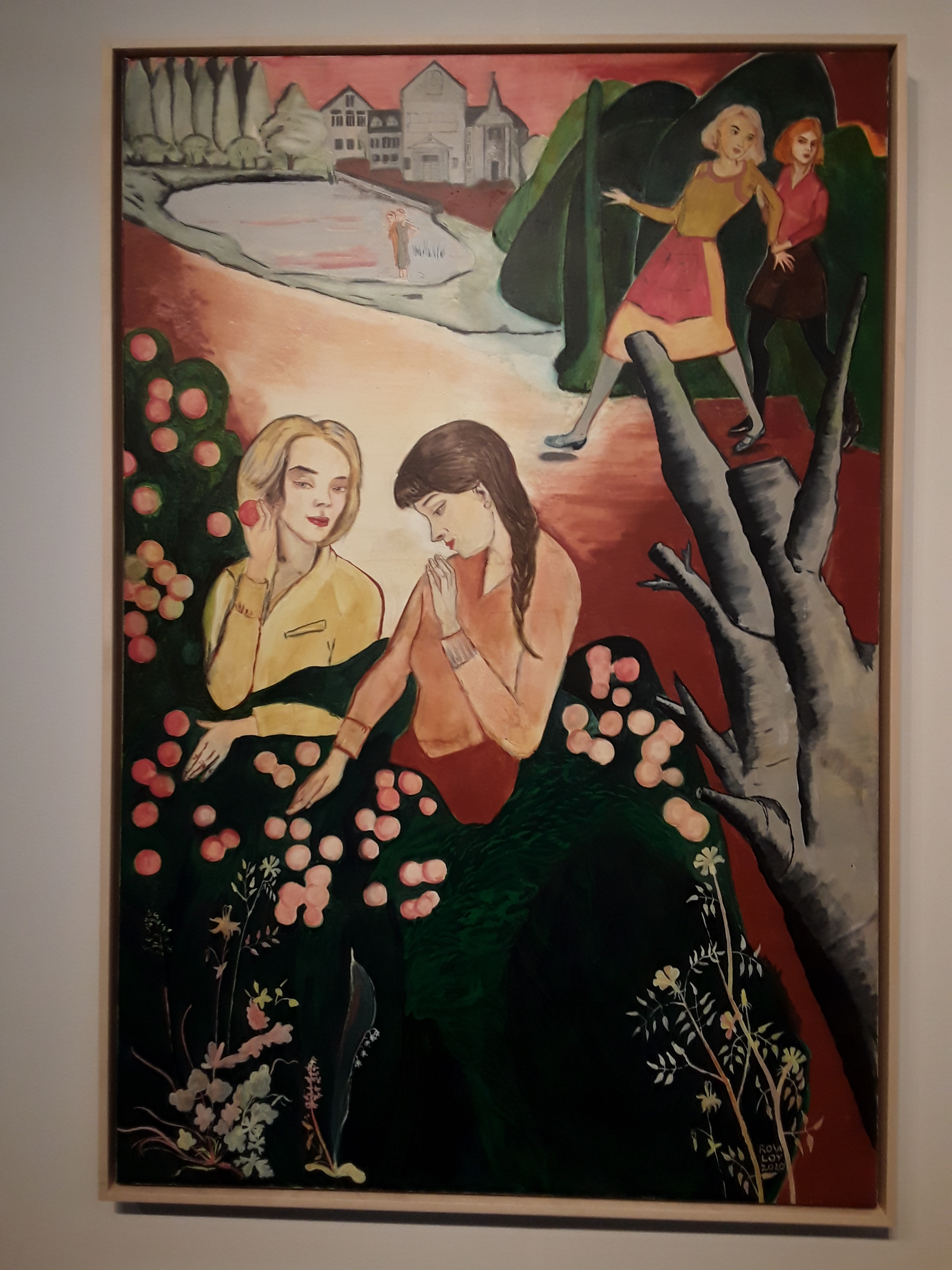
Rosa Loy’s painting, on the other hand, creates different magic with narratives, in which unknown looms in the air. The Leipzig-based painter makes compositions, in which women perform in seemingly weird and ritual-like settings.
Rosa Loy, Tu das nicht, 2020, Casein on canvas. Kohn Gallery, LA.
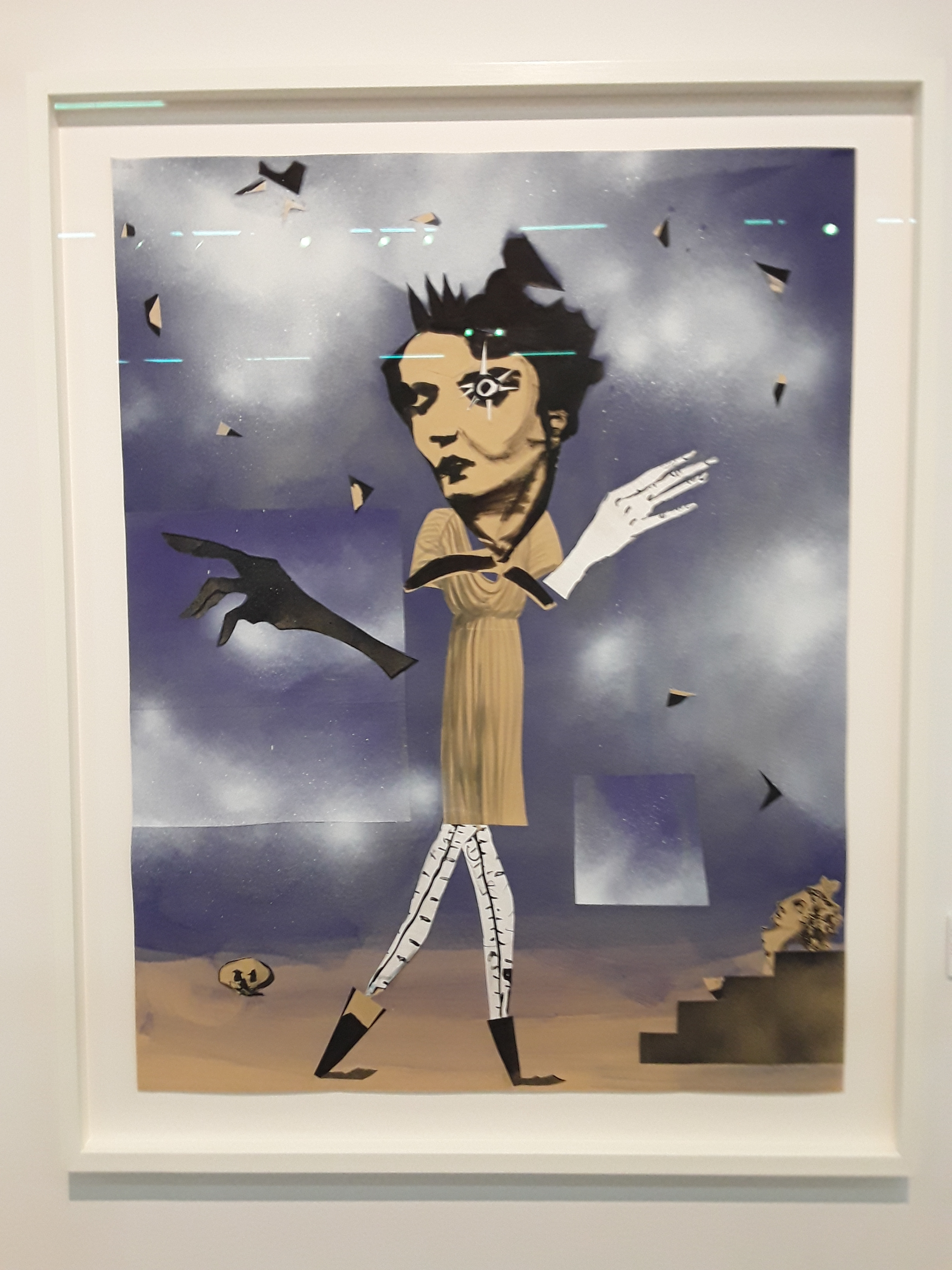
Moyna Flannigan’s new works include paintings and collages. They draw from art history, mythology, and popular culture to explore issues in the contemporary society. She is interested in the representation of women in art. The figures in her works, have ambiguity in mind. The dark tones are discovered with humor and irony. She is at The Armory with the Ingleby Gallery from Edinburgh.
Moyna Flannigan, Tear 52, 2019, ink, gouache, spray paint and collage on paper. Ingleby Gallery, Edinburgh, UK.
These artworks remind us of the fact that the life is in a state of suspension. The everyday life feels more as if we face it in a raw spacetime continuum.
Rina Banerjee’srecent sculptures are part of her concept of ‘irresistible earth’, that can be described as something uncontrollable and unconditional. In it, our senses play a central role in a process of figuring out, what is right and what is wrong in the migrating destinies of our lives. Banerjee is an Indian artist who lives in New York City, and is represented by GalerieNathalie Obadia in Europe. Of her new sculptural work, she writes poetically.
“Fastened to two walking sticks and lopsided imagined she in a world without opponents, unburdened by squabble and masonary bricks, she a prop propped up man from man not capable of understanding the parts that ripped and torn like partition, camps, detention pockets and passport tangles bottled black glory and tangerine blossom.” (Rina Banerjee, 2020)
Nancy Wilson-Pajic, Falling Angels, 1996, unique cyanotype photogram. Robert Koch Gallery, SF.
For the Women’s History Month, Nancy Wilson-Pajic’sfeminist cyanotype photogram recalls the time, in which women artists were not accepted to the canon of the art world. Therefore, the radical expression of her art developed into significant styles that she became known for. Her multidisciplinary art was aiming, “to create mental spaces within which creative reflection may take place.”
These artworks remind us of the fact that the life is in a state of suspension. The everyday life feels more as if we face it in a raw spacetime continuum.
Finnish artist Sirkku Ketola had her performance project A Body Called Paula at the NARS Foundation Gallery in Brooklyn in November. In Finnish the word paula means a ribbon, something to tie or to be enchanted with. It is also a synonym for a trap. Globally Paula is known as a female name, originating from the Greek word ‘Paulus’, which means small.
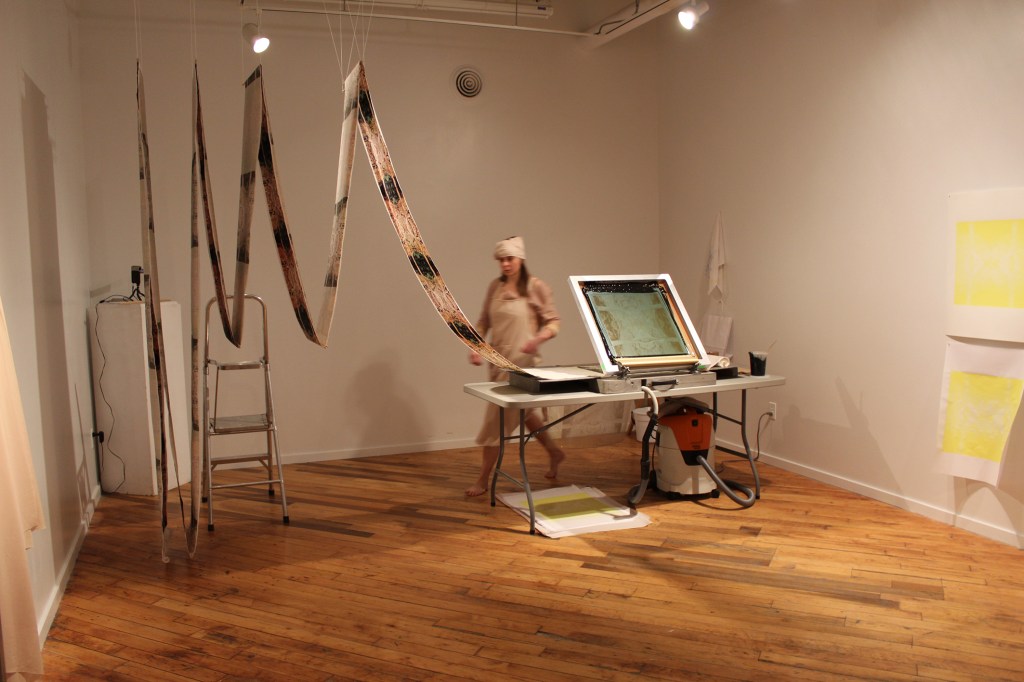
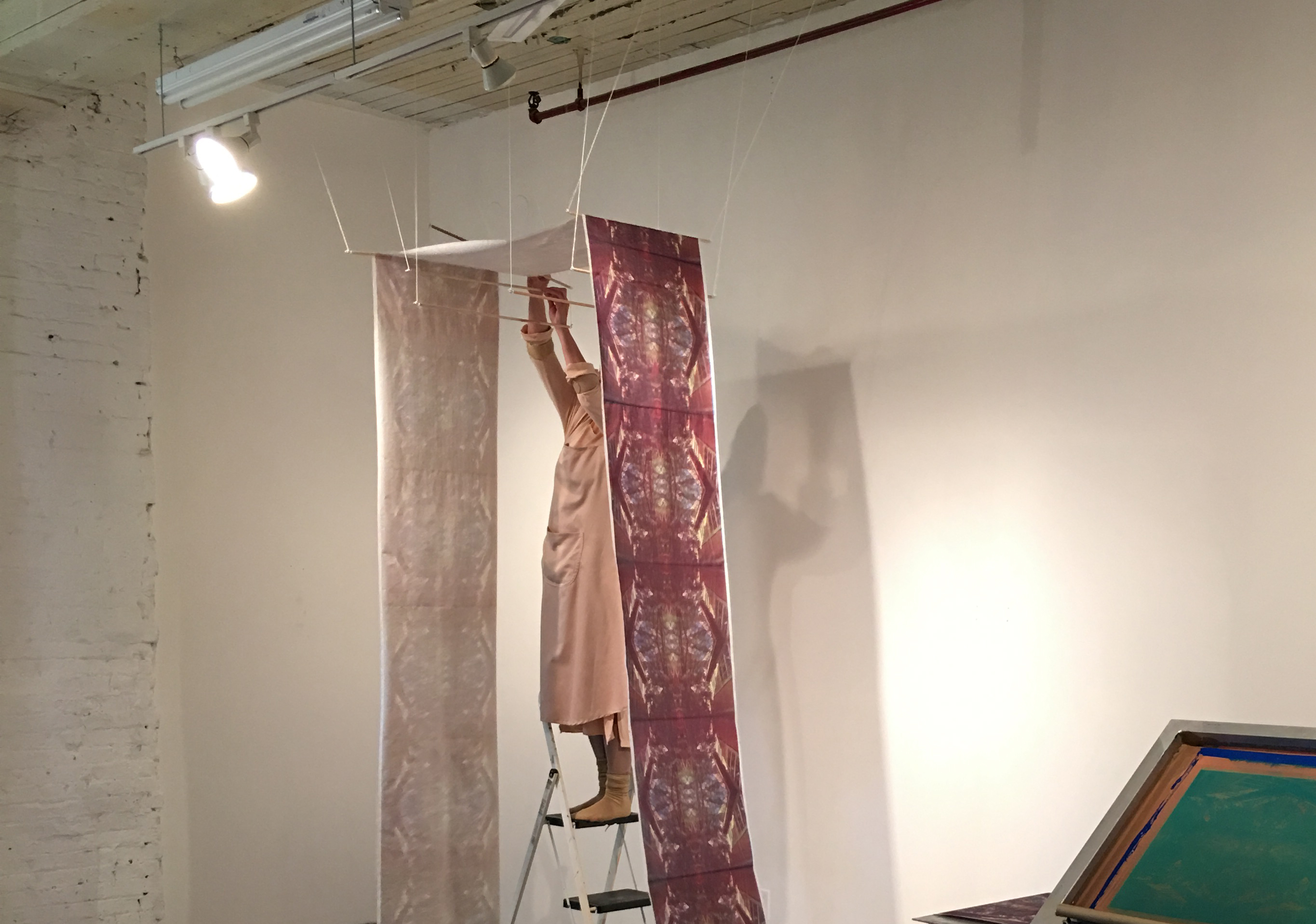
In her current project of ten years, Ketola creates an installation that mixes screenprinting with performance. Part installation, part performance, A Body Called Paula is a piece that develops over the days of the installation through long-duration printing sessions. The movements and their soundtrack create an enchanting, sensual machine with the main themes of time and temporality, pleasure, and the meditative process of working.
The narrative story behind the performance hunts beauty through the themes of light, passion, knowledge, reality, and depth, finally balanced out by darkness. What is the measure of time? Ornament is a universal form of visual art in every culture. The installation at NARS is part of Sirkku Ketola’s long-term project. For the duration of ten years ‘A Body Called Paula’ produces hand printed ornaments, or ribbons.
Paula prints by Sirkku Ketola.
Firstindigo&Lifestyle: What comes to mind, when you think about your project Paula is that it is so clearly beyond the visual practice, or enhances the physicality of the practice. What is so intriguing is how you dive into the embodiment and stretching of the paper. Is it that the body becomes a continuation of the paper in the printing process, as if being one with the paper? What kind of metaphors would you like to highlight, or are being evoked in the process?
Sirkku Ketola: I guess I need touchable material to support thinking and understanding. In this case the handling of color and paper together with challenging technical crafting, tune us as one organism, where the tempo is being set in the cohesion of the qualities of the all included matters. The strength of the body, the sensitivity of the hands and the exactness of the eyes, are sensing constantly the fragility, stretching, moistening and drying of the paper, and the consistency and volume of the ink. The local, or should I say site-specific humidity and temperature effect strongly to the functioning of this paper/colour/body formed sensual machine. Also the instant substance of the body, the general vitality, the emotional ambiance, and for example the daytime, give all some special marks, first to the performance, and second to the visual appearance of the ribbon in progress. Imprint is different during mornings and evenings, also in the beginnings and the ends of the ribbons. I have chosen the long and fragile paper to be forced to lose control. The process is too tiring to hold on it. During the series of the performance the same paper roll goes by my hands 12 times so it is impossible to dominate the quality or the crossing effects of different layers. I just must be humble, and let the ribbon teach me. Maybe the greatest thing is that the ribbons still surprise me even though I’ve been working with the same materials for years. The major errors have been avoided, but the danger of errors are constantly present – everything can be irreversibly spoiled even in the last round of printing.
Sirkku Ketola performing Paula in Cable Factory, Helsinki, August 2017.
Sirkku Ketola: The ornament arises on paper in stages from light to darkness. The colours (yellow/magenta/cyan/black), except being common from every home printer symbolize light, passion, knowledge, reality, depth and darkness. Step by step these colour layers, as named the elements of beauty, while mixing and uniting approach the truth, the code of life or would I say the mystery.
The hand printed ornament reminds somehow of the DNA. Basically with the repetition of same patterns, the motif is being affected continuously by the changes of the circumstances. All the variations show together endless amount of visual possibilities and diversity. At the same moment the so-called mistakes come part of the entirety and open up routes for the new beginnings.
Today we talk a lot about unmaterialized art, light and it’s different digitalized reflections. I am blown away by it also, the transfer of energy from one equipment to another accomplishes wonderful outcomes. In my own work process the need of touch, the acception of the tardiness of the body as the part of the thinking self, in other words handling with hands, have so far helped me to the deeper knowledge. I choose to cherish this special bodily tempo – it might be good for human species. When one forces oneself to stop by the slow repetition, one might also have time to understand something essential.
Sirkku Ketola performing Paula in Helsinki, August 2017.
Sirkku Ketola: To be able to do the metamorphosis to become a sensual machine I had to create a role. My character Paula is simultaneously enraptured and trapped (in Finnish there is a sentence with both meanings, derived from the word ‘paula’ which also is a ribbon). She is a metaphor of a small human in cosmos. The name Paula comes originally from the Greek name Paulus which means small. So my Paula works with paula, with her special ribbon. Her job is to communicate visually by printing this repeating and overwhelmingly beautiful ornament. She wanders globally and communicates of the seen beauty. The previous place sets the next pattern, for example the New York effects to Paula will be seen next spring in Helsinki, Finland.
The machine is slow and time bending. It is a factory that is able to work without problems approximately four times per year. The doctor’s order has set the limit. I forget the rules always in the beginning of the new project, but now, when the Brooklyn ribbon has been finished, the pain in my hands is there and that makes calming down easy. By respecting this manual of the project, it will be possible to enjoy after ten years from now about the yet unknown massive installation, which is made of these forty different and international printed ornament ribbons.
I feel extremely privileged to be able to define the speed of the assembly line. For that reason the pleasure is an important part of the performance. Paula enjoys her movements and the choreography set by the printing process. The ink flows and the paper glides with the hands accepting to follow the weight of the body. The touch varies from strong to gentle and the rhythm beats with the working steps. The birth of the image feeds the will to come along to the anonymous destination. The possibility for sudden challenges forces the printer into the extreme concentration and to overcome difficulties and accept the errors. With the physicality, the mental part is also reacting all the time to the present. The chosen repetition grows thinking and developes strong pleasure.
Sirkku Ketola: Feedback, 2016. Handprinted silkscreen on wood. 81 x 105 cm. Process picture.
Firsindindigo&Lifestyle: How do you prepare for the performance of this scale, which is almost a marathon? What is the preparatory phase like, and what happens during the performance aftermath?
Sirkku Ketola: During the performing period I take specially good care of myself. I try to do the outdoor activities daily, sleep enough and eat healthier. I try also to avoid the evening happenings and alcohol. The preparation for the performance takes mentally the whole day, but the most intense are the two hours before the show. The soundtrack of the performance follows me since morning. I’d like to highlight, the sound scape of my music and the noise of the printing table are essential elements of the performance. When arriving to the show space I tend to eat lightly and drink a lot of water. After it is time to check all the technical equipments and to mix the printing inks, the hue and the saturation needs to be done carefully. I have a special ritual order to do this. After this, I isolate myself, warm up and slowly become my transformation to the role. Thirty minutes before the show it is time to change the costume and become Paula. She doesn’t speak. The aftermath of the show is quick, washing the make up and changing the clothes are rapid, so I’m soon ready to communicate with the world again as myself. Before leaving I clean the colours and check all the technical details for the next day. When arriving home I stretch well and take a warm shower, except in Finland my choice is sauna.
Ketola performing at the NARS Foundation in New York, November 2017.
Firstindigo&Lifestyle: How is New York as a place different, and this performance venue special, in terms of what is their impact on the quality and outcome of the work? How is the location different from the rest, say, Canada or Finland where you also created this performance piece?
Sirkku Ketola: The place impacts mainly how the performance is being installed. I like different spaces because they challenge the art work and keep it impossible to predict. The space in NARS in Sunset Park in Brooklyn is many ways special. First, it is near the Finntown, where there was a strong community of Finnish emigrants. During today’s new emigrations flow it felt important to mark the difficult roots of my own country. Second, the size of the gallery was perfect for the project. It fit there well, both visually and functionally. Third, the space is in the building, which is full of working artists, situated in the middle of the industrial Brooklyn. Where else should the sensual machine be? I came to New York as a visiting artist-in-residence of Finnish Cultural Institute for two months. My main goal was to research the structures of the money and power in the contemporary art scene. Beyond A Body Called Paula –project I started to sketch the new large-scale print installation referring to this research theme. The work will be produced during next three years. My colleagues in Brooklyn taught me a lot about independent artists’ living at the capital of contemporary art (NYC).
Paula performance, NARS Foundation in New York, November 2017.
The physical dimensions and the quality of the NARS space gave the rhythm for the installation when growing during the performances. The intimate gallery of the Sunset Park made possible to the paper ribbon to take a shape of a visually fine zig zag when it landed to dry to the perches I mounted. Also the rest of the visual elements of the performance found their places to create a dynamic composition. There was space for Paula to move and the audience was able to have several standpoints. The space was also photogenic with A Body Called Paula – and that’s important in our social media time.
This was the fourth time and the fourth place for Paula. In Toronto it was seen in a gallery with the long hallway. There the magic of Paula worked like in the story of the Pied Piper, when people saw the action from far, they just had to reach to the space. In Helsinki Paula measured the huge hall in Cable Factory during the five hours marathon performance. And in Turku, Finland she worked behind the lightened window in the darkness of the first autumn evenings by the riverside. And in Brooklyn she captured the industrial space around the other artists. I believe that during the next ten years, Paula can capture many different structures and spaces as rich as she has done in her first year of the process. The big scale quality will be seen in the end of the whole process. All in all, these places are valuable treasures for me, and will affect the final installation.
— — —
Next time A Body Called Paula will be seen in Helsinki in March 2018. After that Sirkku Ketola travels mostly in Central Europe. She will be back in New York City during autumn 2019.
— — —
The screenprints made in New York have been prepared at the Robert Blackburn Printmaking Workshop: http://www.efanyc.org
More information:









 Firstindigo&Lifestyle