Category: interviews

  • Teresa Dunn’s Event Horizon at First Street Gallery

    Teresa Dunn’s Event Horizon at First Street Gallery

    Teresa Dunn is a Michigan-based artist whose narrative paintings on panel explore worlds with texture and complexity. Her recent paintings, now on view at First Street Gallery in New York City, are full of figures who are confronting points of no return. The strong exhibition title Event Horizon displays works full of ‘tightrope walkers’, burning boats, exposed flesh and rising waters; all this as if the settings create dreamlike atmospheres.

    This slideshow requires JavaScript.

    The narratives put the characters and their motivations in tests when they look into the incongruous landscapes around them. The works are full of story, where mothers and fathers, animals and children, friends and strangers interact in tightly woven communities. The paintings depict absurdity and metaphorical allusions. Together the works link into each other, and so rearrange the reality in a new order. As the artist states:

    Peculiar reality becomes normal, as in dreams or memory. Amidst bizarre sequences of events, dreams are believable when we are immersed in them. Memories distort, dissolve, and rearrange themselves until we are unable to discern fact from invention.

    Dunn’s paintings seem to connect to a stronger sense of reality than what would perhaps be without the symbolic hindrance and delay. Her tactics of ’disconnect in perception’ shows the underlying ideas telling about identity and interaction. ’’Seasons, relationships, jobs, and cities attempt to define us. Peculiar occurrences, symbolism, and metaphor tie together some loose ends and fray others.’’ (Teresa Dunn).

    FIRSTINDIGO&LIFESTYLE: Your new exhibition Event Horizon is now on view in New York’s City and has gained attention. How would you describe the gallery?

    TERESA DUNN: I appreciate that First Street Gallery has given me the opportunity to show my work in New York. Being a resident of the Midwest it is more difficult to put my work into the world. Being in a community of supportive artists in a major art center is critical to keeping me in the conversation.

    Your works narrate multiple events which perhaps relate to natural disasters, as the burning boats, floods or risen water show. What does this vision mean to you?

    TD: The element of natural disaster is new in my work just appearing in this body of paintings. I am interested in the combination of the fire and the water events because the characters in my narratives seem to have to choose between two negatives–fire or water; precarious balance on the tightrope or falling to an unknown abyss; frigid wintery environment or blazing car fire. But not all of the people fear about the disasters some look with awe or indifference. Is the flaming horizon reddish from the setting sun or from a fiery disaster just out of sight? It is the ambiguity that life presents us that both makes it invigorating and terrifying.

    In one of the works there is in fact this chilly atmosphere, with two people, perhaps a couple, and the face in the background has a scull written on it. What kinds of representation do you relate to this particular image (titled: Because I could not stop for Death)?

    TD: In the painting to which you refer with the winter environment and the skull “Because I could not stop for Death” the title is borrowed from an Edna St. Vincent Millay poem. In this painting there are elements of my Mexican background from my mother’s side. In Mexico, images of skulls, death, and skeletons are traditionally not representative of an existential anxiety in they way we see them in American culture. Instead the skull represents the tie between those who come before and those who come after. I like presenting the seasonal metaphor of death as dormancy alongside the skeletons and the chicken protecting its egg in anticipation of the season turning to spring. The painting talks about life as cyclical as opposed to being simply linear. In fact all of the narratives intend to provide a non-linear approach to story telling in format and/or content.

    How did you become a storyteller, it is fascinating, also because we don’t that often see contemporary artists really entangle themselves into stories that much. What do you wish to say about it?

    TD: I have always been interested in story telling and from childhood drew pictures of people in unusual environments with dramatic events occurring. I enjoy observing life as it unfolds and am very compelled by people’s personal stories. My love of the story also carries into literature and film. In many ways I see the cinema as having the closest relationship to my work in the way that it deals with narrative in terms of time, space, and content. This is why I am currently drawn to more cinematic horizontal canvases. The Italian Renaissance is a huge influence on my work as well with the story being a critical part of image interpretation–in additional this period of paintings deals with time and space in a way that I find addresses a more circular or non-linear perspective in story telling. Where it is through multi-panel works; recurring characters; strange use of scale, space, or color, and complex composing.

    How about a conflict between nature and culture, between humans and their living habitats? Our future with environment, and climate change problem are timely topics now and so is a question how we as people face them; does this resonate to what you do?

    TD: My work is less directly about the current environmental problems we as a society face. Although they do present a very relevant and accessible metaphor to be interpreted in ways that are meaningful to the viewer.  In the conflict you suggest between humans, nature, environment, and culture these are exciting analogies to be used to deal with the way in which we interact with our communities, ourselves, and our trials and tribulations.

    Tell in few words how do you work as an artist, and balance between your university-teaching and painting?

    TD: Regarding teaching and painting: Painting always must come first. Understanding the issues at hand in my field feeds my teaching in the same way that I view life experience as feeding my artwork. It is a bit more difficult these days being a mother to a 2 year old to balance the three-painting, family, and teaching. However I am fortunate to teach at Michigan State University, an institution that highly values my creative research. This body of work was created during a sabbatical leave in the first half of 2014 and I currently have a research leave funded through a university grant which is allowing me to further probe these new ideas.
    Teresa Dunn’s Event Horizon is on view until October 4, 2014 at First Street Gallery – 526 West 26th Street, Suite 209, Hours: Tuesday-Saturday, 11 am-6 pm.

    See the artist website: www.teresadunnpaintings.com


  • Artist spotlight: Hiroaki Umeda discusses his recent works

    Artist spotlight: Hiroaki Umeda discusses his recent works

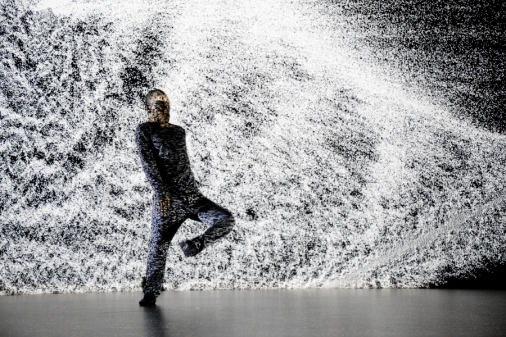
    Japanese contemporary choreographer Hiroaki Umeda recently presented his new choreography Peripheral Stream with L.A. Dance Project at Théâtre du Châtelet in Paris. in 2013, he worked with an ensemble of 11 dancers from GöteborgsOperans Danskompani in Sweden. In the piece, Interfacial Scale, Umeda created the choreography, set, costume, light and sound design. As well as being a choreographer and dancer, Umeda is a visual artist, photographer and video artist. He established his own company S20 in 2000. Umeda has entered the international scene with his multimedia performance works that employ his own body and self-created video images, music and lighting designs. These are recorded on a single notebook computer.

    (On the video Hiroaki Umeda talks about the Interfacial Scale which he created for the GöteborgsOperans Danskompani in Sweden in 2013)

    Since he first drew attention at the 2002 Yokohama Dance Collection R, Umeda has gone on to win praise of dance professionals around the world for the way he wraps his improvisational body movement in intricately woven spaces defined by light (video) and music with the beauty of an art installation. (Tatsuro Ishii for 国際交流基金 / The Japan Foundation Performing Arts Network)

    FIRSTINDIGO&LIFESTYLE: You are known for your own choreographic language that has influences from different styles, and, from the movement point of view is highly flowing and gestural. Is there a way to trace the evolution of it, how did the movement develop?

    Hiroaki Umeda: I started to dance at the age of 20, which is very late in general. At the beginning, I took some dance classes, such as Ballet, Hip Hop and etc. After a year of taking some dance lessons, I realized that there is no specific “dance style” that I want to learn: the dance I wanted to pursue had in fact not existed yet. Plus, I found that what is interesting for me in dance was, not the style, but what lays beneath those styles which is the “principal of movement.” So I started figuring out and understanding the principal of movement by myself, then I applied that principal to my body movement. I would say that my dance should be addressed not as dance but rather as a movement, since I focus on, again, what lays beneath the system of dance, which is the system of movement.

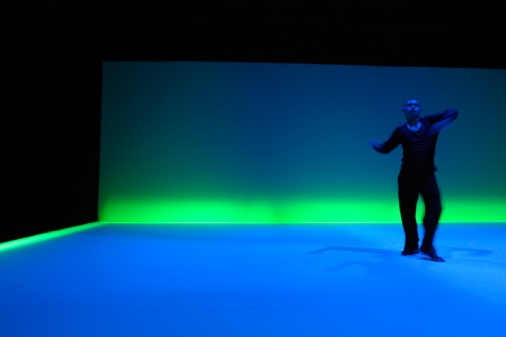
    HIROAKI UMEDA: "Haptic." Photo: Shin Yamagata.
    HIROAKI UMEDA: “Haptic.” Photo: Shin Yamagata.

    You are a Japanese contemporary choreographer, can you describe the dance scene in Japan?

    HU: I have been accepted more abroad than in Japan from the beginning of my career, so I cannot say much on behalf of the Japanese choreographers about what you are asking. However, I personally feel that contemporary dance scene in Japan has not been developed enough yet. The scene is very closed. But on the other hand, it is also true that because of the close-knit circumstances, it has developed very idiosyncratic styles. I cannot say if this close-knit condition is good or not good for the Japanese contemporary dance scene. Anyway, in Japan now, there are so many people who have been struggling and working hard to develop and open-up the scene more; that is a really big hope for me and I thank them a lot.

    You started your artistic career with photography, and then moved towards dance, how did this transition happen?

    HU: I was looking for an art style, which can accept real-time expression, thus, more than photography, I found that dance could be suitable for what I want to express. Dance is an art form in which I can physically put myself into in real time. In photography, on the contrary, it was really hard for me to materialize a piece in real. That is why I shifted to dance from photography. However, I have not totally detached myself from the photographic art form since I have been taking a standpoint throughout that dance can be a form of visual art. Lighting design, which I learned in photography, is now an essential factor for a dance piece.

    The way you construct your choreography seems multidisciplinary. The sound and lighting design, and the visual dimension is crucial in your composition? Can you even differentiate which comes first?

    HU: In practice, I start from abstract drawings, in fact, just lines. This drawing expresses my image of the tension of space, and it functions like the score of the piece to become. According to the drawings, which envision the whole image of the piece, I put together all materials, such as sound, light, dance and etc.

    The visual addition or sometimes ’distortion’ makes your compositions also appear aesthetically ’charged’, could you say something about it?

    HU: In my work, I focus a lot on how the bodily sensation could emerge from the space, and how, in turn, the bodily sensation could change the tension of space. That is, first and foremost, what I am interested in. The basic composition of my piece is always based on choreographing the tension of the space. By acutely tuning into the space, it is possible to attain a lot of stimuli that can provide you with physical sensations.

    What does it culturally mean to be a Japanese choreographer now, from the point of view of globalization?

    HU: have not been working consciously as a “Japanese” choreographer. I have been working as just an artist, focusing on how to bring my pieces to more people all over the world. I think that it is more important to be one of the many artists of the world, than just a Japanese artist.

    Does Butoh as art movement mean anything to you? How about Kabuki, Gutai, and action art? They have also called you ’’avant-garde’’?

    HU: I really appreciate their art works. But actually I am not so close to those Japanese avant-garde cultures. And I cannot tell if they have called me as “avant-garde.”

    What role a nature and technology play in your mind-set?

    HU: Nature and technology are not oppositional concepts for me. As a matter of fact, technology is a tool to understand and approximate nature. By the same token, I think that human beings and art, which human beings create, are a part of nature.

    Where did you grow up? Where do you work these days?

    HU: For the last several years I have been traveling almost all year round. I grew up in Tokyo, and I consider Tokyo as my hometown. But I have been working everywhere in the world. I think that what I do in my art is not connected to any specific country, city or place, so actually I don’t mind working any place in the world.

    You did a work for Gothenburg Dance Company (GöteborgsOperans Danskompani). How was it to work in Sweden, also in terms of cultural exchange? Did dancers like the movement?

    HU: Dancers of the company were from all over the world. They were really skillful and had great intelligence, and were very professional. To start off with, I gave them a system of movement which becomes the under layer of my choreography, and the dancers tried to find their own movements from tapping into that system. I am sure that I enjoyed seeing their movements develop from my system, even more than they enjoyed learning my system. At the moment, I have limited experience as a choreographer for big companies so the dancers helped me a lot and I learned so much from them. I would say that the process was more of collaboration, rather than providing choreography to the dancers.

    In terms of the cultural exchange you are asking, the company was too international to feel any specific cultural differences. I would say that working with them was rather like a kind of universal project, working in various mixed cultures.

    How was it to collaborate in Benjamin Millepied’s LA Dance Project 2? How was the audience response in Paris?

    HU: Compared to LA Dance Project, the Gothenburg Dance Company was strict in terms of working procedures and time schedule precisely because they are a huge public company; I needed to follow their administrative schedule in terms of creative process, which I totally understood. On the contrary, Benjamin’s LA Dance Project is, although they have diverse range or repertoire, still small in scale as a company. For this reason, I could work more closely with the dancers and staff that enabled me to go further and experiment more in the piece. To be very honest, I didn’t expect a good response from audience in the Châtlet. Surprisingly, however, the Paris audience quite openly accepted and appreciated my piece. I was impressed by their open-mindedness.

    Can you name some of your influence or mentors, colleagues?

    HU: There are too many names to list up here.

    What are your plans for the future, and dreams?

    HU: From last year, I have started making choreography devoid of human body. For me, human bodies are not the only elements for choreographic consideration. In fact, I want to really challenge choreographing anything with “movement,” and develop a dance piece with various elements. One of my dreams now is to choreograph water.


  • Fashion Curating: Unsustainability, gender and class readdressed

    Fashion Curating: Unsustainability, gender and class readdressed

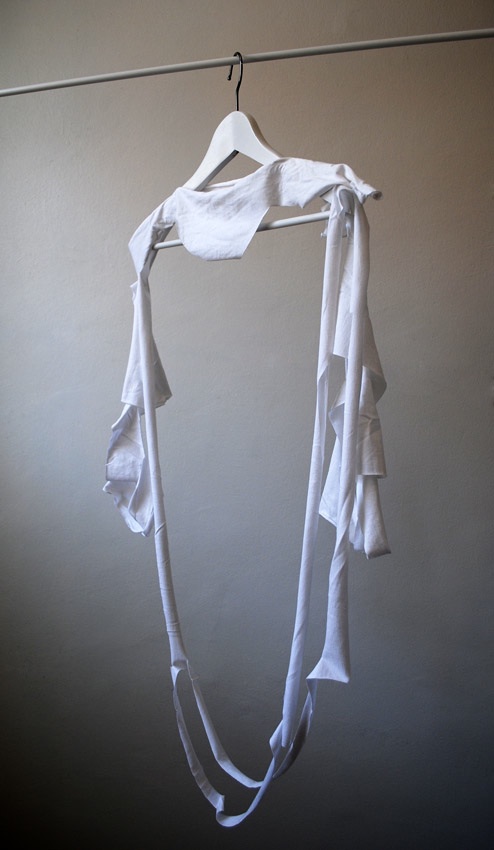
    Fashion Interactions is a multidisciplinary exhibition that explores fashion culture by means of contemporary art, design and media. The exhibited works comment, on the unsustainability of the fashion industry, analyze the relationship of fashion and corporeality, and investigate how people use clothing as a tool for building identities. The exhibition is Curated by Annamari Vänskä & Hazel Clark and it presents works from: Federico Cabrera, Heidi Lunabba, Jasmin Mishima, Anna Mustonen, Nutty Tarts, Timo Rissanen, Salla Salin, Heidi Soidinsalo, Saara Töyrylä and Timo Wright. This exhibition opens on Friday November 15, 2013 in New York City. It is a collaboration with Parsons The New School for Design and the SheilaC. Johnson Design Center, Finnish Cultural Institute in New York, and the Centre for Fashion Studies (Stockholm University).

    Image 

    (Fashion Interactions-exhibition, Timo Wright-‘un fit’ video still)

    FASHION CURATING NOW is a daylong symposium at Parsons The New School for Design on Saturday November 16 9:30 am-5 pm. The symposium reflects the subjects around the Fashion Interactions exhibition focusing on the possibilities and challenges of contemporary fashion curating on a global scale. Critical points of view are stressed, as is contemplation of fashion’s kinship with art, design, industry, performance, and self-presentation. I asked a few questions from Leena-Maija Rossi, who is the Executive Director of Finnish Cultural Institute in New York, about the seminar and other related topics. 

    Firstindigo&Lifestyle: Can you explain the background of the seminar?

    L-M Rossi: The background of the Fashion Curating Now is in the exhibition project Fashion Interactions. It has its origins in the show Boutique, curated by Annamari Vänskä, which was part of Helsinki’s World Design Capital year in 2012. Finnish Cultural Institute wanted to bring a new edition of the show to New York and partnered with Parsons New School for Design in order to do that. The process of “re-curating” an already existing exhibition made us think of curating fashion at large: how to present fashion in an interesting way “outside the  market”? How to make engaging exhibitions on fashion, how to show its entwinement with fine art, how to find new fora for curating, e. g., in the new media? How to make visible the political aspects of fashion?

    Firstindigo&Lifestyle: Finnish fashion and design have gained more international visibility, creating their own trends as well, how do you see current research field is following trends from the industry?

    L-M Rossi: I see fashion research as a developing and dynamic field, especially when it connects with studies on class and consumerism, and, of course, studies of gender and sexuality. I do not know if the task for the research is to follow the trends, I rather see research as a field for critical interventions.

    Firstindigo&Lifestyle: In Finland, it seems that industries have also been able to point to cultural questions, what do you see as current research themes coming from the field/industries themselves?

    L-M Rossi: Sustainability is of course a timely research theme, and the way it intersects with the issue of class. I am also really interested in the potentiality of queer fashion research, and I would really like to see more analysis on gender nonconformity, not so much of equaling queer with identity categories.

    Firstindigo&Lifestyle: Yourself, you have written about advertising, media, gender representations/performance-related, in the contemporary visual culture. What do you see this global exchange is giving to these themes?

    L-M Rossi: I think fashion is a crucial part of visual culture at large, especially because of its border-crossing nature. Gender is being profoundly done by people’s choices of dressing up and wearing their clothes, and these choices are, again, influenced by advertising. So one could say that the fields of fashion and advertising are constantly participating in the global processes of doing and undoing gender.

    Firstindigo&Lifestyle: How well or how do Finnish fashion industries communicate globally? How do you see the branding, would it be more individual voices than a canon etc.?

    L-M Rossi: It seems that many Finnish designers communicate quite naturally in the international field of fashion. Like visual artists, I think they first and foremost present their individual voices; it is very difficult to build a uniform “brand.” But then again, many seem to be thinking of such issues as high quality materials and sustainability. 

     Firstindigo&Lifestyle: Art, fashion, design: How would you speed-describe these together?

     L-M Rossi: Fashion and design are artforms, fashion is an interesting field within design. All of them make difference in everyday life.  

     Image

    (Fashion Interactions-exhibition, Nutty Tarts & Heidi Lunabba) 

    /// INFO: FASHION INTERACTIONS ///

    Fashion Interactions-Exhibition

    Opening: Friday November 15, 6pm – 9pm

    November 11 – December 13, 2013

    Open daily 12pm – 6pm

    Arnold and Sheila Aronson Galleries

    Sheila C. Johnson Design Center

    Parsons The New School for Design

    66 Fifth Avenue at 13th Street, New York

    The exhibition is supported by the Finnish Ministry of Education and Culture, Frame Visual Art Finland and Consulate General of Finland in New York.

       /// FASHION CURATING NOW ///
    Symposium, Saturday November 16, 9:30am – 5:00pm

    David Schwartz Fashion Education
    Parsons The New School for Design
    560 Seventh Avenue at 40th Street
    New York

    Finnish Cultural Institute in New York Facebook.

    http://www.ficultureny.org/node/330

    http://www.newschool.edu/sjdc