Category: music

  • Riikka Talvitie: A Finnish composer

    Riikka Talvitie: A Finnish composer

    Finnish contemporary composer, oboist and music pedagogue Riikka Talvitie is an artist greatly influenced by her audience. She believes that the audience and community have an impact so important that there is a need for new notions of authorship and agency in music. Her compositions are brought into practice in performances, and so the discussion of the community’s role in collaboration is relevant. As a woman composer, Talvitie also wears an activist hat in society. Women are still in the margins as art music composers. 

    There are topics and ideas that Talvitie is ready to discuss more, and she collaborates with artists of many genres. She is currently in the process of doing her artistic doctorate in music at the Sibelius Academy, University of the Arts in Helsinki.  

    Firstindigo&Lifestyle: How did you pick oboe as your instrument?

    Riikka Talvitie: As a child, I lived in Kerava, in a small town near Helsinki. When I was seven years old I started to play piano in a local music school which was founded in those years. (This autumn I am composing a piece for the 40-years celebration.)

    When I was around 14-years old I asked our music teacher if I could start to play oboe in a school orchestra. In the orchestra, there was also an older student, oboist, who started to teach me. I didn’t know how difficult it was to start the instrument.

    Later after school, I did entrance examination for Sibelius Academy with both instruments. I got in with oboe, which was a sort of coincidence. I also started to read mathematics at the University.

    Self Portrait (video still), Riikka Talvitie, 2018.
    Self Portrait (video still), Riikka Talvitie, 2018.

    Firstindigo&Lifestyle: How much did your own instrument define and influence your creations in the early face of your career?

    RT: I just did a video work Self-Portrait which is dealing with this question. The main thematic issue of the work is a relationship between a composer and a musician. I am performing both persons at the same time, so I am discussing with myself. I am also improvising some bodily exercises with the oboe. (See the video here
    https://fmq.fi/articles/composer-at-work-a-critical-self-portrait)


    Firstindigo&Lifestyle: What else in your musical training and background created who you are, and what made you choose composing?

    RT: I chose a high school, which was specialized in performing arts. All my friends had something to do with theatre, cinema, literature or dance. So while I was studying oboe playing I composed and improvised music to theatre plays and short movies. I was quite enthusiastic with these projects so I took composition as a secondary subject.

    I was also quite interested about contemporary music in general. I played myself a lot and I was visiting many festivals.

    Firstindigo&Lifestyle: How many years ago was this, and how has your career path evolved?

    RT: I had my first composition lesson in 1994 in a summer course with Jouni Kaipainen and Magnus Lindberg. At that time I had lots of ideas and plans but no craftsmanship or technical skills. After the course I started to study really seriously.

    The world might have been a bit different place in the 90’s because I was able to study composition quite long at the Sibelius Academy after I had graduated with oboe.

    I have also been twice in Paris. First time I was studying oboe and composition at the conservatory of Paris. And the second time I was following one-year-course of music technology at Ircam.

    Finally when I got my first child, in 2004, I stopped playing oboe because I didn’t have time to practise and travel anymore. In the video work I am quite strict to myself and ask: why did you stop playing? You did not think about your career? The answer is not that simple. This autumn I have some oboe performances coming so I am still dealing with the same question.

    Firstindigo&Lifestyle:  What words describe your music?

    RT: Light, airy, ironical, tasteless, fluent – perhaps.

    Firstindigo&Lifestyle:  What kinds of themes do you usually develop in your compositions?

    RT: Many themes and interests have changed during the years. When I was younger I got excited with mathematical ideas. Abstract world without social intrigues fascinated me in many ways. Then I have worked a lot with texts – poems, plays etc.

    Nowadays, I am more into political and critical themes. I have a feeling that concert music is repeating some kind of old ritual where the most creative ideas are forbidden. Many things are not allowed, socially and aesthetically. I find this quite contradictory to the main purpose of art.

    At this moment, my goals are more interactive and communal. I am preparing an artistic research about shared authorship and communality in a composer’s practice.

    Firstindigo&Lifestyle:  Are there ways to categorize contemporary music? Do contemporary works differ from modern music, say in tonality, and in aesthetical ways?

    RT: I just read an interesting book Music After the Fall: Modern Composition and Culture since 1989 by Tim Rutherford-Johnson. The writer argues that contemporary music is not anymore so much linked to modernism as we tend to think. instead, it should be analysed in the context of globalization, digitization and new media. He starts the new era from the year 1989. I recommend this book to all composers and musicians who are trying to define the state of contemporary music scene today.

    I see some trends among composers. The growing use of video and multimedia is now very common in concerts all over. Also the question of material is changing. In modernism a composer created his/her own material on which the composition was built. Now, there is more liberal relation to musical material which can vary from different musical styles to short samples of already existing music or sound.

    One of the most important changes is the effect of social media. All the composers are marketing and presenting their works openly in the internet. It gives composers freedom to find their own paths but on the other hand it feels like a global competition of recognition.

    Firstindigo&Lifestyle: Does being a woman composer mean something special to you?

    RT: Yes, it means a lot. I am a feminist, in a way. I strongly support equality and diversity in the society and correspondingly in the music field.

    These values are unfortunately missing in the project of canonizing composers and art works. I am interested in artists who are left outside the canon. A year ago, I was presenting a work by Ethel Smith, a British composer from the beginning of 20th century. She was not mentioned in our music history classes in my youth. And how many others are there?

    While doing my artistic research, I have many times wondered why the different waves of feminism haven’t left almost any imprint on art music composition. In Finnish composers society there are still only 10 % female composers. If we think about what happened in performance and video art in the 60’s and 70’s there were lots of artists participating in the happenings for sexual emancipation. At the same time, among contemporary music we just invented new composition techniques 🙂

    I have also considered this question while teaching. What values do we forward to the next generation?

    Firstindigo&Lifestyle: Finland has a woman composing star, Kaija Saariaho, who is also well-known in New York City music world. Do you think she has developed a way for others to follow?

    RT: Kaija Saariaho has an important role in Finnish music life, for sure, and in that sense her career is a sort of example for woman composers. She is also really warm and gentle person towards colleagues, especially for young students.

    On the other hand, Kaija is presenting quite traditional image of a composer. Her career is based on international reputation, large commissions, prizes and so on. This position is actually quite hierarchical, and mythical.

    There are plenty of artists who don’t want an individual international status. They want to work in working groups or in a pedagogical field. We are different. In that point of view Kaija is not a role model for all Finnish female composers.

    Firstindigo&Lifestyle: What are your key influences as a composer, and how do you conceptually start your works?

    RT: Every project is slightly different but I still try to give some concrete examples. I start every composition by discussion with other people who are involved. I try to figure out who is playing, what skills musicians have, what are the interests of a producer, what is the schedule, what else is performed in the same concert, is there a musical theme like era or an ideological theme like protection of seas etc. For me it is really important that musicians and performers are fully engaged in the big picture.

    I also collaborate quite a lot with other artists. In those situations I normally wait a moment and listen to others. I feel that I have much to learn because contemporary music has been so isolated in the abstract world for a long time. I am also curious about ideas and opinions of my audience. Also different audiences like non-musicians, children, teenagers etc.

    When I start to compose I spend a lot of time looking for suitable material for each situation. I sit at the piano and try out things. I look for certain ”constraints or boundaries” for each project. Almost always, I meet the musicians and give some sketches to play. Lately, I have increased to send demos while I am working, just to open up the process and get feedback.

    I consciously think composing as an ongoing collaboration.

    Firstindigo&Lifestyle: What is the composition process for you like, how long do you usually develop a work? 

    RT: I like to work slowly and develop ideas with other people.

    Firstindigo&Lifestyle: How many solo instrumental works have you composed so far, how about chamber music and orchestral works?

    My works in numbers:
    – 4 operas
    – 1 radio-opera
    – 8 works for orchestra
    – 14 choir works
    – 18 songs
    – 12–15 chamber works
    – 5 solos
    – 1 radiophonic work
    – pedagogical works
    – theatre projects
    – short movies

    Riikka Talvitie, The Judge_s Wife, Juha Uusitalo as the Judge. Photo Teemu Mäki.
    Riikka Talvitie (composer), The Judge’s Wife, Juha Uusitalo as the Judge. Photo Teemu Mäki, 2017.

    Firstindigo&Lifestyle:  Recently you have also worked with opera. Could you tell more about these projects?

    RT: I have recently composed two operas. The first one is called The Judge’s Wife which is based on TV script written by Caryl Churchill at the time of IRA terrorist attacks 1972. The text deals with the power structures of social classes and the difference between terrorism and a revolutionary act.

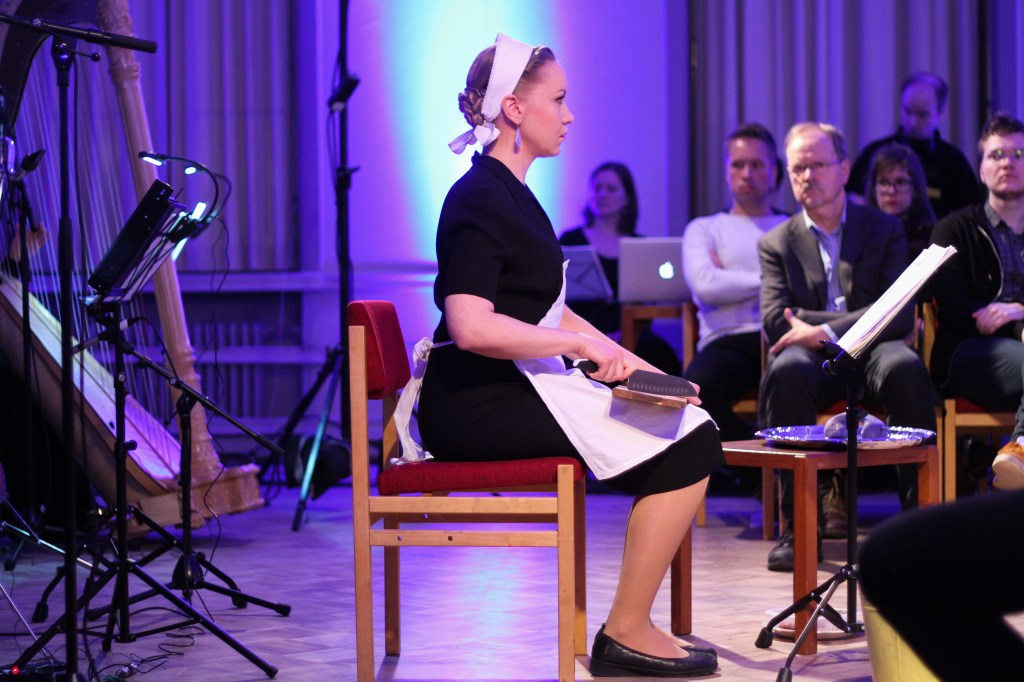
    The opera was carried out as a cross-art performance with some additional text and documentary video material by its director Teemu Mäki. The performance was closer to contemporary theater or live art than traditional opera. It included music, drama, videos, texts, humour and also a meal, vichyssoise soup, which is also written into the libretto (http://www.teemumaki.com/theater-judgeswife.html).

    Riikka Talvitie (composer),Tuomari (The Judge's Wife), performance photo by Teemu Mäki, 2017 (2).
    Riikka Talvitie (composer), The Judge’s Wife, Tuuli Lindeberg as Judge’s wife. Photo Teemu Mäki, 2017.

    The second opera Queen of the cold land was a radio opera commissioned by Finnish Broadcasting Company (Yle-radio). The libretto is a sort of rewriting of the Kalevala – a present-day version of some abstract life situations. The aim of the working group was to look at the Kalevala from a socio-historical point of view. Kalevala is not qualified as a source of Finnish mythology because the mythical images of folk poems have been transformed and merged into new entities by Elias Lönnrot. Lönnrot’s goal was not only to collect poems and to propose them as a coherent epic, but the goals went together with the nationalist idea to create a common image of the past, customs and culture of the Finnish people.

    The opera is dealing with several issues like diversity, sexual identity, nationality and naming. As a composer, I would state that the main theme of the musical narration is nationalism or rather the future of national states. This theme is presented in the musical material.

    The music consists of orchestral music, chamber music, operatic and folk singing combined with radiophonic possibilities. The composition is based on a variety of materials. The most extensive material consists of national anthems by different states and people. In addition to these I use folk music, war songs, wedding anthems and lullabies.

    (here I am pictured as a bird in the project: https://yle.fi/aihe/artikkeli/2017/12/02/queen-of-the-cold-land)

    Firstindigo&Lifestyle:  In Finland, composers like Jean Sibelius are master voices in the classical music world, for their emancipatory approach of voicing national myths, and yet speaking to broad international audiences. Sibelius is a widely known European composer in the United States with his Finlandia, and Violin concerto. Has this tradition created a sense of your own status as a composer who has Finnish roots?

    RT: As an answer to this question, I just tell that have composed a chamber opera called One seed, one sorrow – conversations with Aino Sibelius. Aino was a wife of Jean Sibelius. At least it was an other perspective to the question of national heroes.

    Firstindigo&Lifestyle:  We met in Lapland in 2007, while doing a nature piece in Pyhatunturi. Do you still get inspired while spending time in nature?

    RT: I am really worried about nature and by that – also inspired. This year I work with several pieces which are processing nature and particularly climate change.

    Last spring, I carried out a project called Heinä (Grass) with playwright Pipsa Lonka. It was performed in Silence Festival in Lapland. The performance contained images that a grass had drawn. I tried to read or interpret those images by composing them for bass clarinet and voice. The performance took place in an old cottage with smoke and a dog. The atmosphere was quite unique.

    Riikka Talvitie at the Silence-festival, Hiljaisuus Festivaali, Day3, Thursday. Photo Jouni Ihalainen, 2018.
    Riikka Talvitie at the Silence Festival, Hiljaisuus Festivaali, Day3. Photo Jouni Ihalainen, 2018.

    Firstindigo&Lifestyle:  Are you critical of your own work?

    RT: Of course I am critical and I would like to rewrite all my compositions but I just don’t have time for that. So let them be…

    As for the future composition, I have challenged myself to ask every time ”why do I do this piece”. I feel that every art project should have a reason or meaning or aim which is something more than a commission, a commission fee, reputation or a course credit. This goal can be both an internal musical idea or external starting point. It should be something that connects our work to the surrounding society.

    Firstindigo&Lifestyle:  Who gives you the best feedback?

    RT: The best feedback comes from my children when they ask ”what on earth are you doing” or ”how awkward”.

    Firstindigo&Lifestyle:  What is the role of commissions in your work?

    RT: The art funding is quite different here in Finland than in United States. Mostly I work with small commissions by different musicians, ensembles, choirs, orchestras or festivals. However, the main income of Finnish composers comes from the working scholarships.

    Some of my works are collaborations with other musicians and artists. Then we apply funding together as a working group from different foundations and institutions.

    Firstindigo&Lifestyle:  Do you have specific plans for the future?

    RT: I have plenty of plans for the future. In a near future I will finish my artistic doctorate that is about shared authorship and communality. For that, I still have couple of projects to compose. After that I will devote my time to activism.

    Firstindigo&Lifestyle:  How about dreams, perhaps international presentations and residencies?

    RT: An old image of a composer with a wig is quite outdated. This image contains travelling and prestige. Luckily the world has changed – women and mothers can be composer too and they don’t need to represent ”a plaster composer”.

    Mainly, I don’t travel. I work nearby. I am quite often at home in the afternoons when my children come home from school. And in the evenings they have hobbies. My plan – not a dream – is to spend time in residencies after my children are grown-ups. I just need to be patient because it will take ten years still.

    I don’t dream about an international career, firstly, because I like my daily local life. And, secondly, because I am at this moment interested in subjects and working methods which are rather marginal in classical music f.e. community art, live art, performance and philosophy. These are not the themes of a grand audience.

    I dream about ideological aims. I hope we will see the world where the terms of consuming, owning and competing are less valued. I also hope that there would be a turn in over-consuming that finally we are saved from dystopical eco-catastrophe. I am not that worried about my own career.

    RT: I have a small activist inside me who says that we should listen to different voices. So I would recommend you some other Finnish female composers here:

    Minna Leinonen www.minnaleinonen.com
    Jennah Vainio www.fennicagehrman.fi/composers/vainio-jennah
    Lotta Wennäkoski www.lottawennakoski.com
    Outi Tarkiainen www.outitarkiainen.fi/en
    Asta Hyvärinen core.musicfinland.fi/composers/asta-hyvarinen
    Sanna Ahvenjärvi www.sannaahvenjarvi.com
    Maija Hynninen www.maijahynninen.com
    Maija Ruuskanen www.maijaruuskanen.com
    Sanna Salmenkallio https://fi.wikipedia.org/wiki/Sanna_Salmenkallio

    Also Paola Livorsi, Italian composer living in Helsinki, is worth of listening:
    core.musicfinland.fi/composers/paola-livorsi


    ***

    Featured image: Saara Kiiveri as Peg in The Judge’s Wife. Photo Teemu Maki, 2017.

    ***

    website: https://www.riikkatalvitie.com/
  • Aimee Lee about sound, art books and hanji

    Aimee Lee about sound, art books and hanji

    Aimee Lee is an artist, papermaker, writer, and the leading hanji researcher and practitioner in the United States. With paper, she makes thread, sculpture, books, drawings, prints, garments, and installations. Aimee Lee’s background as a performing artist and musician carries traces of paper as sets and costumes. Her installations are artistic research on paper and sound. She has pursued a career with traditional Korean hanji, coming up with new aesthetic concerns and techniques for her artistic practice.  As a scholar, she is author of award-winning book, Hanji Unfurled (The Legacy Press).

    Firstindigo&Lifestyle: You are a musician, a performer with live violin. How did you start creating performances onsite, including your own installations, manifesting set designs and creating costumes? Did everything start with music?

    Aimee Lee: My early aspirations were to become a concert violinist, but I learned in college that I was not serious enough to devote the requisite hours of practice and study. However, I still loved music and wanted to stay close to musicians, so I continued to play and my first jobs were in music administration—bringing music to people who did not have access, or bringing people together through music.

    When I moved to Chicago for graduate school, I entered an interdisciplinary program that encouraged combining different media, especially performance. It was a book and paper program, but I was interested in the intersection of books and performance. Once I began to make paper, the connection between paper and performance was so compelling that I created installations that were dependent on paper that I made. The performances, which almost always included sound from my violin, activated the installations.


    Firstindigo&Lifestyle: Some of the live performances, which you composed and put together implement almost haunting kind of sound that responds back from the architecture of the venue, and then audience is stretched to interactive listening and feedback, where did you get the ideas to make these works?

    AL: Mostly, I studied classical music, but later learned improvisation and jazz. The heart of what I have always loved to do is rooted in improvisation, whether or not I was aware of it. Human communication, which sound and music are, has always fascinated me, so I wanted immediate feedback and interaction with my audiences. In Chicago, I was influenced by performance residencies with Aaron Williamson and Greg Allen, and by Julie Laffin.

    Firstindigo&Lifestyle: Now, we can perhaps say that you have become a master of hanji, the Korean traditional paper making. Where did you find the enthusiasm to start exploring it, and how did it come about?

    AL: While I studied papermaking history in the graduate school, I noticed that it began in China, moved to Korea, and then traveled to and flourished in Japan. Most of the existing research in English on East Asian paper was based in Japan, and I was unable to find much about hanji (Korean paper). I grew up at a time and place in the US where people always tried to guess my heritage, but they could only imagine that I was Chinese or Japanese. This sense of Korea being overshadowed affected me deeply, so I felt a curiosity about Korean paper history. My Fulbright research in Korea uncovered an entire history and culture that fascinated me on all levels, as an artist, a researcher, a Korean American, a person in the world. After my return to the U.S., I felt a strong responsibility to share what I had learned. I would never call myself a hanji master, but will always be a steadfast hanji ambassador and artist (read Aimee Lee’s exhibition review in Firstindigo&Lifestyle)

    Firstindigo&Lifestyle: Is the knowledge of making hanji widespread in Korea today, how about the new generations and passing down this historic form that goes back hundreds of years?

    AL: Korea has similar issues to the U.S. and other cultures where the current knowledge of traditional craft by the general public is quite limited. It is not a priority in contemporary life, so not many people in Korea are aware of the process of making hanji and its impact on Korean history. There are less than 25 paper mills remaining in Korea, and very few have serious apprentices, because it’s not an easy living. In a world where you could live and work in an urban center with all the amenities you need, why would someone decide to live in a rural area doing manual labor for very little money? There are no good incentives to do the work, even if you believe in continuing an ancient and important tradition.

    Firstindigo&Lifestyle: How sustainable is the process, could you tell about the ecological aspect of the paper making?

    AL: Papermaking on a small scale (meaning individuals or families who are in business) in Korea is ecologically sustainable, though it may not be financially so. The main raw material is the paper mulberry tree, which is cut each year. This coppicing practice encourages the plant to grow back every year, so the same plant can produce material for over 20 years. These are not trees in the way Western minds think of hardwood lumber: they are tall and skinny, almost shrublike, and cutting them down does not kill the plant. The traditional methods of processing always used plant materials so that production byproducts were easy and not toxic to dispose of or reuse. The bulk of the energy that goes into making hanji is human energy, which means that the process is very labor intensive but has a very light ecological footprint.

    Aimee Lee discussing hanji at the Korean Cultural Center, NY, March 2016
    Aimee Lee discusses hanji objects at the Korean Cultural Center in New York, March 2016

    Firstindigo&Lifestyle: Is it correct that Hanji derives from nature, or implies a closeness to it?

    AL: Hanji is made from plants, and could never have been invented without a human closeness to non-human nature by observing the possibilities of certain species and experimenting over time. Dorothy Field, artist and author (my favorite is her book Paper and Threshold) writes beautifully about how certain plants long to become paper, and all they needed was the human hand to let them reach that state.

    Firstindigo&LifestyleCan Hanji accessories, or clothing, be compared to textiles, or is it irrelevant?

    Paper and textile have a very strong connection, aside from each being able to be transformed into the other. The first paper was made from hemp cloth, and hanji can be cut, spun, and woven into cloth. Hanji has been used to make clothing, and today’s contemporary designers and manufacturers are including hanji into their textile production.


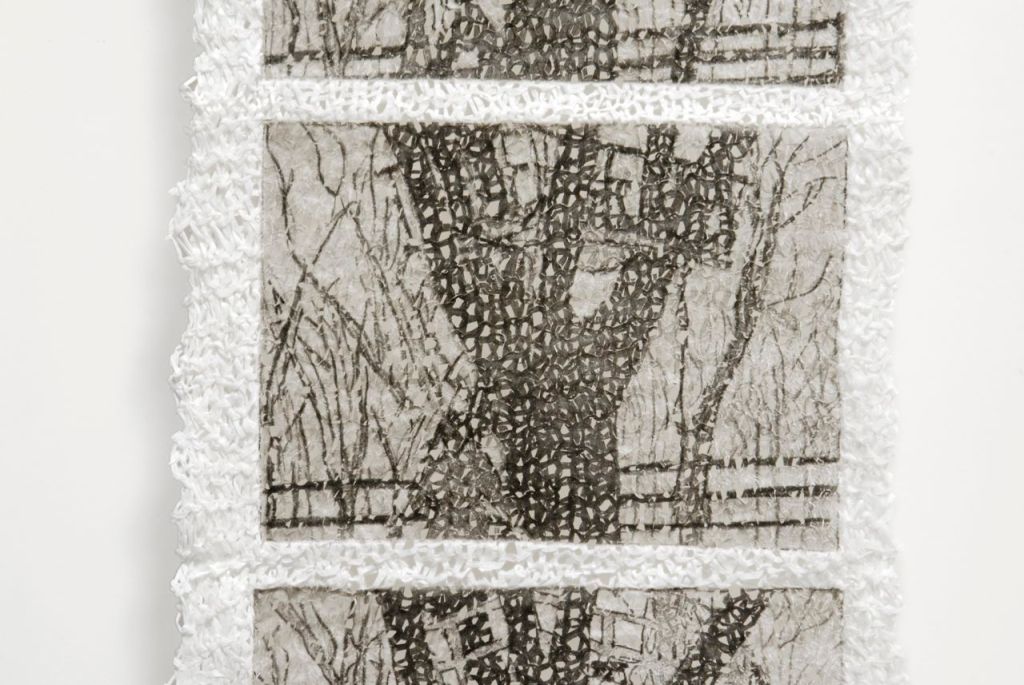
    Aimee Lee, All there, 2016. Dye on paper, thread. 11 x 11.5″. Private collection.
    Aimee Lee, All there, 2016, Dye on paper, thread, private collection.

    Firstindigo&Lifestyle: You are teaching as well, could you tell about the workshops and education aspect?

    AL: I mentioned before that sense of responsibility to share knowledge about hanji to a much wider audience. Part of this is from a conservation instinct, out of a fear that hanji is disappearing. But most of it comes from a joyous instinct, out of my love for this material that is so endlessly versatile. I always knew that handmade paper had great range, but even after almost a decade, I continue to find possibilities for hanji. If the substrate was not impressive, I would not feel compelled to promote it. However, I want people to know about hanji as an option, so that they can have another tool in the toolkit. This means that I teach a range of workshops, from preparing fiber to making hanji to manipulating it by hand. I travel continually to spread the word, in the hopes that eventually hanji will become as familiar as other papers, and that paper itself can be regarded on the same level as canvas, clay, metal, glass, wood, and so on.

    Aimee Lee, Beating fiber to make hanji while teaching students at Paper Book Intensive 2016 at Ox-Bow in Saugatuck, Michigan.
    Aimee is beating fiber to make hanji while teaching at Paper Book Intensive 2016 in Saugatuck, Michigan.

    Firstindigo&Lifestyle: The aesthetic form of Hanji art and folk art influences your making, how do people receive these traditional objects, which you are making today?

    AL: Most people don’t know about the lineage of the objects, so the responses are mostly of wonder—they are amazed that my pieces are made of paper in the first place. This provides an opening to share the stories of their historical use, and illuminate the ways that humans have always made objects that are not only useful, but embedded with meaning. Some have asked if I am interested in using the techniques to make much more contemporary ‘looking’ art. I have wanted for years to extend crafts like jiseung into installation and larger work that goes past the original shapes and functions of their predecessors. The issue is that the time and labor that it takes to make one piece is so great that I could only go in that direction if I had a very long and uninterrupted stretch of time to work. However, I am gratified to see that some of my students are moving in that direction after learning about hanji and its applications.

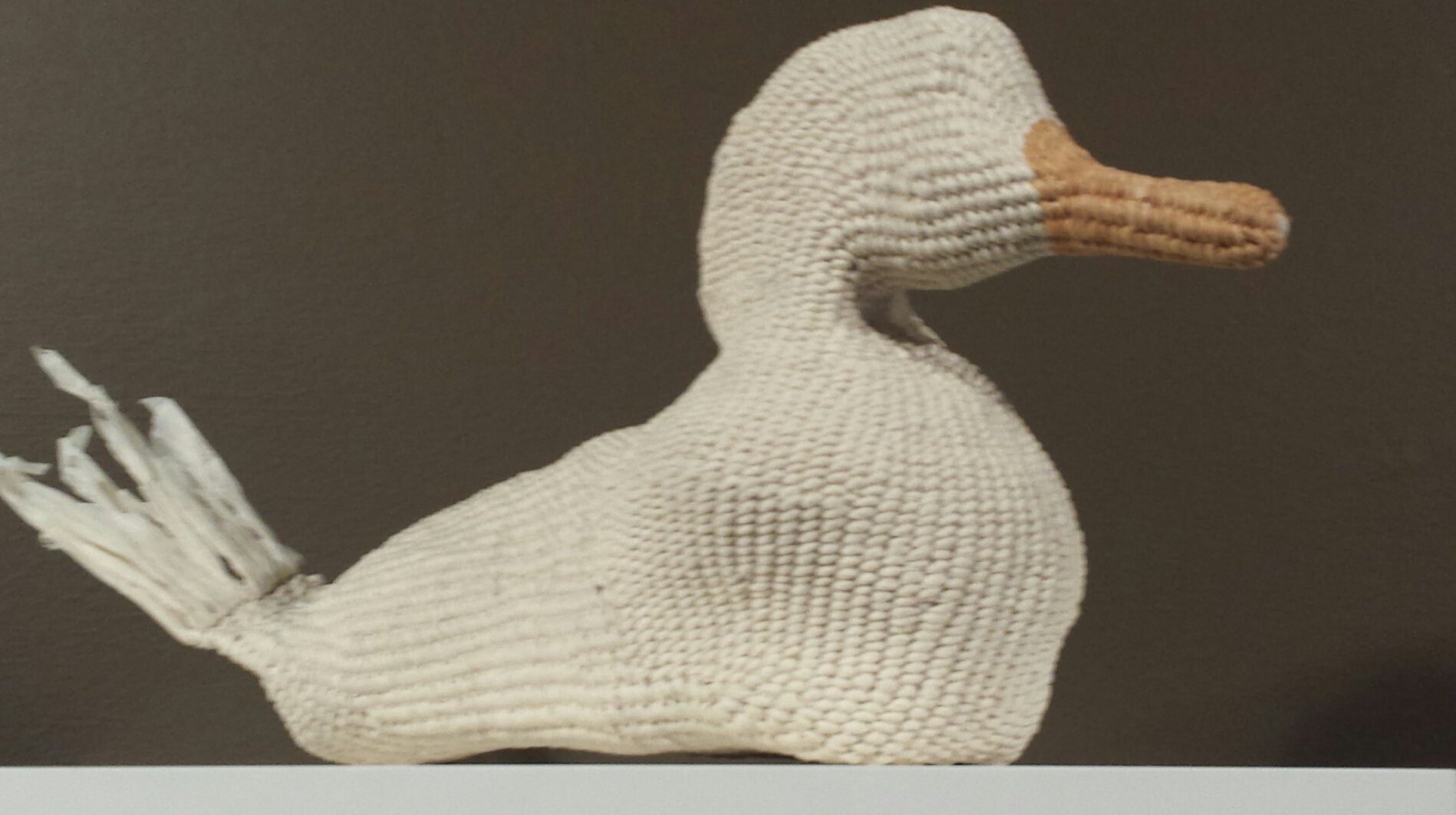
    Aimee Lee, hanji duck, Korean Cultural Center, March 2016
    Aimee Lee, hanji duck, exhibition at the Korean Cultural Center, NY, March 2016

    Firstindigo&Lifestyle: What other materials do you use today in the making of your art?

    AL: For the longest time, I have been very strict about using hanji whenever possible, or other handmade papers. My thread box is always full of different paper threads I have made, though I use cotton, linen, and silk thread to sew my hanji dresses. I also use the raw materials that make these papers, such as the cooked bark before it is beaten to a pulp. I use mostly natural dyes and finishes, which add color, structure, and protection to the paper. Last year, I collaborated with Kristen Martincic on a paper and ceramic installation, and recently had a couple of jewelry metals artists help me with additions to my paper ducks at Haystack Mountain School of Crafts. I’m interested in continuing this last investigation further.

    Firstindigo&Lifestyle: What is fascinating about your use of paper is its multiple dimensions from small objects to books. Your own writing and art (illustration) is sealed into these art books. Tell about the books, which you have made, how did the stories develop?

    AL: Books came first for me, before paper. I was making artists’ books at Oberlin College while studying with Nanette Yannuzzi Macias, which was a game changer. It was a way to combine writing, drawing, storytelling, and all kinds of other media into a form that felt very familiar and yet new. I don’t remember when I started to draw comics, but like improvisation, it was something that came naturally to me. I always thought that the point of being able to make my own books was the ability to create all of my own content. Most of my books contain original writing and stories that come from my own life experience, literature that I love, and the immediate present moment—whether an emotional space or an actual time in history that could be marked in the news cycle.


    Firstindigo&Lifestyle: Do you travel to Korea to get new ideas and exchange?

    AL: I am able to get back every several years, whenever I am funded. However, because of the distance and difficulty of making enough time to visit (I prefer going for longer periods of time), it’s not a journey I make often. Certainly it is inspiring, but it is a challenge as well because the expectations of me as a Korean American woman can be stressful.

    Firstindigo&Lifestyle: Often you hear that there is a division of thought between Eastern and Western approaches or philosophies. Do you feel you are bridging the gap between east and west in your practice, or do you think about these questions?

    AL: This idea comes up often and much of my work can be seen as bridge building between cultures. However, I do my best to stay away from the reductive nature of “East/West” because it sets up an automatic “Us/Them” mentality that can become dangerous. My life experience of feeling reduced to a single word, automatically, because of how I looked, keeps me aware of the unconscious instincts we have to categorize everything. I prefer to present my scholarship and artwork as being rooted in and inspired by many different traditions and cultures. It’s impossible for me to work any other way because I was born to immigrant parents and always lived between at least two disparate cultures.

    The “east meets west” cliché is one I particularly dislike, as if it has just happened, and as if there are only two monoliths in the world. It also comes from the point of view of a certain place being the center or more superior, which is problematic. Most cultures around the world have been in contact with each other for centuries, so cross-cultural understanding is not a new thing or an anomaly. Rather, it’s the norm.

    Firstindigo&Lifestyle: Where do you see yourself as an artist and educator in the future?

    AL: My goal is to build a new hanji studio for myself, where I can work, make paper, and teach independently, while continuing to travel to teach and exhibit. I want to train apprentices in this new space so that I can increase the number of people who can support hanji. There’s at least one more scholarly book left in me as well, so I look forward to finding the ideal setting to properly research and write it. All of this will be unlocked, I think, once I find the right place for myself to be.

    … … …

    Check out Aimee Lee on web: http://aimeelee.net/

    Her artists’ books can be found under the Bionic Hearing Press imprint from Vamp & Tramp.


  • Anri Sala’s musical mystery

    Anri Sala’s musical mystery

    “Anri Sala: Answer Me” -exhibition, which will be on display at the New Museum until April 10th, 2016, features multichannel audio and video installations. In his recent works, Albanian artist Anri Sala has interpreted musical compositions, classical works so to speak, with experiments that are structured into video and sound installations. The monumentally compound works navigate through the limits of our perception; mapping the sound and the spatial, and investigating the sound in the architectural spaces. This experiment transformed New Museum floors into symphonic areas of soundful meaning, leaving room for small encounters.

    Anri Sala’s often political works have tested the boundaries of sound and language in our construction of cultural realities. From cultural point of view, his works seem to investigate contexts that are outside the dominant aspects of reality. Or the realities are rather revealed through the layering of world of sounds. We have adopted a notion that the words create the meaning in our cultural communication. Yet, as Sala with his approaches has shown, it is possible to challenge this definition further by mapping and deconstructing the terrain, in which words actually restrict our ways of interpreting or seeing the world. From this perspective, the everyday life is full of noises that communicate without restricted syntax. Sound, form this point of view, has a great capacity to alter meaning.

    Sound’s features are attached to the material world that is so close to music. For Anri Sala, sound plays a role of an incomplete music, or music, which is in the state of becoming. Sound as a mediating device – even when it is real musical pieces divided into fragments – can document and edit reality, and communicate on a new level of poetic composition. This becomes immanent through the artist’s works, which New Museum profoundly projects. What stays with the viewer, is the personal corporeal experience, which is created in the architectural space as the entirely new perception. The change in the reception of the artistic works is focally in the embodiment. The surrounding sound world invites the viewer to walk into the next room full of sound. Or it freezes on the threshold, making the mystery of the sound’s origin more significant.

    Fragmentation and repetition is evidential in Sala’s second floor installation. The work unfolds as a two-channel HD video from 2014: ‘The Present Moment (in B-flat)’. This installation depicts different interpretations of an original compositional score by Arnold Schoenberg, titled ‘Verklärte Nacht Op. 4’ (1899).’ On the video, the chamber music setting acts as a fictional rearrangement of the historical work. Two videos feature a sextet of two violins, two violas and two cellos that play solitary notes from the musical work. Eventually the original musical score unfolds. The audio-visual installation works powerfully on two separate screens absorbing the body of a viewer into its mellow soundscape. The intimate portraits of the musicians, the movements and gestures of their heads, hands, arms, and backs, act as counterbalance to the interior, in which their playing has been recorded. The setting of empty room or hall creates an atmosphere of a vast space that accumulates sound on multiple stages. Sala’s meditative and mesmerizing piece truly puts an emphasis on the present moment.

    Upstairs, at the fourth floor of the museum, is a presentation of Anri Sala’s installation ‘Ravel Ravel Unravel’, from 2013. This is the work’s US premiere, it debuted in 2013 at the 55th edition of the Venice Biennale, where the artist represented France. In the title work ‘Ravel Ravel’ (2013), Sala reinterprets Maurice Ravel’s ‘Piano Concerto for the Left Hand and Orchestra in D major’. The composer created the composition in 1929 for an Austrian pianist Paul Wittgenstein, who had lost his right arm during the World War I.

    The museum space, in which the ‘Ravel Ravel’ video is installed, is designed to absorb sound and prevent echoes. In this chamber like room, there are two unique and separate performance interpretations of Ravel’s composition taking place. The musical echo is produced with ‘in and out of sync’ parameter, as two simultaneous performances measure temporal dimensions. The two pianists gradually shift out of unison, they are projected with their performances with two different orchestras. The one might evolve slightly different from the other, creating a minimal echo. Shifting between doubling notes and echoes creates the difference of the entire work, leaving the spectator paralyzed and in awe.

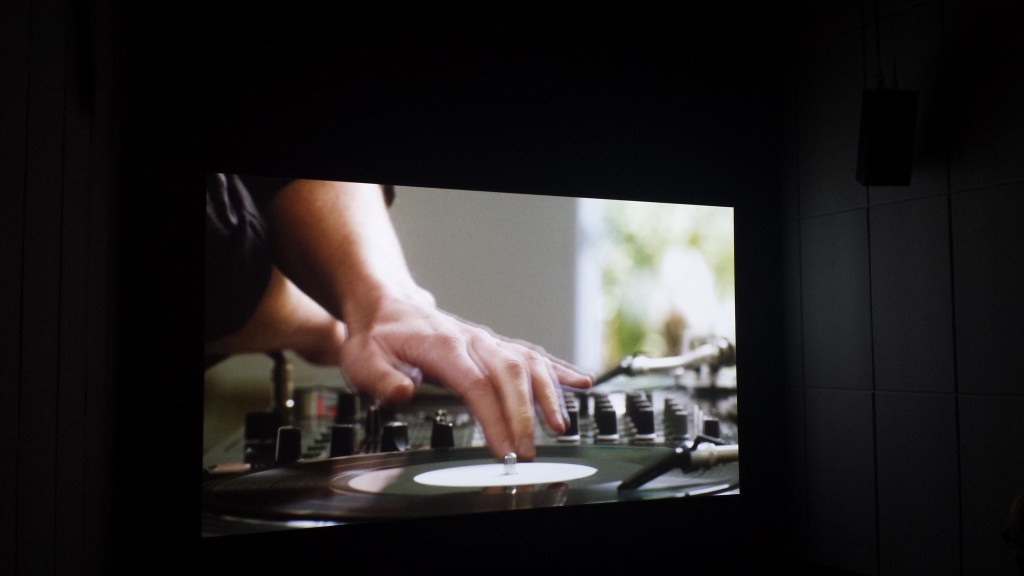
    Sala’s work contours in time, with tempo variation and within the space that has left no chance for error. The other video in the fourth floor being part of this work is titled ‘Unravel’, 2013. It debuted at the Venice Biennial alongside ‘Ravel Ravel’. ‘The Unravel’ video presents DJ Chloé Thévenin who takes part in the manual and physical manifestation of these two concerto recitals. She has the performance recitals on two turntables, in which she accelerates and slows the records in process. Fascinating, a visual turnout of the concerto sound in a new gesture.

    More info about the artist and the current exhibition “Anri Sala: Answer Me” :

    Hauser & Wirth about Anri Sala

    The exhibition info at New Museum