Category: performance&dance

  • The Scandinavian American Theater Company’s evaporated themes

    The Scandinavian American Theater Company’s evaporated themes

    The Scandinavian American Theater Company (SATC) has through its 5 year of existence engaged itself to an array of controversial themes, which question, evaporate, give new perspective, challenge, and perhaps empower the very notion of the ‘Scandinavian’ theater tradition, as it might appear in the world marketplace.  The theater company was started by Danish actor Albert Bendix, who after landing in the New York theater scene in 2006, had a vision to establish a collective of theater artists who would represent talent from various Nordic countries. The idea was to bring a Scandinavian perspective to local scene; introducing a new generation of Scandinavian playwrights and theater artists with great ideas and work. In 2014, the company has already proven that the Scandinavian perspective offers both interdisciplinary ideas and multiple voices. The works and approaches create dialogues between current world trends and contemporary artists, and genre tradition and historical themes. The end products are narratives that are empowering. 


    SATC Founding Members are: Henning Hegland (Norway), Albert Bendix (Denmark), Lisa Bearpark (Sweden/US), Sebastian Nyman Agdur (Sweden/UK), Vigdis Hentze Olsen (The Faroe Islands), and Jane Pejtersen (Denmark). Current company members are following: Artistic Directors: Henning Hegland (Norway), Albert Bendix (Denmark), Lisa Bearpark (Sweden/US) and Sebastian Nyman Agdur (Sweden/UK). Associate Members: Vanessa Johansson (US/Denmark), Drew O’Kane (US), and Kwasi Osei (Denmark)

    The company does full productions and reading series, which introduce plays, respectively, from different Nordic countries including Sweden, Norway, Finland, Iceland, Denmark, Greenland, and the Faroe Islands. In May 2013, the play Gorilla handled a theme of corporate life, where main characters were entangled with struggle of gender, greed and power. Rhea Leman’s script was directed by Ari Edelson, and produced by the Scandinavian American Theater Company. Gorilla ran three weeks in The Lion Theatre at Theatre Row.

    In 2012, the company’s Reading Series included an exiting world-premiere of BASTARDS OF STRINDBERG, which introduced four short plays inspired by August Strindberg’s “Miss Julie”.  The plays were written by American and Swedish playwrights. The premiere will get a full production in September 2014. Bastards of Strindberg will also open in The Lion Theatre at Theatre Row.

    The most recent company’s endeavor started their 2014 season of production, on Monday January 27. The reading of a play The Tailor’s Tale (Skraedderens fortaelling) took place at the Scandinavia House in New York City. The play was written by Danish-British filmmaker and writer Alexander Bodin Saphir, and it was directed by Kim Bodnia, also from Denmark. The stage-reading performance was accomplished in English by 8 actors at the Victor Borge Hall of the Scandinavia House. The full house of audiences testified a plot, which was going back 70years in the European history. The play’s theme was based on a story of ‘Rescuing of Danish Jews’ during the WWII.

    The Tailor’s Tale challenges a commonly told story of the Danish king, who himself was believed to wear a yellow star during the WWII to show the nations support and solidarity towards its Jewish population. This idea in the plot was partially formed around the question of, whether the king really wore the star, or whether it would have happened, if the Danish Jews had to put up a yellow star wearing it, like their other European brothers and sisters.

    Lars, a character depicting a doubting academic historian, enforces through his own questioning that the story is completely made-up. Contrastively, Isak, a character whose Jewish family survived the war, emphasizes the miracle-side of the story of saving the Jews of Denmark, saying that the miracle is really the only thing that matters. In reality, unlike in most European countries that were occupied by Nazi Germany, the great majority of Jews from Denmark were saved, and brought to Sweden by boats (leaving from many cities), since Sweden remained ‘neutral’ during the War, and was able to take in War refugees.

    In the play’s narrative, the life-stories of the two, now already aged men go back into the fall of 1943, when the German razzia went into effect in the occupied Copenhagen, Denmark. Isak’s father worked as a Jewish tailor during the war, and the plot goes back to the young boy’s experiences while he was hearing and experiencing the Nazi terror starting to take place in Copenhagen. The plot covers also preparations to escape, as Isak’s father gives him orders to quickly pack, get ready, and alarm other member of the community. Lars, on the other hand, is in the present moment very occupied with existential reasoning. He keeps asking, what really happened in the past, namely 70 years ago. He suffers of inner doubts that concern his own father, who was one of the fisherman with a boat rescuing the Jews. After his own father died in the war, Lars has been seeking the truth about, what were his motives while he helped to save his Jewish neighbors. In today’s meeting, the two old men face unexplained stories, different experiences, doubts, fears and anger of the past. In the plot, Isak and Lars meet at Isak’s house, which he shares with his wife Sara. Lars comes to visit the couple with a new girlfriend Eva, and wants to dig into Isak’s side of the story with her help. He wishes to interview Isak for his book, which handles a theme of the Danes and Danish Jews during the WWII.

    The playwright Alexander Bodin Saphir told on the January 27th performance in New York City, how the play is very personal to him, as it is based on his grandfather’s Jewish story.  Kim Bodnia, play’s director and a cousin to the playwright, described also his personal attachment to his great uncle’s story.  Bodnia said that the work-in-progress play benefited greatly from the New York reading and rehearsal experience.

    The evening was a collaboration of the Scandinavian American Theater Company, Breaking Productions and The American-Scandinavian Foundation.

    tailor's tale

  • Many talents of Artist-Professor Pirjo Yli-Maunula

    Many talents of Artist-Professor Pirjo Yli-Maunula

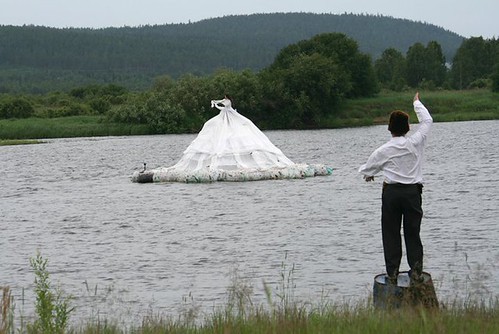
    In June 2010, Finnish dancer and choreographer Pirjo Yli-Maunula was one of the four dancers to travel up the Muonio and Torne Rivers in Finnish Lapland. Their living and dancing installation River Woman was built on a ferry consisting of plastic bottles (about 25 000 plastic bottles were used to build a diameter of ten meters ferry, which operated a gliding dance-installation on a stage across the Muonio and Torne Rivers). Pirjo Yli-Maunula (being the main incubator of the project), dancer-choreographer Reijo Kela, and dancers Catherine and Anne Angeria were on a three-week river trip from Karesuvanto to Tornio performing to the audiences on the way. This dancing ferry is a kind of project that Pirjo Yli-Maunula would create, telling about how we are close to nature, and the nature is a stage for everything we do. Her performance projects – often taking place in the Northern Finland – have involved local audiences to participate and collaborate in mesmerizing ways.

    Reijo Kela dances with Jokinainen
    (Pirjo Yli-Maunula dances as Jokinainen/River Woman with dancer Reijo Kela on shore)

    FI: What are you doing these days, you have quite a long career as an established choreographer and festival leader?

    Pirjo: I am busy with many things: I am working as a choreographer and a dancer, artistic director, curator and a producer.

    At the moment I am in the middle of creating a new duet with French choreographer-dancer William Petit. We are currently in Italy sharing a residency in Matera. We will have the premiere of ”Scars” in the beginning of November in Oulu in Northern Finland.

    Then, this year our company Flow Productions started to arrange a series of visiting contemporary circus performances in Oulu. I have been busy curating, producing and arranging this series. I am hoping that we can continue with the series next year as well.

    I just started to work again as the artistic director of Full Moon festival. I was in the job in 2004-2006. My current contract is for 2014-16.

    FI: You went to Cardiff couple of weeks ago, was this your first time in the festival?

    Pirjo: Yes, this was my first time in World Stage Design – festival. The week was intense, very interesting and great experience as a whole.

    FI: It seems that your international networking abilities are tremendous, you have been able to attract visitors to come to Finland, where did you learn these skills?

    Pirjo: I have learnt through the work itself. My different jobs have helpt me to build up the network. It is great to jump from the position of an artist to the position of a artistic director or funder or producer. Those different points of view help me to understand the bigger picture of the art world.

    FI: How multidisciplinary are you as an artist, what are your modes and styles of working?

    Pirjo: I am very much interested in working collaboratively with artists from different art forms. I have worked with artists in the fields of video, music, photography, new circus, theater, literature, games, new media, as well as costume, light and sound design.

    Every production and process is different: I have created not just contemporary dance pieces on stage but also dance-installations, site-specific works, dancevideo or works that could be considered as live art.

    I strive to create complete, meticulous works of art which nevertheless build upon improvisation and spur-of-the-moment insight.

    FI: What did you gain by attending WSD2013 in Cardiff?

    Pirjo: I was inspired by many things in the exhibition, meeting of other artists, and the overall exciting atmosphere of the festival.

    FI: Who are the people that influence you the most?

    Pirjo: I feel that the other artists that have worked with me have influenced me the most. As I am often also producing or co-producing my own work I am lucky to be able to build dream teams, where I can learn and get inspired by others.

    FI: Where do you see yourself in the future, what dreams do you hold within you?

    Pirjo: I would love to spend time in longer residencies and tour abroad more. I have quite an extensive repertoire that I believe would be interesting. For instance our multidisciplinary creation Susurro, that I also performed in Cardiff, would be a perfect piece to show for instance in Japan or South-Korea. I would like to tour in South American countries as well.

    FI: Name your most important collaborations, and why?

    Pirjo: I could talk about a number of different people and various different works. But if I would be allowed to mention just a couple I would definitely talk about French choreographer William Petit and Finnish light designer Jukka Huitila as I have worked with them so much.

    I have known William since 2004. I have danced in his work and we have co-created pieces together. The intimacy, authenticity and bravery that we have found while dancing together has been very important to me. That has had an impact to my other work as well.

    The collaboration with Jukka Huitila has also been vitally important to me. His sensitivity, openness, generosity, intelligence and creativity are superb. His input seems to always deepen the work. The trust that we have in each other has helped me to grow as a person and as an artist.

    From the collaborative pieces that I have done I am maybe most happy about these two: Karsikko and Susurro. They have both been an adventure to something completely new as a form of art.

    Susurro
    (Pirjo Yli-Maunula in Susurro)


    Susurro

    FI: Last but not least, how does Finnish landscape help in creating your works, what would you like to say about our climate, the landscape, Northerness, Lapland and the nature?

    Pirjo: Many of my pieces reflect my relationship with the natural environment, as well as natural phenomena and seasons of the Northern landscape. For instance my work Karsikko (co-created with dancer-choreographer Titta Court) is based on a tree and animal characters, and it derives from nature´s materials and soundscapes.

    LINKS:
    Pirjo Yli-Maunula showreel: https://vimeo.com/73019936
    Susurro trailer: https://vimeo.com/65130595
    Karsikko trailer: https://vimeo.com/35430024

    www.flowprod.fi
    http://www.fullmoondance.fi/
    https://www.facebook.com/pirjo.ylimaunula
    https://twitter.com/PirjoYlimaunula

  • Finnish Samuji attending Capsule in New York

    Finnish Samuji attending Capsule in New York

    Finnish Fashion brand SAMUJI will be part of CAPSULE Women’s fashion showing on September 15-17 2013 in New York. The brand started in 2011 with a collection for women, and for fall 2013 with a collection for men. SAMUJI’S story embeds love for the everyday, highlighting its simple functionality, and setting values for designs that are sustainable.  In addition, SAMUJI items are crafted from quality materials coming from European and Japanese suppliers, and are made in Europe. The flagship store is in Helsinki. SAMUJI is also sold in selected stores in Europe, Asia and North America. www.SAMUJI.com 

    More information about the Capsule show including brands and event location here