Artist Suhair Sibai was born in Syria in 1956. She was educated as an artist in Los Angeles, California. Her work explores identity and the self through beautiful and colorful female portraits. Suhair Sibai is based in Los Angeles, where she exhibits her art and works as an artist. Her work has also received international acclaim in Europe and the Middle East.
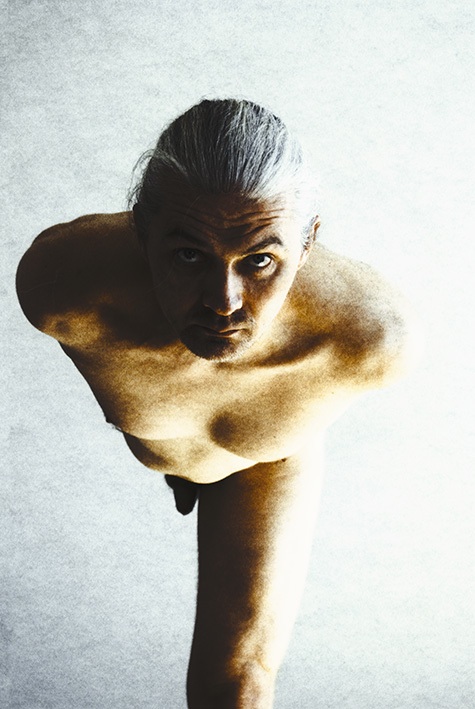
In his photographic portraiture of the male body, Kari Soinio studies masculine corporeality, body language, sexuality and identity and looks at the ways perception and recognition operate through visual representations. His auto-portraiture-based work takes a critical look into masculinity and femininity in maleness, showing ambiguous bodies with traits of both and in doing so addresses and challenges masculine complacency and self-importance.
Kari Soinio, Athletic Hero #1, digital C-print, 2012
When looking at Kari Soinio’smale portraits, it feels relevant to ask, how do we actually portray the male bodies in general? Soinio’sportraits offer answers that are more subtle than loud. His work is more questioning than giving answers, more provoking than seducing, and more aiming to challenge than trying to frame simple answers. The presence in his photography is strong. The body in the images becomes the one, which is both looking at you as a viewer, and simultaneously makes its own subject the mysterious one. The portraits are saying, you can look at me now, but here is the movement, which does not create passivity of an object. The entire question could be played around the underlying theme of a ’hero’. I am a male as a subject for photography, and, therefore, when you label me, I’m aware of the multiplicity of the ways you are looking at me.
Generally, one can suppose, a man who is portrayed, stands for a cultural hero, often a superhero. We can imagine man and his sports, man in the wilderness, man in action, man doing his duty, man and the muscular body, man and a celebrity status, man and nature, man and the urban life, man and his gadgets, man in his clothing, man in his business suits. The list is endless when we think about it. In the Western art world, we tend to think a man of modernism is someone who is portrayed as part of the bourgeoisie. While he was posing, he came out as a dandy, as a flâneur, being mostly comfortable in his position of posing, being able to pose and gain gaze through a masculinity with substance (think of Oscar Wilde, for instance). Now, self-portraiture is an interesting sport itself, how to present your own body, how to create the gaze, how to, simply, pose?
How about a naked man? Is there a controversy regarding the subject? Seeing naked men in portraits is still quite a taboo outside the art-context. Perhaps, even photography and male nudity still have a quite fresh relationship. Even when the history of performance art and some theatrical traditions of avant-garde have exposed naked bodies as sites of performance throughout the past century, the subject matter still has the power to startle us. The human body and its performativity is a powerful tool enabling us to discuss society, gender, sexuality, identity, culture, power, class, race, beauty and aesthetics.
Kari Soinio, Athletic Hero #13, C-print, 2012
Body representations and questions relating to them, and to our ways of posing are without argument more often associated with women’s bodies. However, whether it is our bodies in advertising, in media, in television, in art, in fashion, in sports, in health and nutrition, we have opinions about our physicality. Our skin is reality. It is the window to our selves rather than what we aim to say, or how we wish to act. Our visually overexposed cultures tend to invite us to look at, to evaluate, to be seduced, to judge, to react to the lens. Yet, that is a very human characteristic. We are bodies, and we need to focus the conversation on what is our relationship to ourselves.
Kari Soinio says that his source of inspiration is the complexity of the male ’self-consciousness and body image’. This opens into many interpretations of the masculine essence in our culture, showing maleness through icons of male heroes. Soinio’s portraits discuss with these cultural images, yet they offer ways to look at the masculinity as a more vulnerable entity, which nudity already poses. Is his posing creating classic male bodies? In the ways the torso, arms, head, shoulders etc. are presenting shape and balance, yes. When it comes to mixing the color palette into the image, some of the more toned ones are definitely blurring the lines of the self. The rigid becomes more soft and round.
Is nudity a surface where naked male body transforms into something else than naked female body, because of the culture they impose? The latter is often a territory for many cultural signs, which note male gaze, voyeurism, sexism and pornography. Therefore, portraying women’s bodies differently is a constant challenge in the art of photography. The iconography of a male posing in pictures might offer a surface to investigate our bodies as sites for many identities, which are necessarily not just male. This play is of course available for ‘any-body’ regardless of gender. In Soinio’s photographs, the viewer can see a body that is in and out of balance. The portraits do not fit inside their frames, they want to step out. From this viewpoint, the naked heroism is within our acceptance of our body as a spirituality. We might see the human body as part of nature, part of yoga-culture, part of wellness and balance. The nature-body communicates across the simple boundaries of gender. Our bodies are aiming to balance and be off-balance. The experience as the viewer is to kinesthetically feel together with the portraits, and move outside the frames.
…Kari Soinio is a New York based artist working mainly with photography. He received his BA from the Lahti Polytechnic in his native Finland and his MFA from University of Art and Design in Helsinki. He has also studied at the International Center of Photography in New York…
Kari Soinio has recently shown at Storefront Bushwick in NYC (2013), at Heino Gallery (2012) and Korjaamo Gallery (2011) in Helsinki, at Northern Photographic Center in Oulu (2011) and at several galleries and museums in Finland, including numerous shows at the Museum of Contemporary Art Kiasma and Finnish Museum of Photography in Helsinki. His monograph “From Landscape to Place” was published in 2009 in conjunction with shows at Heino Gallery and a mid career survey at Kerava Art Museum. His show at the Institut Finlandais in Paris was part of Mois de la Photo in 2010 and received significant attention from the French art press. His work has been shown internationally in the US and in Europe: at Mappin Art Gallery, Sheffield, England, NGBK gallery, Berlin, Germany, Arthouse, Sofia, Bulgaria, Ludvig Museum, Budapest, Hungary, Signe Vad gallerie, Copenhagen, Denmark, Peer Gallery, New York, USA, Gallery Papatzikou – Photobiennale Thessaloniki, Veroia, Greece, Ingrid Hansen Gallery, Washington DC, Municipality of Neapolis Gallery, Thessaloniki, Greece, and Kakelhallen, Mariehamn, Åland. Soinio’s work has appeared in NY Arts Magazine, Connaissance des Arts, l’Humanite, Réponses Photo, Art Actuel, La Tribune, Next Level and in numerous books, newspapers and TV programs in Finland.
Gallery Information:
Station Independent Projects organizes exhibitions and events with a focus on artist advocacy. It is located in Lower East Side.
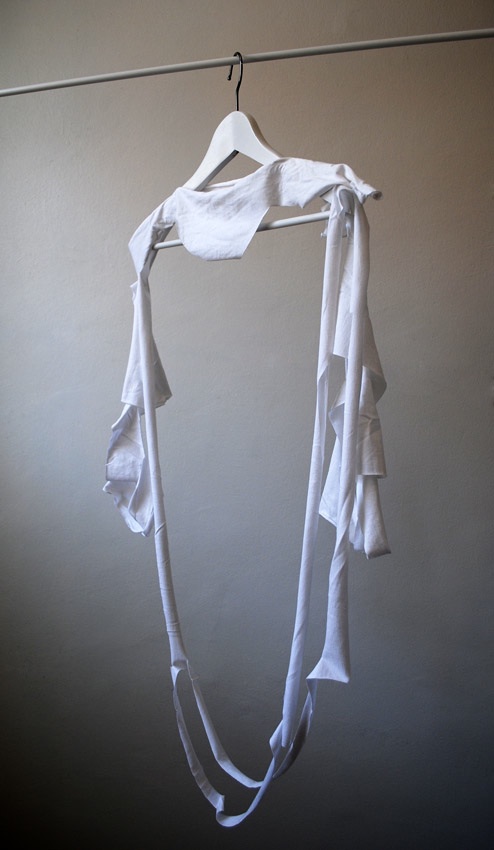
Fashion Interactionsis a multidisciplinary exhibition that explores fashion culture by means of contemporary art, design and media. The exhibited works comment, on the unsustainability of the fashion industry, analyze the relationship of fashion and corporeality, and investigate how people use clothing as a tool for building identities. The exhibition is Curated by Annamari Vänskä & Hazel Clark and it presents works from: Federico Cabrera, Heidi Lunabba, Jasmin Mishima, Anna Mustonen, Nutty Tarts, Timo Rissanen, Salla Salin, Heidi Soidinsalo, Saara Töyrylä and Timo Wright. This exhibition opens on Friday November 15, 2013 in New York City. It is a collaboration with Parsons The New School for Design and the SheilaC. Johnson Design Center,Finnish Cultural Institute in New York, and the Centre for Fashion Studies (Stockholm University).
(Fashion Interactions-exhibition, Timo Wright-‘un fit’ video still)
FASHION CURATING NOW is a daylong symposium at ParsonsThe New School for Design on Saturday November 16 9:30 am-5 pm. The symposium reflects the subjects around the Fashion Interactions exhibition focusing on the possibilities and challenges of contemporary fashion curating on a global scale. Critical points of view are stressed, as is contemplation of fashion’s kinship with art, design, industry, performance, and self-presentation. I asked a few questions from Leena-Maija Rossi, who is the Executive Director of Finnish Cultural Institute in New York,about the seminar and other related topics.
Firstindigo&Lifestyle: Can you explain the background of the seminar?
L-M Rossi: The background of the Fashion Curating Now is in the exhibition project Fashion Interactions. It has its origins in the show Boutique, curated by Annamari Vänskä, which was part of Helsinki’s World Design Capital year in 2012. Finnish Cultural Institute wanted to bring a new edition of the show to New York and partnered with Parsons New School for Design in order to do that. The process of “re-curating” an already existing exhibition made us think of curating fashion at large: how to present fashion in an interesting way “outside the market”? How to make engaging exhibitions on fashion, how to show its entwinement with fine art, how to find new fora for curating, e. g., in the new media? How to make visible the political aspects of fashion?
Firstindigo&Lifestyle: Finnish fashion and design have gained more international visibility, creating their own trends as well, how do you see current research field is following trends from the industry?
L-M Rossi: I see fashion research as a developing and dynamic field, especially when it connects with studies on class and consumerism, and, of course, studies of gender and sexuality. I do not know if the task for the research is to follow the trends, I rather see research as a field for critical interventions.
Firstindigo&Lifestyle: In Finland, it seems that industries have also been able to point to cultural questions, what do you see as current research themes coming from the field/industries themselves?
L-M Rossi:Sustainability is of course a timely research theme, and the way it intersects with the issue of class. I am also really interested in the potentiality of queer fashion research, and I would really like to see more analysis on gender nonconformity, not so much of equaling queer with identity categories.
Firstindigo&Lifestyle: Yourself, you have written about advertising, media, gender representations/performance-related, in the contemporary visual culture. What do you see this global exchange is giving to these themes?
L-M Rossi: I think fashion is a crucial part of visual culture at large, especially because of its border-crossing nature. Gender is being profoundly done by people’s choices of dressing up and wearing their clothes, and these choices are, again, influenced by advertising. So one could say that the fields of fashion and advertising are constantly participating in the global processes of doing and undoing gender.
Firstindigo&Lifestyle: How well or how do Finnish fashion industries communicate globally? How do you see the branding, would it be more individual voices than a canon etc.?
L-M Rossi: It seems that many Finnish designers communicate quite naturally in the international field of fashion. Like visual artists, I think they first and foremost present their individual voices; it is very difficult to build a uniform “brand.” But then again, many seem to be thinking of such issues as high quality materials and sustainability.
Firstindigo&Lifestyle:Art, fashion, design: How would you speed-describe these together?
L-M Rossi:Fashion and design are artforms, fashion is an interesting field within design. All of them make difference in everyday life.




 Firstindigo&Lifestyle