Category: scandinavian

  • Nordic nature: light and darkness represented

    Nordic nature: light and darkness represented

    ”As one follows the lines drawn at the map, across the light blue surfaces, further north, twists and turns, further north, straight lines, still north. This is where I see myself, at the island furthest north, at the North End, standing at the northernmost cliff, facing the North Sea.” (Tonje Bøe Birkeland/Lumiére, from Papa Westray in Orkney Isles, 1900)

    Darkness & Light contemporary Nordic photography –exhibition just opened on February 22nd at the Scandinavia House in New York City. Norwegian Tonje Bøe Birkeland’s photograph, displayed above, is part of her project that reflects how she takes on the role of fictional photographer Luelle Magdalon Lumiére (1873-1973), and recreates an imaginary journey to the Orkney Islands. Birkeland’s project travels back in time.  Her art combines photographs and texts, and she is also writing letters to Lumiére who as a traveler explored ie. western parts of Norway and New York. The artwork is an interesting dialogue between past and present, that is encompassing two life stories. Yet the images appear dreamlike hovering between fiction and reality.

    Two captivating photographers in the exhibit are from Iceland. Bára Kristinsdóttir’s Hot Spots’ photography-series portray Iceland’s geothermally heated greenhouses. Her style owes to Dutch Golden Age still lifes. Her photographs play with opposites, such as light and dark, cold and hot, indoor and outdoor, natural and artificial.  Kristinsdóttir shows interest in nature photography, and so does Pétur Thomsen, another Icelandic photographer. He takes, yet, a more critically environmental stance with his works. His ‘Imported Landscape’ project is based on his visits (since 2003) to a Kárahnjúkar Hydropower Plant, a construction site on the east coast of Iceland. The artificial lake and the construction project have spoiled the biggest wild nature in Europe. Environmentalists have been fighting for the preservation of the wild nature. The voices supporting the project discuss about the need to use the energy from the nature. Thomsen’s photographic project has explored this debate, as he has documented the transformation of the landscape.

    Bara Kristinsdottir - Hot Spots2(above: Bára Kristinsdóttir ‘Hot Spots’ 4, 2004 From the series Hot Spots R print, 47 1/5 x 39 1/3 in. (120 x 100 cm), courtesy of the artist)

    Pétur Thomsen Imported Landscape AL3_9a(above: Pétur Thomsen ‘Imported Landscape AL3_9a’, Kárahnjúkar, Iceland, 2003 Pigment print, 43 1/3 x 55 in. (110 x 140 cm) Courtesy of the artist)

    Darkness & Light: Contemporary Nordic Photography will run through April 26, 2014. The exhibition focuses on a diverse selection of recent photographic works displaying a selection of over 30 works by 10 emerging and established photographers. The artists from Denmark, Finland, Iceland, Norway, and Sweden, (two from each Nordic country) are:

    Thora Dolven Balke, Tonje Bøe Birkeland, JH Engström, Joakim Eskildsen, Ulla Jokisalo, Bára Kristinsdóttir, Tova Mozard, Nelli Palomäki, Katya Sander, and Pétur Thomsen.

    The exhibition aims to display ”the ways in which light—and the lack thereof—informs the practice of contemporary Nordic photographers. The exhibit  demonstrates the breadth and strength of Nordic photography today.”

    The exhibition is organized by leading figures in the world of Nordic photographic art.

    More information found on the  Scandinavia House: The Nordic Center in America’s website

  • The Scandinavian American Theater Company’s evaporated themes

    The Scandinavian American Theater Company’s evaporated themes

    The Scandinavian American Theater Company (SATC) has through its 5 year of existence engaged itself to an array of controversial themes, which question, evaporate, give new perspective, challenge, and perhaps empower the very notion of the ‘Scandinavian’ theater tradition, as it might appear in the world marketplace.  The theater company was started by Danish actor Albert Bendix, who after landing in the New York theater scene in 2006, had a vision to establish a collective of theater artists who would represent talent from various Nordic countries. The idea was to bring a Scandinavian perspective to local scene; introducing a new generation of Scandinavian playwrights and theater artists with great ideas and work. In 2014, the company has already proven that the Scandinavian perspective offers both interdisciplinary ideas and multiple voices. The works and approaches create dialogues between current world trends and contemporary artists, and genre tradition and historical themes. The end products are narratives that are empowering. 


    SATC Founding Members are: Henning Hegland (Norway), Albert Bendix (Denmark), Lisa Bearpark (Sweden/US), Sebastian Nyman Agdur (Sweden/UK), Vigdis Hentze Olsen (The Faroe Islands), and Jane Pejtersen (Denmark). Current company members are following: Artistic Directors: Henning Hegland (Norway), Albert Bendix (Denmark), Lisa Bearpark (Sweden/US) and Sebastian Nyman Agdur (Sweden/UK). Associate Members: Vanessa Johansson (US/Denmark), Drew O’Kane (US), and Kwasi Osei (Denmark)

    The company does full productions and reading series, which introduce plays, respectively, from different Nordic countries including Sweden, Norway, Finland, Iceland, Denmark, Greenland, and the Faroe Islands. In May 2013, the play Gorilla handled a theme of corporate life, where main characters were entangled with struggle of gender, greed and power. Rhea Leman’s script was directed by Ari Edelson, and produced by the Scandinavian American Theater Company. Gorilla ran three weeks in The Lion Theatre at Theatre Row.

    In 2012, the company’s Reading Series included an exiting world-premiere of BASTARDS OF STRINDBERG, which introduced four short plays inspired by August Strindberg’s “Miss Julie”.  The plays were written by American and Swedish playwrights. The premiere will get a full production in September 2014. Bastards of Strindberg will also open in The Lion Theatre at Theatre Row.

    The most recent company’s endeavor started their 2014 season of production, on Monday January 27. The reading of a play The Tailor’s Tale (Skraedderens fortaelling) took place at the Scandinavia House in New York City. The play was written by Danish-British filmmaker and writer Alexander Bodin Saphir, and it was directed by Kim Bodnia, also from Denmark. The stage-reading performance was accomplished in English by 8 actors at the Victor Borge Hall of the Scandinavia House. The full house of audiences testified a plot, which was going back 70years in the European history. The play’s theme was based on a story of ‘Rescuing of Danish Jews’ during the WWII.

    The Tailor’s Tale challenges a commonly told story of the Danish king, who himself was believed to wear a yellow star during the WWII to show the nations support and solidarity towards its Jewish population. This idea in the plot was partially formed around the question of, whether the king really wore the star, or whether it would have happened, if the Danish Jews had to put up a yellow star wearing it, like their other European brothers and sisters.

    Lars, a character depicting a doubting academic historian, enforces through his own questioning that the story is completely made-up. Contrastively, Isak, a character whose Jewish family survived the war, emphasizes the miracle-side of the story of saving the Jews of Denmark, saying that the miracle is really the only thing that matters. In reality, unlike in most European countries that were occupied by Nazi Germany, the great majority of Jews from Denmark were saved, and brought to Sweden by boats (leaving from many cities), since Sweden remained ‘neutral’ during the War, and was able to take in War refugees.

    In the play’s narrative, the life-stories of the two, now already aged men go back into the fall of 1943, when the German razzia went into effect in the occupied Copenhagen, Denmark. Isak’s father worked as a Jewish tailor during the war, and the plot goes back to the young boy’s experiences while he was hearing and experiencing the Nazi terror starting to take place in Copenhagen. The plot covers also preparations to escape, as Isak’s father gives him orders to quickly pack, get ready, and alarm other member of the community. Lars, on the other hand, is in the present moment very occupied with existential reasoning. He keeps asking, what really happened in the past, namely 70 years ago. He suffers of inner doubts that concern his own father, who was one of the fisherman with a boat rescuing the Jews. After his own father died in the war, Lars has been seeking the truth about, what were his motives while he helped to save his Jewish neighbors. In today’s meeting, the two old men face unexplained stories, different experiences, doubts, fears and anger of the past. In the plot, Isak and Lars meet at Isak’s house, which he shares with his wife Sara. Lars comes to visit the couple with a new girlfriend Eva, and wants to dig into Isak’s side of the story with her help. He wishes to interview Isak for his book, which handles a theme of the Danes and Danish Jews during the WWII.

    The playwright Alexander Bodin Saphir told on the January 27th performance in New York City, how the play is very personal to him, as it is based on his grandfather’s Jewish story.  Kim Bodnia, play’s director and a cousin to the playwright, described also his personal attachment to his great uncle’s story.  Bodnia said that the work-in-progress play benefited greatly from the New York reading and rehearsal experience.

    The evening was a collaboration of the Scandinavian American Theater Company, Breaking Productions and The American-Scandinavian Foundation.

    tailor's tale

  • Fashion Curating: Unsustainability, gender and class readdressed

    Fashion Curating: Unsustainability, gender and class readdressed

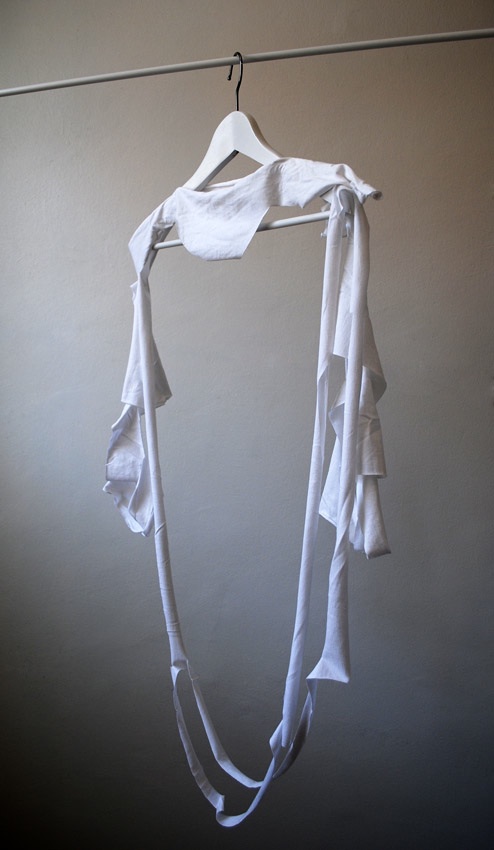
    Fashion Interactions is a multidisciplinary exhibition that explores fashion culture by means of contemporary art, design and media. The exhibited works comment, on the unsustainability of the fashion industry, analyze the relationship of fashion and corporeality, and investigate how people use clothing as a tool for building identities. The exhibition is Curated by Annamari Vänskä & Hazel Clark and it presents works from: Federico Cabrera, Heidi Lunabba, Jasmin Mishima, Anna Mustonen, Nutty Tarts, Timo Rissanen, Salla Salin, Heidi Soidinsalo, Saara Töyrylä and Timo Wright. This exhibition opens on Friday November 15, 2013 in New York City. It is a collaboration with Parsons The New School for Design and the SheilaC. Johnson Design Center, Finnish Cultural Institute in New York, and the Centre for Fashion Studies (Stockholm University).

    Image 

    (Fashion Interactions-exhibition, Timo Wright-‘un fit’ video still)

    FASHION CURATING NOW is a daylong symposium at Parsons The New School for Design on Saturday November 16 9:30 am-5 pm. The symposium reflects the subjects around the Fashion Interactions exhibition focusing on the possibilities and challenges of contemporary fashion curating on a global scale. Critical points of view are stressed, as is contemplation of fashion’s kinship with art, design, industry, performance, and self-presentation. I asked a few questions from Leena-Maija Rossi, who is the Executive Director of Finnish Cultural Institute in New York, about the seminar and other related topics. 

    Firstindigo&Lifestyle: Can you explain the background of the seminar?

    L-M Rossi: The background of the Fashion Curating Now is in the exhibition project Fashion Interactions. It has its origins in the show Boutique, curated by Annamari Vänskä, which was part of Helsinki’s World Design Capital year in 2012. Finnish Cultural Institute wanted to bring a new edition of the show to New York and partnered with Parsons New School for Design in order to do that. The process of “re-curating” an already existing exhibition made us think of curating fashion at large: how to present fashion in an interesting way “outside the  market”? How to make engaging exhibitions on fashion, how to show its entwinement with fine art, how to find new fora for curating, e. g., in the new media? How to make visible the political aspects of fashion?

    Firstindigo&Lifestyle: Finnish fashion and design have gained more international visibility, creating their own trends as well, how do you see current research field is following trends from the industry?

    L-M Rossi: I see fashion research as a developing and dynamic field, especially when it connects with studies on class and consumerism, and, of course, studies of gender and sexuality. I do not know if the task for the research is to follow the trends, I rather see research as a field for critical interventions.

    Firstindigo&Lifestyle: In Finland, it seems that industries have also been able to point to cultural questions, what do you see as current research themes coming from the field/industries themselves?

    L-M Rossi: Sustainability is of course a timely research theme, and the way it intersects with the issue of class. I am also really interested in the potentiality of queer fashion research, and I would really like to see more analysis on gender nonconformity, not so much of equaling queer with identity categories.

    Firstindigo&Lifestyle: Yourself, you have written about advertising, media, gender representations/performance-related, in the contemporary visual culture. What do you see this global exchange is giving to these themes?

    L-M Rossi: I think fashion is a crucial part of visual culture at large, especially because of its border-crossing nature. Gender is being profoundly done by people’s choices of dressing up and wearing their clothes, and these choices are, again, influenced by advertising. So one could say that the fields of fashion and advertising are constantly participating in the global processes of doing and undoing gender.

    Firstindigo&Lifestyle: How well or how do Finnish fashion industries communicate globally? How do you see the branding, would it be more individual voices than a canon etc.?

    L-M Rossi: It seems that many Finnish designers communicate quite naturally in the international field of fashion. Like visual artists, I think they first and foremost present their individual voices; it is very difficult to build a uniform “brand.” But then again, many seem to be thinking of such issues as high quality materials and sustainability. 

     Firstindigo&Lifestyle: Art, fashion, design: How would you speed-describe these together?

     L-M Rossi: Fashion and design are artforms, fashion is an interesting field within design. All of them make difference in everyday life.  

     Image

    (Fashion Interactions-exhibition, Nutty Tarts & Heidi Lunabba) 

    /// INFO: FASHION INTERACTIONS ///

    Fashion Interactions-Exhibition

    Opening: Friday November 15, 6pm – 9pm

    November 11 – December 13, 2013

    Open daily 12pm – 6pm

    Arnold and Sheila Aronson Galleries

    Sheila C. Johnson Design Center

    Parsons The New School for Design

    66 Fifth Avenue at 13th Street, New York

    The exhibition is supported by the Finnish Ministry of Education and Culture, Frame Visual Art Finland and Consulate General of Finland in New York.

       /// FASHION CURATING NOW ///
    Symposium, Saturday November 16, 9:30am – 5:00pm

    David Schwartz Fashion Education
    Parsons The New School for Design
    560 Seventh Avenue at 40th Street
    New York

    Finnish Cultural Institute in New York Facebook.

    http://www.ficultureny.org/node/330

    http://www.newschool.edu/sjdc