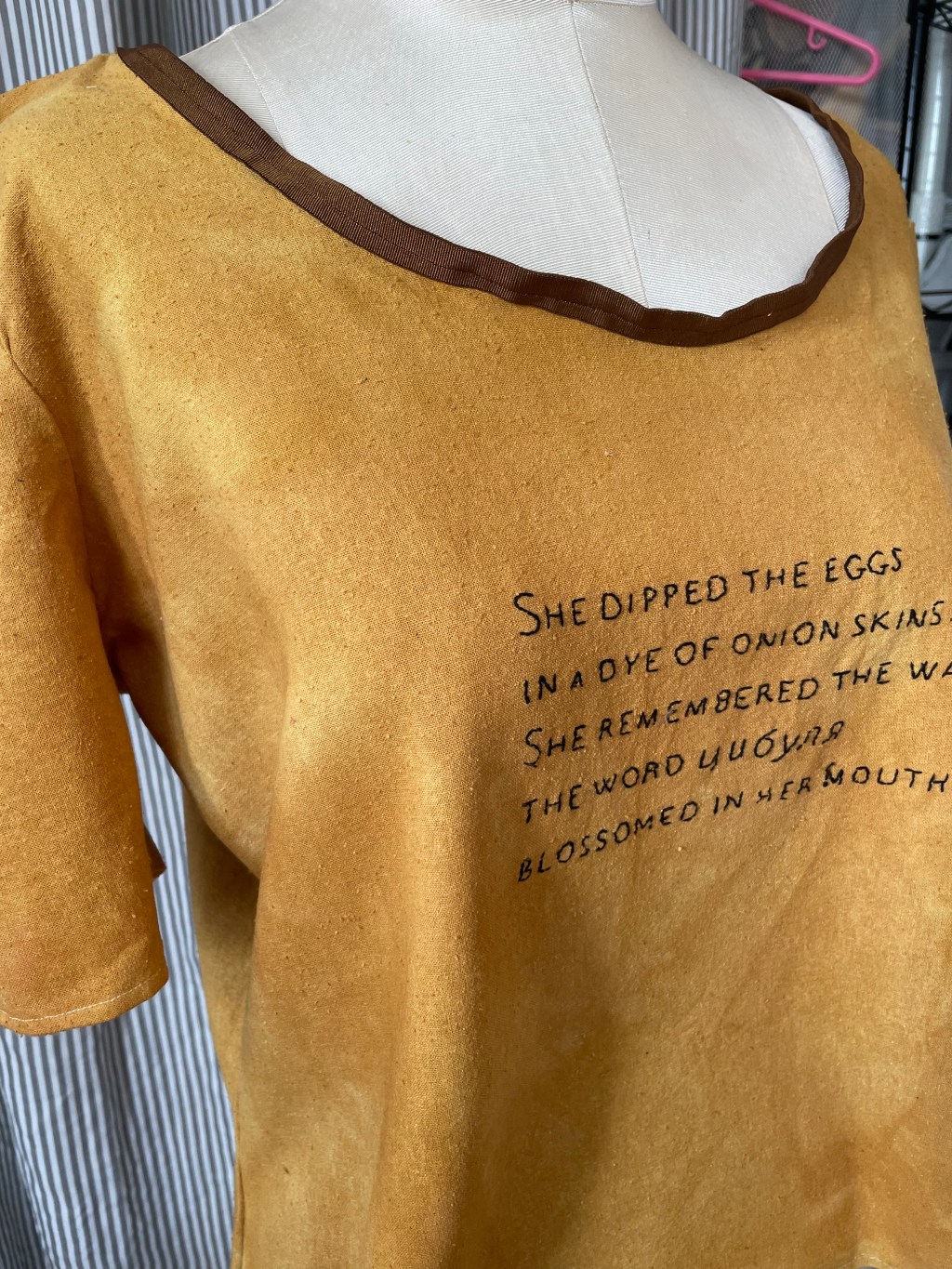
Dip the fabric in a bath of onion skins, like she did. Let the dye cling like her ghost clings to me and to her old furniture, which has become mine, the headboard shaky as names being called, my name over and over. I cannot answer to it. Dip the fabric in a bath of onion skins. I cannot forget her ghost in front of the mirror. I realize her face is framed by my hair. She wanders the maze of armchairs. I fold my body over hers on one of the cushions. She clings to me. There is the end table that was carried with her from the farm where they first settled. Then she opened the window for the first calm in a long time. She felt the discomfort of knowing her family was not part of her peace. This scared her and so did the way their ghosts cling.
I work with art in reaction to poetry. I find textiles work best since they are malleable and react to embroidery, dye, and wax. This helps me focus my poetry. Sometimes I rework the poetry after the textile is completed to create a stronger connection. -Olena Jennings
The idea begins here with collecting onion skins for about a year. They crackle and crunch against each other as thin as a spirit.
The title of the poem “Historical Arrangement” is about the ghost who is a deceased family member, and the voice in the poem is becoming one with history. What is remarkable is that the voice has her furniture and is taking on her features.
The art, a woman’s shirt, is part of the poem because this family member is dyeing with onion skins. The voice in the poem is repeating her acts. My ancestor used onion skins to dye eggs, but I carried the process into my present by dyeing fabric.
_______________
Olena Jennings is a New York City based writer and translator. She is the author of the poetry collection The Age of Secrets (Lost Horse Press, 2022) and the novel Temporary Shelter (Cervena Barva Press, 2021). Olena Jennings has been a translator or co-translator of collections by Ukrainian poets Iryna Shuvalova, Kateryna Kalytko, Vasyl Makhno, and Yuliya Musakovska, among others. She also founded and curates the Poets of Queens reading series and press.
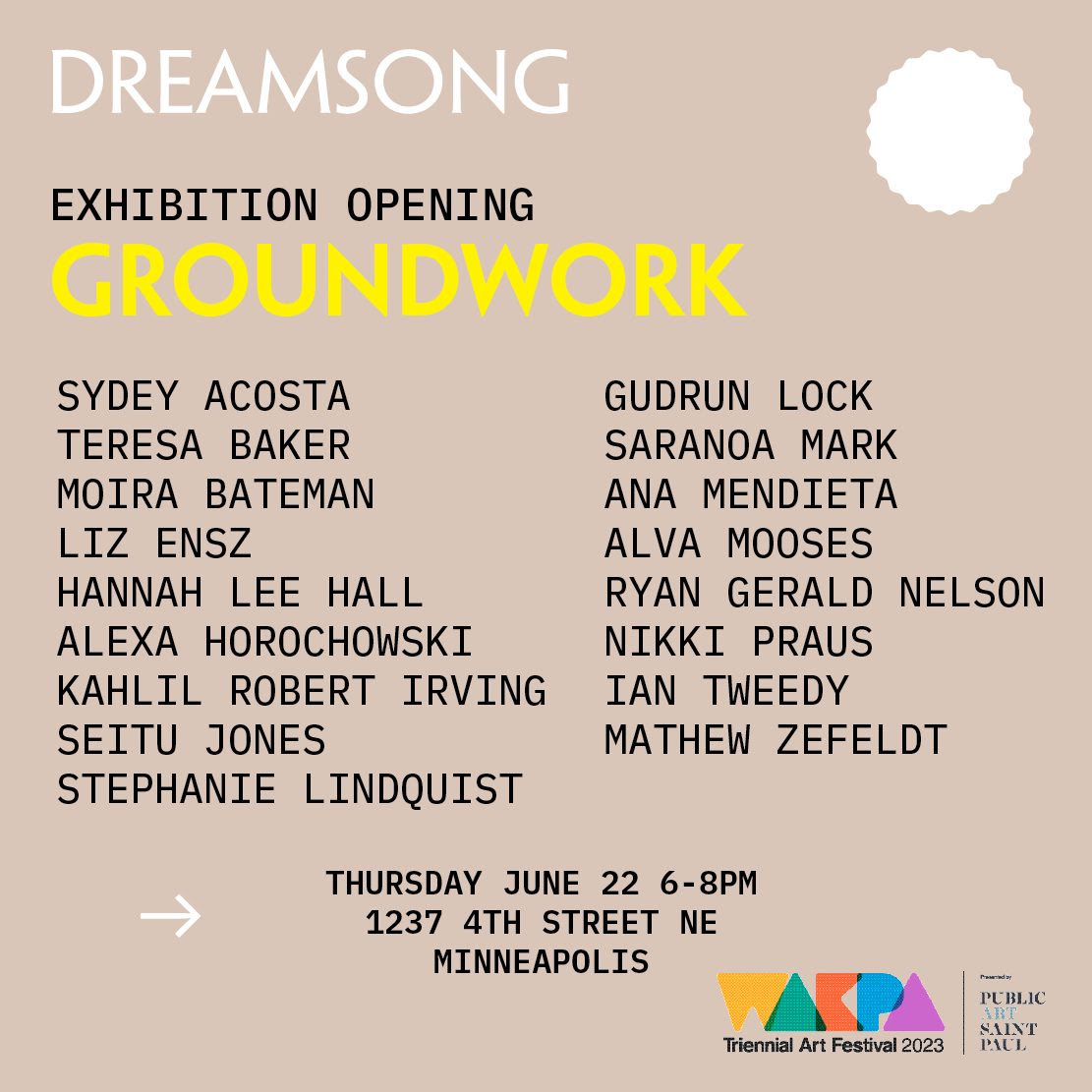
Groundwork, an exhibition opening in Dreamsong gallery in Minneapolis this week celebrates our human connection to the ground. As one exhibition artist Ana Mendieta puts it when she references her artistic endeavour: ” from insect to man, from man to spectre, from spectre to plant, from plant to galaxy.” All artists partaking in the exhibition promote ‘terra firma’ both as their subject matter and medium. Groundwork is showcasing in the Twin Cities as part of a Wakpa Triennial Art Festival with opening reception taking place on June 22, 2023.
The artists, who span generations and territories across the United States, include: Sydney Acosta, Teresa Baker, Moira Bateman, Liz Ensz, Hannah Lee Hall, Alexa Horochowski, Kahlil Robert Irving, Seitu Jones, Stephanie Lindquist, Gudrun Lock, SaraNoa Mark, Ana Mendieta, Alva Mooses, Ryan Gerard Nelson, Nikki Praus, Ian Tweedy, and Mathew Zefeldt.
We can state that the exhibition is a call for planetary matters and ecological awareness. A soil is the context and source for enlivening nutrients. It is a semiotic signifier of territory and identity, as well as a land/site of conflict over indigenous rights and environmental protection. There is of course a tradition of the Land Art of the 1960s and 1970s. The artists in Groundwork are not purposefully having dialogues with pioneers like Robert Smithson or Michael Heizer, and with a perhaps romanticized idea of ‘empty’ Western landscapes. The artists, rather, wish to discuss their homage to detail, paying more attention to what it means to connect to locally embedded and lived histories. And as such the exhibition relates to questions of how the past legacies echo into the future.
“Adopting anticolonial, queer, feminist, environmentalist, and other critical lenses, they seek communion with the specificities and spiritual meanings of place, burrow into the legacies and experiences of their ancestors, and express concerns about our collective future.”
Many artists consider the direct consequences of a fast-deteriorating planet, and their art acts as a kind of site-specific artistic research project showing the case of climate change. Forest fires, colonialist over-use of land, mining, resource extraction, droughts, damages from conflict; the list is endless when we start thinking of ancestral time and memory that it evokes in the context of land and soil.
Focusing on land in artwork, in which ground acts both as subject and material, the exhibition wishes to engage in the conversations about the earth’s preservation. What do different local contexts and materialities mean? What are the disputes about, for the people with ancestral rights that bear spiritual and physical connection to the territory, to heritage? How about modern built environments with technical challenges in preserving the soil and environment?
In each of the exhibited artistic projects, metaphorically, the future will be grounded as long as there are innovative strategies that learn from the histories they wish to navigate.
“the indelible connection between our modern built environment and its raw material is made explicit, our vast inscription upon the earth metaphorized by materially innovative strategies that seek to collapse the boundaries between history, place, and representation.”
The exhibition is organized by Public Art Saint Paul. The inaugural edition responds to the theme “Network of Mutuality”, a phrase from Dr. Martin Luther King, Jr.’s Letter from Birmingham Jail, which speaks to social justice, mutual care, interdependence, and inextricable links among humans.
… … … … …
Dreamsong is a space for contemporary art comprised of a gallery, a standalone Cinema, and an artist’s residency. Our program is focused on intergenerational emerging and mid-career artists from Minnesota and beyond, with an emphasis on female-identified and under-recognized artists. Founded in June 2021 by Rebecca Heidenberg and Gregory Smith, Dreamsong is located in Northeast Minneapolis.
Featured Image: Stephanie Lindquist, Tasting Tart Cherries, 2021, acrylic, and cyanotype on canvas, 40 x 48 in.
Meditation as a practice implies self-awareness. Finding about inner strength, intuition, thought processes and wishes. Otherwise, putting things in the background while finding the inner focus to clarify and perform. All these aspects create the assurance of different levels of balance. One might believe that meditation is a pure focus, while the contrary is in fact true.
Mindfulness as a concept, a reality of nourishing the mind and soul by turning into more quiet time. Quieting one’s mind in order to listen to inner atmosphere of feelings and emotions. Why not to discover the universe that is within us? Replacing negative thoughts with appreciation of ourselves, of others and the world.
Breathing
It is not only about tuning into balancing acts, but also inspiration and self discovery. We are full of emotions and feelings, which are positive and not at all negative; and even some of the negative ones may turn into new energy and offer insight. Meditation implies a pause, opening a pathway to our inner thoughts.
A truthful path includes maintaining a certain level of anxiety and uncertainty when it comes to specific problems like climate change. If we sit back and relax, wash away our mind with calm waters of emptiness, we won’t have the energy required to fight the problem. Where our attention is needed, where frustration isn’t supposed to be solved by simply relying on our positive energy.
Collage: Firstindigo&Lifestyle @polyvore-designs
For the overachieving among us, stretching beyond our everyday selves is not the biggest question. Finding treasures in the more simplified notions of our inner powers might be. Not all progress is necessarily meaningful. But finding answers in more everyday actions, in nature, in the natural world, and in those encounters with others.
Sometimes there is time to learn compassion for ourselves, in order to better listen and pay attention to the natural world. Compassion is the key turned into caring on a deeper level about anything important. In meditation this manifests in being attentive to breathing, keeping the mind and body aware of the breathing. Step by step this awareness opens up into something deeper, reaching outside the limitations of us as humans.
Our consciousness can open up to thoughts where breathing becomes part of the universal rhythm of breathing together with this planet. The natural world requires our attention to the actual concept of breathing. We are all living, palpable things. Over consumption, unnecessary interruption of the natural course of life, creates chaos over rhythm of breathing in all living things. Planetary destruction is emblematic of bodies that have moved away from their breathing.
Meditation can be motivational, it can energize us to think more deeply about ourselves and others. This planetary home of ours calls for our attention into our breathing. Meditation is about becoming aware of how the parts can fit into the whole, and how that whole can mend the individual parts.
Between East and West
French philosopher Luce Irigaray’s literary work “Between East and West: From Singularity to Community”, investigates Eastern practices and philosophy from the point of view of the body, in which breathing has a central role. After herself practicing yoga and meditation, her research implies a personal awakening that has manifested through practice of the conscious breathing. Following ancient Eastern practices of breathing and yoga, Irigaray argues that both humans (women and men alike), nature, and the natural world including the spiritual life, are part of a bigger plan of discovering our being in here.
In this writing Irigaray examines the Western tradition through ancient Eastern disciplines. It is the meditation that teaches us to breathe. Yogic traditions, according to Irigaray can offer us a meaningful way to reconnect our human and planetary pasts with its futures.
In Jewish Kabbalah, which also is an ancient tradition, there is a lot of thought put into spirituality and our collective well being. We should gain more compassion for one another, and understand that ultimately we are all creatures essentially bound up with other creatures. All levels of the creation and the preservation of the planet is a common goal for us being here.
From this perspective, our meditative approach can lead to a child-like approach when it comes to life; the wonder that locks our inner core into things beautiful and wondrous. When we grow up, we tend to forget how things in nature put a smile on our face, how literally everything that grows out there can feel exciting and worth exploring. Nature’s mysterious part is also something that can open to one who will pause, sit back and absorb its presence. Listen to a birdsong, look at the trees behind the brick wall in the midst of urban life. We can imagine going back to nature anytime. Meditation is one key to acknowledging that this is possible.
The Natural world can lead us to believe in higher beings, in something more universal than our mundane lives. Species and subspecies come from somewhere, the universal energy and movement can lift us to have faith in the worlds that are often invisible.
Sparkles and a vessel as a thought introduced in Kabbalah. Our divine task to help ‘creation’, to correct errors in nature. To make the world a better place for all living things. There is something divine in the sun with the radiance that it wakes us up to each new day. The universe that keeps repeating the same mantra of coming back fresh every single day. We haven’t been able to stop the sun from rising, even with all our destructive human behavior. Even when sun stays in the clouds.
Climate change
It is more and more discussed how climate change can bring disturbance to our lives and shake our balance. The World Health Organization published a study about how climate change can have an impact on our overall health.
“The principal reason for the global increase in temperatures is a century and a half of industrialization, with the burning of ever-greater quantities of oil, gasoline, and coal; the cutting of forests; and use of certain farming methods.” (https://www.who.int/heli/risks/climate/climatechange/en/)
Global warming will certainly have consequences where our health may be at risk. In terms of changes in our ecosystems and as catastrophic weather phenomena, climate change can create new emergencies.
When we meditate, we can learn to appreciate each new day. And think how we can better meet the challenges. Climate Change is adding another layer that intensifies patterns and experiences that are abnormal, when the future holds more extreme rainfall, floods, tropical cyclones, droughts and heat waves, in addition to the increase in the frequency of calimas and atmospheric dust. (https://www.una-climateandoceans.org/448491047)
One of the nature’s emergencies is called calima. The calima is caused by a storm or change in weather impacting the Saharan Air Layer. Climate change will cause more of the phenomena. The hot, dry and dust filled system is located above the Sahara desert. It meets the more humid and colder system that linger over the Atlantic Ocean.
Reference: Luce Irigaray (2002): Between East and West. From Singularity to Community. Translated by Stephen Pluhácek. Columbia University Press.





 Firstindigo&Lifestyle