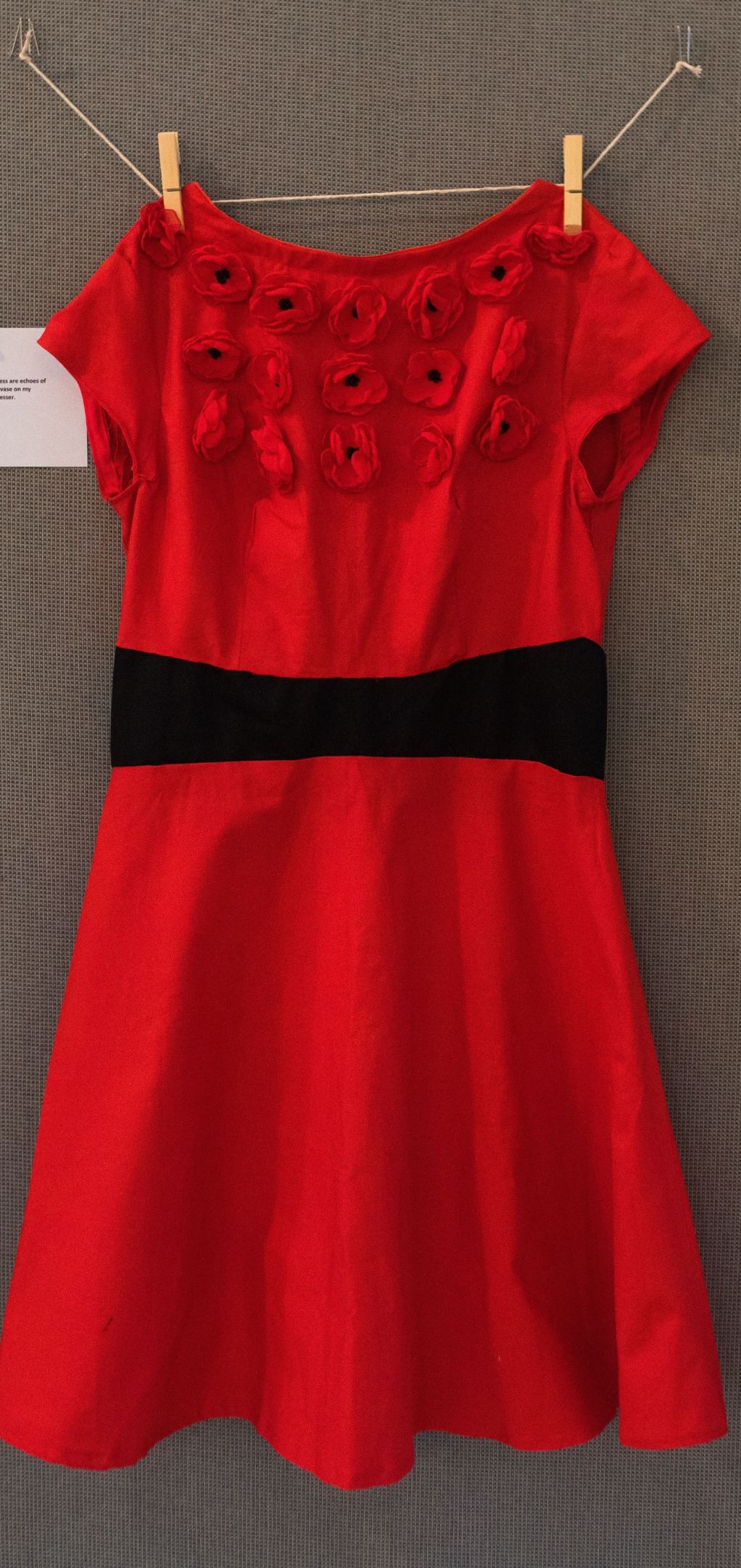
In 2018, a New York City poet Olena Jennings created poetry based on her family’s stories, attempting to visualise photography with words. The poems that resemble photography, carry them as frameworks of memory. In Olena Jenning’s THE MEMORY PROJECT:The memory comes before the poem. The poem comes before the art.
“I chose ink and paper for the poems. I chose fabric for the art. The poems are a small slice of time in which I experienced memories, many based on photographs in my grandparents’ photo album. I experienced the memories in 2018 and they were embellished by memories I was creating as I lived.”
Red and blue on the dresser,
dust in the folds,
stretching towards the dim lamp.
Click of lipstick cap,
spritz of perfume,
snap of purse,
and she will turn the light off.
The flowers will wither
into their dreams
and I will put my lips
into their centers,
ready to blow away pollen.
The yellow dust caught in my eyes,
when I see for a moment
from her perspective, I look out
onto the yard. I see myself
throwing a rubber ball into the flowers,
crushing their petals,
the place where I convinced
my little brother there was a snake,
there was something to fear.
To make up for my deception,
I gave him one of the plastic flowers,
deceiving him again, pretending
I bought it at the corner gas station
from which we had collected all
of our dishes with the points we got
from pumping gas. I want to make up
more than that now—absences
when I would become like that yellow dust,
a quiet star.
Olena Jennings, Map Dress, installation view. Photo: Elvis Krajnak.
PAPER MAPS Olena Jennings
Even flat maps have texture.
They carry with them
someone’s memory of the streets.
I will walk near the water
to draw the places off the map
on the palm of my hand.
We used to make paper
out of recycled letters,
rough, imperfect,
for a moment – wet,
on our knees
ripping
We mark our way to the castle
with the handle of a shovel.
We could live inside
our fairytale, find our way
despite the sand
in our eyes.
Poems and dresses by Olena Jennings. Photos of the dresses by Elvis Krajnak.
Stephanie A Lindquist is a New York based artist and photographer, whose photo collages gather ideas of plants with world-wide origins. Her works bring forth anscestral memories from diasporic places, and create meaning mapping our global existence as travelers and settlers. Food has always played enormous role in peoples adaptation to new places, creating and sustaining cultures. Art can have as much to say about this subject too.
Firstindigo&Lifestyle: I have understood your recent photography art is based on your research on plants that are native, local or indigenous to areas. How did you start this art project?
Stephanie A Lindquist: I started gardening and reading about plants and how to grow them. I was especially inspired by farmer, philosopher Masanobu Fukuoka. He is the father of natural farming and a proponent of natural dieting–both of which he believed to be beneficial for the environment and human health. According to Fukuoka, a natural diet consisted of local and preferably ancient plants–something nearly impossible for any urban dweller like me to accomplish.
This sparked my interest in identifying and promoting many little-known indigenous food plants from my ancestors in Africa and Europe, to where I currently live in the Americas.
Firstindigo&Lifestyle: Where did you grow up, and live prior to New York City?
Stephanie A Lindquist: I grew up in Los Angeles. I’ve also had opportunities to travel abroad to Europe and Central America.
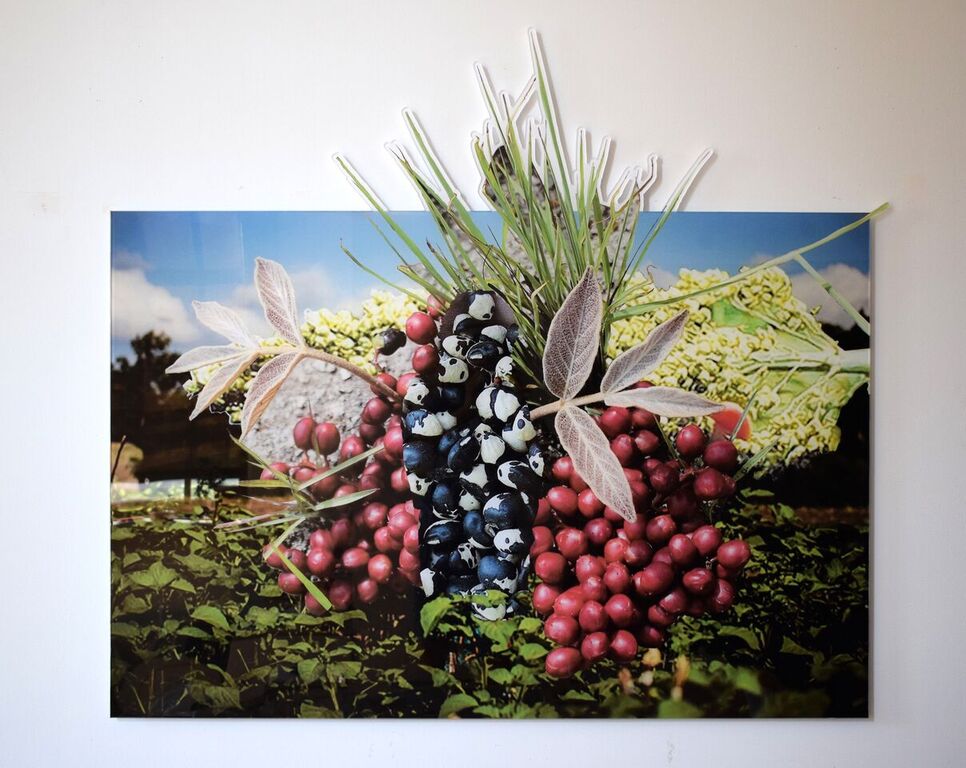
Stephanie Lindquist, Lablab oryza glaberrima celosia, 2017, Digital print on aluminum diode, Edition of 3, 4’ x 4’ ft.
Firstindigo&Lifestyle: As one major inspiration behind your art making are the plants, do you cultivate or grow plants yourself and have your own garden?
Stephanie A Lindquist: I garden regularly in East Harlem and the South Bronx. It is an essential part of my practice and life. Gardening allows me to cultivate, consume and appreciate some of the plants I study first-hand. It is a way to immediately begin creating a more reciprocal relationship with nature.
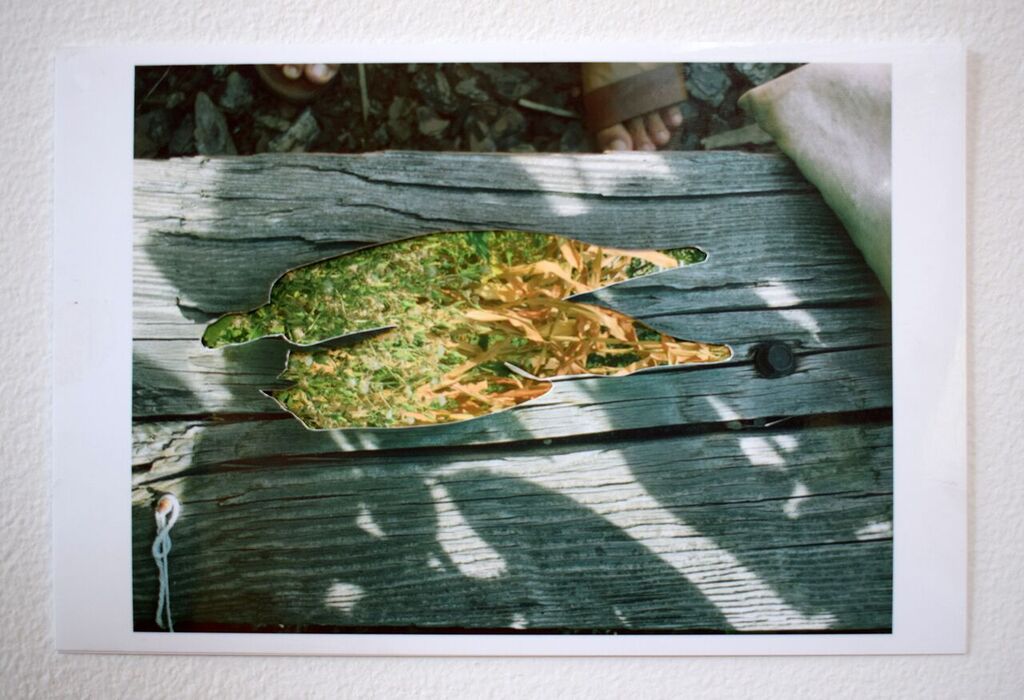
Stephanie A Lindquist, Okra at 103rd 2018 Photo collage, Edition of 5, 7.5″ x 10″.
Firstindigo&Lifestyle: Do you think that flowers, fruits and vegetables, etc. as subjects of art carry ideas about sustainability and environmental philosophical concepts?
Stephanie A Lindquist: Definitely. Potawatomi scientist Robin Wall Kimmerer writes about our need to listen, observe and learn from plants as our teachers–rather than only learn about plants. I truly believe that plants can teach us how to lead sustainable lives if we listen.
Cultures close to nature have the benefit of accumulating indigenous knowledge of a diverse number of plants and their uses than city-dwelling folks. To see, recognize and know thousands of local, indigenous food plants is a powerful way to live in communion with the world. By taking care of widely diverse plants within our local ecosystem, we begin to take care of ourselves too–physically and spiritually.
It is my aim to heighten our awareness and appreciation of indigenous food plants and to collectively reimagine the local cuisine of specific regions.
Firstindigo&Lifestyle: Are there other concepts and philosophies attached to your art?
Stephanie A Lindquist: My work is inspired by the work of many scientists including Mary Abukutsu-Onyango. Since the 90s she has been promoting the cultivation and sustainable consumption of African indigenous vegetables and fruits. On a continent plentiful with plants, it is surprising that most do not eat a sufficient amount of vegetables.
The promotion of these plants have commercial and cultural implications as well as physical and spiritual effects on our health. Most of these plants have been purposefully displaced by genetically engineered cash crops and changing tastes. To rekindle our relationship with the oldest, local plants is also to remember the unique history of the land and how we arrived here.
Stephanie A Lindquist, Cowpea Lannea Edulis Sorghum African Nightshade (East Africa) part of Founded series 2018 Digital print on acrylic 44“ x 50”.
Firstindigo&Lifestyle: Do people act amazed when seeing and hearing about your work?
Stephanie A Lindquist: It has been very satisfying to hear people’s reactions to my work. Even urbanites like me are full of surprising information about plants and their uses, which I happily add to my arsenal of knowledge.
As the daughter of a Liberian-American immigrant and descendant of Swedish and Irish immigrants, I have been invested in reclaiming ancestral knowledge for a long time. Conversing with others about indigenous plants has been a very satisfying way of piecing together our ancestral knowledge of the natural world around us.
Firstindigo&Lifestyle: Who inspires you to do your art?
Stephanie A Lindquist: I admire many artists including Julie Mehretu and Wangechi Mutu. I am also inspired by the authors I read and the emerging artists I meet everyday.
Firstindigo&Lifestyle: How do you design your collages and what is the process like in making photographic prints?
Stephanie A Lindquist: I begin by researching a number of indigenous plants to a specific region and learning about their history, uses, and the people who cultivate them. Next I collect images of them, and if accessible take original photographs of the plants.
I cut the prints by hand and arrange the composition on a smaller scale until satisfied. Next, I digitally produce and print the collage at a larger scale or sometimes hand-cut a larger collage on fine paper.
Firstindigo&Lifestyle: Tell a little more about yourself, where did you study art?
Stephanie A Lindquist: I have studied art since I was little. I received by BA in Urban Studies and Visual Arts from Columbia University. Since then, I’ve had the opportunity to participate in residencies in Rome, Berlin and Staten Island, and to exhibit my work in museums and alternative spaces in New York and California. I also work as an arts administrator.
Firstindigo&Lifestyle: Your objects and prints seem to carry domestic ideas in them, or it gets transmitted as a feeling with the coffee cup on a table, or with the flowers. Does this resonate with your intentions?
Stephanie A Lindquist: Yes, my previous body of work in photo collage was concerned with capturing colorful, jarring, domestic still lives. I often chose the materials used to create the stage in memory of family and friends in my life, like my mother, my partner, or a particular place like the Kitchen Floor. Through collage I bring new meanings to these objects, in this case now where an okra blossoms and fruits. Their patterns are playful, somewhat minimal, abstract, full of textile, and tactile.
Stephanie A Lindquist, Kitchen Floor 2017 Photo collage 14.5“ x 17.5”.
Firstindigo&Lifestyle: Some collages of yours are really colorful. Do you find that colors have significance and carry meaning?
Stephanie A Lindquist: The colors reflect my mother’s textiles, family photographs, and the landscape around me.
Firstindigo&Lifestyle: Do you consider yourself similar to feminist art practices in which domestic life and the everyday gives to details and form in the art?
Stephanie A Lindquist: Yes, in many ways I make my art to create space for feminism and equality among humans and all that lives in the world. I treasure these often feminized spaces of the home and garden. And I enjoy propagating this image into my viewer’s subconscious of a plentiful, sustainable earth.
Firstindigo&Lifestyle: Also your knitted objects would signify not only sculptural dimension as objects that hang on the wall, but also about art-historical connection to the women artists?
Stephanie A Lindquist: The knitted objects Needles and String and Rosary for me were living sculpture–something I could create and disassemble again and again as a public performance and private meditation.
Firstindigo&Lifestyle: How do you separate your own artistic practice from curating, and working with other artists in your work?
Stephanie A Lindquist: I make time for it. I also let it bleed into my research interests and writing. My practice gains a lot from being in such close contact with artists and curators on a daily basis. I am constantly listening to and collaborating with other visually creative minds.
Firstindigo&Lifestyle: Can you describe what art projects are you planning for the future?
Stephanie A Lindquist: I am thrilled to show recent work around indigenous food plants at Smack Mellon as a part of AFRICA’S OUT! inaugural benefit exhibition, Carry Over: New Voices from the Global African Diaspora curated by Kalia Brooks Nelson. To have my work in the context of Firelei Báez, Layo Bright, Melissa Calderón, Baseera Khan, Jasmine Murrell, Anna Parisi, Keisha Scarville, Pamela Phatsimo Sunstrum and Saya Woolfalk is a joy!
I am also looking forward to presenting work at CTRL+SHFT Collective in Oakland this summer. Other than that, I’m excited to spend part of the summer camping and learning more about plants indigenous to the eastern seaboard.
I treasure these often feminized spaces of the home and garden. And I enjoy propagating this image into my viewer’s subconscious of a plentiful, sustainable earth.
Anne Raudaskoski is a Finnish enterpreneur who wishes to create new connection to nature. Her approach can change the game of sustainability. With a background in dance, she has faith on the power of the arts:
“Arts provide a holistic approach to existence, and this is what we need to change the current linear system. Human beings are part of the nature; nature isn’t something that is “out there” to be exploited, but rather, we need to re-establish our connection with the nature to realise that we can create sustainable growth and well-being with far better rules than what we presently have”. (Anne Raudaskoski)
Firstindigo&Lifestyle: When and how did you start Ethica consulting company?
Anne Raudaskoski: I started Ethica in 2013 with my business partner Paula Fontell. We actually didn’t know each other at the time, but we both had been talking to our mutual friend of having a dream to set up a company focused on sustainability and the circular economy. This friend of ours suggested we should meet and share our ideas. We had our first meeting over lunch and we realised we shared the same vision. Three months later Ethica was formally established.
Firstindigo&Lifestyle: How did you get interested in the circular economy?
AR: My approach to CSR (corporate social responsibility) and sustainability has always been very business oriented. It means that there has to be a solid business case for sustainability and it should be embedded in strategy and R&D in such a way that sustainability works as a spring-board for the strategy instead of being an add-on or philanthropy. I wrote about the circular economy (CE) in early 2012 on my blog site after reading some articles on the Ellen McArthur Foundation (the global driver for the CE) site. I felt that some of the questions and pain points that CSR could not resolve – especially the intersection around environmental, strategic and economic issues – were inherently part of the circular economy. So when we started Ethica, it was very clear to us that the circular economy would be part of our service portfolio.
Firstindigo&Lifestyle: Is it possible to define, what circular economy actually changes?
AR: Circular economy is an economic model, so it affects all sectors and organisations in some way. I always say that the biggest hurdle in transition from a linear to a circular economy is our current mindset. All our processes, decision-making, governance and actions are based on linear thinking. In a nutshell, this means that we keep overusing natural resources, we accept the concept of waste as de facto, design processes are not based on biological and technical cycles and we haven’t figured out yet how to do business within the planetary boundaries. All this is changing as part of the transition towards the circular economy.
Firstindigo&Lifestyle: What are the basic principles that define the circular economy?
AR: The below list of six principles offers a good starting point to explore CE more in detail.
1 Circular economy is a resource wise economic model that is restorative and regenerative by nature. It operates within the planetary boundaries.
2. Materials cycle endlessly in technical and biological loops in society. Materials are safe & non-toxic.
3. The value of products, components and materials is maintained and increased through refinement.
4. All energy is renewable and is used efficiently.
5. Solutions are systemic and based on designing life cycles, ecosystems and multiple purposes.
6. Equal distribution of resources and well-being is in the heart of the circular economy.
Firstindigo&Lifestyle: How would you describe the ‘ethical’ core of Ethica?
AR: We want to create a circular future. To us this definition also entails equality, social well-being and in fact, a more just and transparent economic model than what we currently have as the result of the linear economy.
Firstindigo&Lifestyle: Finland seems to be a forerunner for ethical solutions when it comes to consumption, and the country is also involved in introducing new clean practices. What aspects in Finnish culture support these kind of thinking?
Indeed, there are quite a few aspects supporting this and I’d say it’s the unique combination of culture, history and welfare state: high number of clean tech innovations; excellent education system that educates children and young people about sustainability topics; frugal manners that our grandparents and parents had to adopt during the war, which then were passed on to younger generations; good recycling infrastructure with incentives…and of course ambitious policies and action plans in place. For example, circular and bio economy are one of the five flagship programmes of the current government. Finland was also the first country in the world to publish a national circular economy roadmap in 2016.
Firstindigo&Lifestyle: What in your mind defines good consumption?
AR: Understanding your own impact and power as a consumer. Exploring your own values; what kind of world I want to be building, do I want to be part of the solution or part of the problem? Questioning your own consumption habits: is there something that I could do and choose differently? Being your own leader when it comes to adopting new, sustainable solutions.
Firstindigo&Lifestyle: Tell more about your Relooping Fashion project?
AR:Relooping Fashion was about creating circular fashion. We piloted a circular ecosystem consisting of seven business partners ranging from waste management company to fashion retailer and packaging service. So the goal was to build, test and learn how a closed loop fashion ecosystem could work. Another important goal was to test VTT’s (Technical Research Centre of Finland) new technology for cotton dissolution that replaces the use of virgin cotton. Ethica’s role in the project was to model the business ecosystem as well as research the consumer interface. i.e. how to create demand for circular clothing.
Anne Raudaskoski, photo: Janne Häkkinen, JFramesPhotography.
Firstindigo&Lifestyle: Where do you find your daily inspiration from?
AR: No matter how cliché it may sound, I simply and truly enjoy my work, so the work itself coupled with the opportunity learn new things is my source of inspiration. Every project is different, we have great clients and collaboration partners to work with and of course our own team is brilliant.
Firstindigo&Lifestyle: What can the world learn from Finnish innovation in clean practices?
AR: Great education and innovation support system are essential enablers. I also think that the Finnish way of living and thinking inherently has a fairly good level of social and environmental responsibility, and when these aspects are combined with innovation, you get the solutions that the world needs.
Firstindigo&Lifestyle: How do you like to influence and motivate people in their everyday life to incorporate more sustainable solutions and choices?
AR: There are a number of different players who all have a role to play. Of course we need businesses to develop solutions that are not only sustainable, but they’re also the best solutions available. Legislation can speed up the development and help mainstreaming new solutions. Education and the media also play a hugely important role in making sustainable choices the “new normal”.
Firstindigo&Lifestyle: Do you think that your background as a dancer helped you in your career path?
AR: It did in many ways. Working as a freelance dancer requires endless curiosity, self-discipline, perseverance and ambitious attitude. You’re always seeking new opportunities and you need to welcome constant change. You need to be a good team player, but at the same time you’re 100% in charge of your own development. There are hardly any permanent vacancies available, so you have to build your own career and make sure you are sufficiently networked just to be even considered to be one of the many candidates. Basically, you work as an entrepreneur without the formal status of entrepreneur.
Also my dance teacher background has been an asset when running workshops and giving presentations.
Firstindigo&Lifestyle: In what ways can arts support circular economy?
Arts can create connections and mental horizons that escape the typical business environment. It can bridge rational and emotional in a way that enables eureka moment, which is a prerequisite for willingness to change the status quo.
Firstindigo&Lifestyle: How many countries have you visited to lecture and share about your business?
AR: A few so far: China, the Netherlands, Estonia and Reunion Island (France). We also exhibited in Austin (US) at the EcoExhibition a couple of years ago. Next month I’m going to Sweden.
Firstindigo&Lifestyle: Is it easy to name clients that are best for your brand?
AR: The ones who want to work ambitiously, are truly interested in raising the bar and finding new opportunities through the circular economy thinking, no matter the size or sector of the organisation. From the circular economy perspective, we are still at the dawn of the new era and endless opportunities that this new approach can provide us with.
Firstindigo&Lifestyle: Is the questions of climate change significant and embedded in your models?
AR: Absolutely. To start with, all energy should be renewable, this is one of the basic tenets of the circular economy. Decoupling growth from the use of virgin raw materials and resources is another key principle. In short, it means doing more with less and designing our products, systems and societies in a circular way so that emissions can be decreased significantly.
Featured image credit: textile hackathon, Sara Malve-Ahlroth.




 Stephanie A Lindquist, Kitchen Floor 2017 Photo collage 14.5“ x 17.5”.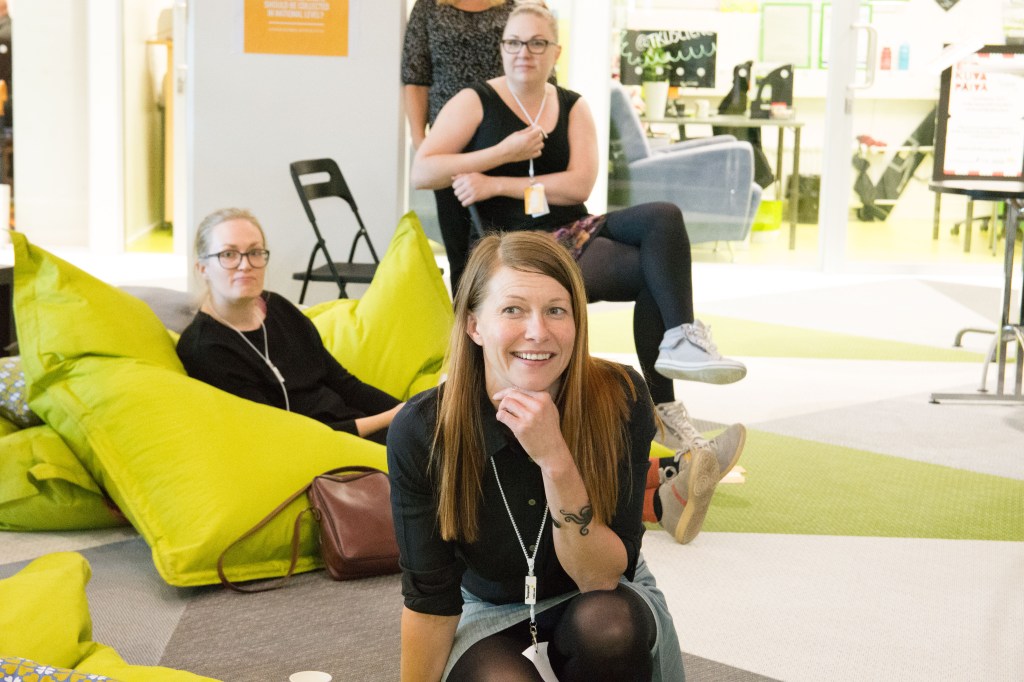

 Firstindigo&Lifestyle