Category: urban planning

  • Future perspectives in verses

    Future perspectives in verses

    Climate Change brings to mind emissions, which require solutions, such as futures with bikes and more car free highways. The planet Earth is calling us to bring nature to the negotiation table. These are the verses for the new year.

    "Nature's rhythm is different from the pace of the contemporary society."

    What we don’t seem to realize is that nature is in fact offering space without asking us to limit our dreams. Two years into the pandemic has changed our everyday perspectives; we have voluntarily moved our lives more outdoors. We suddenly pay attention to dear little details that we see in nature, and think about the future livelihood and living on this planet.

    Nature’s rhythm is different from the pace of the contemporary society. This is also something that this pandemic has taught us oh so well. Did we ever imagine that we would be capable to pause, and start dreaming of a different future? Some of us did dream, at least.

    Looking at the birds in winter, as they descend to a freezing environment.
    "Looking at the birds in winter, as they descend to a freezing environment." 

    Let’s take birds in the winter as an example. What is it in their circumstances, the birds in suburban environments, that is causing us to pause and consider if the animals have enough food.

    Cars, parking lots, people going shopping in their vehicles, trains, commercial projects surrounding geese habitat. What is so special about these animals living next to human habitation, geese in our urban and suburban parks. They make us think changes in season, and how the big birds used to migrate someplace warmer.

    Humans are responsible for destroying wilderness, wetlands, populations, to name a few. With geese, as their extinction was more evident due to destruction of the species natural habitat – the birds were brought into urban areas where they had never been living before. The natural migration cycle stopped and the geese stayed in their new settings. Humans have since then found that the birds’ new existence is perhaps too close, birds taking over parks and parking lots.

    "We can be thankful that they still have some wilderness to roam and be birds."  

    A question of food for geese is a problematic one, since feeding and making them accustomed to vacate human habitat eventually means that nature’s own cycle is being interrupted. Not because geese themselves were opting for these new environments. We can be thankful that they still have some wilderness to roam and be birds.

    "Future perspectives do imply stricter and more compassionate approaches, when it comes to ever busy air and street spaces."
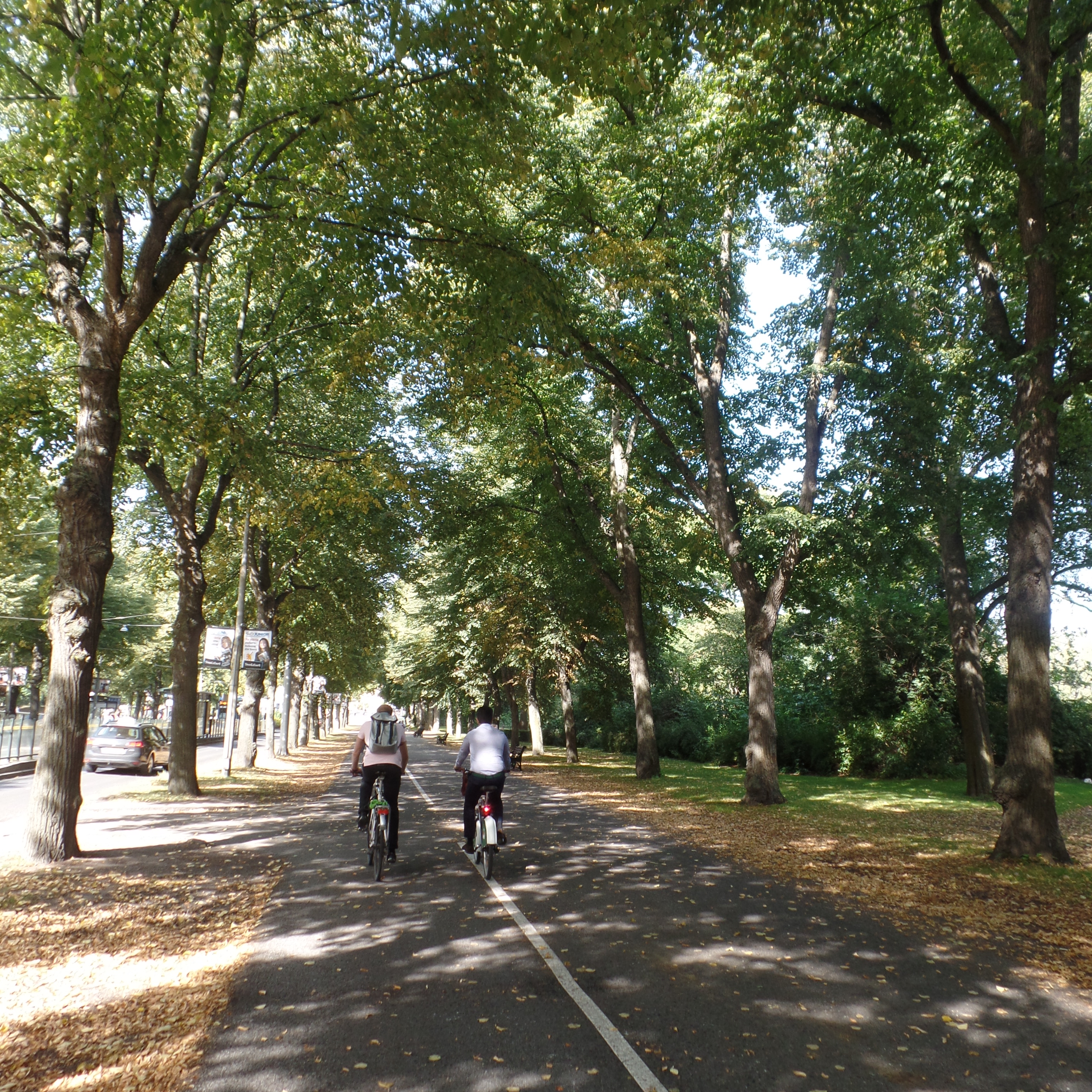
    Biking is an old fashioned green new deal. It also goes together with the nature’s rhythm. The pace is one of wondrous.
    "Biking is an old fashioned green new deal. It also goes together with the nature's rhythm. The pace is one of wondrous." 

    To participate in a green new deal, cutting back emissions is of course not just an act of love for many of us who like to travel and seek far away adventures. Yet, future perspectives do imply stricter and more compassionate approaches, when it comes to ever busy air and street spaces. Cutting down greenhouse gas emissions is easily a foreign language concept or theory that stay away from the realities of modern individuals, who can count cars in the garage. Everybody needs their own car just to get around. How to explain this in simple terms, how to change this pattern?

    "The awakening is bringing nature closer to our communication, forming new communities." 
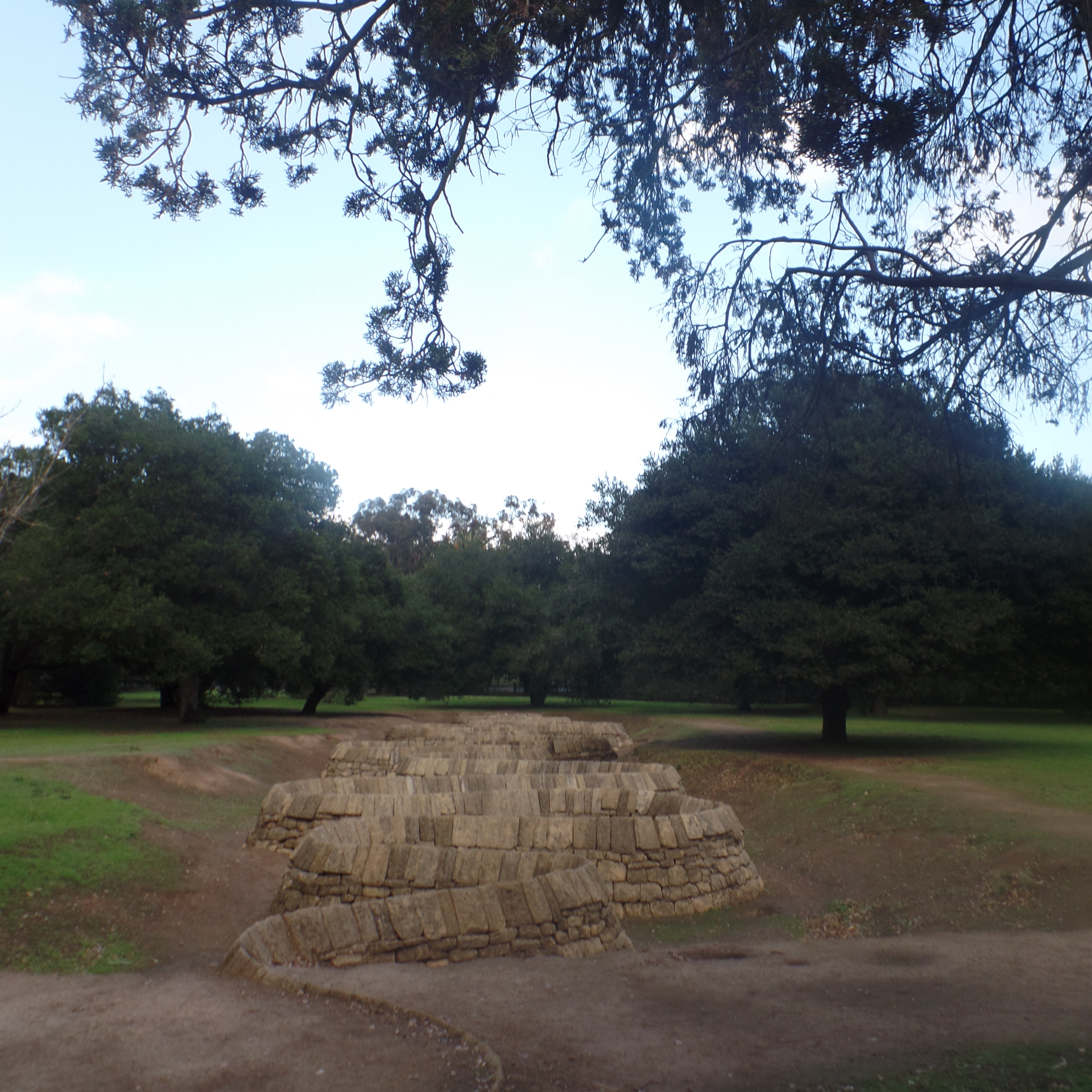
    Stone River by Andy Goldsworthy outside the Stanford University Cantor Center for Visual Arts.

    Futures hold promises for the world in the form of awakenings. Climate coalitions and awakenings for earthy subjects are thankfully becoming one kind of new normal.

    "World, in which constant profit is a standard, and where sustainability and co-creation are like dialects of foreign languages."

    When it comes to art, fundraising is meeting with auction house practices to make equity and ethical planetary standards meet in the productions. How much sustainability can we create with these methodologies, is yet to be discovered – not just in the form of capital, but as acts of recycling, repurposing, and meeting circular economy standards.

    World, in which constant profit is a standard, and where sustainability and co-creation are like dialects of foreign languages. Co-creation implies a communal aspect of creating together. As such it is somewhat strange to Western notions, which rather highlight the success of ego-driven selves.

    At its best, the awakening is bringing nature closer to our communication, forming new communities. Community and art can meet in various ways. The art works that take over public spaces are a great example.

    Outside the Stanford University’s Cantor Center for Visual Arts is a Stone River, a large wall created of sand stones. A sculptural serpentine project created by artist Andy Goldsworthy (2002), is blending with its campus environment, growing naturally in the landscape of trees and meadow, bringing joy for people working and visiting the campus and the Art Center. These stones are remnants of campus buildings. The stones had fallen during two earthquakes that hit the bay area in 1906 and 1989.

    Stone River is composed of rumble that was left behind after two earthquakes.

    The Stone River was inaugurated in 2002 at the campus. Goldsworthy found out that the campus had remnants of historic earthquakes that shook the area, in 1906 and 1989 respectively, forming stone rumble that had fallen off the buildings. He instantly gained a feeling that stones could organically return back to earth, forming a flow which almost seemed that it had archeological origins. As if the stones had been there for a long long time.

    Goldsworthy is referencing rural Scotland, where there is archeological presence of people layering stones, layer after layer like this.

    In Stone River, the stacked stones in the sculpture, set in a nearly 3 1/2-foot trough dug in the earth, rise from a 4-foot wide base to an almost impossibly precise undulating line. “I call it a river, but it’s not a river,” Goldsworthy said. The sculpture is “about the flow. There’s a sense of movement in the material, through the individual stones, so you just see this line.” –Barbara Palmer, Stanford Report

  • Diana Al-Hadid: Liquid City

    Diana Al-Hadid: Liquid City

    Diana Al-Hadid: Liquid City is an exhibition full of history that is so relevant today. Al-Hadid’s solo show is currently on view through September 24, 2017 at San Jose Museum of Art in San Jose, California.  Liquid City is like a micro-cosmos of a world, in which the observer has carefully assembled her sharp point of view towards the core. It features an art-historical study on a matter that is hybrid and timely in the world, where archaeological sites and cultural homes are disappearing in front of our eyes. The subject is immense, but in this exhibition, the history gets rewritten in more pleasant terms.

    The exhibition focuses on Al-Hadid’s creative process by bringing together works and related primary source materials. One example of this fruitful exchange is a large sculptural installation titled Nolli’s Orders (2012), which refers to Giambattista Nolli’s landmark 1748 map of Rome. The artist has included a reprinted folio of Nolli’s map and works on paper by old masters, to support the idea for the sculpture. The two-dimensional papers are an interesting contrast to the three-dimensional sculpture, perhaps showing how the process evolves from sketches to more complete forms. The constellation addresses how works are fluid and in-between states before their final spatial configurations.

    Sculptural centerpiece Nolli’s Orders brings Al-Hadid’s installation idea to the museum space. With the multiple references, the sculpture addresses an idea of a city as public and shared space. Showing private and public structures of contemporary life, it anchors the idea of the sculpture into city with piazzas and fountains. Cities have been shaped around sources of water, around which the people have gathered and shared their belongingness. The conflict, which this work implies, is embedded in the idea of not belonging. It touches on the private spheres in which people feel uncertainty and alienation from firm structures, lacking the real connection to the architecture of the city. Resulting in the shapes as structures without roots, narrative and story?

    The idea of the sculpture continues also in Al-Hadid’s two-dimensional works, which aesthetically relate to its colors and patterns. On the other hand, Diana Al-Hadid has employed yet another ephemeral pattern and style on their surface. In these works, the historical evidence is present as influence of ruins. The dripping paint creates the delicate surface as if showing traces of archeology as rendering marks. During her graduate studies, the artist was influenced by Hellenistic history that is visible in the ruins near Aleppo. She also explored Moorish layers in Spanish cathedrals.

    Diana Al-Hadid, Untitled, 2013, Conte crayon, charcoal, pastel and acrylic on Mylar.
    Diana Al-Hadid, Untitled, 2013, Conte crayon, charcoal, pastel and acrylic on Mylar. Collection of ICG Advisors, Los Angeles. photo: firstindigoandlifestyle

    Diana Al-Hadid: Liquid City is displayed in the SJMA’s central skylight gallery, and as such fits to the space eloquently. The work questions boundaries of the space. Putting together the reference materials is brilliant, as all surrounding works add to the monumental scale of the sculpture. The visual of the artist’s own works is compelling, interwoven, giving a context to a deeper thinking of history. Al-Hadid’s thinking is full of vivid ideas of fusing materials into new order, rewriting history from today’s point of view. How the artist got interested in the borderlines and beloningness/alienation thematic, comes from her own background as an immigrant to the United States. The artist was born in Aleppo, Syria, but was brought up in Ohio, US. Being contradicted with different experiences was a nourishing source for imagination and thinking. The theme connects many fragmented ideas across continents, beyond physical and social realms, and certainly travels across the world with its relevance. The works in the exhibition are far from being literal.

    ***

    More information about the exhibition at San Jose Museum of Art: http://sjmusart.org/exhibition/diana-al-hadid-liquid-city

  • SFMOMA Serendipity

    SFMOMA Serendipity

    The opening of a new expansion of the SFMOMA art museum was celebrated just a couple of weeks ago. The intention of the new Snøhetta designed museum, is to increase public access to the museum by creating more room for education for the arts and related fields, to bridge the gap between the exhibiting gallery spaces and unticketed areas, as well as connect the outdoor spaces around the museum. More room to hang out, to meet, to educate, to inspire and to be inspired. SFMOMA opened at its current location in 1995, when the construction was designed by Mario Botta. For the reconstruction, Snøhetta design team had a challenge to double the gallery spaces, and help create a museum, which is a hub for new things to emerge. The refurbished museum aims to bring together American and International arts, while the collections span through gestural modernism and conceptual art, to the emerging contemporary art from the Bay Area. SFMOMA has also promised to reach out to global art communities at large.

    The new SFMOMA proves that it is possible to reinvent an art museum. First, the museum architecture plays a huge role in creating the potential for the artworks that are being installed, as innovative architecture contests the boundaries of the space. This time, museum interior communicates with the exterior. Snøhetta has created a construction, which is seamlessly woven into the existing building, adding into the city’s urban dreams. As a result, the museum goes beyond its construction site, and communicates with surrounding parks and alleys. This proves that the ‘institutional’ side of the museum’s bureaucracy is set in the background, and the numerous stages of the public dwellings offered to the visitors is more apparent. A visitor attains the key role through the alteration of the spatial elements. Having so many choices to play with, the architecture transmits the perception, and creates together with the artworks a unique encounter for each visitor. The architectural line, it’s material continuation inside and outside sparks into multiple directions. Second, art plays with architecture in a new and unexpected ways, and changes the constructions too. With Richard Serra, Sol LeWitt, and Alexander Calder, among others, it’s hard to make the space appear as null. But there is so much art in the world to add into the master classics. New works show as much potential to communicate with the space.

    A new contemporary art installation inaugurates the museum’s New Work -space. Leonor Antunes, has created work with a title ‘a spiral staircase leads down to the garden’ (2016).  This piece communicates with the architecture, showing diverse angles to enter the gallery space. The artist has stated that she carries ghosts with her into her works, in bringing artists, designers, and architects whom she admires to her installations. ‘a spiral staircase leads down to the garden’ is no different, appearing as a continuation of the space as an interior. The handcrafted materials cover the floor, hang from the ceiling, light the space, and block a direct path. The installation shows the artist’s interest in the Modernism, highlighting especially the woman practitioners in the history of craft and design.

    Leonor Antunes, installation view at SFMOMA.
    Leonor Antunes, 2016, installation views of her new work at SFMOMA.

    Leonor Antunes, new work at SFMOMA.
    Leonor Antunes, ‘a spiral staircase leads down to the garden’, 2016, Brass, cork, leather, hemp rope, nylon yarn, monofilament yarn, steel, electric cables, light pulps, brass and Bakelite light bulb sockets, and foam. Courtesy of the artist and kurimanzutto, Mexico City.

    The Doris and Donald Fisher Collection creates much of the museum’s art collection. In particular, noteworthy is the display around the historic gestural abstraction, which started molding the American Art after the end of the World War II. The movement started to erase questions about the art’s capability to evoke thoughts and feelings. Perhaps it originated in the idea of believing in the healing mechanisms of the art. One work is particularly interesting. Joan Mitchell’s large size triptych ‘Bracket’ (1989), is a great example of the instantaneous moment in art. For her, painting could represent similar forces as the sculpture, forging out the movement and physicality.

    Joan Mitchell, Bracket, 1989, oil on canvas, is an example of the gestural modernism.
    Joan Mitchell, Bracket, 1989, oil on canvas, is an example of the gestural modernism.

    The show around gestural modernism is well thought out as part of the SFMOMA’s new opening. It reaches up to redefining the concept of a gesture via selection of works. This becomes a red thread to other artistic displays as well. The museum exhibits plenty of work coming from the plural identities of the Bay Area, yet, some combining elements construct a more cohesive palette. The best part is that the transitional space of the West Coast and its cultural crossroads confuses the pattern of the gesture as something fixed, measured, white and universal. The inside of the culture is turned outside, as much as the architectural environment overlaps both domains.

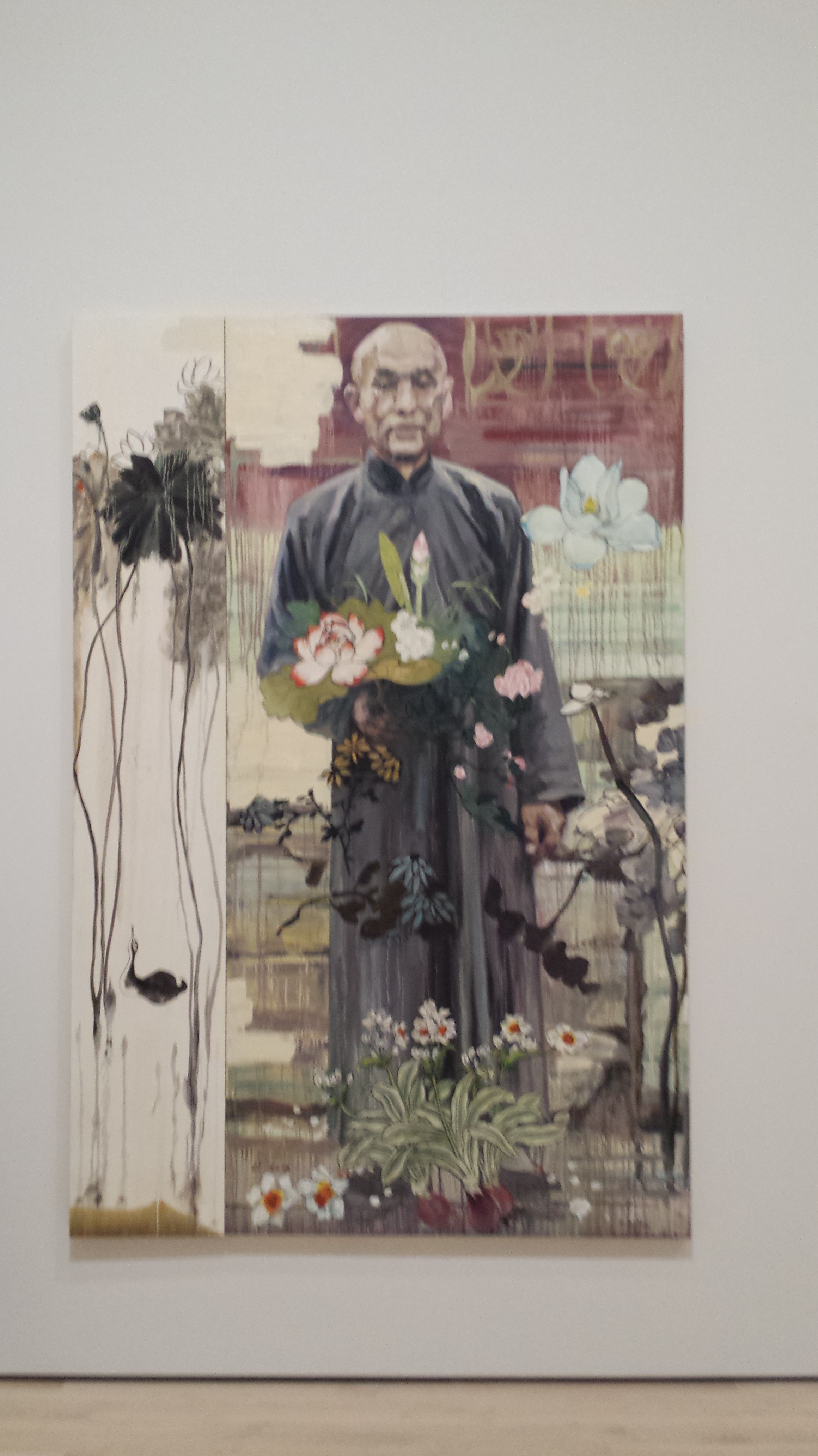
    Hung Liu's oil on canvas.
    Hung Liu, The Botanist, 2013, oil on canvas.

    The contemporary artworks do not create separation, but quite wisely culminate in supporting each other. Series of contemporary works follow black and white patterns, with a hip touch of pop art, and borrowing from chic minimalism of American interiors. These could of course be easily absorbed into the world of design and culture lending to Modernist and Postmodernist architectural patterns. Over all, the sometimes too heavy collective experiences are not so much emphasized, and there is more room for subdued artistic politics. Fragmented selves and posthumous experiences, ghosts of the artist’s personal influences as part of the installation define the process in the contemporary art.


    Images: Firstindigo&Lifestyle.