Category: urban planning

  • The Egg provides environmental harmony

    The Egg provides environmental harmony

    What is a role of architecture in democracy is a grand question to ponder. First critical question can be directed to the volume of buildings in our urban public spaces. The human scale, people and architecture relationship cannot be taken for granted. Architecture may also be a spoiled industry. The problem is that architecture is sometimes taken as harmless, not harming the environment. It is easier to point to the exploitation of environment by oil and gas industries.

    Democracy plays also with massive volume. It wants to show off. Former governor of NY Nelson Rockefeller commissioned a plan to elaborate Albany as a state capitol. Imagine a relatively small town in Upstate New York that has an appearance of a state capitol hosting democratic ideals in architecture. Such is the story of the Empire State Plaza.

    The story goes that Nelson Rockefeller drafted himself the basic designs for the Albany’s government campus. Architect Wallace Harrison revised the plan, which included mixed aesthetical styles in it. The aesthetics of Versailles, Indian capital Chandigarh’s urban designs by Le Corbusier (in 1950s), and Brazilian architecture were used as inspirations to create plaza of the democracy: for all the people of New York. Overall, the idea was that the urban massive scale would be visible also as a feature across the Albany skyline. What one can see are the mixed styles of modern architecture and some elements of the baroque style coming from the French palace. Contradictory idea, as this mixture might appeal to people who come to visit the city, yet the city itself is quite small to attract with such a volume. For what reason? To show off the democracy’s playground?

    Behind this critical questioning is, in fact, a deeper question about the functioning of the plaza/place. How could the massive buildings be incorporated in the people’s everyday life? The role of public places, which the Empire State Plaza in Albany also is, is to be building democratic societies. Many architectural associations and sustainable development programs have been pondering how to use this type of urban spaces better.

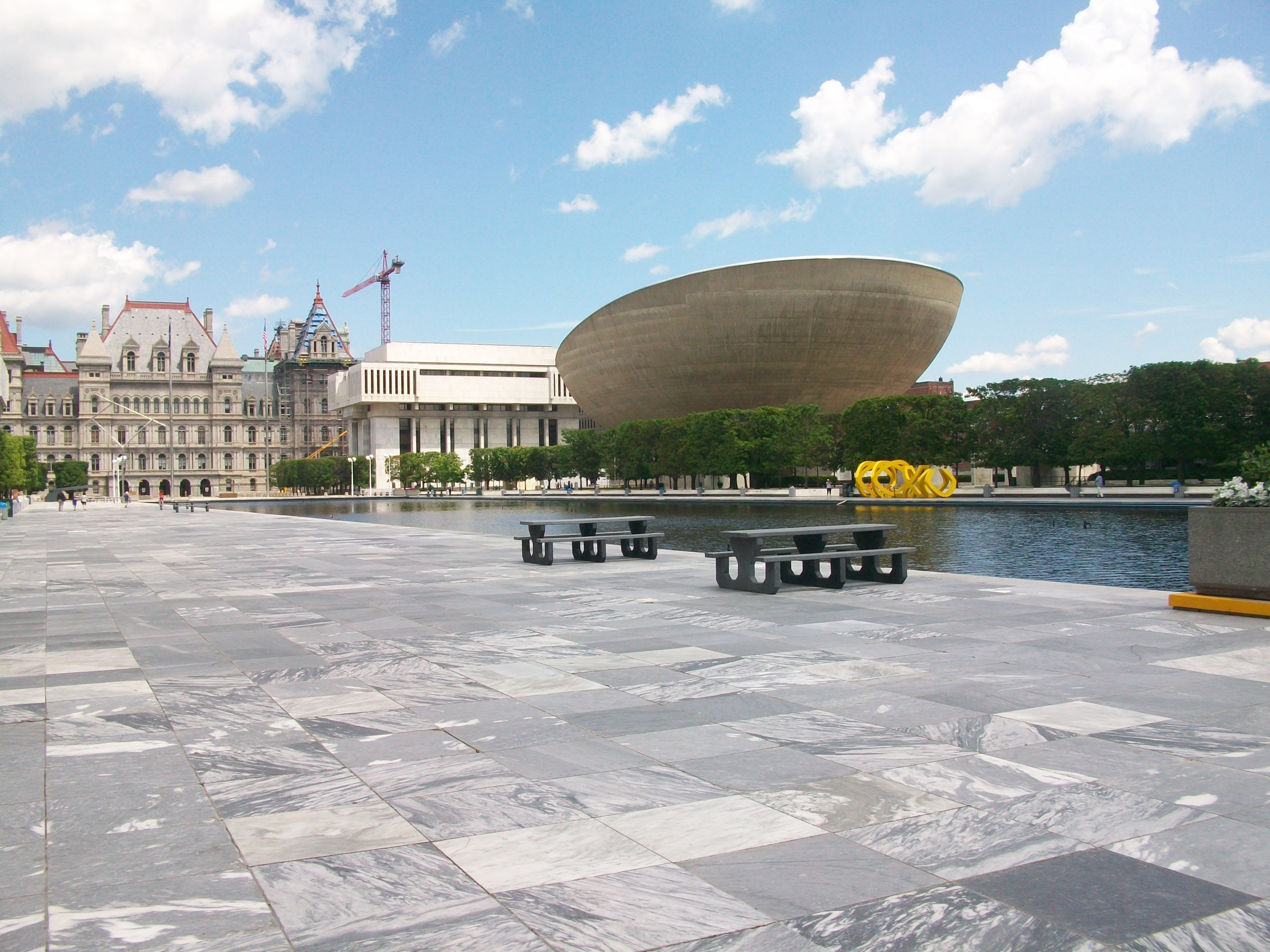
    When I was walking on the Albany campus, the buildings around me felt massive. For example, The Egg gives out an exterior, which is changing according to the viewpoint. It looks like a spaceship with a robotic structure from some angles, feeding more an imagination of ‘the off-limits’. The Egg feels too massive and claustrophobic to be inviting as a structure, yet it certainly is full of curiosity, which actually nourishes me with an imagination that the interior might hold happenings that are inventive, new and futuristic. The form gives me expectations.

    Then again, The Egg is harmoniously nesting in its environment. It shows evidence of an amazing era in modernist architecture. Despite of its massive sculptural looks it appears actually as harmonizing entity. The plaza’s plentiful atmosphere with all the modernist sculptures looks more peaceful with the Egg.

    The Empire State Plaza campus can be a place where you sit down and eat your power lunch, or mingle like a tourist. Yet it would be hard to imagine that public assemblies would take place in it. It is really not a place for Occupy Wall Street– type of events. In fact, Occupy Albany -protestors were arrested quite soon. The place attracts tourists and visitors, and people, who work in the area in administrative jobs. As hangouts for locals who walk by as part of their daily activity, the significance is of course evident. American society of civil engineers nominated the building with The New York Outstanding Civil Engineering Achievement in 1979.

    The construction of The Egg began in 1966 and it was completed in 1978. Like the plaza, it was meant for all the people of New York State. The Egg hosts a Performing arts center. A quick overview to the program shows it as quite conservative. One would expect the Egg to host innovative programs, workshops, performances and festivals. It houses the Lewis A. Swyer Theatre and the Kitty Carlisle Hart Theatre; the interior is also reflecting the exterior. The walls are curving upward; the theaters provide intimate settings (Swiss pear wood veneer provides both warmth and good acoustics).

    Overall, The Egg is made durable. The stem goes deep down into the earth through six stories, and the structure is by a girdle that is made as a reinforced concrete beam. The beam helps to transmit the weight onto the supporting pedestal.

  • I found this architecture book from St. Mark’s Bookshop

    I found this architecture book from St. Mark’s Bookshop

    What a nice thing to find out that St. Mark’s Bookshop can celebrate its upcoming 34th anniversary with victory.  Cooper Union agreed to a new one-year lease to reduce the bookshop’s monthly rent, this was necessary so that the bookshop can continue serving the Lower East Side community (and other visitors as well).  Every signature did count, I was one among the 44,128 on the online petition. The organization behind the action is the Cooper Square Committee, and for over 52 years it has ensured that the diverse community of Lower East Side may continue to bloom.

    The bookshop has become my favorite, it is a smaller scale, and yet, the books that the store carries makes it really a big bookstore. Among subjects of philosophy, arts, religion, psychology, social sciences and so forth, St. Mark’s Bookshop carries great books about architecture and design. I found one of my favorite architecture books from their selection.

    ‘The Architecture of Deconstruction: Derrida’s Haunt‘, is a book written by architecture professor Mark Wigley (1993, paperback 1995, The MIT press).  The following theme of ‘the image of the house, and the visitors in the house’ offers a good puzzle for reading architecture from more deconstructionist points of view. In the narration, “it is the spacing that makes the architecture possible even while, or, rather, only by, violating its apparent order” (1995, 219). The sense of space, the rhythms of spacing, come about with the visitors, the house guests. It is the visitor, when entering the space, who brings forth the laws of the house by his well-rehearsed behavior, or by her disruption of the space. What is compelling in this puzzle is that, especially the ill-behaviored guest actually provides the law of the house by her disruption of the space; whereas architecture itself stands for the all-too-welcome house guest, who would guarantee the space.

    The idea of the inside and outside of the space, the house and the architecture is interesting, because it seems that the outsiders would create the space/architecture when entering into it. Fascinating thinking. This can be applied to considering our contemporary architecture as well. A question would be, how can we as diverse communities share the same urban public spaces that we use, when in fact each of us perceives and experiences the ‘same’ spaces so differently? From Derrida’s point of view, perhaps, the idea of the ‘same’ space sounds to be false, since the visitors, outsiders (we), who, each time while entering it, actually make the space?  So, the urban environment would also be experienced by and as diverse encounterings and as the spacings, which show the urban environment as possible. The book offers us a puzzle, which can go on and on.

    …back to the St. Mark’s Booshop: Join the Victory Celebration and the St. Mark’s Bookshop in their 34th anniversary, on Thursday, December 1st, 2011, between 5:30-7:30. The address is 31 Third Avenue (corner of 9th street).

  • Eero Saarinen’s TWA in Open House New York

    Eero Saarinen’s TWA in Open House New York

    (TWA-terminal)

    I am proud to be Finnish appreciating our architectural roots. Finnish-American Eero Saarinen’s father Eliel Saarinen was an architect visioning Finland’s future together with the architect partners Herman Gesellius and Armas Lindgren (the firm was established 1896). Architect-trio designed Finnish Pavilion for the World Expo in Paris is 1900s (Exposition Universelle). Finland, The Grand Duchy of Russia at that time, was first time exhibiting its designs in the own pavillion, so appearance in the expo was creating a strong sense of new future (Finland gained independence from Russia in 1917). Architects Gesellius, Lindgren and Eliel Saarinen designed Hvitträsk in Kirkkonummi (near Helsinki). Constructed in 1902, It was first the firm’s studio and became then Saarinen’s private home. The house was named after Lake Vitträsk, [H]vitträsk meaning White Lake. The striving National Romanticism and Jugend/Art Nouveau of the late 19th and early 20th century opened up the way to the modernism and futuristic agendas in the arts and design.  Finland’s national epic The Kalevala (Finland’s poems), which had been published in 1849, inspired the designers and architects with mythologies and epic poetry in the earlier times, the mythical characters might still enter the modernism in new abstract forms.

    In New York, Eero Saarinen designed TWA-terinal. It opened in 1962 (another wing was added in 1969). TWA inspires with the natural organic forms and continues to be a timeless piece that shows the essence of environment in the architectural structure?  The monument does not threaten people with massive interiors, but organically pads and holds. TWA should be open for public and it should be site for great artistic works, a surrounding for innovations and discussions, as the design echoes sustainability and continuation. When TWA terminal opened it paraded modernism with red-colored seats and swanlike arches. Curvy white lines of modernism speak in the Flight Center, and it pays homage to the era in architectural history.  A question is timely today as the terminal is open to public for visit as part of the Open House New York weekend.

    (below: Hvitträsk in Kirkkonummi)