Category: Venice Biennale

  • Ocean Space in Venice meets indigenous art

    Ocean Space in Venice meets indigenous art

    During the opening week of the Venice Biennale, there are multiple programs of artist talks and performances taking place. This is also true in the Ocean Space-an art and scholarship incubator that was established in 2011. It has supported artistic production and environmental advocacy, bringing together collaboration and creating knowledge that is often missing in mainstream science.

    In the decade of ocean, while many conservation efforts are taking place across the world’s oceans, it is timely that Biennale in 2024 will have a program around the ocean. Playfully coined in the program’s title “Re-stor(y)ing Oceania“, the new exhibition and performance series in Ocean Space may just do that, restoring and mending broken practices. In a multidisciplinary artistic way, two new site-specific commissions by indigenous artists who come from the Pacific worked with a curator Taloi Havini, who is herself an indigenous artist from the Pacific. The new commissions by artists Latai Taumoepeau and Elisapeta Hinemoa Heta combine performance, sculpture, poetry, and movement. Bougainville-born curator Taloi Havini returns to Ocean Space after her own 2021 solo exhibition there.

    Ocean Space is part of TBA21–Academy, which as an educational branch of TBA21 (Thyssen-Bornemisza Art Contemporary) is a center for research initiatives. Ocean Space fosters a deeper relationship with the ocean and waterways, using art to inspire action. The center has been bringing art, science, policy and conservation around the same table.

    TBA21–Academy’s Ocean Space reopened “doors of the Church of San Lorenzo” when inaugurating their home in Venice few years ago. It has become a global incubator presenting and creating action and literacy about the ocean, creating programs and events around different artistic practices, design, architecture and research. Education programs, exhibitions and performances, also open the season of Ocean Space during the 60th Biennale Arte.

    Curator Havini’s vision is guided by an ancestral ‘call-and-response method’. She uses the concept as a vehicle to find solidarity and kinship in times of uncertainty. When exploring knowledge, she is focused on production, transmission, inheritance, mapping, and representation. Havini examines these in relation to land, architecture, and place. “Re-stor(y)ing Oceania” opened in Ocean Space on March 23, 2024, and will be on view through October 13, 2024, during the Venice Biennale.


    Real threats to life call for the need to slow down the clock on extraction and counter this with reverence for life of the Oceans.

    The Pacific Islands are one of the regions most impacted by the damaging effects of climate change. The area has many Indigenous leaders and entire communities who have participated in the call for action on the rising sea levels, and have advocated for the climate emergency that the planet is facing. There is more study of the crisis now, and there is a greater awareness of what is going on in terms of urgency, risk mitigation, and what it means to be vulnerable when it comes to the future of ocean-front communities. The indigenous artists have a voice in this continuum-their perspectives from across Oceania, Australia, and the Asia-Pacific, including the Diaspora, bring exchange and conversation. These voices create the meeting point around which the performances and exhibitions take place.

    The conversations and happenings in Ocean Space include three days of live performances held over the Venice Biennale vernissage week (April 16–20, 2024). These will also remain accessible online after the events. There will be a new archive of stories, including voices from the First Nations artists, curators, writers, community leaders, poets and musicians. Additionally, collaborators include navigators, sailors, fisherfolk and scholars, who will navigate the world’s oceanic spheres, and create further understanding about ocean’s existence.

    For the new commissions, curator Havini invited artist Latai Taumoepeau, who uses faivā (performing art) grounded in Tongan philosophies of relational vā (space) and tā (time). Taumoepeau is 2022 ‘ANTI Festival Live Art’ (Finland) Prize winner.

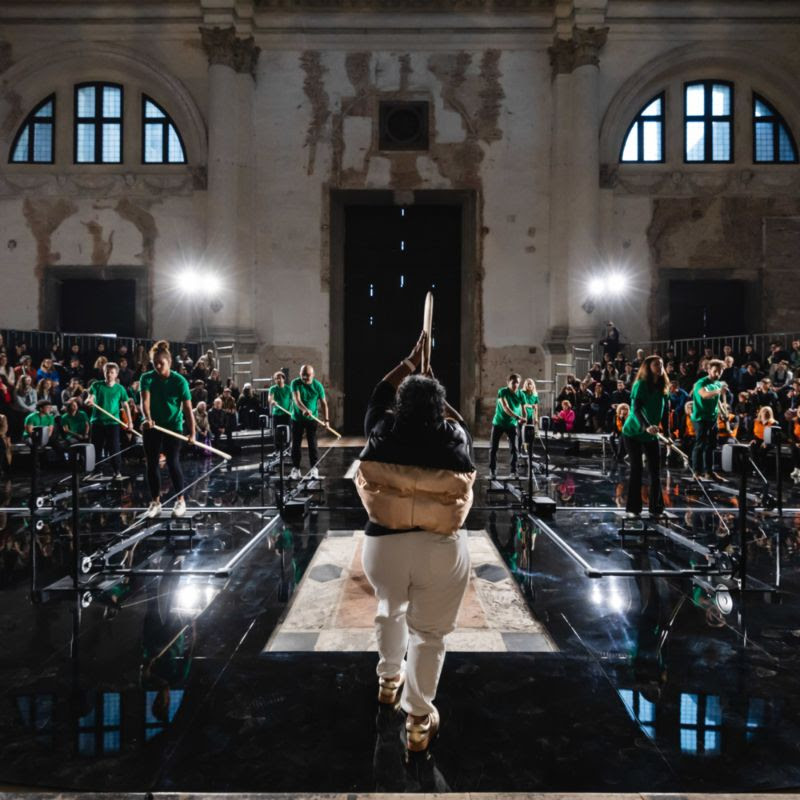
    Centered in the body, faivā cross-pollinates ancient and everyday temporal practices to make visible the impact of the climate crisis in the Pacific. In the artist’s own words, ‘The more ancient I am, the more contemporary my work is’. The artist’s commission addresses deep-sea mining in a new choral work. Her resistance is shown in a poetic way, using songs that share a power to store histories and carry values and knowledge in Taumoepeau’s homeland of Tonga. The newly commissioned work, Deep Communion sung in minor , “ArchipelaGO, THIS IS NOT A DRILL”, engages audiences in the process of giving Pacific islanders an opportunity to be heard in front of diverse audiences.

    There are sculptural and interactive machines installed in Ocean Space, which provide audiences with opportunities to engage with the Deep Communion sung in minor. Participants can either activate the installation – which will trigger part of the musical score – or take a seat in the surrounding bleachers to witness the performance. The work is being perfomed by local sports teams in live performance events.

    In response to Taumoepeau‘s new solo commission, a live project space has emerged at Ocean Space that was created in collaboration with architect Elisapeta Heta, a Māori, Samoan, and Tokelauan leader and advocate for change. Her imagination has provided Maori and Pasifika perspectives on the importance of place to design and cultural identity, and brought that knowledge to Ocean Space.

    As her response to the exhibition, the architect includes a new installation that uses a multisensory embodiment of ‘The Body of Wainuiātea‘. This title of the work means a ceremony combining ritual and a ceremony guided by the Māori concept of tikanga. She comes from Aotearoa, New Zealand, using the concepts from her ancestral lands alongside those from across the Te Moana-nui-a-kiwa.


    Tikanga is derived from the Māori word ‘tika’, which means ‘right’ or ‘correct’, so to act in accordance with tikanga is to behave in a way that is culturally proper or appropriate.

    The space is welcoming visitors and audiences, as it is also designed for exchange and collaboration. The space is formed around the ancient way of knowing and relating through story, and waiata (song). The goal is to connect to a greater awareness of atua (the gods’) connections to the Ocean. The tapu (sacred) is very much needed by current environmental and scientific campaigns, which seek to protect the life of the planets’ largest bodies of water.

    Hosting guests through various forms of storytelling, is a common practice in the Pacific communities. Heta’s work, The Body of Wainuiātea, is a safe space for a network of artists, curators, writers, community leaders, poets, musicians, as well as ocean-professionals and scholars to come together. Collaborators include Dr Albert Refiti, Hiramarie Moewaka, and Rhonda Tibble.

    The program is commissioned by TBA21–Academy and Artspace, Sydney, and produced in partnership with OGR Torino culture and innovation hub.

    — — —

    Curator Taloi Havini (Nakas Tribe, Hakö people) was born in Arawa, Autonomous Region of Bougainville and is currently based in Brisbane, Australia. She employs a research practice informed by her matrilineal ties to her land and communities in Bougainville. This manifests in works created using a range of media, including photography, audio – video, sculpture, immersive installation, and print. She curates and collaborates across multi-art platforms using archives, working with communities, and developing commissions locally and internationally.

    Latai Taumoepeau (b:1972 Gadigal Ngura (Sydney), Australia) makes live-art-work. Her faiva (body-centred practice) is from her homelands, the Island Kingdom of Tonga and her birthplace, the Eora Nation. She mimicked, trained, and un-learned dance in multiple institutions of learning, beginning with her village, a suburban church hall, the club, and a university. Latai engages in the socio-political landscape of Australia with sensibilities of race, class & the female body politic; committed to bringing the voice of unseen communities to the frangipani-less foreground. Latai has presented and exhibited across borders, countries, and coastlines. Her works are held in private and public collections, including written publications. Latai is the 2023 recipient of The Creative Australia Emerging and Experimental Arts Award following her win of the 2022 ‘ANTI Festival Live Art’ Prize in Finland.

    Elisapeta Hinemoa Heta (Ngātiwai, Ngāpuhi, Waikato Tainui, Sāmoan, Tokelauan) is a multidisciplinary artist, designer, and mother, living and working in Tāmaki Makaurau, Auckland, Aotearoa New Zealand. Elisapeta’s career has spanned architecture, art, writing, film and performance, teaching and research and has resulted in a rich tapestry of collaborative works and projects that are centered on indigenous mātauranga (knowledge and ways of knowing) and tikanga (protocols and ceremony). In working through multidisciplinary practice, Elisapeta creates experiences that make visible our stories, many of which have been hidden, with a focus on indigenous and wāhine (women) centered story-telling. Through her art practice, Elisapeta, in collaboration with photographer John Miller (Ngāpuhi), took the exhibition Pouwātū: Active Presence to the 22nd Biennale of Sydney: NIRIN 2020, and brought it home to Objectspace Gallery in Tāmaki Makaurau (March – May 2021)

    Program in Ocean Space: March 23-October 13, 2024.
    Address: Chiesa di San Lorenzo
    Castello 5069, Venezia

    Photo: Latai Taumoepeau performing her work ArchipelaGO, THIS IS NOT A DRILL with local sports team in Ocean Space.
  • Yuko Mohri creates the Japan Pavilion in Venice

    Yuko Mohri creates the Japan Pavilion in Venice

    Yuko Mohri is creating Compose for the Japan Pavilion in this year’s Venice Biennale. Mohri is putting focus on environmental issues with her work, which acts like a circular economy approach to creating art. With a title that etymologically references “to place together” (com+pose), the exhibition questions what it means for people to be together – at home, in society and at work – that pandemic changed. The post-pandemic world also faces a planetary climate emergency.

    The exhibition in the 60th Venice Biennale runs from April 20 to November 24, 2024, with the inauguration on April 17 in Japan Pavilion (Giardini di Castello, Venice). Compose is curated by Sook-Kyung Lee, Director of The Whitworth in Manchester UK, and it is organized by The Japan Foundation.

    Mohri who is interested in organic ecosystems is right at home in Venice. She has focused on the 2019 Venice floods and rising sea levels. The theme ’soft and weak like water’, which is a reference to the classical Chinese text ‘Dao De Jing’, is a source of inspiration for Mohri. The text by Lao Zi acts as a metaphor for change as “generated through gentle and persistent force”. The artist also created work for the 14th Gwangju Biennale in the Japan Pavilion. Her collaborator, curator Sook-Kyung Lee was the artistic director of the Biennale.


    Yuko Mohri has long been interested in the crisis and its connections to paradoxical creativity. She was interested in the Tokyo subway workers who needed to find solutions to water leaks.

    Utilizing materials that are sourced locally, from Venetian antique stores and furniture shops, as well as from grocery stores, liquor stores, and farmers and flea markets, Mohri took over the whole pavilion and made it to her own studio for a few months prior to its public opening.


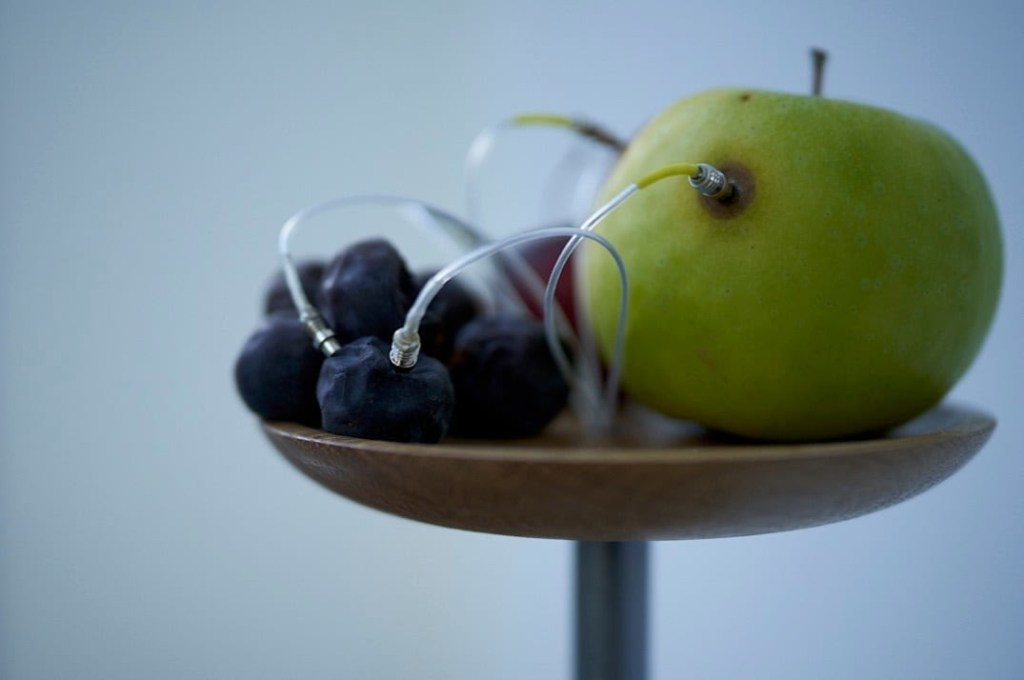
    From floor to ceiling – installation’s organic forms include experimental elements and acoustic sculptures, which are made of rotting fruit. Mohri’s creation repeats a series a works that are unified by a common element: water. The artist’s latest installations, Decomposition and Moré Moré (Leaky) will emerge as rare site-specific, one-time realizations presented in the Venice Biennale.

    The work Compose, additionally references the legacy of composers and artists; Erik Satie, Marcel Duchamp, John Cage, Nam June Paik, and the Fluxus Movement. All of these artists had an experimental approach, using methods of chance and improvisation as a basis, and strongly commenting on everyday mundane life with their works.

    Yuko Mohri takes a stance on nature, which is disappearing, and environmental catastrophe. Even if not literally, what is highlighted as the latent “changing events” of creating ecosystems that will be disappearing, are bound to water, the scarcity of it, and the flood that comes with it. Still using very familiar everyday objects as their backdrop.

    Known for her installations that are like ‘events’, Mohri creates changing environmental conditions for the Pavilion. It will be an event of light, sound, movement and smell.

    Mohri was born in Kanagawa, Japan in 1980 and now lives and works in Tokyo. She has been included in a number of international group shows including the 14th Gwangju Biennale (2023); 23rd Biennale of Sydney (2022); Asian Art Biennial (2021); Bienal de São Paulo (2021); Glasgow International (2021); Tai Kwun Contemporary, Hong Kong (2021); Ural Industrial Biennial of Contemporary Art, Russia (2019); Palais de Tokyo, France (2018); Asia Pacific Triennial of Contemporary Art (2018); Biennale de Lyon, France (2017); Centre Pompidou-Metz, France (2017); Kochi-Muziris Biennale, India (2016); Yokohama Triennale (Japan, 2014), among others.

    Featured photo: Courtesy of Yuko Mohri and Tanya Bonakdar Gallery.

  • Southeast Asian voices in Venice Biennale

    Southeast Asian voices in Venice Biennale

    A historic Venetian palazzo is a stage for the Southeast Asian artists to showcase during the 20204 edition of the Venice Biennale. The palazzo is located in the Cannaregio district near the grand canal and hosts an exhibition “The Spirits of Maritime Crossing”. A group exhibition by artists from Southeast Asia, examines topics of displacement, the diaspora, and colonialism using the ocean as a metaphor. The exhibition is on view from 20th April to 24th November 2024 at Palazzo Smith Mangilli Valmarana. The space hasn’t been accessible to the public for 11 years.

    The exhibition highlights a timely topic of colonialism and wars that have happened throughout the Southeast Asian region. When the voices also include indigenous points of view, the artists have chosen to speak about the importance of nature and the spirituality that is embedded in the land and its ancestral connotations.

    The Spirits of Maritime Crossing exhibition is curated by Prof. Dr. Apinan Poshyananda, who is also Chief Executive and Artistic Director of Bangkok Art Biennale (BAB). With the BAB Foundation, the Venice exhibition is co-hosted by One Bangkok.


    The curator shares about the exhibition,

    “We are delighted to present a survey of Southeast Asian artists to international audiences in the Global North to coincide with the Biennale Arte, ahead of Bangkok’s own biennale in October 2024. Moreover, it is a great honor that a new short film featuring world-renowned Marina Abramović, winner of the Golden Lion at Venice Biennale in 1997, will be shown within the exhibition. The contents of this film and exhibition that focuses on sea travel, displacement and diaspora relate directly with the main Exhibition. It is fascinating to see such synergy across Venice.” (Prof. Poshyananda)


    Prof. Poshyananda created a film which brings the East and West together. The film features well known performance artist Marina Abramović together with Thai dancer and choreographer Pichet Klunchun.

    Mediums such as painting, sculpture, mixed media and video installations, bring together fifteen artists from Cambodia, Indonesia, Laos, Myanmar, Malaysia, The Philippines, Singapore, Vietnam and Thailand. The complex realities and diverse cultures, as well as the histories of the region, meet the Western narratives in this Venice exhibition.

    Cambodian artist Khvay Samnang, directed Calling for Rain, which explores deforestation that has been a major problem in Cambodia. Other films include Hunting & Dancing: 15 years by Moe Satt; There’s no Place by Jakkai Siributr; The Sea is a Blue Memory by Priyageetha Dia and many more works by renowned artists displayed across the palazzo. A collaborative two-channel video installation by Chitti Kasemkitvatana and Nakrob Moonmanas, presents a montage reflecting on the parallel worlds of Italy and Thailand, displaying the multitude of languages and cultures.

    The exhibition is a journey from Southeast Asia to Venice through cultural and diasporic experiences looked through the eyes of those who don’t live in their homeland; this includes both physical and spiritual aspects.

    Southeast Asian artists share many similarities, while also differing in ethnicity, religion, and their languages. This can create a sense of ‘foreignness’ among the artists. The legacy of each of them, however, resonates with a notion of a ‘cultural hybrid’, as among them are also refugees, immigrants, and stateless people, who create new identities in the diaspora.

    Many of the artistic works dive into the indigenous histories, and narrate about the environmental impact of colonialism. Many of us know that environmental destruction, loss of land and livelihood as well as displacement, are common struggles told in the Southeast Asian stories.

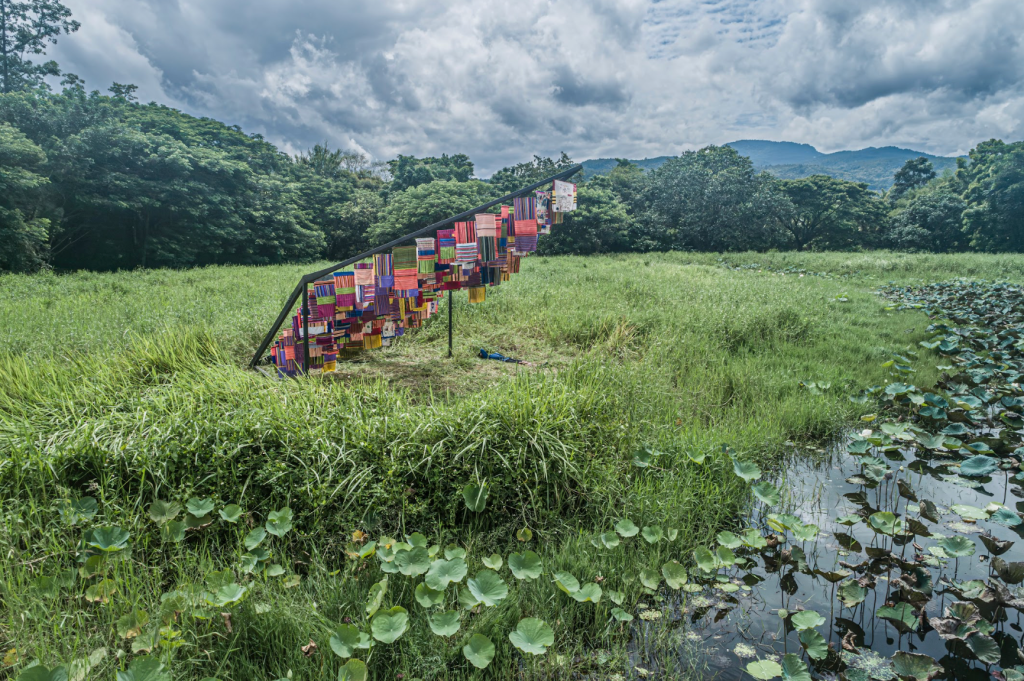
    Cambodian artist Khvay Samnang’s video work examines hegemony and deforestation in Cambodia. It is a story of local worship inspired by Ramayana, an ancient poem. Yee I-Lann’s film depicts a collaboration with weavers and local sea-based communities to revive ancestral knowledge. The story is about the maritime and indigenous histories in Malaysia. Jakkai Siributr has used textiles to provide commentary on ethnic cleansing in society. The topic resonates in the intricate embroideries that have been created together with asylum seekers. Moe Satt, who is a performance artist, uses his body for identity and estrangement. He has a voice about survival of the violence in his homeland Myanmar. Also, a performer, Kawita Vatanajyankur creates works about foamy blue dye highlighting female labor in patriarchal society and focusing on the role of water in the context of femininity and the textile industry. Priyageetha Dia’s video of the deep sea examines ancestral migratory movements from India to the Malay Peninsula. Truong Cong Tung shows an installation of gourds that draws upon mystical ritual and indigenous mythologies.

    The Spirits of Maritime Crossing-exhibition also features paintings and a bronze sculpture by Natee Utarit, who blends Buddhist philosophy and Western art history, showing a meeting of East-West influences. Metal sculptures by Bounpaul Phothyzan are crafted using found bombshells, exploring the historical impact of American occupation in Southeast Asia, documenting the region’s tumultuous past.

    Jompet Kuswidananto’s installation of shattered chandeliers examines the history of colonization, with a focus on missionary work across Indonesia. Alwin Reamillo’s mixed media work utilizes found objects and assemblages to reveal layers of colonialism. References to Christian iconography in the Philippines, and the influences of migration and globalization. The artist’s work presents the 14 Stations of the Cross. It is a Catholic devotion that commemorates Jesus Christ’s last day on Earth as a man.

    The exhibition builds on the local voices and narratives. The regional histories are a significant meeting point of cultures with trade and cultural references overlapping from one area to the other. The proximity of geographical relationships between places is one strong signifier.

    Photo credits: Jakkai Siributr, There is no Place, 2020. Courtesy of the artist.