Diana Al-Hadid: Liquid City is an exhibition full of history that is so relevant today. Al-Hadid’s solo show is currently on view through September 24, 2017 at San Jose Museum of Art in San Jose, California. Liquid City is like a micro-cosmos of a world, in which the observer has carefully assembled her sharp point of view towards the core. It features an art-historical study on a matter that is hybrid and timely in the world, where archaeological sites and cultural homes are disappearing in front of our eyes. The subject is immense, but in this exhibition, the history gets rewritten in more pleasant terms.
The exhibition focuses on Al-Hadid’s creative process by bringing together works and related primary source materials. One example of this fruitful exchange is a large sculptural installation titled Nolli’s Orders (2012), which refers to Giambattista Nolli’s landmark 1748 map of Rome. The artist has included a reprinted folio of Nolli’s map and works on paper by old masters, to support the idea for the sculpture. The two-dimensional papers are an interesting contrast to the three-dimensional sculpture, perhaps showing how the process evolves from sketches to more complete forms. The constellation addresses how works are fluid and in-between states before their final spatial configurations.
Sculptural centerpiece Nolli’s Orders brings Al-Hadid’s installation idea to the museum space. With the multiple references, the sculpture addresses an idea of a city as public and shared space. Showing private and public structures of contemporary life, it anchors the idea of the sculpture into city with piazzas and fountains. Cities have been shaped around sources of water, around which the people have gathered and shared their belongingness. The conflict, which this work implies, is embedded in the idea of not belonging. It touches on the private spheres in which people feel uncertainty and alienation from firm structures, lacking the real connection to the architecture of the city. Resulting in the shapes as structures without roots, narrative and story?
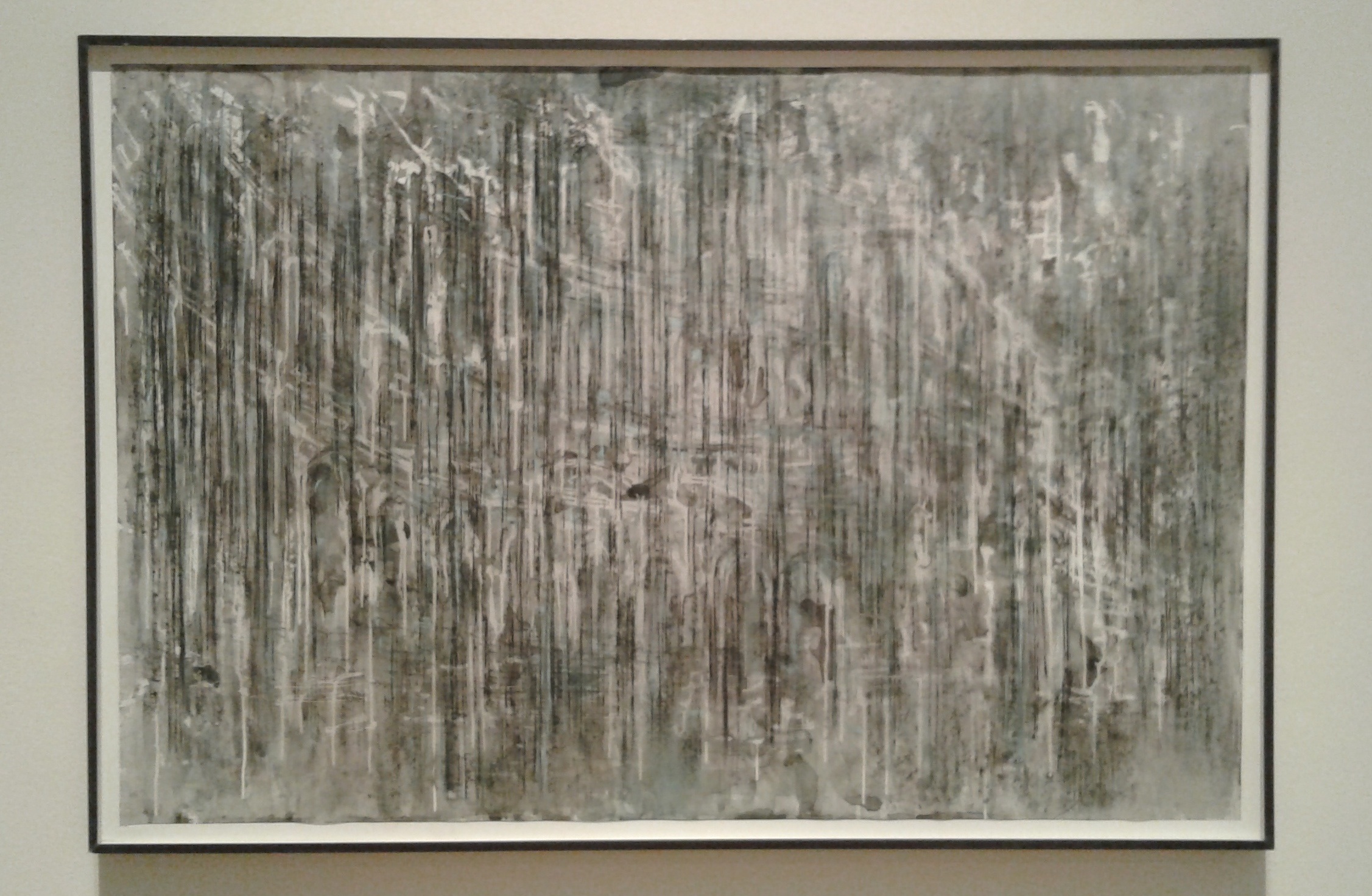
The idea of the sculpture continues also in Al-Hadid’s two-dimensional works, which aesthetically relate to its colors and patterns. On the other hand, Diana Al-Hadid has employed yet another ephemeral pattern and style on their surface. In these works, the historical evidence is present as influence of ruins. The dripping paint creates the delicate surface as if showing traces of archeology as rendering marks. During her graduate studies, the artist was influenced by Hellenistic history that is visible in the ruins near Aleppo. She also explored Moorish layers in Spanish cathedrals.
Diana Al-Hadid, Untitled, 2013, Conte crayon, charcoal, pastel and acrylic on Mylar. Collection of ICG Advisors, Los Angeles. photo: firstindigoandlifestyle
Diana Al-Hadid: Liquid City is displayed in the SJMA’s central skylight gallery, and as such fits to the space eloquently. The work questions boundaries of the space. Putting together the reference materials is brilliant, as all surrounding works add to the monumental scale of the sculpture. The visual of the artist’s own works is compelling, interwoven, giving a context to a deeper thinking of history. Al-Hadid’s thinking is full of vivid ideas of fusing materials into new order, rewriting history from today’s point of view. How the artist got interested in the borderlines and beloningness/alienation thematic, comes from her own background as an immigrant to the United States. The artist was born in Aleppo, Syria, but was brought up in Ohio, US. Being contradicted with different experiences was a nourishing source for imagination and thinking. The theme connects many fragmented ideas across continents, beyond physical and social realms, and certainly travels across the world with its relevance. The works in the exhibition are far from being literal.
After four decades in painting, American artist Francie Lyshak has a deep knowledge on her practice. A woman-artist who has a lifelong approach to learning, finds nature and it’s varying stages influencing her work. The artist examines nature also with photography. It seems, as if those pictorial notes would transfer into her paintings with subtle poetry and movement. In this interview, she discusses her career, love of painting and the meditative approach to being with her art. Remarkable is how the artist views art as a career, also in psychological terms as a radical act. Francie Lyshak’s recent paintings, which examine movement and gestures, will be on view until April 27, 2017 in the Carter Burden Gallery of NYC.
Firstindigo and Lifestyle: How did you find yourself doing painting? Where did you grow up?
Francie Lyshak: I will share with you two central memories that are at the very early roots of my art career (before it begun):
I am in Detroit, Michigan, in a single family home with a nice yard. I am a small child, somewhere between toddler and latency age. I am sitting in the mud, alone making a mess and enjoying it totally.
In the second memory, I am 18 years old, attending my first art history class. As I watch the projected images of works by modern artists, it is suddenly clear that making paintings is what I need to do with my life. I began to paint was when I went to a summer art school in Paris around the age of 19. I haven’t stopped since that time, except for one year in Boston in the early 70’s. After that point I switched from abstraction to figuration.
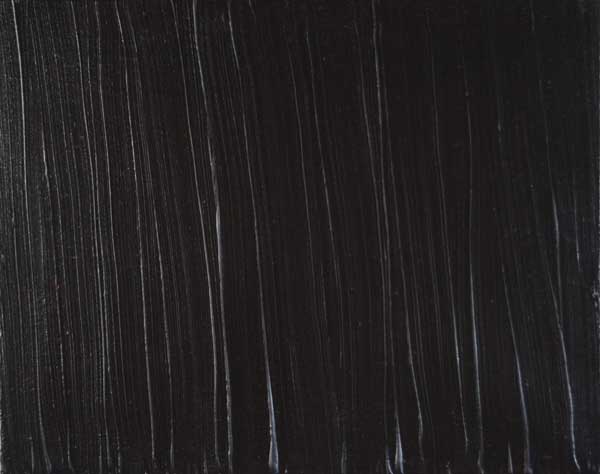
Francie Lyshak, Black Curtain, oil on canvas, 16×20, Courtesy of the artist.
Firstindigo and Lifestyle: You have an exhibition opening now at the Carter Burden Gallery in NYC, tell more about the theme of your paintings in the show?
FL: These paintings focus purely on the physicality of painting, of paint, painter’s tools and the interaction of the painting surface with light. The use of a palette knife can be a violent destructive attack on a painting’s under-layer. A flowing brush mark can be evidence of the painter’s sweeping gesture. The painting then becomes a stop-action image of what was either a waltz or a wrestling match between the artist and the medium. It is painting without any intention other than leaving the physical evidence of its own dynamic birth.
Firstindigo and Lifestyle: What is really interesting is that your career spans for four decades, and there can be so many changes that fit into that time frame. Did you start with figurative or representational art?
FL: In my early work, my visual language was a figurative and a metaphorical narrative with strong feminist overtones. This work lasted for two decades in the 1970s and 80s. Animals, humans, dolls and toys populate these paintings, each one describing the psyche captured in a critical moment of time. Influenced by art therapy theory and practice, their emotional rawness challenged the viewer to contemplate disturbing aspects of life that are typically overlooked or avoided. After years of these explorations, I unearthed evidence of my own childhood sexual abuse. With the support of the late Ellen Stuart and La MaMa/La Galleria, this work resulted in a one-woman exhibition in 1993 narrating my own trauma recovery through my paintings. The series of paintings with accompanying prose was published in a book in 1999 entitled, The Secret: Art and Healing from Sexual Abuse. This exhibition provided me with a release from the narratives of the past. After that show, my work changed slowly but radically, moving towards landscape, then abstraction.
Firstindigo and Lifestyle: How did you choose painting and photography, how are they similar or different to you?
FL: I am a painter. However, I believe that no matter what medium an artist chooses, they cannot escape their artist’s sensibility. That means that we cannot help but consider the aesthetics in our environment. Also, we cannot help but be creative. It is a kind of compulsion that requires an outlet. In that vein, I took up photography. This was in part because I found it offensive that paintings are generally only affordable by the wealthy. I experimented with printing and multiples as a way to make my work more accessible to those with less means.
Firstindigo and Lifestyle: Can you say that what you do is abstract art, and if so what would this kind of abstraction be?
FL: The best way to describe my new work is ‘pre-verbal’. Before words, ideas and memories there is a mental space that is responsive to shape and texture, color and amorphous mood. That is the space that my paintings occupy. My abstract work is not expressionistic, nor is it minimal or conceptual. My newest work has something in common with action painting. Over the long haul, the trend of my work has been increasingly reductive. I seem to be constantly trying to reduce the content of my work to its simplest components. I removed the figure. I removed the narrative. I removed the symbolism. I removed the suggestion of landscape. Then I tried to suggest empty space alone (which made the work illusionist). Now I am just looking at the surface, the medium and the tools of application.
I recently saw a show that was simply lighting in an empty gallery. I understand that.
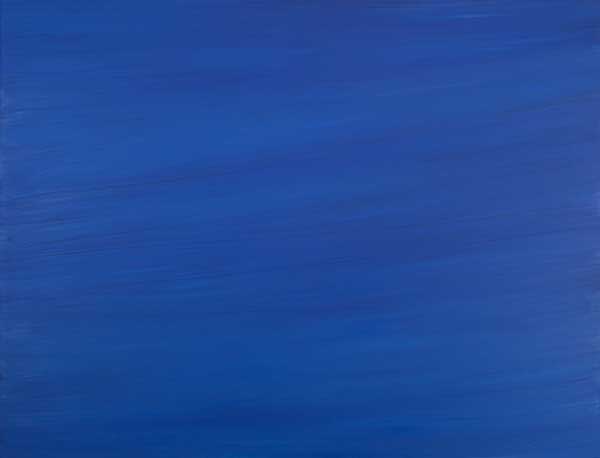
Francie Lyshak, Brushed Blue, oil on canvas, 34×44, Courtesy of the artist.
Firstindigo and Lifestyle: How do you choose your works for the exhibition, do you ‘curate’ yourself?
FL: No, my dealer is fully in control of the choice of work and the hanging. Of course, it is up to me to choose the paintings from which she makes her selection.
Firstindigo and Lifestyle: The process is of course different with each artist, do you like to add older paintings into the show, or is it mostly recent works?
FL: Mostly very recent works are shown in April exhibition. My first exhibition at Carter Burden had some pieces that were several years old but had never been displayed.
Firstindigo and Lifestyle: You are watching a lot of movies, how apparent is it that those moods or aesthetics you gain from films enter your works somehow? FL: I don’t think that the aesthetics of film influence my work, but perhaps the moods do on a subconscious level. I find great solace in the work of these great, underappreciated independent film makers. They address very important, very real aspects of being human. Hollywood spends mountains of capital selling fantasy worlds to viewers because it is a natural,human inclination to avoid and escape harsh reality. The filmmakers that I love make me look at the challenging underbelly of being human. This gives me courage and support in my effort to stay honest as a painter, to not be fooled by the illusionary rewards of commercial success, to lead my viewers to the challenging aspects of being human.
I have a fantastic list of my list of favorite movies. It is a long list and the titles are unrecognizable to most people. Almost all of the films were borrowed from the New York Public Library which has a treasure trove of great films.
Firstindigo and Lifestyle: What does a notion of ‘zen’ mean to you as an approach?
FL: I am not formally trained in Zen practice. However, I understand that Zen does not have a god head, and is focused on what westerners call mindfulness practices. My mind is constantly racing. I hunger for empty space and quietude. (Perhaps this is reflected in my urge to constantly minimize the content in my paintings.) We live in an overheated, overstimulating world (at least in NYC). I know, however, that it is not the fault of my environment that I am so mentally restless. I reach for ‘zen’ as a pathway towards a quiet mind or to attain full attention. When I paint, I am in a ‘full attention’ mode. In this sense, painting is a mindfulness practice. (Click the link to see a series of paintings that were specifically intended to be ‘meditations spaces.’ http://www.francielyshak.com/archive/New%20Monochromes/index.html)
Firstindigo and Lifestyle: What else do you do to balance with making art?
FL: Not much. I do some Yoga practice, go to the gym, take walks and, of course, watch movies. I would add that there isn’t anything much more rewarding that good conversation with other artists and intellectuals.
Firstindigo and Lifestyle: Where do your influences come from other than abstractions? Do you blend in narrative contents from today’s world and events? FL: My goodness, the political climate has a tremendous impact on the ‘climate’ of my work. There is very little joy in my work these days. On the other hand, I am finding surprising strength and power there. My work is definitely a mirror of my psychological condition. My psychological condition is a mirror of my personal and social life (which in these times encompasses the political environment). A new painting included in this April exhibition is entitled “Silence equals Extinction”. It was clearly a response to the nightmare political situation in the US.
Francie Lyshak, Knifed White, oil on canvas, 34×26, Courtesy of the artist.
Firstindigo and Lifestyle: In your photography there is a lot of nature in them; fog, mountains, trees, moon, and so on. How do you find your photographic subjects, do you just happen to be in those places in the moment?
FL: Yes, everything was done either in Michigan, where my family has a summer home, or NYC. I also did some photography when I did some traveling along the Adriatic, Ionian and Aegean Seas and along the Pacific Ocean shore. I am wild about landscapes.
On influences:
I am not influenced by art theory nearly as much as I am influenced by psychoanalytic theory, philosophy and religion. I have no belief in any religion. However, I find the search for self and meaning to be central to my practice as an artist. I am most affected by any work of art that creates a space for the viewer to engage in this search for identity or meaning. Works by Frieda Kahlo, Mark Rothko and Fred Sandback all succeed at doing this for me; although each uses a radically different method to set a stage for this to happen to the viewer.
On color:
Colors have a strong valence, a kind of personality. My latest pieces have been in various shades of black. I am choosing black because I have always feared it. Black oils cannot be controlled because they are wildly interactive with the light in the environment as it reacts to the surface of the painting. The color black, for me, has much to do with loss, change and the unknown. So colors themselves have a kind of personality and meaning and different oil colors also have a unique physicality, such as color density.
On my use of color in photography and painting:
I think of myself as a painter. I have spent forty years painting. Photography has been secondary to my work as a painter. My photography is in the early stages of development; but is created on a foundation of 40 years of evolved aesthetic sensibility and artistic practice. My photography is mostly rooted in local color or black and white. My new paintings, on the other hand, are each a deep explorations of color, the oil paint medium, the painters tools and methods of application. In other words, my practice as a painter has evolved to a point where I am exploring the very basics of the medium. It is full circle, back to the beginning.
Firstindigo and Lifestyle: Do you find inspiration in your travels to foreign places, how about those leaving an impact on your thinking and aesthetics?
FL: I just traveled to Japan. Their aesthetic and social values were a great comfort to me. The Japanese seemed so much more civilized than Americans. It was heartening to experience their aesthetic and their culture. I felt that my own values were much more supported by the Japanese culture than they are in my own culture.
Firstindigo and Lifestyle: Did you ever come up with a notion, who would be your best art audience, or collector? FL: Probably intellectuals, other painters and psychologically-minded people. It is hard to tell who is most taken by my work because people usually don’t say much. Most of us become a little inarticulate in the face of meaningful visual art. Art takes us to a non-verbal place. I admire people like you who are willing and able to give us language in the face of visual art.
Firstindigo and Lifestyle: With so much insight in the practice, we all want to know, what would you like to teach or say for younger generation artists and painters?
FL: I would like to say to them that it is worth the battle to stay true to their artistic sensibility. This is because, in the long term, losing touch with one’s core strivings (to be an artist, to be creative) has an unbearable cost. I would tell them, however, that they shouldn’t expect to be rewarded. Artmaking is essentially a radical act, because it means turning away from the influence of others and, instead, opening a channel to one’s true self. Being true to one’s core self usually means letting go of many of the rewards of social/commercial success. After all, in the short term we are nurturing ourselves rather than others. Who knows if our art will nurture others in the long term. That is in the hands of the vagaries of the art market.
Achieving commercial success in the art world is a totally different side of being an artist. It takes a combination of ambition, talent, personality, timing, social resources (such as health, social networks, time and money) to make income from making art. To have these resources is often a matter of privilege and other random social events. Artists don’t have control over most of these factors.
Francie Lyshak’s exhibition info:
April 6 – 27, 2017
Examining Movement & Gestures: Jonathan Bauch and Francie Lyshak
· Pratt Institute, Art Therapy and Creativity Development, Masters of Professional Studies, NYC, 9-76 to 5-78
· Wayne State University, Painting and Drawing, Bachelor of Fine Arts, Detroit, Michigan, 1-69 to 5-70.
· Center for Creative Studies, Fine Arts, Detroit, Michigan, 9-68 to 5-69
· University of Michigan, Humanities, Ann Arbor, Michigan, 9-66 to 5-68
Sasha Huber is a multidisciplinary artist who hopes that our world would be a better place for people with different ethnic and racial backgrounds. She is determined to continue her family’s Haitian heritage in the arts, and has challenged the postcolonial controversies left behind by figures like Christopher Columbus and Louis Agassiz. Her artistic career has brought her international merit across continents. Sasha Huber’s art is currently shown in theDNA of Water -exhibition at the Newhouse Center for Contemporary Art inStaten Island, New York City.
Firstindigo&Lifestyle: You were born in Switzerland with Swiss and Haitian heritage, how did this dynamic and background influence your youth and early artistry? Where did you get your education from, and how did you eventually find yourself living in Finland?
Sasha Huber: Being from two such opposite cultures inspired me from the start, although becoming an artist was not my first choice in my professional live. My interest was first in graphic design that I learned in Zurich, Switzerland. I then worked some years as a graphic designer at different studios and agencies and then applied and was accepted for a one year scholarship at the research and design and research centre Fabrica by Benetton in Treviso in 2000. Its a multidisciplinary and international environment that I missed in Switzerland. That is also where I met my husband and collaborator Petri Saarikko who is from Finland. So love brought me to Finland at the first place. There I also graduated in 2006 with the Masters Degree in Visual Culture from the University of Art and Design, today known as Aalto University.One situation that triggered the idea for my first art project that I made in 2004 was related to that I was not allowed to visit my mother’s home country and family in Haiti, due to the political situation there. My mother was especially worried for me, and basically forbade me to go when I was younger. Starting to make my art about Haiti served as a compensation instead, and eventually brought the place closer. As an adult I’ve visited Haiti so far twice and each time within the artist context. First time Petri and I took part in the 2nd Ghetto Biennale in 2011, and the second time we were invited to make projects at the Le Centre D’Art in Port-au-Prince during one month in 2016. Both visits went very well and allowed us to work collaboratively with multidisciplinary artists. Working with the Centre D’Art was also special for me since my artist grandfather Georges Remponeau was one of the co-founders of the school in 1944.
Firstindigo&Lifestyle: Could you tell more about in what ways your European upbringing was intercultural. Do you have an opinion that European culture and heritage changed in recent years in relation to migration, and with the impacts of globalization?
Sasha Huber: Coming from a rich cultural background with over ten different nationalities, including the joining families through the different unions in our family, made me aware of the differences and similarities in cultures, and broadened my horizon. I think it helped me to feel comfortable in new places very quickly. For me this is a positive experience. Now when Europe is growing, as we can see with the influx of the newcomers and others too, there are also conflicts, and that brings sorrow to the people trying to find safety.
I would hope there could be other, more human and respectful ways to handle this situation. Luckily there are creative initiatives by grass roots organisations, and individuals who help to contribute to make welcoming people more dignified. Sometimes its forgotten that Europe is also made of very many cultures after all. In a time like this, where racism against the black and brown people is in the rise, and not only in Europe, I’d came to think that it would be good for people to read more such books as James Baldwin’s book I’m not your Negro, or watch the documentary by Haitian film maker Raoul Peck (1953–) under the same name. And read the Orientalism by Edward Said (1935–2003) who founded the academic field of postcolonial studies. Both books were written long ago, but are very relevant in the current climate we live in.
Firstindigo&Lifestyle: One of your artistic discoveries relates to the historical context of the colonization and cultural imperialism. What did you find out about the subject from your specific study, and how did you translate it into your artistic practice?
SH: I would say that the starting point of my career was to deal with the colonialism, and the topic has actually been a red thread throughout my entire practice ever since. In my first project, which was a portraiture series named Shooting Back – Reflection on Haitian Roots, I for instance portrayed people that were responsible of the troubles in Haiti. I started from the beginning and portrayed Christopher Columbus (1451–1506), a figure that has in recent years become more and more challenged; which I find is very important. For instance, in the United States several cities don’t celebrate the Christopher Columbus Day anymore in October as his first arrival in the “New World”. Instead they highlight the meaning as Indigenous Peoples Day. Or, in 2015 in Argentina his statue was replaced with the large statue of freedom fighter Juana Azurduy. We should not forget that some 95 % of the indigenous population in the Americas were killed after his arrival, and the European invasion that followed brought disease and slavery.
Sasha Huber, Installation view within the Share/Cheat/Unite group exhibition curated by Bruce E. Phillips at the Te Tuhi in 2016. Photo: Sam Hartnett. Courtesy of Te Tuhi, Auckland.
KARAKIA – THE RESETTING CEREMONY, 2015 5:20 min Direction: Sasha Huber, Karakia: Jeff Mahuika (Kāti Māhaki, Poutini Kāi Tahu). Videostill.
Firstindigo&Lifestyle: Is a question of taking over land and leaving marks on its surface, in the environmental sense perhaps, part of the colonization history as you understand it and discuss it in your artistry?
SH: I became conscious about this in 2007, when I joined part of the Demounting Louis Agassiz campaign that was launched by historian and political activist Hans Fässler. Until recently, the life and work of Louis Agassiz (1807, Switzerland – 1873, USA) have been intentionally embellished. He has mainly been presented as a glaciologist, scientist, and director of academic institutions, both in his country of origin, Switzerland, and in his adopted country, the USA. The campaign raised awareness that Agassiz was a proponent of scientific racism and a pioneering thinker of segregation and “racial hygiene”. The aim was at removing Louis Agassiz’s name from a 3946 m peak in the Swiss Alps and renaming it Rentyhorn in honour of the Congolese-born slave Renty, and of those who met similar fates. Agassiz ordered Renty to be photographed on a South Carolina plantation in 1850, “to prove the inferiority of the black race”. This initiative began to open the eyes of the Swiss public, and exposed Louis Agassiz’s involvement in the crimes against humanity. Today, there are over sixty places all over the world, and in our Solar System (the Moon and Mars) that bear Agassiz’s name. I call this micro colonialism of a single person marking his existence around the world while ignoring the local perspective.
My way to react and act through my work as an artist manifested for the first time after I joined the transatlantic committee of Demounting Louis Agassiz, as I started to plan my first intervention to the Agassizhorn in 2008. I airlifted a metal plaque bearing a graphic representation of Renty to the top of Agassizhorn, on the borders of the Swiss cantons of Berne and Valais. In doing so, I took the first step towards renaming the mountain into Rentyhorn. I also started the petition website rentyhorn.ch which is still online. Even though for now, the mountain will not be renamed officially after many years of negotiating with the communes. In New Zealand’s Te Waipounamu – South Island in comparison, I traveled to the Agassiz Glacier with local Māori greenstone carver Jeff Mahuika who performed a karakia (Māori blessing) on the glacier to symbolically de-name the glacier and hens cleanse it from it’s associations to Agassiz’s racism. *
Prototype of Sasha Huber and Thomas Götz as Louis Agassiz, Wet plate collodion photography by Borut Peterlin, comissioned by Sasha Huber, 2013, 10” x 12”.
Firstindigo&Lifestyle: Your background is in graphic design, and you have also worked with video; how do these mediums and techniques correlate with your artistic vision and outcome?
SH: I use a variety of mediums to realize projects. For me the defining reason to choose a specific medium is, first the idea I want to realize and then to decide based on that. I also often collaborate with experts to help me realize a work, such as videographers, editors and photographers.
Firstindigo&Lifestyle: Do you also work with text, for example, to generate ideas, which then take visual forms and so forth?
SH: My artworks are predominately visual, but finding the title of the works is important, and for each project I write a text as well. Sometimes the artwork idea is inspired by text, poem or song as for instance the Strange Fruit poem. I made two projects about this poem that were performed by Billy Holiday and Nina Simone as well. The poem was written by a teacher Abel Metropol in 1937. It protests American racism and tells about the lynching of African Americans.
Firstindigo&Lifestyle: Do you write about your own art, keep diary, and perhaps discuss it in essays?
SH: Mostly curators, academics and journalists write about my work. I participate in conferences to speak about my work. As an example, last year I was a keynote speaker at the Archival Re-enactments Symposium arranged by the Living Archive project of the University of Malmö in Sweden. This summer, I will participate in the 6th International Afroeuropeans: Black Cultures and Identities in Europe conference (http://www.uta.fi/yky/en/6thafroeuropeans/index.html) in Tampere, Finland. I’m currently also doctoral student at the Art Department of the Aalto University’s School of Arts, Design, and Architecture in Helsinki, Finland. So far, I’ve published two books as part of my doctoral project, which I started several years before in collaboration with some historians. I edited Rentyhorn published by Kiasma Museum of Contemporary Art in Helsinki. Then, I co-edited (T)races of Louis Agassiz: Photography, Body and Science, Yesterday and Today published as part of the 29th Sao Paulo Biennale in 2010.
Sasha Huber in collaboration with Petri Saarikko, The Prototype, 2013, installation view.
Firstindigo&Lifestyle: As a result of your investigations through several years, do you see that your art is influenced by Haitian aesthetics, nature and environment in multiple ways?
SH: As mentioned earlier, the starting point of my art practice was inspired by Haiti’s history. As a matter of fact, I developed a technique for myself with metal staples shot with air pressure onto abandoned wood, as for instance in the Shooting Back – Reflection on Haitian Roots (2004) portrait series. For me the staple gun is like a weapon and I use this technique only when the project relates in some ways to the historic trauma. But aesthetically it could perhaps remind of the traditional beading and stitching as for instance utilized in the creation of the colourful Voodou flags.
You Are Missed, is a work in progress project by Sasha Huber, depicting a new portrait series that uses wood and metal staples stitching. Started in Huber’s artist residency at Axenèo7 in Gatineau, Canada in 2017.
Firstindigo&Lifestyle: In the fall of 2016, there was a curated group exhibition titled “Botany under Influence” taking place at Apexart in New York City. Your collaboration with Petri Saarikko was included in the show. How did you get involved in this special exhibition?
SH: We met curator Clelia Coussonnet in Paris, where I participated in the Haïti exhibition about contemporary and historical Haitian art at the Grand Palais in 2014. When she was planning her group exhibition Botany under Influence I told her about our Australian remedies video that she then included into her exhibition at Apexart (http://apexart.org/exhibitions/coussonnet.php). The exhibition delves into the politics of plants, and explores systems of meaning that have been impressed upon nature, flora, and seeds throughout the eras of imperialism, colonialism, and globalization.
Firstindigo&Lifestyle: Could you tell more about the video work that you showed in Apexart. The title of it is ‘Remedies Australia’ (2014). Does this work include material from several geographical locations and have different cultural components in it? Is this process still ongoing?
SH: Remedies is a series I initiated with my artist husband Petri Saarikko during an artist residency at Botkyrka Konsthall in Sweden in 2010-11. It was inspired by our interest in aurally transmitted family knowledge and remedies that we learned from our own families. Later we expanded the project to New Zealand, Australia, Haiti, Russia, Germany and back in Sweden. The Australian edition of Remedies casted Mildura based inhabitants to contribute eucalyptus tree related unwritten narratives and oral histories for an individual and collective portraiture.
Firstindigo&Lifestyle: You are currently in New York City taking part in an exhibition DNA of Water, what kind of works do you have in Staten Island?
SH: Together with my family we just came from a residency in Canada, and continued directly to our current artist residency on Staten Island. We are participating in the group exhibition DNA of Water at the Newhouse Center for Contemporary Art which is curated by Sasha Dees. I am showing couple projects of which two are portraits from the ongoing Shooting Stars series, which is dedicated to worldwide victims of gunshot assassinations and killing perpetrated for political, ethnic, ideological or economic reasons (http://sashahuber.com/?cat=10040). I will show the portrait of Martin Luther King Jr. (1929-1968). I also made a new portrait of Eric Garner (1970-2014) who was living on Staten Island. At the end of the exhibition in September, I will gift the portrait to his mother Gwen Carr.
Sasha Huber & Petri Saarikko, Black Lives Matter, performance, actor Joseph T. Shavel, 2017. Installation view from The DNA of Water exhibition.
Sasha Huber, Shooting Stars Series, Martin Luther King Jr. (1929–1968), white leaf gold on metal staples and wood, 27 x 32 x 4 cm, 2014. Installation view from DNA of Water exhibition in Staten Island.
— — —
The DNA of Water exhibit is open from March 26 until September 3, 2017 on Wednesdays through Sundays from 10;00 a.m. to 5:00 p.m., at the Newhouse Center for Contemporary Art at the Main Hall of Snug Harbour, Staten Island (http://snug-harbor.org/event/the-dna-of-water/?instance_id=3179).





 Sasha Huber in collaboration with Petri Saarikko, The Prototype, 2013, installation view.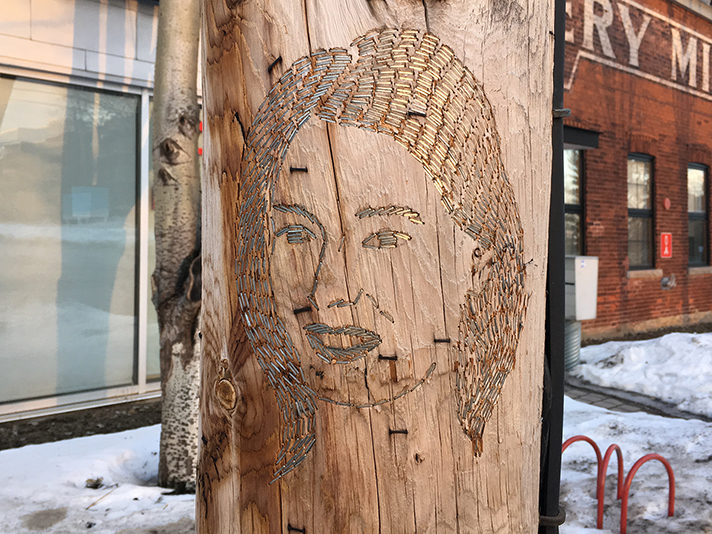


 Firstindigo&Lifestyle