• Yuko Mohri creates the Japan Pavilion in Venice

    Yuko Mohri creates the Japan Pavilion in Venice

    Yuko Mohri is creating Compose for the Japan Pavilion in this year’s Venice Biennale. Mohri is putting focus on environmental issues with her work, which acts like a circular economy approach to creating art. With a title that etymologically references “to place together” (com+pose), the exhibition questions what it means for people to be together – at home, in society and at work – that pandemic changed. The post-pandemic world also faces a planetary climate emergency.

    The exhibition in the 60th Venice Biennale runs from April 20 to November 24, 2024, with the inauguration on April 17 in Japan Pavilion (Giardini di Castello, Venice). Compose is curated by Sook-Kyung Lee, Director of The Whitworth in Manchester UK, and it is organized by The Japan Foundation.

    Mohri who is interested in organic ecosystems is right at home in Venice. She has focused on the 2019 Venice floods and rising sea levels. The theme ’soft and weak like water’, which is a reference to the classical Chinese text ‘Dao De Jing’, is a source of inspiration for Mohri. The text by Lao Zi acts as a metaphor for change as “generated through gentle and persistent force”. The artist also created work for the 14th Gwangju Biennale in the Japan Pavilion. Her collaborator, curator Sook-Kyung Lee was the artistic director of the Biennale.


    Yuko Mohri has long been interested in the crisis and its connections to paradoxical creativity. She was interested in the Tokyo subway workers who needed to find solutions to water leaks.

    Utilizing materials that are sourced locally, from Venetian antique stores and furniture shops, as well as from grocery stores, liquor stores, and farmers and flea markets, Mohri took over the whole pavilion and made it to her own studio for a few months prior to its public opening.


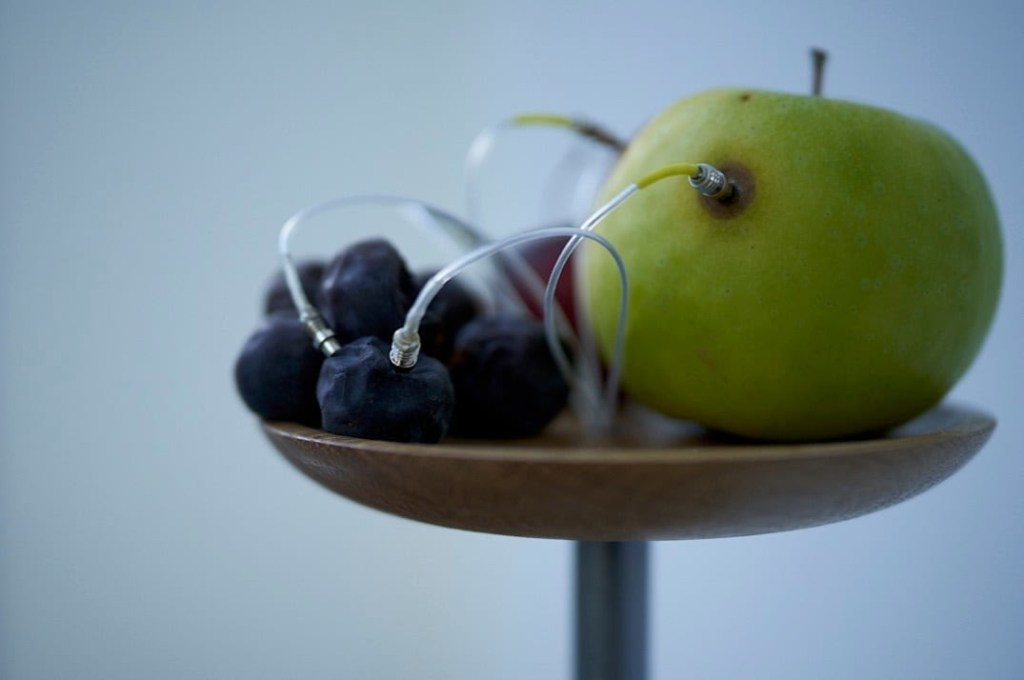
    From floor to ceiling – installation’s organic forms include experimental elements and acoustic sculptures, which are made of rotting fruit. Mohri’s creation repeats a series a works that are unified by a common element: water. The artist’s latest installations, Decomposition and Moré Moré (Leaky) will emerge as rare site-specific, one-time realizations presented in the Venice Biennale.

    The work Compose, additionally references the legacy of composers and artists; Erik Satie, Marcel Duchamp, John Cage, Nam June Paik, and the Fluxus Movement. All of these artists had an experimental approach, using methods of chance and improvisation as a basis, and strongly commenting on everyday mundane life with their works.

    Yuko Mohri takes a stance on nature, which is disappearing, and environmental catastrophe. Even if not literally, what is highlighted as the latent “changing events” of creating ecosystems that will be disappearing, are bound to water, the scarcity of it, and the flood that comes with it. Still using very familiar everyday objects as their backdrop.

    Known for her installations that are like ‘events’, Mohri creates changing environmental conditions for the Pavilion. It will be an event of light, sound, movement and smell.

    Mohri was born in Kanagawa, Japan in 1980 and now lives and works in Tokyo. She has been included in a number of international group shows including the 14th Gwangju Biennale (2023); 23rd Biennale of Sydney (2022); Asian Art Biennial (2021); Bienal de São Paulo (2021); Glasgow International (2021); Tai Kwun Contemporary, Hong Kong (2021); Ural Industrial Biennial of Contemporary Art, Russia (2019); Palais de Tokyo, France (2018); Asia Pacific Triennial of Contemporary Art (2018); Biennale de Lyon, France (2017); Centre Pompidou-Metz, France (2017); Kochi-Muziris Biennale, India (2016); Yokohama Triennale (Japan, 2014), among others.

    Featured photo: Courtesy of Yuko Mohri and Tanya Bonakdar Gallery.
  • Southeast Asian voices in Venice Biennale

    Southeast Asian voices in Venice Biennale

    A historic Venetian palazzo is a stage for the Southeast Asian artists to showcase during the 20204 edition of the Venice Biennale. The palazzo is located in the Cannaregio district near the grand canal and hosts an exhibition “The Spirits of Maritime Crossing”. A group exhibition by artists from Southeast Asia, examines topics of displacement, the diaspora, and colonialism using the ocean as a metaphor. The exhibition is on view from 20th April to 24th November 2024 at Palazzo Smith Mangilli Valmarana. The space hasn’t been accessible to the public for 11 years.

    The exhibition highlights a timely topic of colonialism and wars that have happened throughout the Southeast Asian region. When the voices also include indigenous points of view, the artists have chosen to speak about the importance of nature and the spirituality that is embedded in the land and its ancestral connotations.

    The Spirits of Maritime Crossing exhibition is curated by Prof. Dr. Apinan Poshyananda, who is also Chief Executive and Artistic Director of Bangkok Art Biennale (BAB). With the BAB Foundation, the Venice exhibition is co-hosted by One Bangkok.


    The curator shares about the exhibition,

    “We are delighted to present a survey of Southeast Asian artists to international audiences in the Global North to coincide with the Biennale Arte, ahead of Bangkok’s own biennale in October 2024. Moreover, it is a great honor that a new short film featuring world-renowned Marina Abramović, winner of the Golden Lion at Venice Biennale in 1997, will be shown within the exhibition. The contents of this film and exhibition that focuses on sea travel, displacement and diaspora relate directly with the main Exhibition. It is fascinating to see such synergy across Venice.” (Prof. Poshyananda)


    Prof. Poshyananda created a film which brings the East and West together. The film features well known performance artist Marina Abramović together with Thai dancer and choreographer Pichet Klunchun.

    Mediums such as painting, sculpture, mixed media and video installations, bring together fifteen artists from Cambodia, Indonesia, Laos, Myanmar, Malaysia, The Philippines, Singapore, Vietnam and Thailand. The complex realities and diverse cultures, as well as the histories of the region, meet the Western narratives in this Venice exhibition.

    Cambodian artist Khvay Samnang, directed Calling for Rain, which explores deforestation that has been a major problem in Cambodia. Other films include Hunting & Dancing: 15 years by Moe Satt; There’s no Place by Jakkai Siributr; The Sea is a Blue Memory by Priyageetha Dia and many more works by renowned artists displayed across the palazzo. A collaborative two-channel video installation by Chitti Kasemkitvatana and Nakrob Moonmanas, presents a montage reflecting on the parallel worlds of Italy and Thailand, displaying the multitude of languages and cultures.

    The exhibition is a journey from Southeast Asia to Venice through cultural and diasporic experiences looked through the eyes of those who don’t live in their homeland; this includes both physical and spiritual aspects.

    Southeast Asian artists share many similarities, while also differing in ethnicity, religion, and their languages. This can create a sense of ‘foreignness’ among the artists. The legacy of each of them, however, resonates with a notion of a ‘cultural hybrid’, as among them are also refugees, immigrants, and stateless people, who create new identities in the diaspora.

    Many of the artistic works dive into the indigenous histories, and narrate about the environmental impact of colonialism. Many of us know that environmental destruction, loss of land and livelihood as well as displacement, are common struggles told in the Southeast Asian stories.

    Cambodian artist Khvay Samnang’s video work examines hegemony and deforestation in Cambodia. It is a story of local worship inspired by Ramayana, an ancient poem. Yee I-Lann’s film depicts a collaboration with weavers and local sea-based communities to revive ancestral knowledge. The story is about the maritime and indigenous histories in Malaysia. Jakkai Siributr has used textiles to provide commentary on ethnic cleansing in society. The topic resonates in the intricate embroideries that have been created together with asylum seekers. Moe Satt, who is a performance artist, uses his body for identity and estrangement. He has a voice about survival of the violence in his homeland Myanmar. Also, a performer, Kawita Vatanajyankur creates works about foamy blue dye highlighting female labor in patriarchal society and focusing on the role of water in the context of femininity and the textile industry. Priyageetha Dia’s video of the deep sea examines ancestral migratory movements from India to the Malay Peninsula. Truong Cong Tung shows an installation of gourds that draws upon mystical ritual and indigenous mythologies.

    The Spirits of Maritime Crossing-exhibition also features paintings and a bronze sculpture by Natee Utarit, who blends Buddhist philosophy and Western art history, showing a meeting of East-West influences. Metal sculptures by Bounpaul Phothyzan are crafted using found bombshells, exploring the historical impact of American occupation in Southeast Asia, documenting the region’s tumultuous past.

    Jompet Kuswidananto’s installation of shattered chandeliers examines the history of colonization, with a focus on missionary work across Indonesia. Alwin Reamillo’s mixed media work utilizes found objects and assemblages to reveal layers of colonialism. References to Christian iconography in the Philippines, and the influences of migration and globalization. The artist’s work presents the 14 Stations of the Cross. It is a Catholic devotion that commemorates Jesus Christ’s last day on Earth as a man.

    The exhibition builds on the local voices and narratives. The regional histories are a significant meeting point of cultures with trade and cultural references overlapping from one area to the other. The proximity of geographical relationships between places is one strong signifier.

    Photo credits: Jakkai Siributr, There is no Place, 2020. Courtesy of the artist. 

  • Patricia Chow: Pilgrimage to Gwangju

    Patricia Chow: Pilgrimage to Gwangju

    This is the story of how a trip to the 14th Gwangju Biennale in May 2023 led me to throw 10 paintings out of my second story window like Rapunzel’s hair.

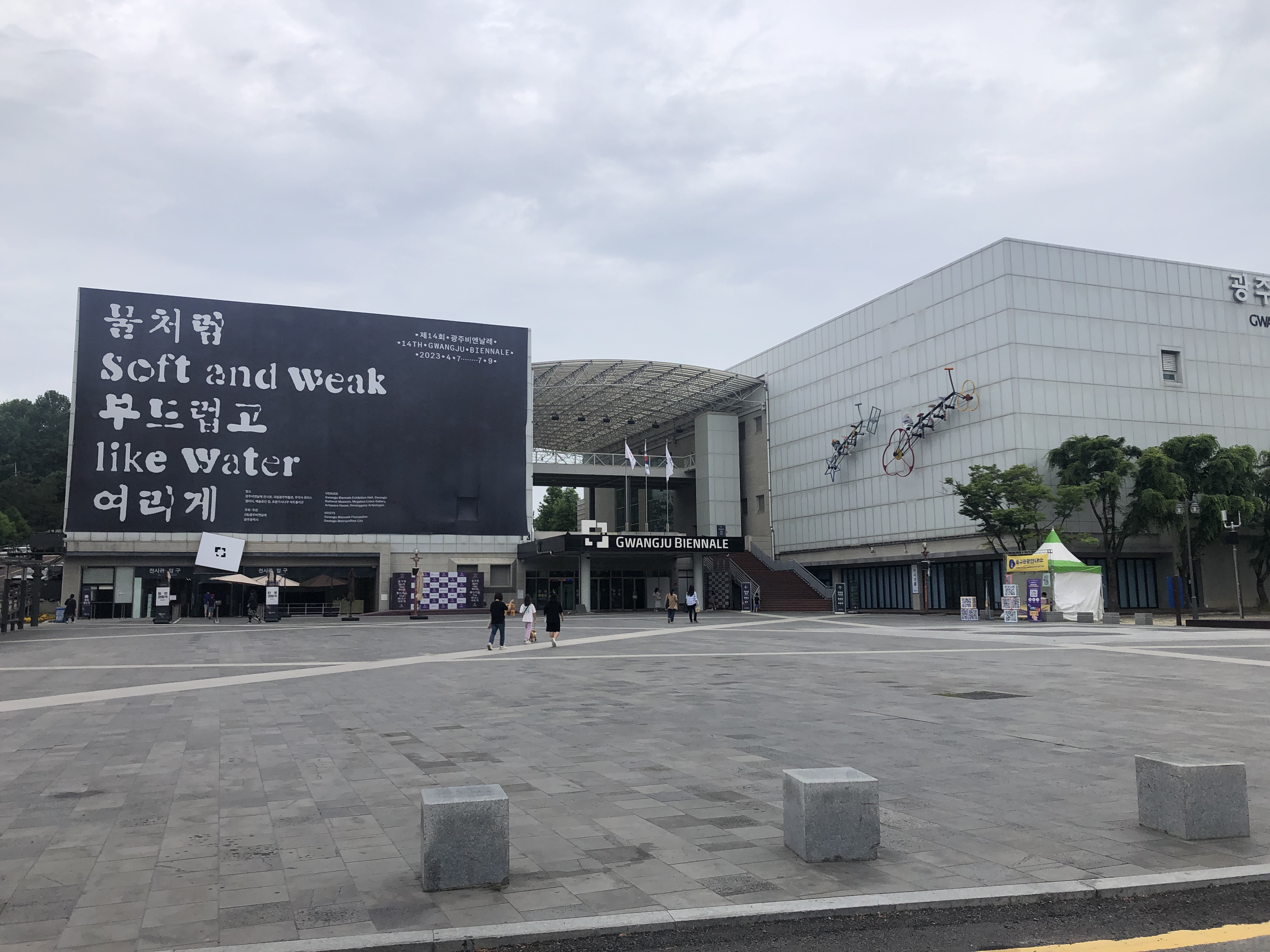
    When I was doing my MFA, I led a graduate seminar on the art biennale phenomenon, and have been slowly making my way to as many of them as possible ever since. A last minute opportunity to visit Korea gave me the chance to see this year’s iteration of the Gwangju Biennale, titled “Soft and weak like water.”

    Gwangju Biennale May 2023

    Gwangju is in southwestern South Korea, about a 2-hour train ride south of Seoul. It is considered the cradle of Korean democracy due to the 5.18 Gwangju Uprising, a pro-democracy popular uprising in May 1980 that was brutally suppressed by the military regime with the loss of up to 2,000 lives. After democracy was restored in 1987, the biennale was founded in 1995 to commemorate the spirit of the uprising and celebrate the city’s cultural heritage.


    This year’s artistic director, Sook-Kyung Lee, senior curator of international art at Tate Modern (and soon-to-be director of the Whitworth Gallery in Manchester), is the event’s first Korean artistic director since Kim Hong-hee in 2006.

    The title “Soft and weak like water” comes from the Tao Te Ching, and according to Lee, “is about the paradoxical power of seemingly weak things, referring to the transformative nature of water that could break hard things like rocks or change the course of a river over a long period of time.”

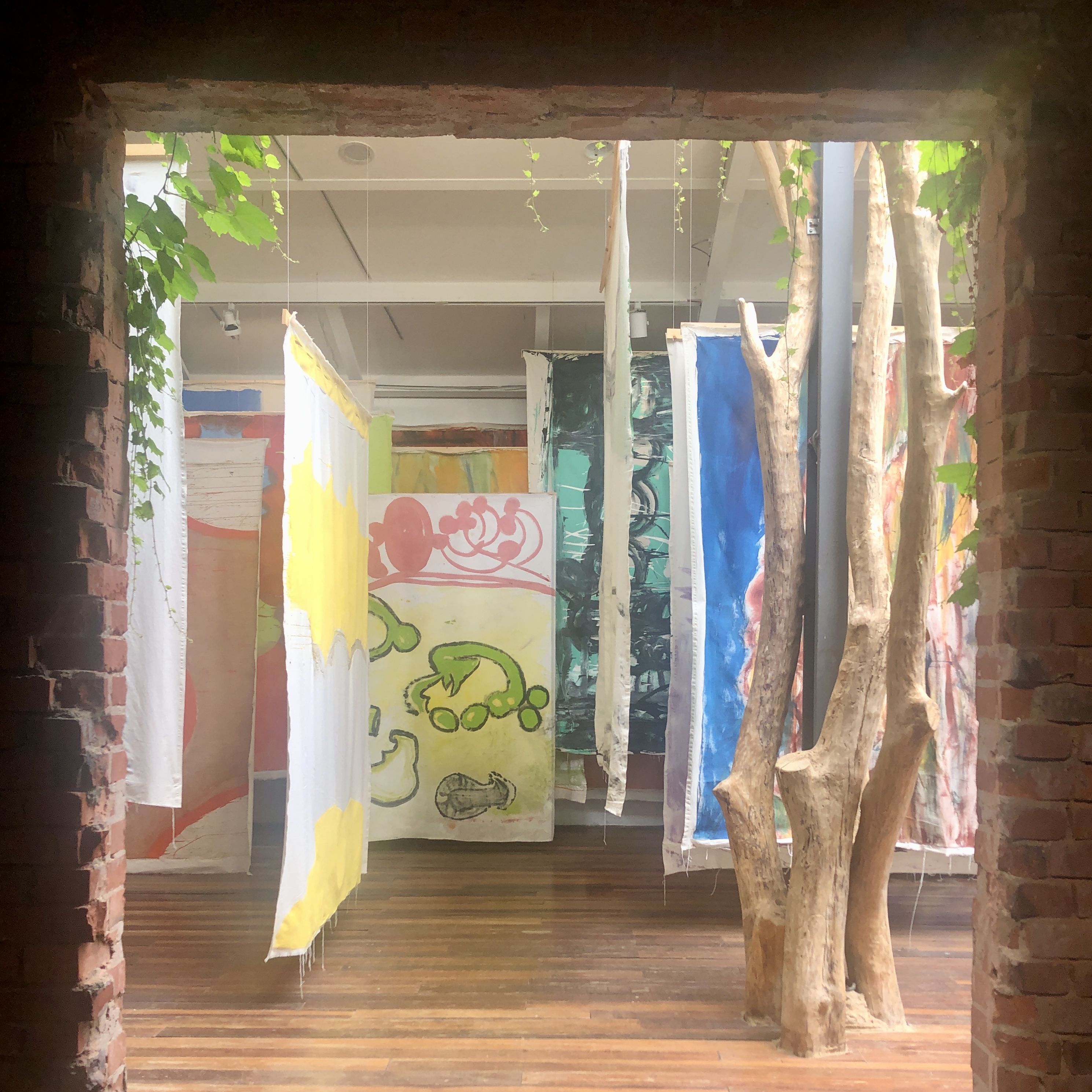
    Beyond the exhibition in main biennale hall, smaller exhibitions and country pavilions were housed in a multiple venues across town. My favorite was the Horanggasy Art Polygon, a glass pavilion located on the edge of a forest on Yangnim mountain. Walking up the winding alleys of the Yangnim-dong neighborhood felt like wandering around on the nostalgic streets of a Hayao Miyazaki film, with its mix of traditional Korean architecture and turn-of-the-century Western-style houses, now full of small galleries and tea rooms.

    Vivian Suter installation view.

    Inside the glass pavilion, I encountered for the first time in-person the work of Argentine-Swiss artist Vivian Suter. Suter is the subject of Rosalind Nashashibi’s 2017 short film Vivian’s Garden (one of two films that earned Nashashibi a Turner Prize nomination in 2017). The film is set in the jungle near Lake Atitlan in Guatemala, where Suter has lived and worked for four decades. A flood in her studio in 2005 caked all of her work in mud, and after recovering from the initial shock, Suter discovered that rather than destroying her paintings, nature had simply become part of them, and her practice subsequently incorporated the mud and rain and plants and insects and dog paw prints that are part of her lived environment directly into the paintings.

    What was most prominent when entering the pavilion was the smell of the paintings. This I did not expect. The enclosed space did not smell mildly of oil paint and gesso and canvas. Instead, you could breathe in the earth and rain that had seeped into the vast concentration of hanging cloth paintings. I had never experienced paintings as an olfactory sensation before.

    What I had done was experience music as painting. Specifically, the 1,027 opera broadcasts I listened to during Covid lockdown were distilled into the 18 paintings of the series I called “Synaesthesia” (2022). Synesthesia is perceiving something in one of the senses and simultaneously feeling it in another.

    Kandinsky famously dropped out of law school to study painting after attending a performance of Wagner’s opera Lohengrin, where, he later said, “I saw all my colors in spirit, before my eyes. Wild, almost crazy lines were sketched in front of me.”


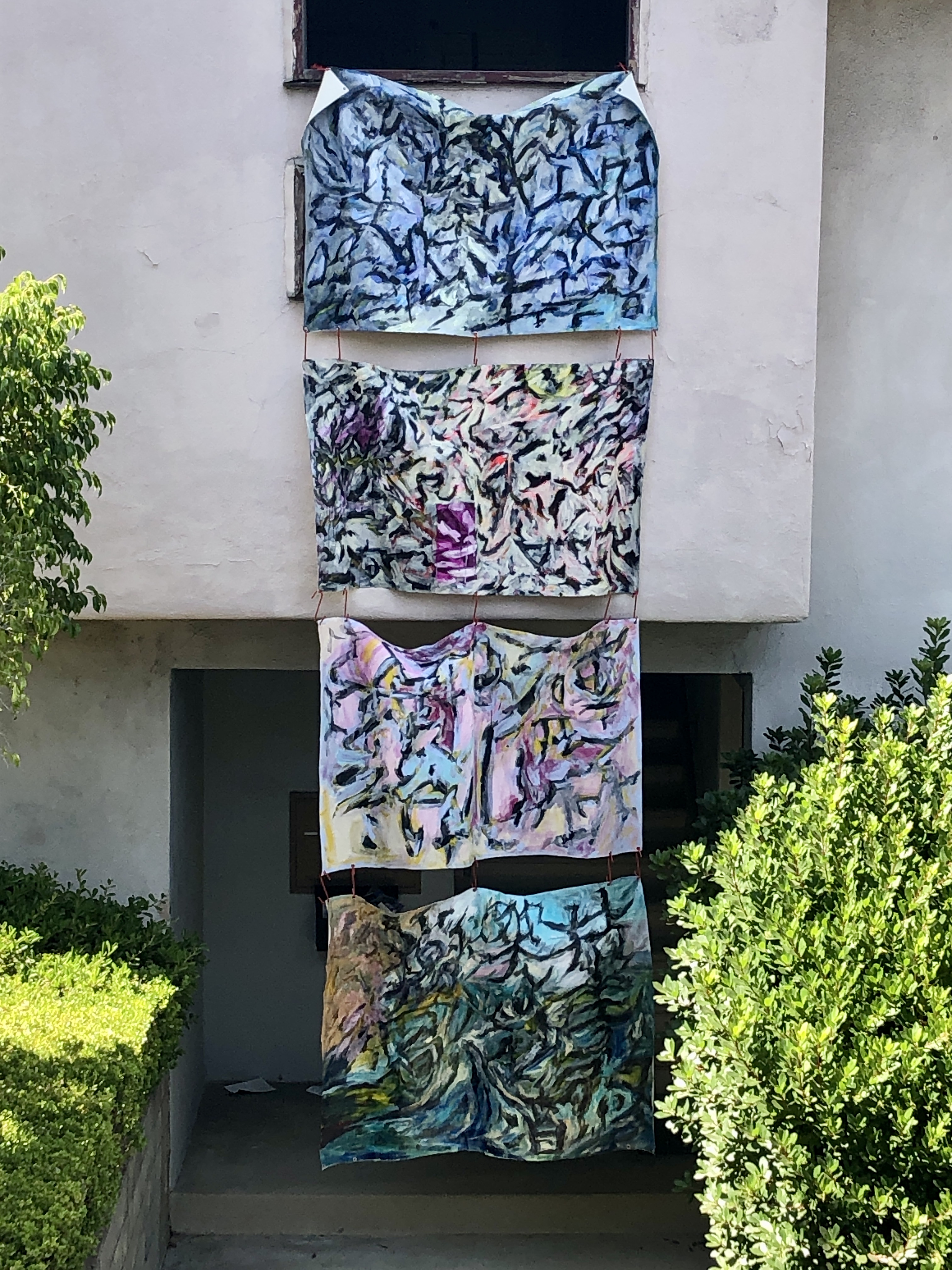
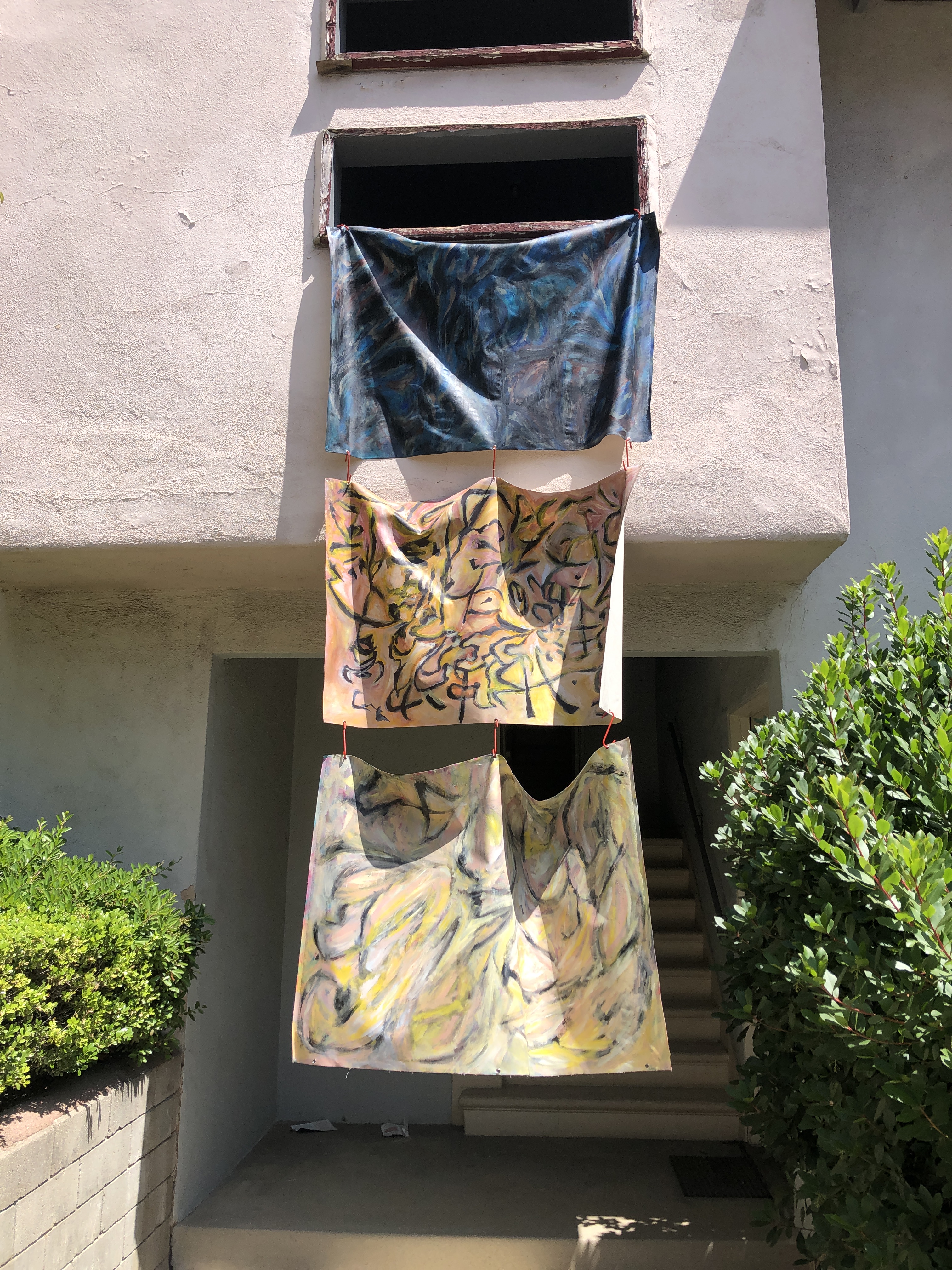
    Each of my paintings are a visual profile of the music of an opera character. In some cases, I painted specific interpreters of those roles. The paintings are acrylic on unstretched canvas, 3 to 4 feet high and about 4½ feet wide. When I got home from Korea, I decided to hang all of them up in my apartment, like in the Suter exhibition. But instead of attaching them to beams in the ceiling or to track lighting (I don’t have either), I attached them to each other, and ultimately hung them off the balconies around my split-level apartment complex. In homage to Kandinsky, I picked out the 10 Wagner opera characters to display.


    And that is how this installation came about.

    Patricia Chow, Tristan (Ben Heppner), Kundry, Isolde, Brünnhilde_installationview
.
    Patricia Chow, Erda, Fricka, Rhinemaidens_installationview.
    Patricia Chow, Tannhäuser, Senta, Ortrud (Leonie Rysanek)_installationview.

    From top to bottom:

    1. Patricia Chow, Tristan (Ben Heppner), Kundry, Isolde, Brünnhilde
    2. Patricia Chow, Erda, Fricka, Rhinemaidens
    3. Patricia Chow, Tannhäuser, Senta, Ortrud (Leonie Rysanek)