• Interview: Eric Decastro, a French painter

    Interview: Eric Decastro, a French painter

    French artist Eric Decastro is known for his large-sized paintings that he constructs using the dripping technique. He is focused on creating a balance of color and light by applying thick impasto into canvas. Since 2008, Decastro has been running an art space Kunstraum Dreieich | Artspace Frankfurt in Germany that promotes artists with the motto of welcoming them back. The artist himself has a solo exhibition A Whiter Shade of Pale, Level 2 in New York City at The Bronx Art Spaceuntil April 30. Decastro is also showing as part of the DOPPELGÄNGER -exhibition, which is currently at Torrance Art Museum in California, and runs until May 28. The group show is a dialogue between German and US artists, and is curated by Dr. Julia-Constance Dissel and Sandra Mann from Germany together with Los Angeles-based curators Ichiro Irie and Max Presneill. The exhibition explores similarities of practices within globally expansive and hyper-connected art production.

    In the solo exhibition at the Bronx Art Space, the visitor encounters a poetic cosmos, ‘which is intentionally designed to allow the illusion of landscapes or outer spaces.’ The theme of the Whiter Shade of Pale, Level 2 -exhibition is to explore issues of fugacity.
    Firstindigo&Lifestyle: How did you decide to become a painter? 

    EricD: I already knew as a child that I wanted to be an artist. When I was 5 years old I was able to paint in my mothers atelier. It was something I was destined to do and I finally fulfilled my dream.

    So what did you learn from your mother, who is the painter Mirei de Castro? How about your other influencers?

    EricD: I learned the basics from my mother. Painters like Richard Poussette Dart, Lee Krasner but also Cecily BrownFabienne Verdier, Paul Rebeyrolle, Gerhard Richter and Sigmar Polke, have all also influenced me.

    There is installation and performance development mixed with your paintings. In one installation you used, or it looks like, fake grass in the gallery as part of the show?  

    EricD: The installation Prevenue d’avance (Warned in advance) from the performance artist Mike Hentz (USA) and myself at a Kunstverein near Heidelberg 2012  has been furthering me a lot. Through Mike I was able to get a perspective for what one can call art. The lawn was actually real and has been tended and watered for a week in Kunstraum-Dreieich. After the event, it was fully removed. Then, the over dimensional “Dejeuner sur l’herbe” was a parody of the famous works of Edouard Manet.

    prevenudavance
    Eric Decastro, Dejeuner sur l’herbe, installation view.

    You have also painted tsunami? 

    EricD: After the Fukushima Tsunami, I did a complete series of works that looked like aerial shots of Tsunamis.

    Some of the dripping technique paintings come out with natural confrontations, what do you see yourself in the works, are there reoccurring themes that come out?

    EricD: One topic has been on my heart since 2008. My near death experiences have been both positive and negative for me, and I’ve been trying to depict this experience on canvases through a dripping technique in a meditative state. That’s how those paintings mostly have been created.

    A really interesting one is the point when you washed some of the acrylic painting out of the canvas, and went on the real action forward method of making art. Tell about the work, in which the canvas and you are hanging from the tree?

    EricD: This artwork was actually not created in the woods. I was walking with my dogs and saw this tree who looked like it could be a perfect frame for a canvas. I called a good friend of mine, a renowned Art-photographer Sandra Mann. We decided to do a photoshoot with one of my green paintings and put it in the natural frame of the tree.

    How does the performance aspect work with the painting, are they part of the same discipline for you?

    EricD: Of course the performance on a canvas in a natural state is my art. The work is being created, the performance oftentimes is the beginning of an idea that develops through painting.

    For example, in “suffocating performance” the artist wrapped cellophane around his head to represent a type of suffocation. He was filmed and was also supervised (Don’t try at home). Afterwards I painted his performance “Suffocating Performance” for the exhibition “CARNAL DESIRE” in Museum Villa Rot. The other artists were Wim Delevoye, Hermann Nitsch,  and Fischli and Weiss. It’s a hommage to a boy from Kosovo who was suffocated and skewed and grilled all while his father was watching. I tried to depict the cruelty of this war.
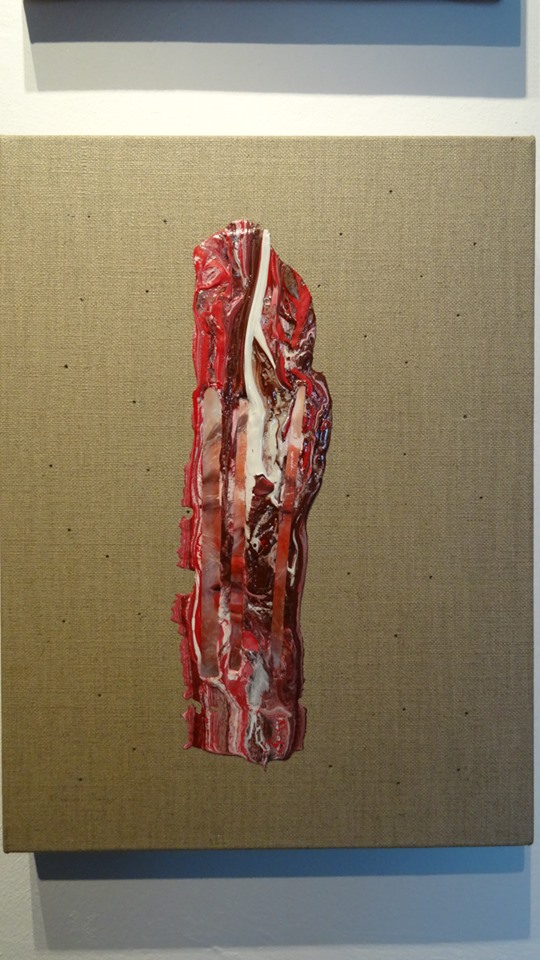
    suffocate
    Eric Decastro, Suffocating Performance, Acrylic on canvas.

    Then, few questions about identity, how do you criss-cross between different countries, locations, and even continents? 

    EricD: I’ve been traveling my whole life. I really enjoy it and have been able to visit over 110 countries in this world. I’m getting my inspiration and positive energy from exceptional places. In the next time I’ll be traveling to Tibet, Nepal, Buthan and North India.

    You have recently been exhibiting in Peru, and one of your galleries is in France, how are these art cultures different from each other?

    My gallerist Mathias Bloch from Gallery Younique is French and my last exhibition was in “Alliance Française de Lima” so it was a home match for me as a French man myself. My abstract art is established in South America. A subsidiary of Coca-Cola (Inca-Cola) has recently bought one of my works.

    You must feel that you are dealing with a variety of roles, a gallerist being one, and then a painter, is there a difference that is significant?

    EricD: I’m not a traditional gallerist. I don’t participate in the art fairs. Kunstraum Dreieich  is an Artspace with the motto “Rendes-Vous des Artistes.” It’s supposed to be an opportunity for artists to be displayed in the circles of art collectors that I have tended. This concept works well in Europe and especially in a city like Frankfurt the art will sell really quickly.

    Art world is a phenomenon for its own sake yet many artists are involved in societal practice, mending the world so to speak. What do you wish to say about that? 

    EricD: Jonathan Meese said at Art-Basel in Miami in 2012 „Art is the new currency.“ He’s right, art is seen more like an investment nowadays. Never have people previously in history spent so much money on art as it is done today. Independently from whatever the artist wanted to reach with his art, whether a political message, improving the world, to amuse someone or as a wakeup call, art is and will be a good that can be traded in stock. Most buyers, buy art because they have a mindset to leverage the art.


    unnamed
    Eric Decastro uses dripping technique to create acrylic color patterns on canvas

    As April is the Earth Month, could you say something about, how does art and preserving our planet correlate, or meet thematically?

    EricD: To preserve the planet and to make it better for our children is more vital than to collect art and display it in museums. What kind of benefit comes from a world that has been destroyed when museums are full of artworks, and there are no humans to enjoy the art, because then all of humankind will be too busy to focus on survival than to look at art. Politics don’t react to the signs of mother earth, the glaciers have been melting, global warming is unstoppable, and still there is no change of mind or thinking. One should replace the democracy through Geniocracy.

    Tell a little bit about the project in Nepal, how long has it been in progress, and how did it start?

    EricD: My wife is buddhist, and through her Master Lopen Tensing Namdak Rinpoche we got the idea to build a boarding school for children from Nepal in Tibet through fundraising and even some profit from selling my paintings. Since then it was possible to finance the first step of the project. We have already built a hospice in Katmandu in 2012. I myself volunteer as a hospice worker in a hospice in Frankfurt for about 4 years now. The experiences I have made there have helped me to stay grounded and to be confronted with the topic of death and what happens after death. This has been something I have been processing for years.


    Eric Decastro online:

    Artist website: http://www.decastro-art.net/

    Artspace Frankfurt: http://www.kunstraum-dreieich.de/

    Current exhibitions:

    A Whiter Shade of Pale – Level 2 -solo exhibition at the Bronx Art Space, until April 30, 2016

    http://www.bronxartspace.com/

    DOPPELGÄNGER, at Torrence Art Museum, until May 28, 2016

    http://www.torranceartmuseum.com/


  • Anri Sala’s musical mystery

    Anri Sala’s musical mystery

    “Anri Sala: Answer Me” -exhibition, which will be on display at the New Museum until April 10th, 2016, features multichannel audio and video installations. In his recent works, Albanian artist Anri Sala has interpreted musical compositions, classical works so to speak, with experiments that are structured into video and sound installations. The monumentally compound works navigate through the limits of our perception; mapping the sound and the spatial, and investigating the sound in the architectural spaces. This experiment transformed New Museum floors into symphonic areas of soundful meaning, leaving room for small encounters.

    Anri Sala’s often political works have tested the boundaries of sound and language in our construction of cultural realities. From cultural point of view, his works seem to investigate contexts that are outside the dominant aspects of reality. Or the realities are rather revealed through the layering of world of sounds. We have adopted a notion that the words create the meaning in our cultural communication. Yet, as Sala with his approaches has shown, it is possible to challenge this definition further by mapping and deconstructing the terrain, in which words actually restrict our ways of interpreting or seeing the world. From this perspective, the everyday life is full of noises that communicate without restricted syntax. Sound, form this point of view, has a great capacity to alter meaning.

    Sound’s features are attached to the material world that is so close to music. For Anri Sala, sound plays a role of an incomplete music, or music, which is in the state of becoming. Sound as a mediating device – even when it is real musical pieces divided into fragments – can document and edit reality, and communicate on a new level of poetic composition. This becomes immanent through the artist’s works, which New Museum profoundly projects. What stays with the viewer, is the personal corporeal experience, which is created in the architectural space as the entirely new perception. The change in the reception of the artistic works is focally in the embodiment. The surrounding sound world invites the viewer to walk into the next room full of sound. Or it freezes on the threshold, making the mystery of the sound’s origin more significant.

    Fragmentation and repetition is evidential in Sala’s second floor installation. The work unfolds as a two-channel HD video from 2014: ‘The Present Moment (in B-flat)’. This installation depicts different interpretations of an original compositional score by Arnold Schoenberg, titled ‘Verklärte Nacht Op. 4’ (1899).’ On the video, the chamber music setting acts as a fictional rearrangement of the historical work. Two videos feature a sextet of two violins, two violas and two cellos that play solitary notes from the musical work. Eventually the original musical score unfolds. The audio-visual installation works powerfully on two separate screens absorbing the body of a viewer into its mellow soundscape. The intimate portraits of the musicians, the movements and gestures of their heads, hands, arms, and backs, act as counterbalance to the interior, in which their playing has been recorded. The setting of empty room or hall creates an atmosphere of a vast space that accumulates sound on multiple stages. Sala’s meditative and mesmerizing piece truly puts an emphasis on the present moment.

    Upstairs, at the fourth floor of the museum, is a presentation of Anri Sala’s installation ‘Ravel Ravel Unravel’, from 2013. This is the work’s US premiere, it debuted in 2013 at the 55th edition of the Venice Biennale, where the artist represented France. In the title work ‘Ravel Ravel’ (2013), Sala reinterprets Maurice Ravel’s ‘Piano Concerto for the Left Hand and Orchestra in D major’. The composer created the composition in 1929 for an Austrian pianist Paul Wittgenstein, who had lost his right arm during the World War I.

    The museum space, in which the ‘Ravel Ravel’ video is installed, is designed to absorb sound and prevent echoes. In this chamber like room, there are two unique and separate performance interpretations of Ravel’s composition taking place. The musical echo is produced with ‘in and out of sync’ parameter, as two simultaneous performances measure temporal dimensions. The two pianists gradually shift out of unison, they are projected with their performances with two different orchestras. The one might evolve slightly different from the other, creating a minimal echo. Shifting between doubling notes and echoes creates the difference of the entire work, leaving the spectator paralyzed and in awe.

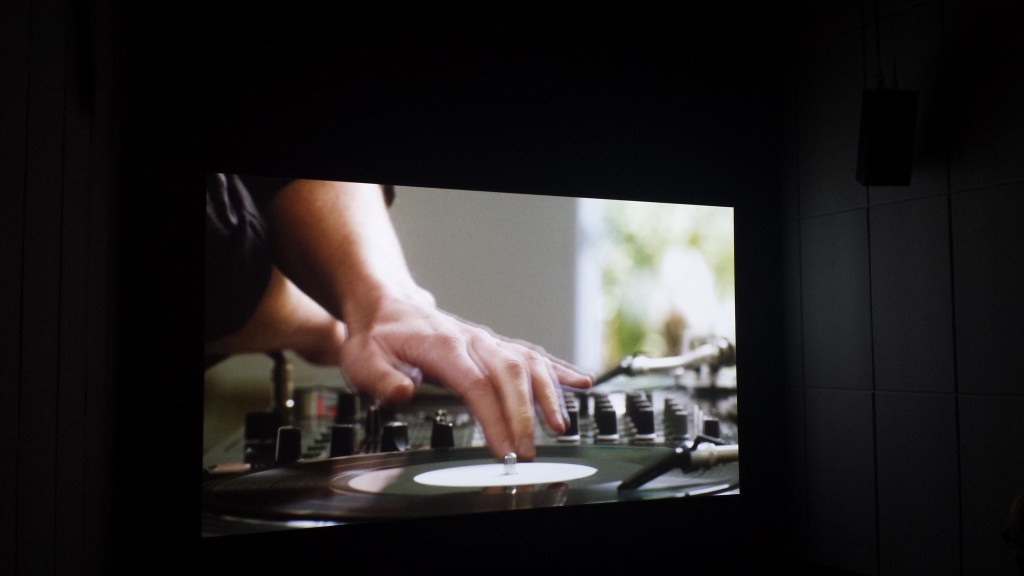
    Sala’s work contours in time, with tempo variation and within the space that has left no chance for error. The other video in the fourth floor being part of this work is titled ‘Unravel’, 2013. It debuted at the Venice Biennial alongside ‘Ravel Ravel’. ‘The Unravel’ video presents DJ Chloé Thévenin who takes part in the manual and physical manifestation of these two concerto recitals. She has the performance recitals on two turntables, in which she accelerates and slows the records in process. Fascinating, a visual turnout of the concerto sound in a new gesture.

    More info about the artist and the current exhibition “Anri Sala: Answer Me” :

    Hauser & Wirth about Anri Sala

    The exhibition info at New Museum

  • Interview: ruby onyinyechi amanze, drawings on paper

    Interview: ruby onyinyechi amanze, drawings on paper

    ruby onyinyechi amanze embeds a notion of scholarly artist in a true sense. Next to her large drawings on paper stands a mind that is influenced by spatiality in a geographical sense. The artist employs a design sensibility that gives her drawings variable perspectives. ruby amanze completed her art degrees, worked in art institutions, and as the Director of Education at the Museum of Contemporary African Diasporan Arts (MoCADA). She was a Fulbright Scholar teaching art at the University of Nigeria, Nsukka in 2012-2013. Currently, while still teaching art, her artistic practice evolves in a studio located in Brooklyn, New York City.

    Firstindigo&Lifestyle: It is fascinating how you translate the theme of hybridity into formations with so much vivid color and fluidity. Do you think this resonates with the fact that you were transferring between various continents?

    ruby: Most definitely. There is a way of being and moving in space, that I feel is unique to the experience of having come from many places. Automatically, there is less permanence associated with land (geography) or a sense of home. My understanding of home was that it changed a lot. So I adapted into a shared consciousness that home equates fluidity. Also, that my physical body had the right to claim space wherever I was- nothing felt off limits. I started to identify myself as a hybrid and to recognize that there were many narratives of hybridity. Initially, there was an idea that people who moved in that kind of way didn’t belong anywhere- that they had no home and somehow weren’t “authentic”. Or that they lost something…something they would always search for. I disagree.

    I feel that my life is enriched by these multiple homes. I meet people from all over the world who have had similar transcontinental experiences, and I know I’m part of a borderless, expansive “country”. We don’t have a landmass. But the space is a legitimate one. A lot of this informs my spatial decisions in the drawings.


    What does being ‘African’ mean to you personally, was there a strong sense of a Nigerian community in England where you grew up? 

    ruby: Being African for me can mean many different things, depending on the context. Generally speaking, I think it’s far too broad and simple of a “classification”. What I know of Africa is miniscule compared to its vastness. And that goes for any of us, who refer to the region so lightly…the truth is we know next to nothing. Even to zoom in to Nigeria, where I’m from- the same sort of complexity exists. Non-African colonizers, as is the case for many – if not all African ‘countries’ – arbitrarily decided the country’s borders. The writer Taiye Selasi said in a Ted Talk, “nations are concepts”. They’re inventions. She said that what makes more sense, is to think about where you are ‘local’ of, as opposed to a ‘national’. I think this is true, so while I was born on the landmass we call Nigeria, what is more accurate to say right now, is that I have a relationship with the city of Lagos. That’s what I know most of Nigeria. That’s where I have friends and routines…where I invest time and spirit. That’s where I am at home. Yes, there was and still are, large communities of Nigerians throughout England. Growing up there, my family was part of a circle of families that emigrated around the same time, some of whom had known themselves in Nigeria prior to relocating. My generation of this circle is still close. We grew up essentially as cousins.

    When did you start making art, how did your career path take direction?

    ruby: I’ve been making art, and identifying as an artist, since I was a small child. It has always been, everything I’ve wanted to do and be. My pursuit of it was single minded. At every point that there was an option, I chose art. Coming from a family of Nigerian immigrants, who had grown up with the societal framework that art is not a career, I had to be quite stubborn and relentless in advocating for it. To my favor, I excelled in all academic areas, so my parents didn’t fight me too much, and perhaps took the mentality of ‘waiting it out’ to see if it would pass! It didn’t pass and here I am today, as I knew I would be. All of my life choices have been around art. I did my B.F.A and M.F.A worked in art institutions, taught art (and still currently do)…The turning point for my career was when I decided to leave the best job I’d had, as the Director of Education at the Museum of Contemporary African Diasporan Arts (MoCADA). I left to do a Fulbright on contemporary drawing in Nigeria. It was a year commitment primarily to the studio. When I returned, there was no going back to anything other than a full time dedication to my career as an artist. This was the best decision I ever made…

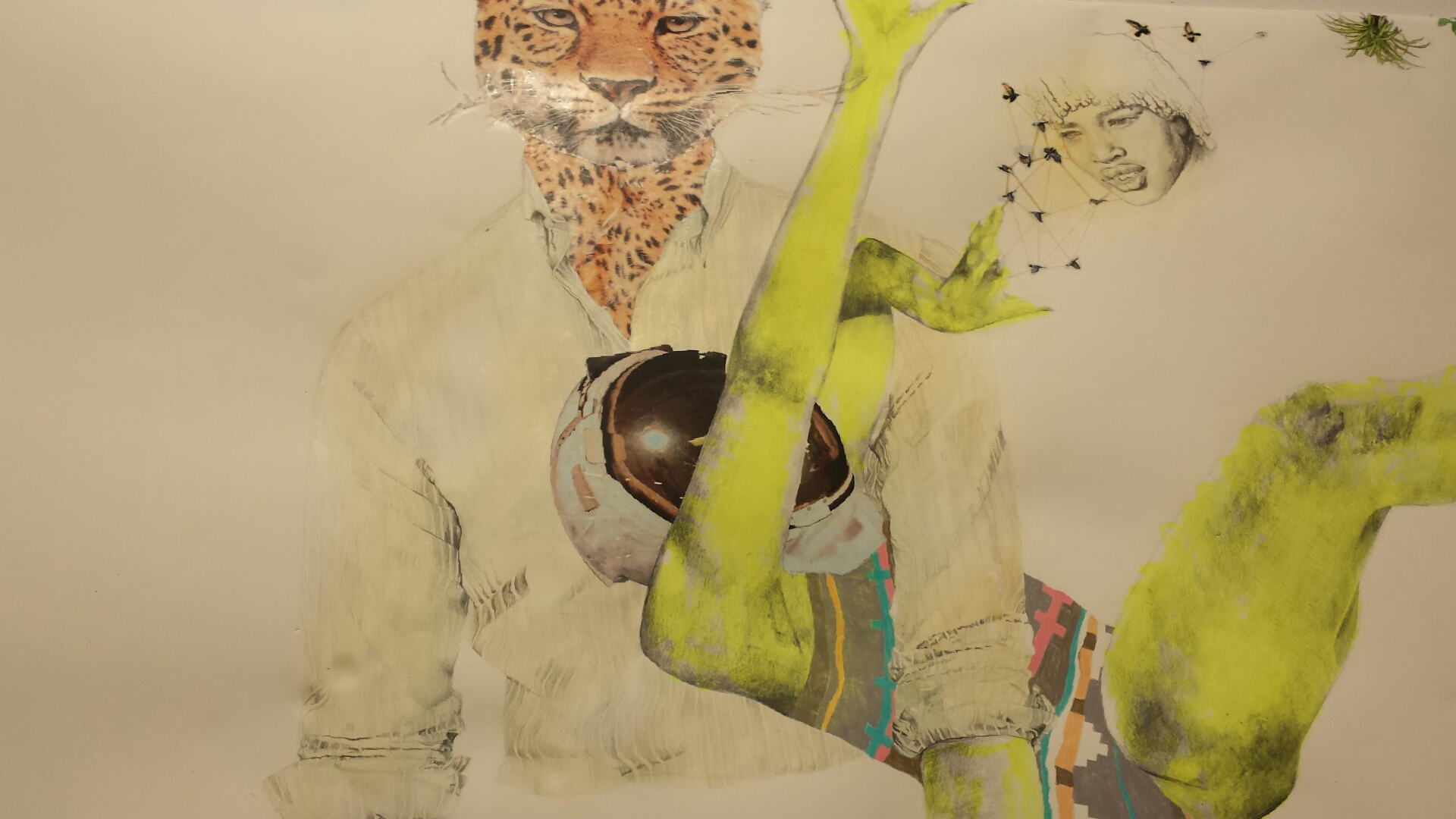
    ruby onyinyechi amanze, works on paper, detail
    ruby onyinyechi amanze, mixed media works on paper, detail. Mariane Ibrahim Gallery, The Armory Show, 2016. photos: FirstindigoandLifestyle

    Can you recall your aesthetic language? Somewhere in the drawings/paper, the characters dance, move, and seem to be very mobile?

    ruby: Funny that you say that, as I’m influenced a lot by dance, performance and movement languages such as Gaga (that I recently discovered and have since incorporated into my extended ‘studio’ practice). Also films…slow moving, non-linear, beautifully ‘choreographed’ spaces and exchanges. I go to the cinema every other week if I can, and am completely absorbed into the imagery. It’s like going to library and collecting books for research. I collect images, not knowing when or how exactly they’ll resurface. Architecture and design influence my imagery a lot.

    In hindsight, I’m aware of many instances where I aligned myself with design conversations and practices. I don’t think I had the language to make the connections before…to talk about my drawings as design. It just was a pull that I kept following. After my M.F.A, I contemplated returning to school to study architecture. I think architectural drawings are so beautiful. And the ways they think about space, as something malleable that can be shifted or constructed, is fascinating to me.

    Your drawings on paper seem to be narrating things, and yet say something very poetic in their way of leaving lots of white space around the figures and colors. How about, are any of these patterns and colors influenced by some African aesthetic traditions, and folk features?

    ruby: I think of the drawings as non-linear narratives. Story telling is a fluid art, and even when it’s ‘true’, there is always an element of fiction in it. I’m a storyteller. And I leave space for the viewers to insert themselves or participate in constructing the narrative. There are clues- some of which come from actual experiences (mine or sampled), some of which are entirely fabricated. I don’t feel any obligation to give the viewer everything. Nor do I feel that art is a platform solely for me to communicate a particular and clear ‘message’. That’s not my job as an artist.

    While spending time in Nigeria, what did you learn and study? How was the experience like; did it feel foreign at times, or was it more like returning home?

    ruby: I’m sure I learned many things…but mostly from the normal day-to-day living, as anyone would wherever they found themselves. There were no grand epiphanies. Generally speaking, there was no “adjusting”. I wasn’t there as a student, but in the position of a professor, I think there’s always a reverse learning that happens in the classroom- if nothing else, how to be a better professor. I was there and it was my home, my life- it felt familiar. Of course, there were things that were different. But the only thing that really rattled me were social attitudes that seemed antiquated when it came to gender or sexual equality. Let’s just say, I got into a few fights!

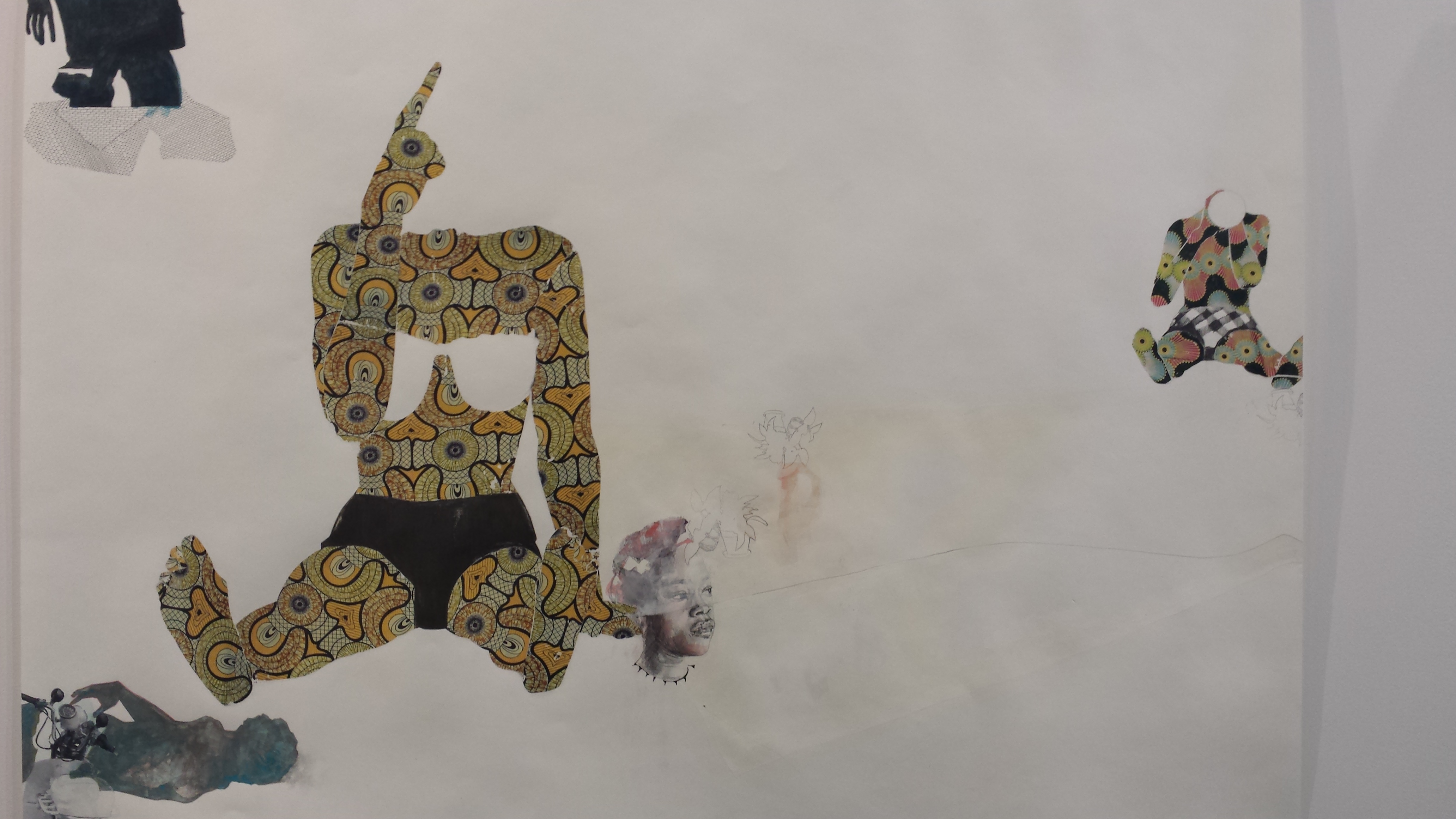
    ruby onyinyechi amanze, works on paper, detail
    ruby onyinyechi amanze, mixed media works on paper, detail. Mariane Ibrahim Gallery, The Armory Show, 2016.

    Do the paper works without borders or frames imply different moods than the ones with frames?

    ruby: No, it’s just a different presentation. I like that paper does many things.

    Could you tell a little about the experience and feedback you received at the Armory Show, you were there with Mariane Ibrahim Gallery during the first week of March? 

    ruby: I’m happy to have had the opportunity. It can be a complicated space for an artist to navigate, because it’s a market. There is little conversation about practice or curatorial interests. I had to separate it in my mind from the studio. In making the work, I was very intentional about maintaining my integrity. Time wise, the work was shown at the Armory, but in a different time, it could have been shown anywhere. In other words, showing at the Armory didn’t change anything for me in terms of what I’m interested in exploring in the studio. More than sales, what I’m most excited about is the visibility…the introduction to museums and such.

    Where are you heading next, artistic plans for the future?

    ruby: I look forward to many things in my career as an artist. But the number one joy in all of this is what happens in the studio. That’s where I’m heading next…

    ruby onyinyechi amanze, works on paper
    ruby onyinyechi amanze, I sent you to survey the world, and when you did not return, I came, 2016.

    Artist website: www.rubyamanze.com