• Dance meets art at Loretta Howard Gallery

    Dance meets art at Loretta Howard Gallery

    Yvonne Rainer’s work Trio A (1966), is one of the most enchanting dance pieces of dance history that paved the way to contemporary and postmodern dance practices. It is an interesting choreographic work, not least because it is exhilarating from pure performance and performer points of view. How many times do contemporary performers get immersed in new projects, where choreographers and directors inquire effortless, non-virtuous task-oriented movements and behavior to use them as backbones for their pieces. This in fact is not so easy to accomplish at all. As what performer goes through is not so much about ‘performing’ from a merely audience seduction point of view, but follows more a neutral way of not-doing too much. This might sound complicated, but makes all sense when in dance the performers start tapping the space, letting their bodies organize the way through the space. The inheritance of this type of movement in dance, a meticulous way of appearing happens sometimes simultaneously in conjunction to things and objects. In sculptural and spatial terms, the dancer is like a living and moving human sculpture. But more than that, the art of dancing in this case is shaped also around imaginary objects, or spatial lines that cut through the architecture of space. In Trio A, it seems that the space and objects were a great source of inspiration for Rainer, acting as inner elements, and shaping the movement sequences. There are, of course, noticeable tricky movements and balancing included in the work, even when the dancer (herself in the original Trio A, which was part of a larger work The Mind Is a Muscle) would not make a full sequence of complicated turns, for example. In 1966, Trio A changed the dance scene by examining the possibilities of human movement. Rainer had learned from Merce Cunningham and John Cage to have different approach to the her audience or spectators in general. She also started to experiment with film using the same methods as in choreography.

    When watching the composition of Trio A evolve on the video, it comes to mind that perhaps the biggest challenge is to maintain a calm steady movement flow. The work became a classic not only because it still makes powerful statements of what a composition and a performance is about; but stating a strong performer making the composition. It changed so much in the Western dance history.

    Dance does not always get noticed among contemporary art forms, or is quite rarely placed in the art history like visual arts. When it appears to be paired together with and being a component of the visual arts as a performance art, or in conjunction of musical composition, it gets a different approach. The so-called post-modern dance era brought in new curiosities in terms of artistic collaborations that stretched beyond boundaries of different art forms and genres.

    Loretta Howard Gallery opens on September 10 with a new exhibition entitled “Where Sculpture and Dance Meet: Minimalism from 1961 to 1979.” The gallery curates annually an historical exhibition, and this truly interesting archival exploration showcases videos of historic performances and sculptures associated with minimalism both in art and dance. The exhibit is timely as it is doing homage to ideas that are still in a dialogue setting current trends in visual arts and performance. The exhibition shows that choreographers and sculptors, for instance, used methods of composition that were known as subjective. Yvonne Rainer belongs to these artists who brought minimalism to dance. She did not eventually wish to include her Trio A showing into the gallery exhibition, but her historic rehearsal recording from Conneticut with a group of performers works as a good intro to her style.

    In the exhibit, there is also a video of sculptor Robert Morris’ work,  in which a masked male performer performs with a sculpture created by Morris. In the 1960s, he built his early sculptures in Yoko Ono’s loft that also involved unique performance elements. Choreographer Simone Forti’s archival video of her piece Slantboard (1961), is an important addition to the exhibition. The work includes a platform in its center for performers to attach to and play with. The exhibit culminates around a piece Dance created by Lucinda Childs (original from 1979). The video is a double performance in a sense that Childs’ company performs in the background video when the Dance is recreated for stage. The choreography gathers an architectural sculpture from Sol LeWitt around it. Childs collaborated with the artist in set designs, and used music from composer Philip Glass.

    Andy Warhol’s installation of helium filled pillows, Silver Clouds, adds an interesting story to the exhibition. Warhol created the pillows which then functioned as a set in Merce Cunningham’s dance work Rainforest (1968). Performers in this choreography encountered the clouds when they were floating across the stage. Cunningham often explored dancers and objects to create ‘random’ encounters, so it is great that the exhibition’s shows a performance video and the sets in the gallery space to make the central point come across.

    In addition to the artists and collaborations mentioned, Loretta Howard Gallery displays Trisha Brown’s video Group Primary Accumulation (1973) as part of this archival display. The choreography explored altered understanding of the beauty and power with simple repetitive movements. Brown used principles of mathematics, modularity and repetition when composing the dance. Next to this video, there are minimalistic sculptures on the walls from Donald Judd, who created designs for some of Brown’s choreography. Then, a strong sculptural work is on display from Ronald Bladen.

    The exhibition “Where Sculpture and Dance Meet: Minimalism from 1961 to 1979”, is curated by Wendy Perron, who is the author of “Through the Eyes of a Dancer” and former editor in chief of Dance Magazine. It is co-curated by Julie Martin, who is an independent scholar and currently Director of Experiments in Art and Technology (EAT). The exhibit is on display from September 10 until October 31st, 2015 at Loretta Howard Gallery, 525-531 West 26th Street, New York.



  • Cho Kuwakado: making murals

    Cho Kuwakado: making murals

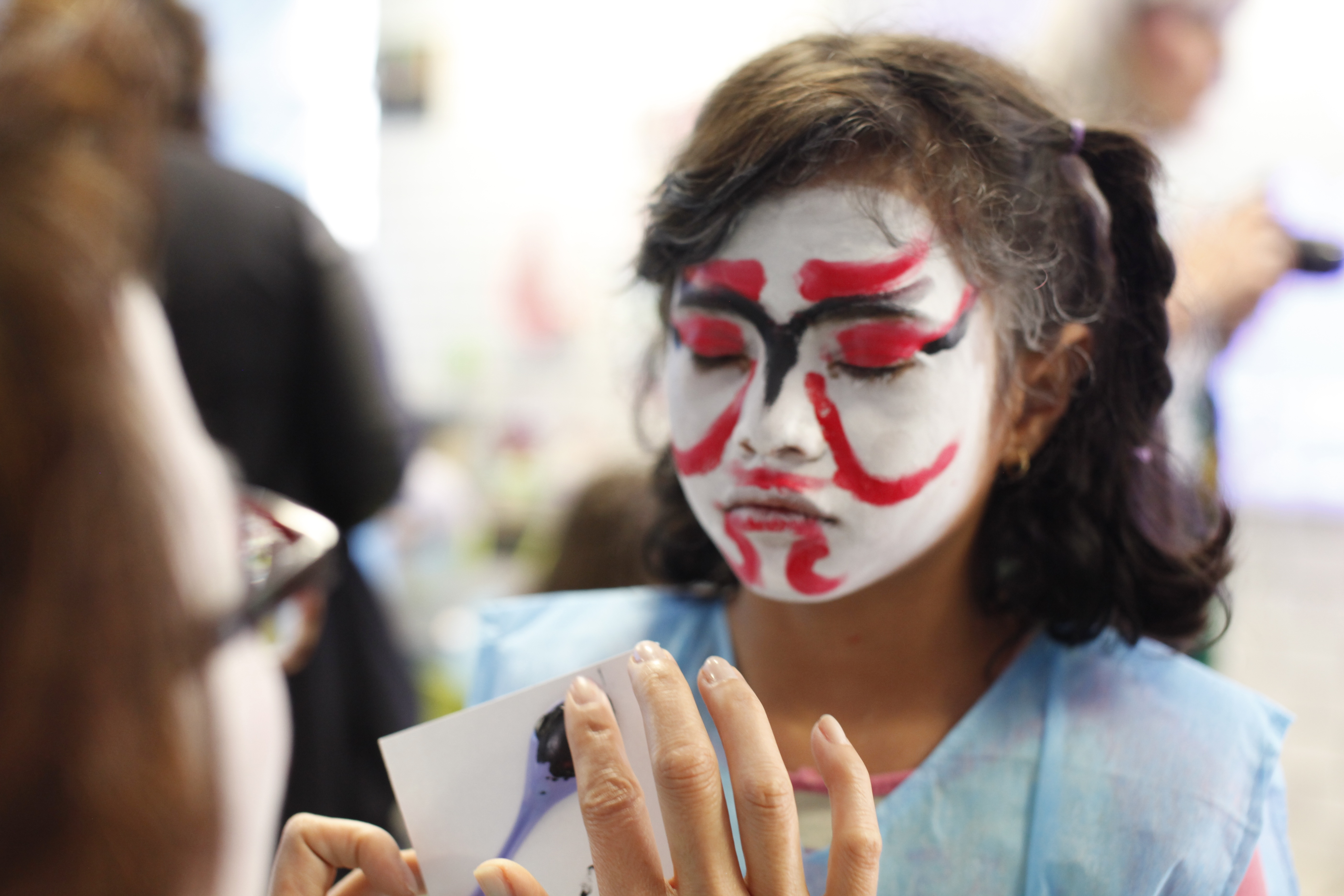
    Cho Kuwakado is a Buddhist priest and director of Lumbini Kindergarten in Saiki City in Japan. He is an Arts educator together with his team that makes Chara-Rimpa mural projects in Japan and abroad. The most recent international collaboration was for the opening event for the celebration of Colegio Madrid’s 75th anniversary in Mexico. In the interview, Cho discusses the background of these projects, and encourages us to think together with his educational philosophy, which is rooted in the history of Art and in the Buddhist thinking.

    There are two levels of nature in my thinking. One is a superficial level like weather, vegetation, and ecosystem. Another is a cosmological level from which the superficial workings of nature emerge. Valuable works of art for me entail some elements of nature at a cosmological level. I think that is the source of the universal appeal of fine art work.


    Chara-Rimpa is an art project initiative with a global production perspective, how did it get started and when?

    It started in Spring 2013 when I began planning for our kindergarten’s 50th anniversary event. I contacted Dr. Yasuyuki Sakura, a graduate of our school and an established artist based in Tokyo, to ask him to be involved in our celebration event. Dr. Sakura agreed to be the art director of our kindergarten as well as to be a co-planner of our anniversary celebration- this was the initiation of the Chara-Rimpa project.

    The global production idea came up when teachers from our sister school in California visited our school in Saiki. They were quite attracted by the professional work of Dr. Sakura and in the large mural in our school play yard that was created with 64 kindergartners in one day. I then thought about the possibility of doing a Chara-Rimpa art project in California and was interested to see how it could be carried out. I made a proposal to one of the teachers, Sarah Clark, to visit her school with my artist team. Then we started to talk about the details of a possible mural making project in California. After six months, in June 2014, we visited the town of Burney, CA where the movie “Stand by Me” was filmed. We worked with the sixth graders of Burney Elementary School. Our Chara-Rimpa project in Burney was a great success.

    I’m very curious, what is your own background in the intersection of the arts and community involvement/community work?

    My family has resided in Saiki City, Oita Prefecture, Japan since the 17th century as a hereditary Buddhist temple chief-priest/caretaker family. I am the 17th head priest of a Shin Buddhist temple, Zenkyoji, as well as the director of its kindergarten. As I grew up, I often looked into the writings and possessions of the former head priests, and I learned that india-ink painting, calligraphy, and mastery in classical Chinese poetry were common practices of former Buddhist priests until a century ago. Nowadays some limited groups of priests do continue these traditional practices. My interest in art came from my predecessor’s interest in Chinese art culture.

    With 1500 households belonging to my temple, I think it is an important part of my responsibility to serve our community. Planning art events and workshops building relationships between children and adults is one of my community commitments.

    Where did you study, and how did you find your international networks?

    I was trained in Buddhist practice at my temple since the age of five. I studied social anthropology at Claremont Colleges (Pitzer) in Southern California, University College London, and Cornell University. My father was a Buddhist priest and a child education specialist. He studied in the US for one year. He developed a scholarly network then, which later led to my interest in studying at a university in the US. When I was a student there, I was fortunate to make friends from various countries, though I lost contact with many of them after graduation. However, through Internet SNS, mainly Facebook, I have reconnected with many friends that I studied with in the US and the UK.

    Your recent project took place in Mexico City, how did the murals come about? How do you feel, what was the impact at the local level?   Do you use multicultural tactics?

    Dr. Sakura and his partner Toshie Yoshioka worked together to develop the design theme of the mural. In a photograph of the elementary school wall, they noticed a water fountain in the lower central part of the wall. The shape of the water fountain resembled a plant pot and they decided to draw a big tree growing from ‘the pot.’ It came out incredibly vibrant and beautiful and the impact of the mural was greater than I had expected. It was an opening event for the celebration of Colegio Madrid’s 75th anniversary. About 20 teachers and 70~80 students participated in making a giant mural on its elementary school building wall. I felt the power of the artists’ imaginations, which enabled many people to work together for the same purpose enthusiastically. The directors, teachers, students, and invited guests all looked happy and marveled to see the beauty of the completed mural. We also organized and ran workshops which incorporated elements of traditional Japanese culture. Our photographer took photographs of Mexican people in “on the job/off the job” style to be used for later workshops in other countries.

    Who are your greatest influencers in terms of the arts and creativity?

    I have always been influenced by the thoughts and activities of Ryuichi Sakamoto (Japanese composer/musician), Levi-Strauss (Claude) for his work “La Pensée Sauvage,” and the Vienna Secession for their quest for freedom in art, departure from historicism and conservatism.

    Could you tell us about your most important collaborators, who are they and what is their role in the projects?

    Dr. Yasuyuki Sakura is the key artist of our project, conceptualizing the overall plan. His partner Toshie Yoshioka is a splendid designer who creates our workshops and mural design. Hiroaki Seo is our indispensable photographer who records the process of our activities, the finished work, and also captures the fleeting expressions of the participants. Hiroaki is responsible for all those vibrant images of the project and the people involved. Hanako Suro, our writer, communicates in a friendly and warm style to share information about our projects for a Japanese audience. Keiko, my wife, helps me making plans and doing projects. Kate Milling Yonezawa always helps me with English wording. Hao Phan, my friend from Cornell University, has been very helpful in planning overseas projects. It was thanks to Hao that our project in Mexico was so successful. I am very appreciative of Hao’s support with her global network. Another Cornell alumna, Young Ju Kwon, owner of the sushi restaurant YUZU, is helping us with possible project development in New York City.

    When we plan our overseas projects, it is crucial to have a devoted, experienced person in charge of the art project. Sarah Clark in Burney and Laura Gilabert at Colegio Madrid were such teachers. We were very lucky to have Sarah and Laura in charge of the project at each school.

    Do you have a specific education philosophy that gives you guidelines? Does being Japanese implement ideas that you think are unique, and that the world should learn about?

    My education philosophy has its base in Buddhism; every individual’s potential is valued equally and is educated accordingly, everyone needs to play a role for a peaceful society.

    A former professor of Tokyo University of Arts, art critic Hideto Fuse points out that one of the distinctive characteristics of Japanese art throughout its history is to cultivate “the mind of children” as expressed in the facial beauty of Buddhist statues. I agree with him that the Japanese art tradition valued “the mind of a child” in the sense that Picasso expressed, “It took me four years to paint like Raphael, but a lifetime to paint like a child. “ I think that if there is something Japanese artists can offer to the world, one thing is its artistic tradition of expressing “the mind of a child” in art forms as can be seen in the contemporary works of Takashi Murakami and Yoshitomo Nara.

    Do you have a favorite art form, performing arts or visual arts, what does being so multidisciplinary mean to you?

    Visiting museums is always a treat for my mind. I was fascinated by William Turner’s work in London. I love music very much. A solo performance by Rostropovich that I attended at Cornell Concert Hall was one of my most fortunate experiences. A Sankaijuku dance performance that I saw in LA was impressive. Form itself does not define my preference. I am more attracted to the spirit expressed in any kind of art form. I think multidisciplinary is a very stimulating concept. It is a very effective approach to reach more audience in the context of technologically progressing diversified modern society. I think our art project can be viewed as a type of participatory art or relational art, which is usually, categorized as multidisciplinary art.

    What kind of role does nature play in your thinking? Are there any specific metaphors in the nature that are important for you personally, and in your creative process?

    There are two levels of nature in my thinking. One is a superficial level like weather, vegetation, and ecosystem. Another is a cosmological level from which the superficial workings of nature emerge. Valuable works of art for me entail some elements of nature at a cosmological level. I think that is the source of the universal appeal of fine art work.

    What kinds of projects you have in mind for the future in Japan and overseas?

    Dr. Sakura and I are planning mural making projects in Japanese towns. We are also planning another overseas art project for the next year involving mural making and cultural exchange art workshops. The mural design and the workshops are planned taking into account the project location and the country’s unique culture and traditions.

    We are also planning to partake in a local festival here to attract more people and to create an improvisational call-and-response singing event. We are hoping that more people will experience and enjoy the spirit of Chara-Rimpa.

    The mural design and the workshops are planned taking into account the project location and the country’s unique culture and traditions.

  • Visiting Linda Cunningham’s studio

    Visiting Linda Cunningham’s studio

    Last month, New York based artist Linda Cunningham showed me her art studio in the Bronx, where she lives and works.  It is located next to the Bronx Art Space that is fostering arts education and collaborative artistic projects. She told me stories behind the art works, both the sculptural works and the collages that combine drawing and photography.  The studio is in a newly renovated building nestling at the heart of the historic urban Bronx.

    Firstindigo&Lifestyle: Linda, you were one of the first artists to come to this location, how was the neighborhood back then, it’s been now a good fifteen years? You did a series of artwork digging into the Bronx history, in which immigration was a theme or a subject. There seem to be real person’s story involved, including documents, such as passports with photos. Could you tell about the project that was exhibited at the Andrew Freedman house in 2012?

    LC: When I first moved to this historic landmarked area of the South Bronx, I began photographing the now renovated 19th Century row houses with brownstone trim, the contrasting graffiti walls with the shopping carts of the homeless. The barbed wire and I merged those images with a young Jamaican’s poetry and rubbings from the historic signage telling about Jordan’ Mott’s iron foundry. Later I was invited to create a large installation in No Longer Empty’s exhibition at the Andrew Freedman House, an amazing building designed like a Renaissance Palace, left from the early 20s when the Bronx was blossoming. My installation was constructed like an open book from broken drywall panels and broken old wood frame windows with each panel referring to an era of Bronx history. I along with other artists scavenged in the water soaked ruins, excavating the papers representing early 20th Century history of the Bronx. Including among them was the unusual passport of a resident of the house with two different last names, both apparently Jewish heritage, along with her photos. She had traveled all over Europe 1936, and through the Third Reich and into Switzerland several times, so her story suggests that she might have functioned as part of an underground.

    Linda Cunningham_bronzesculpture
    Bronze at Linda Cunningham’s Bronx studio

    Firstindigo&Lifestyle: You recently attended an Art Fair in Harlem, titled FLUX art fair in May 2015; do you have any specific notes in regards to engaging with the community during this festival?    

    LC: This was such a lively engaging event during which I enjoyed most interesting conversations about my work. The artwork displayed in this art fair was tough and engaging and in general more accessible than in most other art fairs

    Firstindigo&Lifestyle: What captured my attention was your rich methodology of juxtaposing various elements. Your artwork depicted ancient olive trees in Italy that are approximately 800 years old by now. These trees got bacteria from Costa Rica somehow. Did the local community got involved in saving them? 

    LC: I don’t know anything about the local community. I just read about it in the Times saying that “they” are trying to contain the epidemic.

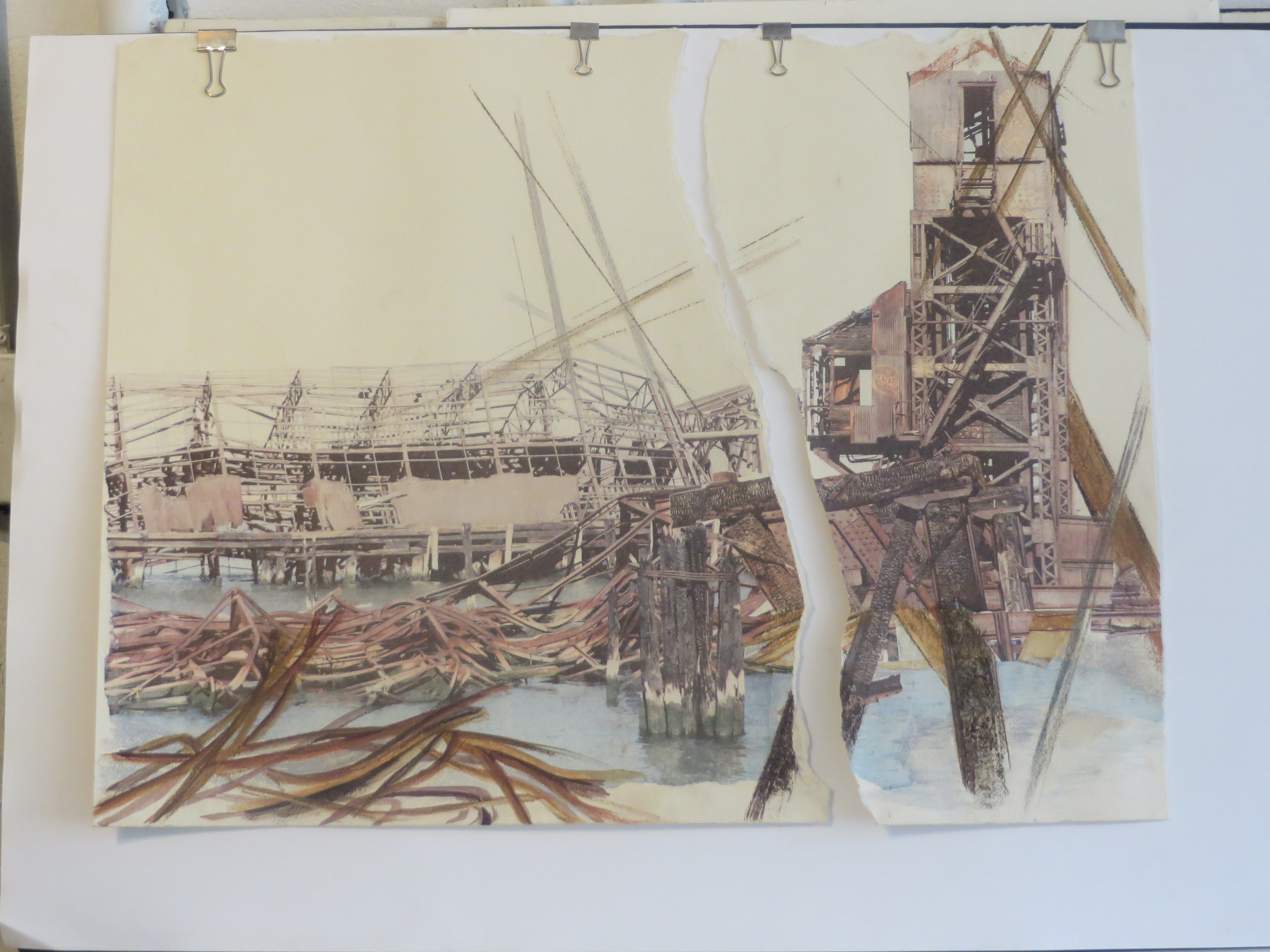
    Firstindigo&Lifestyle: What you did in your collage was that you implemented the trees together with post-industrial photographic scene of Ruhr in Germany. This area used to be a center for coal, and now it’s gone. Tell, what is the particular message behind this juxtaposition?

    LC: Both of these astonishing entities are vulnerable, but these amazing ancient trees will continue being productive and useful for centuries, whereas, the astonishing human designed technology is obsolete in 75 years or less and falls into ruin.

    Linda Cunningham_Collage

    Firstindigo&Lifestyle: You have worked with sculpture. The bronze in them comes from ’recycled’ old weaponry from the Pennsylvania army base. The story behind the material is so intriguing, and the fact that you wished to turn the weapons into ’vegetal’, so the forms are like plants.  The texture of your sculptures remind of natural formations appearing rough, in some parts they are smooth, as if ironed.  Could you tell a little bit about the process, how did you find them, and how was it to work with the material?

    LC: The bronze came from military scrap, which I obtained with some difficulty through a not-for-profit institution where I was teaching for a number of years, Franklin and Marshall College. The scrap bronze, which mostly came from ships, military ships, which are not really weapons. The bronze was smelted and poured into a defined shape in flat, oil-bonded sand molds.  The cooling of the hot bronze creates the rough surfaces as the bronze is poured. I am doing some casting currently.

    Firstindigo&Lifestyle: Another element in your sculptures comes from nature. It’s fascinating how some of the rocks you have in the studio are from the ocean. The nature has worked in them so that the huge pressure in the floor has pressed the shells to attach into the stones. One of the rocks is also volcanic, and comes from the Californian coast. Do you have a specific relation to ocean and water in your artistic thinking, as I see the ocean appear in many of your collages?

    LC: I have always been drawn to the eternal rhythm and power of the waves, but in my youth I had read Rachel Carson’s “The Sea around Us”, a beautiful factual narrative about the origins of life and the vulnerability of the life giving sea so essential to our survival.  Then super storm Sandy gave my early interest a new focus.

    Linda Cunningham_Collage2

    Firstindigo&Lifestyle: Also the technique in your collages is interesting, you are drawing and then adding laser photo transfers to paper. Even the surface has layers, cement or metal appears on the surface of the paper adding three-dimensionality. Could you tell more about this appeal? 

    LC: I have worked as a sculptor, and even when I am engaged with these large drawings I am drawn to include appropriate resonant texture and sensibility.  Even though photography can be manipulated it is essentially documentation and convincing as reality. The veracity of photography seems essential. My exhibition will be at Odetta Gallery in Bushwick in November 2015, and I will include especially drawings fused with sculptural elements. I was working on creating some new spectacular bronze forms that will be included in the show. I work on torn irregular shapes because reality doesn’t fit neatly inside a rectangle shape, rather it’s discontinuous, fractured etc. I work from places I have been, responding to particular environmental and historical issues raised e.g. from flooding of Venice, and a jungle growth strangling Ancient Cambodian temples. I built the installation with the Hebrew text some years ago after I spent a year in Berlin on a Fulbright scholarship. I did an installation In Kassel for an alternative documentary, and obtained many of the elements from the former East/West border known as the Berlin Wall.

    Linda Cunningham_Collage3
    Linda Cunningham’s collage depicting trees and Ancient Cambodian temples

    I have always been drawn to the eternal rhythm and power of the waves, but in my youth I had read Rachel Carson’s “The Sea around Us”, a beautiful factual narrative about the origins of life and the vulnerability of the life giving sea so essential to our survival. Then super storm Sandy gave my early interest a new focus. -Linda Cunningham


    Linda Cunningham_Berlin Wall
    Elements from the Berlin Wall at Linda Cunningham’s studio


    ***

    Artist website: http://www.lindalcunningham.com/

    Check also Bronx Art Space

    All images: Firstindigo&Lifestyle