• Groundwork -exhibition promotes ecological awareness

    Groundwork -exhibition promotes ecological awareness

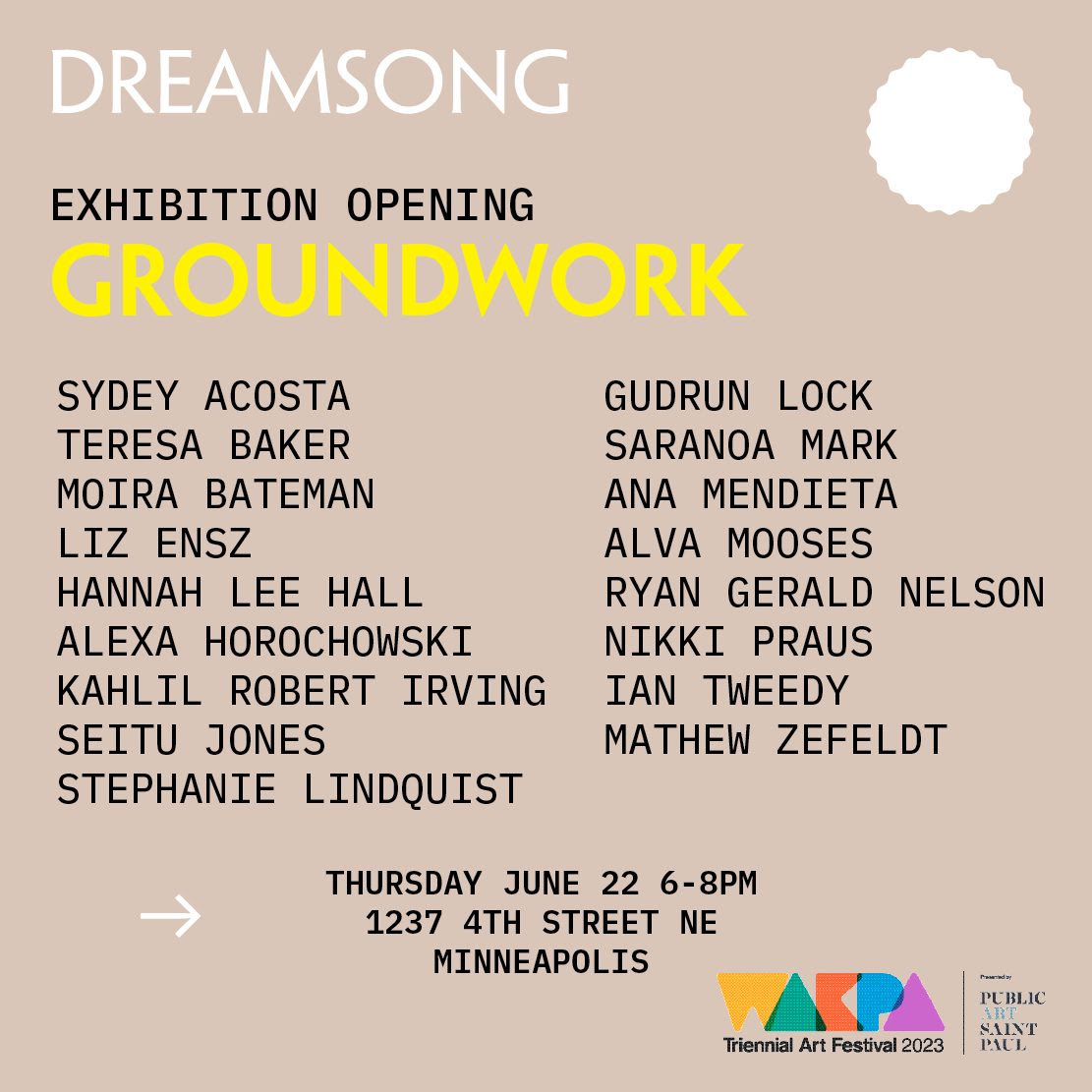
    Groundwork, an exhibition opening in Dreamsong gallery in Minneapolis this week celebrates our human connection to the ground. As one exhibition artist Ana Mendieta puts it when she references her artistic endeavour: ” from insect to man, from man to spectre, from spectre to plant, from plant to galaxy.” All artists partaking in the exhibition promote ‘terra firma’ both as their subject matter and medium. Groundwork is showcasing in the Twin Cities as part of a Wakpa Triennial Art Festival with opening reception taking place on June 22, 2023.

    The artists, who span generations and territories across the United States, include: Sydney Acosta, Teresa Baker, Moira Bateman, Liz Ensz, Hannah Lee Hall, Alexa Horochowski, Kahlil Robert Irving, Seitu Jones, Stephanie Lindquist, Gudrun Lock, SaraNoa Mark, Ana Mendieta, Alva Mooses, Ryan Gerard Nelson, Nikki Praus, Ian Tweedy, and Mathew Zefeldt.

    We can state that the exhibition is a call for planetary matters and ecological awareness. A soil is the context and source for enlivening nutrients. It is a semiotic signifier of territory and identity, as well as a land/site of conflict over indigenous rights and environmental protection. There is of course a tradition of the Land Art of the 1960s and 1970s. The artists in Groundwork are not purposefully having dialogues with pioneers like Robert Smithson or Michael Heizer, and with a perhaps romanticized idea of ‘empty’ Western landscapes. The artists, rather, wish to discuss their homage to detail, paying more attention to what it means to connect to locally embedded and lived histories. And as such the exhibition relates to questions of how the past legacies echo into the future.

    “Adopting anticolonial, queer, feminist, environmentalist, and other critical lenses, they seek communion with the specificities and spiritual meanings of place, burrow into the legacies and experiences of their ancestors, and express concerns about our collective future.”

    Many artists consider the direct consequences of a fast-deteriorating planet, and their art acts as a kind of site-specific artistic research project showing the case of climate change. Forest fires, colonialist over-use of land, mining, resource extraction, droughts, damages from conflict; the list is endless when we start thinking of ancestral time and memory that it evokes in the context of land and soil.

    Focusing on land in artwork, in which ground acts both as subject and material, the exhibition wishes to engage in the conversations about the earth’s preservation. What do different local contexts and materialities mean? What are the disputes about, for the people with ancestral rights that bear spiritual and physical connection to the territory, to heritage? How about modern built environments with technical challenges in preserving the soil and environment?

    In each of the exhibited artistic projects, metaphorically, the future will be grounded as long as there are innovative strategies that learn from the histories they wish to navigate.

    “the indelible connection between our modern built environment and its raw material is made explicit, our vast inscription upon the earth metaphorized by materially innovative strategies that seek to collapse the boundaries between history, place, and representation.”
    The exhibition is organized by Public Art Saint Paul. The inaugural edition responds to the theme “Network of Mutuality”, a phrase from Dr. Martin Luther King, Jr.’s Letter from Birmingham Jail, which speaks to social justice, mutual care, interdependence, and inextricable links among humans.

    … … … … …

    Dreamsong is a space for contemporary art comprised of a gallery, a standalone Cinema, and an artist’s residency. Our program is focused on intergenerational emerging and mid-career artists from Minnesota and beyond, with an emphasis on female-identified and under-recognized artists. Founded in June 2021 by Rebecca Heidenberg and Gregory Smith, Dreamsong is located in Northeast Minneapolis.

    Featured Image: Stephanie Lindquist, Tasting Tart Cherries, 2021, acrylic, and cyanotype on canvas,
    40 x 48 in.

  • Olena Jennings and Natalie the Ukrainian doll

    Olena Jennings and Natalie the Ukrainian doll

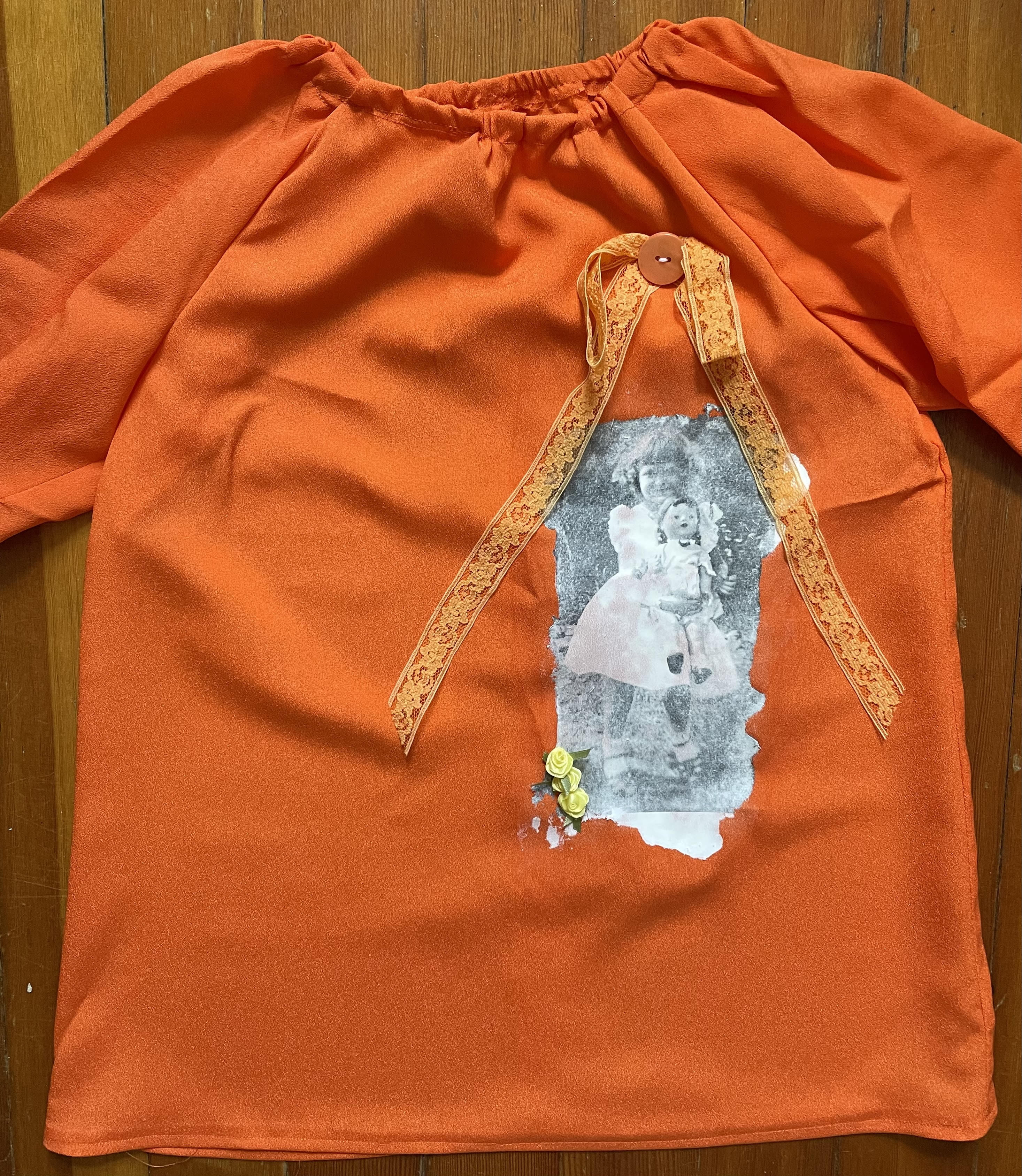
    New York based artist and poet Olena Jennings created an installation of two artworks that are based on a family photograph. These two pieces revolve around one photograph of a little girl, who is Jenning’s mother, on a swing with a doll in the 1950s. The installation includes also connected poems.

    Natalie is a character in a long poem by Jennings. She is someone beloved who goes through many transformations. The colorful wall piece of Jennings’ installation (above), includes an excerpt of a poem from the collection The Age of Secrets (Lost Horse Press, 2022) about Natalie and the doll. The poem embroidered onto the artwork’s fabric is published as, When I Moved To the City. (https://www.apofenie.com/poetry/2021/1/22/when-i-moved-to-the-city):

    Natalie was the doll.
    I worried her eyes would close
    and get stuck,
    stay that way forever.

    -Olena Jennings, 2021 (excerpt, see the whole poem through the link above)

    The family photograph is transferred also into the bright orange crepe fabric, which is a new dress made by Jennings. This orange doll’s attire as part of the art installation, is a replica of the one that the doll actually wore in the family photo. Mother of the artist still has the doll in her house.

    This orange dress is decorated with Ukrainian-patterned ribbon, reflecting my cultural background. The orange dress is the doll’s. I often work with memory, as depicted here in a moment from the past that is repeated in each piece. -Olena Jennings

    Firstindigo&lifestyle: As a Ukrainian descendant, how are you dealing with the war in Ukraine, and thinking of your family and friends? Do you connect your poems and images to the tragedy happening today with the Ukrainian children?

    I think every piece of art I create now has to do with the war in Ukraine. It’s impossible to ignore and the sadness is tangible. As part of this project, I am digging into my roots through images that were taken there or shortly after my family’s arrival in the US. I do this to work through my own emotions and to find a point of connection with my friends in Ukraine. -Olena Jennings

    Below is the new unpublished poem INTERLOCKED, which Jennings created in conjunction to her art installation.

    INTERLOCKED


    A body is bare,
    ready for the dress
    of chiffon.
    My body is bare,
    in the mirror
    where her gaze falls.
    The doll’s is made
    of plastic, her belly button
    blossoms.
    Mine is made
    of warmth, my lips
    wet and petal-like.
    I have long conversations
    with her, her eyes
    stare back.
    We talk about the girls
    who ignore me
    on the swings.
    We talk about the way
    I can almost reach the sky,
    I always want more blue.

  • Flowers on a River: The Art of Chinese Flower-and-Bird Painting 1368-1911

    Flowers on a River: The Art of Chinese Flower-and-Bird Painting 1368-1911

    On March 23, 2023 China Institute Gallery in New York is reopening to the public afer a renovation. The new exhibition in the galleries celebrates Chinese flower-and-bird paintings. On display are masterpieces of Chinese paintings that span over five centuries. The museum is the only in the United States to exclusively exhibit Chinese art, and this exhibition is the largest survey of its kind outside of China. The works are from Tianjin Museum and Changzhou Museum respectively.

    Flowers on a River: The Art of Chinese Flower-and-Bird Painting 1368-1911, includes more than 100 masterworks from 59 artists. The works were created during a 500 year time period between the Ming and Qing dynasties. Not only the individual styles of the artists are highlighted in the exhibition, but it will also detail the academic and literati aspects of the works.


    With these paintings we can escape to nature and imagine the natural world, which has inspired artists throughout centuries everywhere. The imagery of the paintings communicate a deeper meaning of art. In Chinese thinking, the humanity is resilient when it connects to the natural world, living in harmony with its diminuent details and magnificent forces.


    Yun Lanxi (dates unknown) and Zou Yigui (1686-1772) Eight Immortals in the Flower World Album of 8 leaves; ink and color on paper 12 1/8 x 19 in. (30.8 x 25.2 cm) Tianjin Museum (Leaf 3)


    “Flowers on a River will explore the natural world in the context of the human experience. revealing links that tie the genre’s imagery and the country’s everyday life and social customs.”

    Traditional Chinese painting has landscape and figure at its center. The flower-and-bird motives are in their own category. The exhibition will be presented in three parts: Precious Plums of the Palace: Academics and Court Artists; Fragrant Plums in the Wild: The Literati Art, Painters and Painting Schools; and Vitality of Nature: Flower-and-Bird Painting and Social Customs.


    What is really advanced curating in the context of this exhibition is the inclusion of so many women artists. The Ming and Qing periods saw the rise of women artists. They excelled in flower-and-bird painting. The exhibit will display works from eight women artists. Among others, there are scrolls by two of the most acclaimed, Ma Quan and Yun Bing. During Qing dynasty, they were noticed by their talent; and as was typical to those times, through the legacies of their fathers and grandfathers.


    ‘Flowers on a River’ is curated by Willow Weilan Hai, China Institute Gallery and guest co-curators Chen Zhuo, former Director of Tianjin Museum; Lin Jian, Director, Changzhou Museum; and David Ake Sensabaugh, former Ruth and Bruce Dayton Curator of Asian Art at Yale University Art Gallery. The exhibition is organized by the China Institute Gallery together with the Tianjin Museum and Changzhou Museum.

    “We are enormously excited for the reopening of China Institute Gallery and are honored to present some of Chinese art’s greatest treasures.” – Willow Weilan Hai, Lead Curator of the exhibition, Director and Chief Curator, China Institute Gallery.


    The 42-foot horizontal scroll by Zhu Da, one of the greatest artists in Chinese history, is taking the center stage. It is considered one of the masterpieces of Chinese painting. Zhu Da (1626-1705) is also commonly known as Bada Shanren. His large painting was last seen outside of China in the 2013 exhibition of Masterpieces of Chinese Painting at the Victoria & Albert Museum in London.

    “Bada Shanren pushed the expressive possibilities of monochrome ink and brush to the extreme, resulting in incredibly rich effects with an unmistakable individual character,” -Willow Weilan Hai.

    The exhibition is accompanied by illustrated bilingual catalogue featuring commissioned scholarly essays and detailed exhibition entries. China Institute Gallery is featuring a series of events including lectures, an international symposium, and other programs.

    The artists in Flowers on a River include: Lin Liang, Lü Ji, Shen Quan, Hu Mei, Yuan Jiang, Yuan Yao, Gao Qipei, Jiang Tingxi, Qian Weicheng, Miao Jiahui, Chen Lu, Chen Hongshou, Ma Shouzhen, Wen Zhengming, Tang Yin, Zhou Zhimian, Lu Zhi, Chen Chun, Wang Guxiang, Xu Wei, Xiang Shengmo, Zheng Xie, Jin Nong, Hua Yan, Li Shan, Huang Shen, Luo Pin, Gao Fenghan, Bian Shoumin, Shitao, Zhu Da, Yun Shouping, Tang Yuzhao, Ma Yuanyu, Ma Quan, Yun Bing, Yun Lanxi, Zou Yigui, Yun Guangye, Li Jue, Tang Shishu, Zhao Zhiqian, Pu Hua, Xugu, Ren Yi, Zhang Xiong, Wu Changshuo, Tang Luming, Zhu Cheng, Leng Mei, Chen Zun, Fan Qi, Wang Wu, Zhang Cining, Wang Caiping, Li Boyuan, Zhang Sheng, Sun Di, and Aisin-Gioro Yuying.