• Robin Rapoport: From Alexander technique to design sensing

    Robin Rapoport: From Alexander technique to design sensing

    How to describe living the artistic life? How to live a life surrounded by one’s own art? Making art is so intimately linked into one’s sensing of the world that there isn’t simple answers. In the current research of art, we try to map different kinds of knowledge embedded in the artistic processes. ‘Living’ with the arts is like ‘dwelling’, which in fact implies an old meaning for a house. The doors in the house keep opening and closing as a trespass to new fragments of interiors. The repetitious movement of stepping in and out of the interiors gives even the doorhandles almost allegorical significance.

    Robin Rapoport’s designs at her Conneticut home and studio.

    Robin Rapoport is a sculptor and designer who has been choreographing for her dance company Headless Horse. As a dancer in Robin’s company, the creative process made me reconsider dancing together with the sculptural.  Robin has been looking for a living and forming entity in the sculpture, which could be realized through the dancer’s body and her movements. Another layer came from the Alexander technique, which would bring those two materials even closer together. I asked Robin about this entire connection, wanting to know how the Alexander technique has changed her.


    RR: So funny you should ask that. The other day I was speaking with a magazine publisher of home design who wanted her editor to meet me and I said I have a class for Alexander Technique, but will skip it in order to meet her. I reflected that most people do one thing like designing, and here I spend so much time on another activity perhaps losing accounts because I’m not as available. But if you understand Mr. Alexander’s work it is crucial to one’s sense of clarity. The more I go, the more I discover holding in my body that I need to release, and as an artist I am curious where this will all lead. I know I’m changing so much already. The way I stand, my breathing, and so I am not so hyper. I can make better decisions with a calmer mind. We are for the most part so disconnected from ourselves and from the proper use of the self, which enters into all arenas of movement. I am very concerned with health and maintaining it. I do not want to stiffen up but remain easy and fluid. And I think to be an artist is to think outside of the box, to think ahead, to be perhaps more aware of the dangers our planet presents to us on a daily basis. This Alexander Technique is what I do to combat that.

    ORGANIC FORMS

    Robin Rapoport’s sculptures and sculptural furniture display an array of different approaches to organic forms, which could be labeled, as somewhere between Scandinavian and African, they are modern, natural and primitive at the same time.The sculpture and furniture feels animated and living. In some cases it is almost talking to you, and these pieces are shaping the space. The design presence is not too loud, but the pieces make statements and offer alternative points of view to look at the space. A piece of furniture is standing on its own legs, when it is a floor lamp, for instance. And if it is a bookshelf it can even include eyeballs. You might as well know what I mean: When you talk to plants, you talk to trees. And this design is so ’whimsy’ that you might as well talk to it.

    When Robin takes on the art of creating a house with her interior design, she likes to enhance the warmth of the interior walls. The walls already have imaginative touch in them. Cardboard covered walls with a touch of asymmetrical designs gives them a hint of geometry, and overall, they have ethereal lightness in them. This meditative approach, which she also calls as an art of ‘dwelling’ continues in the wooden sculptures. The sculptures both gather and form the space around them, and they have their own individualistic character. Robin’s interest to form is fluid. Materials appear with fluidity; they are towards rough or process-like, rather, than simply solid or static structures.

    Robin Rapoport, eyeball shelves

    THE HUMAN BODY

    The Dance Company is close to being like a living sculpture, where human body is constantly taking new shapes and testing the space where it moves. The dancing bodies with sculptural elements on stage together with them, is another Rapoport’s take on the theme. Along with the abstract, animated and organic forms are these narratives, which have several underlying layers. These stories unfold themselves in a course of a fairytale, or as a series of otherwise magical happenings.

    Dance, short film, sculpture, and light design evolve from the same source creating narratives without suffocating punctuality. Robin’s events evolve around the form and texture. Sometimes a piece of plexiglass gives an idea to a story that becomes a gesture in the dance performance, or it is part of the furniture created, and the objects found, all made for the home. Home is an evolving space, which is the dwelling. And living one’s home is part of the artistic process. Basically home is living together with art, and art keeps changing, as the interiors get different stories and layers.

    Robin has created her home in the woods of Greenwich, CT, together with her husband Edward L. Milstein, who himself is a painter of geometric color. Both share a passion for the arts, design and architecture. These three-colliding elements are coexisting in their home, where exterior is also mixing with the interior. A visitor who comes to their spatial industrial loft-like house and art gallery encounters the presence of the woodland nature. The house is evidently coexisting with its environment, as the landscape is not too worked, but remains the same type of organic fluidity with the rest of the things around. They collaborated with the Robert Young architects to create their ’Art Barn’. In the summer the house has a wire screen wrapped around it which is covered with wisteria, and so becomes a green jewel box in the woods emerging from a winter cinder block form of grey. It is amazing how a ’green screen’ that is like a living skin over most of the surface make the concrete-block look different. The greenery also adds thermal insulation.

    LIGHT DESIGNS

    As of today, Robin has developed Light Designs. She is creating fixtures that come from the sculptural roots of using wood, copper and paper. Interesting ceiling lamps are the ones like an octopus or simply ‘branchy’ wired designs, which are light weighted structures for the ceiling. Ceiling lamp can contain one long rectangular design that has two branchy-designs attached to it, or it can be a smaller sculptural design having one wire inside them.
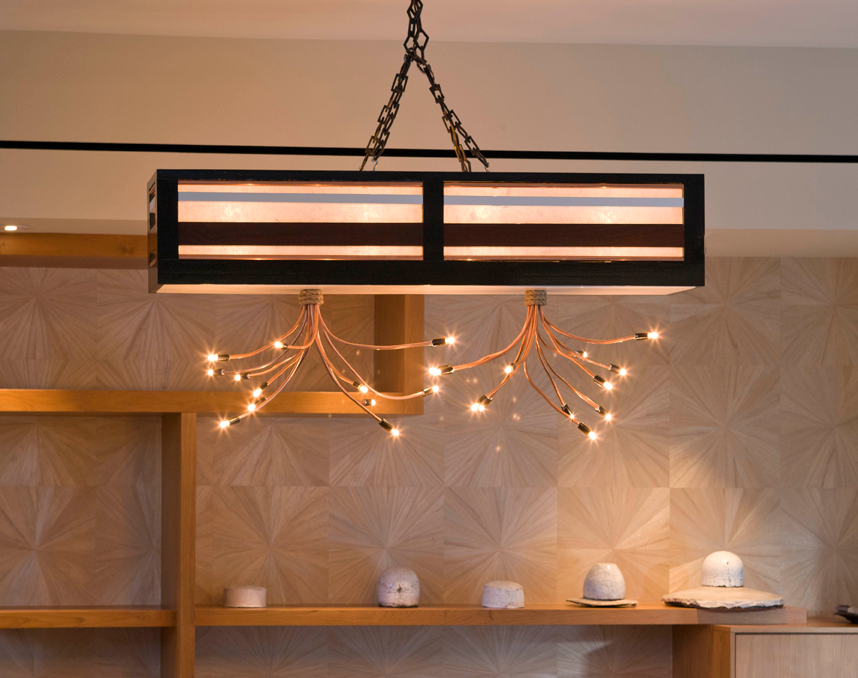
    {photos:courtesy of robinrapoporthome.com}

    I asked Robin few more questions. I wanted to know how living in the woods inspires her. I also asked, where will her designs be in the future, and where will her passion be.

    RR: I think there is nothing more beautiful and magical and instructive as Nature and so I stay here, somewhat hidden and enclosed and perhaps somewhat lonely at times as well but this is where my work unfolds. When I travel to New York it is to study the Alexander Technique but then I come home to walk the property where I have lived for 24 years. Every year I add or shift plants and every following year I can take pleasure in watching them bloom. Outside and inside are distinct yet connected, as are we with both an exterior and interior persona? With so much suffering and tragedy in the world I feel blessed to have this place as a personal sanctuary and which makes me acknowledge every day a higher being which I can attribute the beauty all around me to.

    I hope my Light Fixtures can add beauty to a room. They are crafted by hand so each is unique. I am happy to personalize them for customers meaning that I could change the paper color and or wood color. How fascinating is it in Nature that a plant on the outside can be a dull grey with spikes and when it blooms the most delicate of leaves and colors emerge. And this color is for our eyes to appreciate like cinema except you can touch it.

    My next passion is to have a home furnishing boutique where I would sell my designs for tablecloths and ceramics, as well as have my design services. I love to set the table, and I find very little of interest in the tabletop design right now. So much of what is out there is about simplicity and “whiteness”, but perhaps just too much simplicity. We have lost great craftsmen (women). With the current economy people are afraid to stock inventory that is not trendy. But I am uninspired by what is now trendy. I just find it bland and so will make my own.

    ***

    {ROBIN RAPOPORT’S WEBSITES: Robin Rapoport Home and Robin Rapoport:Dance, Sculpture, Film}

    ***

    Robin Rapoport established Headless Horse in 2002 in New York City. The dance company has performed in live show, in festivals and in her short dance films. Her ‘Thief’ appeared in Palm Springs International Film Festival, and in the Jumping Frames Film Festival in Hong Kong.

    ***

    {/More pictures for the Greenwich, CT house are seen at http://ryarch.com/art-barn}

  • Cultural geography and ‘hiisi’-territoriality…

    Cultural geography and ‘hiisi’-territoriality…

    Cultural geographies can be full of imagination. Finland’s geography shares attributes of ice and snow, whereas some other places are filled with sand and heat. North, cold, south, warm, masculine, feminine, are ideas that we unconsciously relate to our cultural geographies. Then, ‘space’ when attached to cultural geographies is partially ‘virtual’. Interesting is, how our imagination creates space as ‘absolute’, ‘relative’, and ‘relational’ (as David Harvey challenges it).

    What I am thinking in relation to my new work-in-progress research project within arts, is a questions of imagination; how do we as cultural beings and citizens of the global world, create meaning from our cultural origins, or from our cultural geographies. My current research is not about Finland, but I like to reflect one particular attribute, which so often defines Finland’s geographical imaginary. That is the forest, and forest has a meaningful and long prehistory in Finland.

    Folk traditions in Finland’s territory never considered forest as pure wilderness. From the prehistoric times, people utilized its resources leaving marks on a terrain. Originally, forest metsä in Finnish language did not mean the totality of space where trees are a dominant feature of the landscape, but the term pointed to the sacred. Metsä was an edge where inhabited regions of the people ends. It was a borderline for the everyday social life (tämänpuoleinen) and it was a route to the other world (tuonpuoleinen) (Anttonen 2003, 299-301).

    In the thirteenth century, early Baltic-Finnic population covered over 230 local villages in Finland’s territory. An old custom was that ritualized spaces were separated apart from the living areas. Certain trees in metsä had hiisi-inhabitants (hiidenväki) were the dead beings were put to rest at hiisi-sites. These hiisi-inhabitants were the supernatural people of the post-mortal world. When Christianity was brought into the country, the hacking of trees that had hiisi-inhabitants started, and churches were built on those spots. What then happened was, that folklore also converted hiisi –term and its ontological referent to signify ‘Hell’, as a borrowed duality from the Christian theology. The forest started to signify borders between the ‘civilized’ world and the ‘pagan’ world (Anttonen 2003, 299-301).

    How does this imagination enter our current ideas of the forest, is intriguing. How do we see the forest, how do we process it, occupy it, harness it, and so on?

    Reference: Anttonen, Veikko 2003: “Sacred Sites as Markers of Difference-Exploring Cognitive Foundations of Territoriality”. In Lotte Tarkka (ed.): Dynamics of Tradition. Perspectives on Oral Poetry and Folk Beliefs. (Essays in honour of Anna-Leena Siikala on her 60th Birthday, January 1st 2003). Finnish Literature Society: Helsinki, pp. 291-305.

  • What is a virtual feminist museum?

    What is a virtual feminist museum?

    Griselda Pollock’s writes in her Encounters in the Virtual Feminist Museum: Time, Space and the Archive (Routledge, 2007), about the choice and power, as well as about alternative views in the curating of art.

    Spring time is full of art showings. Some of the contemporary art events used ideas that were earlier introduced. Current mixing of concepts and art are already well established. Where is art actually taking place, is it the person performing it, is it in unique details, or is art a social phenomenon, or is it in your subconscious? Looking into Griselda Pollock’s view on curating offers some interesting insights.

    Would art galleries be any different than museums from the perspective of power? In case there would be no space for alternative voices in the museums, would ‘officially’ curated galleries be any different? What Pollock implies is that ‘reading against the grain’ is much more than just aesthetical choices. Virtual feminist museum needs to touch silenced territories. Whose story will be told in the future is important. But we choose to follow the path of retelling the same ‘official’ stories.

    I just learned about an art project, which would fall into a category of ‘alternative’ curating. After all, writing about works in a more positive light, using the power of choice, and overall, rethinking the ethical parameters in actual processes, is crucial for this type of curating. Who gets to participate in a biennale, for instance?

    I found some answers from Estonia. The contemporary art movement called Artishok was established in 2008 in Tallinn. It was initiated by a group of young voices who wanted to “scatter clusters of symbolic capital and status quo”. They were ten young artists, ten young critics, and ten exhibition days, showing new works with critical reviews that opened new works each day. Multiple tastes, philosophies and world views were the key words in the project, which aimed to do something around the exhibition experience as well.

    “Artishok Biennale is an experimental exhibition format that was brought to life by art and criticism…”  (http://artishok.blogspot.com) The next, 3rd in a series, Artishok Biennale will take place in October 10th-20th 2012 in Contemporary Museum of Art of Estonia in Tallinn. The biennale aims to bring X young Baltic and Scandinavian writers to promote X young Estonian artists. This will happen in a moment, where Estonian art world “is struggling for the preservation of the most basic functions”… (III Artishok Biennale will be supported by the Cultural Endowment of Estonia.

    Artishok seems to offer ideas for alternative curating. How would the project do something that relates to a virtual feminist museum?

    Griselda Pollock states that “The dominant social and economic power relations that govern the museum make feminist analysis impossible” (2007, pg. 9). She further adds that “The museum in contemporary society is increasingly bounded into the circuits of capital between entertainment, tourism, heritage, commercial sponsorship and investment” (pg.10).

    So, can this rhetoric be changes in establishing something like the Estonian biennale?

    Art criticism is a tricky institution, and it needs to re-evaluate itself together with the artists. What is truly at stake today is that criticism still has a powerful voice in creating the future for the arts.  The mission statement of the Artishok Biennale is collaborative, as both the artists and writers can be at home “within the ever changing landscape of contemporary art”. What is so great about Artishok is that it has taken the art criticism seriously. It has created reading groups, interviewed renowned professionals from around the world, and brought professional circles and the media together. Artishok has also touched upon the idea of the exhibition spaces. The first two biennales were exhibiting in white and cubic city galleries. The 3rd biennale will take place in Contemporary Museum of Art. The group sees that the art museum is a positive space, because as a young institution the Estonian museum is ambitious and interested in experiments.

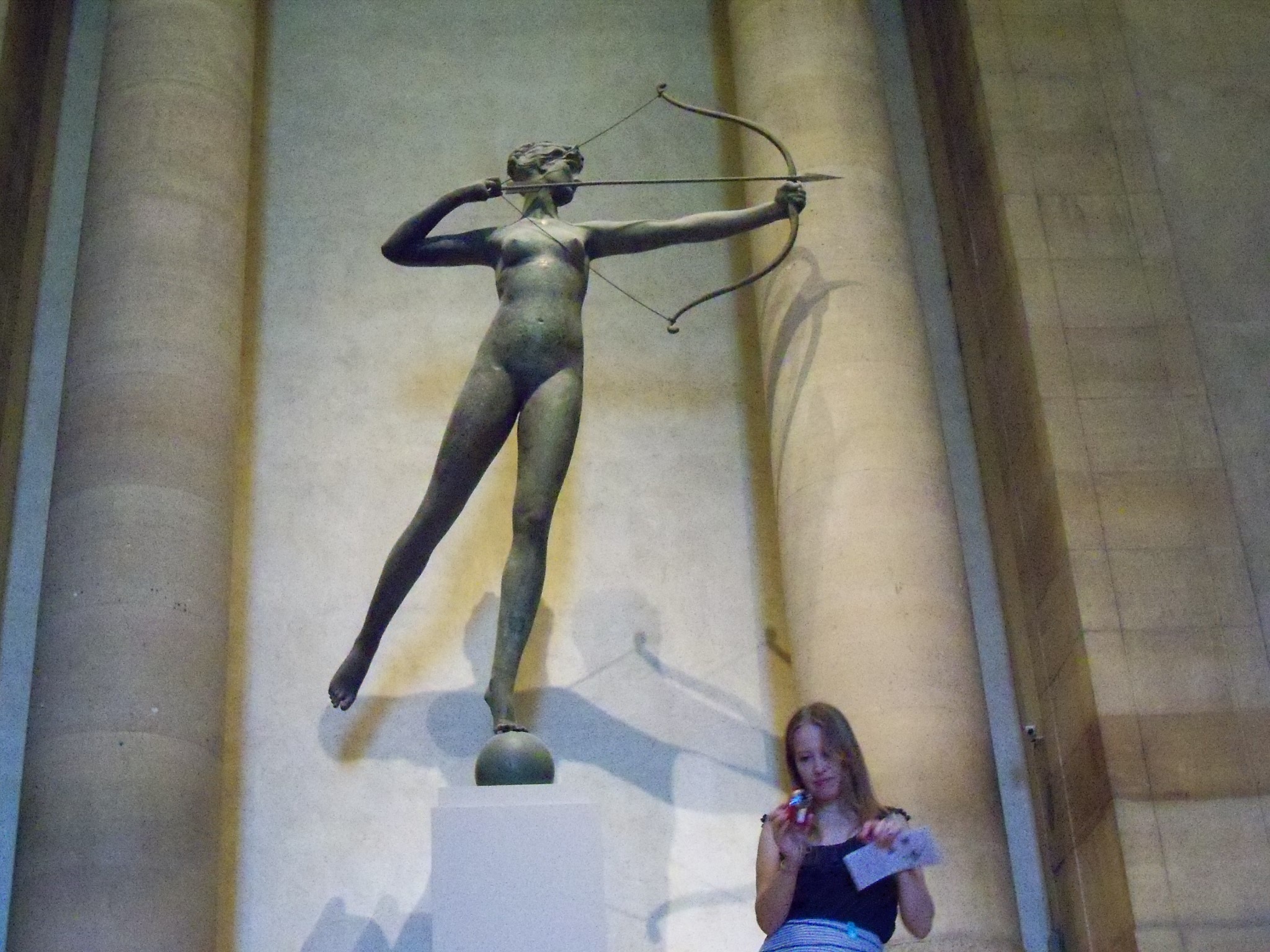
    Coming back to the virtual feminist museum. This blog writing showcases one photograph, which is empowered by a writer of this blog. Her writer name is Firstindigo. In the picture she is looking at her camera, which is her documenting device. She also admirably pretends to hold her defined notes of the documented art. But in fact, this might be completely false. It is rather implied that she holds an art museum program or the museum floor map in her hand. The fact is insignificant in the picture. The location is Philadelphia Museum of Art. The sculpture in the picture matters: Diana was made in America in 1892-94 by Augustus Saint-Gaudens, who was born in Ireland.

    ***

    {Addition to this article by Liisa Kaljula from Artishok comments on March 21, 2012}:

    So nice to read your contemplations on alternative curating and also that you merge it with feminist theory! Some little remarks though on the purely factual: Artishok was founded in 2006 as a platform for different activities on art and criticism, but mainly as an art criticism blog, 2008 it started with Artishok Biennale. The founding formula of the biennale was that there had to be ten artists and ten critics involved in the exhibition each time. The rest has been up to the changing curator. This time instead of one person picking the participants, I wanted to let the critics choose, and for that to make sense, they had to be with as different backgrounds and agendas as possible. So this is why there are critics who are into queer theory and feminism, phenomenology, self-mythology, modernism, video games, sculpture and installation, photography and so on. So basically these ten critics who all have different agendas pick ten artists – and they will all merge in the autumn as one big happy family, when each and every critic has to write about each and every artist.