• Feeling good about my environment

    Feeling good about my environment

    I was tuning into Björk’s Joga, looking at videos of Icelandic landscape and thinking about the affective aspects of our environments. Where we grow up, the landscapes that we get used to, has an impact on us. I strongly believe that landscapes shape our emotions and our approaches to different environments.

    When I think about some of Björk’s own comments about the environment she grew up in, I feel the same way as she does about the North. We should reconsider the Arctic resources and the Northern environment, and take climate change more seriously. Rapid climate change would be huge threat to our landscapes, and even change our feelings about them. I recently learned about a new book, which speaks about the unspoken sites of the climate change process. “To Cook a Continent. Destructive Extraction and Climate Crisis in Africa” is a book by Nnimmo Bassey.

    Bassey writes about Africa, where nature and natural resources have been traditionally considered a blessing. His insight is that by using the nature in a wrong way can turn it into a curse. Bassey accuses global North for taking raw materials from Africa. This also means that when the wealthy economies are consuming fossil fuels, indigenous forests, and commercializing the global agriculture, those economies also destruct their own sense of the good. Our question should be, how to maintain our responsible approach to nature and environment? Perhaps one way is to keep enjoying the nature, and also bring that sense into our designing.

    The human aspect in the community development is a central part of the contemporary design of environments. A new and innovative design-thinking considering public spaces is now more focused in the ‘good-feeling’ aspect that can be attached to making the spaces. Adding dimension of ‘feeling good and happy’ recreates the interiors and designs to fit better in our lives, and to serve us better as communities. Design education at its simplest comes with a recognition that people want to feel good, weather they are in their work offices, at home, or visiting serving centers and service points in public spaces.

    Also, another important question is, what is my favorite place and environment? And, how do I define the good feeling attached to my favorite environment?  I consider a human component to be the core factor even when it comes to a work environment. Feeling good would come with additional space for interaction, which would bring awareness and a sense of collaboration. My experience of my favorite environment is attached to my own memory of different places, which I have visited in my life. Then, the collective images surrounding places shape my feelings about them. In retrospect, my feelings about different environments is influenced by various representations about them.

    In modern design the interiors and exteriors can change my perception of my surroundings quite significantly. How I experience the space, of course, depends of my age, size, and my habitat. I have become nostalgic about the childhood landscapes that my family used to visit. Calling those national parks also my favorite places on this earth makes me rethink how important they are today. Feeling good and remembering the favorite places is one way to respect the future of our environments and the nature.
  • Fashioning ‘eco’ concepts

    Fashioning ‘eco’ concepts

    If fashion is now promoted with both ecological values and celebrity cultures, a question of who is wearing what and whose designs, includes a new kind of conceptual thinking.  Historically, fashion is the clothes that we are wearing. Then, a questions of social class plays an important role, since we are making the clothes our own by wearing them. Traditionally, women have been thought to be the ideal consumers of fashion, so fashion magazines have also created platforms where to discuss and make fashion as part of the women’s lives. In the circulation of fashion, clothes become fashionable again when the trends come back as new combination, and also next to new concepts and ideas. The historical, futuristic, and the near-past fashion are re-produced together with popular cultural icons. The cultural references of fashion keep also changing so that they are able to maintain the ‘hype’ status attached to classical designs. New technologies used in the fabrics, as well as green values are  important factors, which also reflect the moment. More importantly, ecological aspects that promote global awareness and respect the local traditions are now a necessity.

    When in previous decades, the fashion products (and other products) did not take into consideration the ecological dimension of production, today’s processes are very different. The economics behind the change is pricing, as the prices in materials have been rising. Then, today’s consumers cannot be entirely responsible for paying the high cost, so the companies and designers have to be able to reduce the amount in production, and reconsider the materials, which they use.

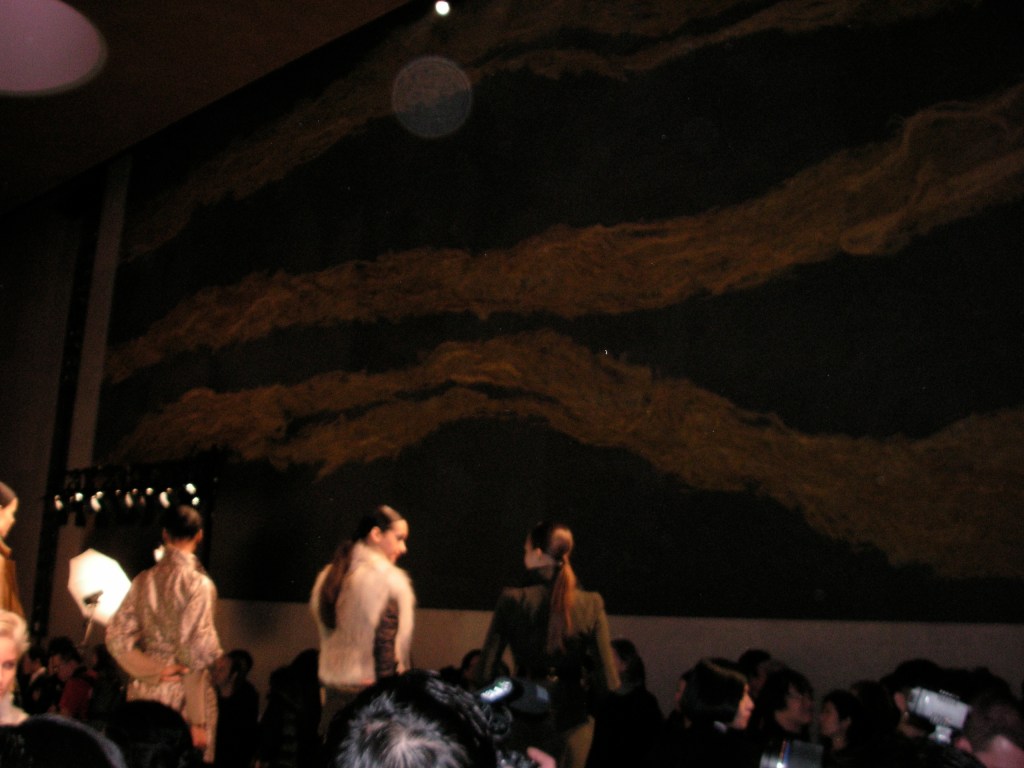
    When we are making our choices as consumers of fashion, more important to us than who is showing up in the shows is to be a conscious consumer. We should be asking, what is the ecological dimension behind the clothes that we buy. In addition, a cultural and geographical referent can become a conscious factor in our decision making; when in the making of the products this means emphasizing the local craftsmanship. One example of this type of local fashioning is a collective Contept Korea that has utilized an idea of Korean fashion culture in their global marketing. Designers who are participating in the collective aim at making Korean cultural image and national competitiveness as their goal. The Korean fashion, which has been promoted overseas has been sponsored by the Korean Ministry of Culture. With that governmental aspect, Concept Korea has been looking for new forums to promote Korean fashion and culture together, and to interact with new technologies. I participated in their showing in Mercedes-Benz Fashion Week in New York in February 2011.

    One of the designers Lie Sang Bong (based in Paris), has been drawing inspiration from Korean folk painting, from the black and white graphic designs which have drops of bright color like red in them. He has also created fashion sculpture and a bauhaus-architecture inspired collection, which both show sculptural dimensionality in clothing. Then, a Korean woman designer Doho impresses with work that has a feminine and flowy touch (see picture from Mercedes-Benz Fashion Week in February 2011). Concept Korea perhaps comes as a continuation of the collective creativity that started with Seoul being the World Design Capital in 2010.

    In today’s economical climate, the design world is thinking alternative solutions. When European countries struggle with economical difficulties, a good news could be that the countries are re-thinking the carbon limits in the production processes.  Only a few decades ago, environmental problems were thought to be part of the policy making of the governments. Now the industrial processes are considering the environmental questions as part of their designing of products.

    Designer Lie Sang Bong with his crew at NY fashion week.
  • I found this architecture book from St. Mark’s Bookshop

    I found this architecture book from St. Mark’s Bookshop

    What a nice thing to find out that St. Mark’s Bookshop can celebrate its upcoming 34th anniversary with victory.  Cooper Union agreed to a new one-year lease to reduce the bookshop’s monthly rent, this was necessary so that the bookshop can continue serving the Lower East Side community (and other visitors as well).  Every signature did count, I was one among the 44,128 on the online petition. The organization behind the action is the Cooper Square Committee, and for over 52 years it has ensured that the diverse community of Lower East Side may continue to bloom.

    The bookshop has become my favorite, it is a smaller scale, and yet, the books that the store carries makes it really a big bookstore. Among subjects of philosophy, arts, religion, psychology, social sciences and so forth, St. Mark’s Bookshop carries great books about architecture and design. I found one of my favorite architecture books from their selection.

    ‘The Architecture of Deconstruction: Derrida’s Haunt‘, is a book written by architecture professor Mark Wigley (1993, paperback 1995, The MIT press).  The following theme of ‘the image of the house, and the visitors in the house’ offers a good puzzle for reading architecture from more deconstructionist points of view. In the narration, “it is the spacing that makes the architecture possible even while, or, rather, only by, violating its apparent order” (1995, 219). The sense of space, the rhythms of spacing, come about with the visitors, the house guests. It is the visitor, when entering the space, who brings forth the laws of the house by his well-rehearsed behavior, or by her disruption of the space. What is compelling in this puzzle is that, especially the ill-behaviored guest actually provides the law of the house by her disruption of the space; whereas architecture itself stands for the all-too-welcome house guest, who would guarantee the space.

    The idea of the inside and outside of the space, the house and the architecture is interesting, because it seems that the outsiders would create the space/architecture when entering into it. Fascinating thinking. This can be applied to considering our contemporary architecture as well. A question would be, how can we as diverse communities share the same urban public spaces that we use, when in fact each of us perceives and experiences the ‘same’ spaces so differently? From Derrida’s point of view, perhaps, the idea of the ‘same’ space sounds to be false, since the visitors, outsiders (we), who, each time while entering it, actually make the space?  So, the urban environment would also be experienced by and as diverse encounterings and as the spacings, which show the urban environment as possible. The book offers us a puzzle, which can go on and on.

    …back to the St. Mark’s Booshop: Join the Victory Celebration and the St. Mark’s Bookshop in their 34th anniversary, on Thursday, December 1st, 2011, between 5:30-7:30. The address is 31 Third Avenue (corner of 9th street).