Tag: artistic practice

  • Nozomi Rose on artistic process during covid

    Nozomi Rose on artistic process during covid

    New York artist Nozomi Rose is a current 2021 artist-in-resident at Lower Manhattan Cultural Council (LMCC)’s Arts Center on Governors Island in NYC. There has been an Island full of snow, couple of birthday cakes, and new artist friends. During times of social distancing, the residency has been fun, and great for exchanging inspirations and ideas.

    Firstindigo&Lifestyle: For artists, Governors Island is a mix of different kinds of approaches and possibilities in place. As you figured your way through the snow, how is it going?

    Nozomi Rose: Yes, what I like about this residency is the true interdisciplinary nature. Our cohort is composed of artists, filmmakers, fashion designers, writers, actors, playwrights, choreographers, etc. If you visit my studio, you see the Jewish “climate change” comic artist Isaac Roller on the right and the black watercolor “house” painter Selwyn V. Garraway on the left. Isaac comes Mondays and Selwyn is there Fridays. The best part of our experience is the ferries. In Kobe, Japan, where I grew up, there were the mountains and the ocean, so this environment brings back my childhood memories, which often appear in my work.

    Firstindigo&Lifestyle: You are also part of a new annual lamp show in Brooklyn. How did you get involved in creating lamps from your paintings?

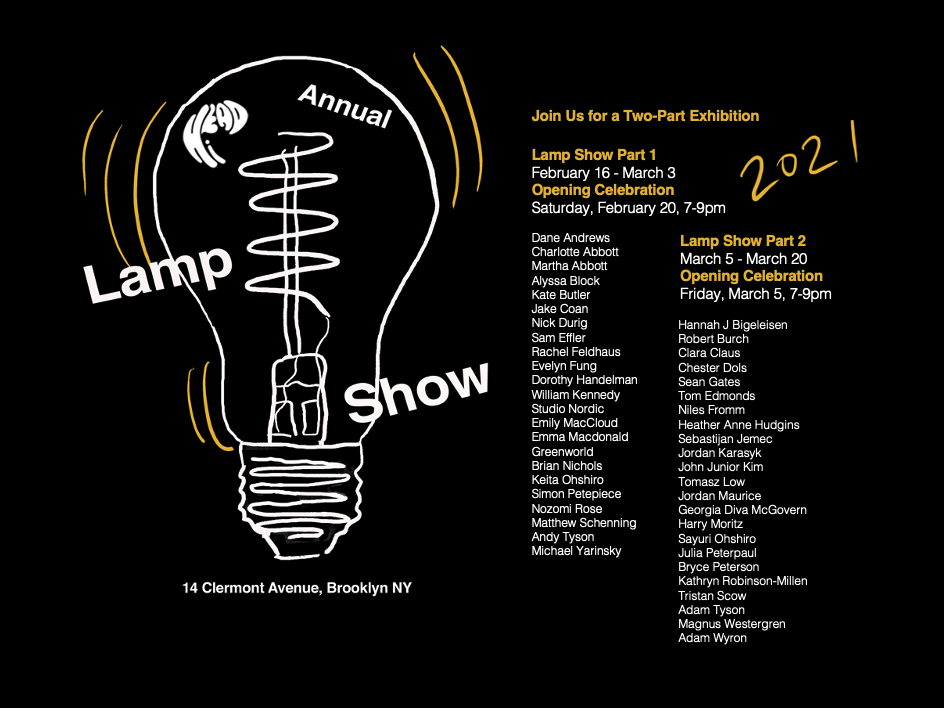
    NR: The annual lamp show started in 2019 when Head Hi Gallery (and art book shop) opened in Fort Greene, Brooklyn/NYC, by the Navy Yard. The exhibition is about creative individuals experimenting with lighting and illuminations, so the owners inspired me to make my “vertical orange lamp” at the time, which visitors can now view at the gallery year-round. My lamp for 2021 is “social distancing lamp” that lights up when someone comes closer than 6 feet.

    Firstindigo&Lifestyle: According to the guidelines by CDC, to practice social or physical distancing, means staying at least 6 feet (about 2 arm lengths) from other people, “who are not from your household.” What is your approach to a ‘social distancing’ work?

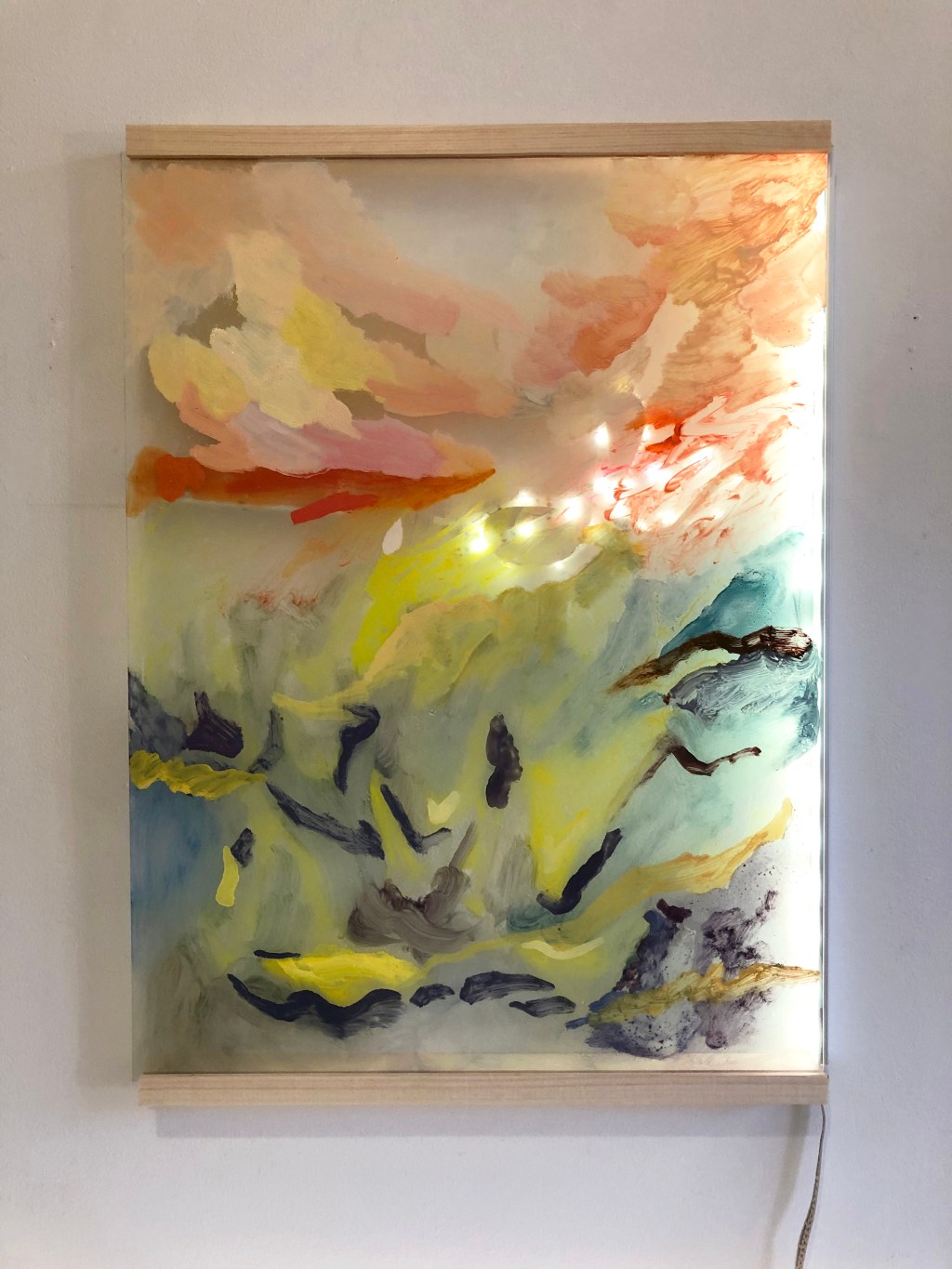
    NR: “Social distancing lamp (your word is a lamp to my feet and a light to my path)”, comes with motion activated light system. The work lights up if someone comes closer than 6 feet. For my paintings, I use both pigmented and fluorescent colors. They are combined with gold and silver paints. To achieve the maximum brightness, I started to paint on glass (with acrylic and oil paints) and attach LED light strips to my painting, but not sure, yet, if my direction is something like Mary Weatherford’s paintings. I am still experimenting with this last aspect.
    Annual Lamp Show 2021

    Firstindigo&Lifestyle: You have a very strong sense of color, in which the colors have a meaning attached to your personal history and memory. How about in relation to this work?

    NR: For my social distancing lamp, I had a “yellow and violet” color scheme in mind at first. I was trying to paint the reflections on the water that I saw from the LMCC studios on Governors Island and the sunset from my ferry rides. 

    I like the location of the Head Hi Gallery by the Brooklyn Navy Yard, in part because my grandfather served as a pilot for the Japanese Air Force during the war, which was part of the Japanese Navy. He lived to see his grandchildren. There are certain moments from my direct experiences with nature on the ferries that I tried but could not capture in photographs (with my camera) and that I desired to preserve in painting. Those seascapes resonated with me because of my personal family history. -Nozomi Rose

    Firstindigo&Lifestyle: As you are working with a different medium than usual, being it paint on canvas, and now glass in which colors may appear differently, how do you mix the colors on this surface?

    NR: Regarding my colors, I simultaneously started in both violet in oil and fluorescent yellow in acrylic on glass for this piece. Drying time for yellow was much faster than violet, so I had to plan accordingly. I mixed different shades of each fluorescent color and also their gradations of gold, silver, and pearl versions. Acrylic parts of my work could dry in a few minutes, but I had to wait for at least 24 hours for oil paint to dry. There were certain colors that I preferred to mix in acrylic and also others only in oil, so I layered both materials in some parts and not in others.

    The processes of creating the lamp piece were more complex than my usual paintings and also new to me, from preparing a couple of different brushes for oil and acrylic at the same time to painting on glass to assembling and disassembling different LED lighting strips. They had to happen all at once due to the tight deadline, but I enjoyed the collaborative aspects (with Head Hi Gallery).

    The color scheme of my actual lamp maybe darker than I first envisioned because I decided to make the top part more pink and orange in oil paint with certain abstract details. This was in part because I was planning to place the LED light on the back. You know, white paint catches light and the work was supposed to be back-lit. But, oh well. -Nozomi Rose

    Firstindigo&Lifestyle: Did you have a vision of using this material as a lighting piece, perhaps an artistic direction beforehand for the aesthetical changes?

    NR: My idea of the social distancing lamp stemmed from a “painting that changes composition by itself when the viewer comes closer than 6 feet,” so the image had to be something that immediately grabs people’s attention and intrigues them enough to approach the work in order to observe the detail. And I had to achieve this in abstract imagery.

    I feel like everything I planned went “wrong” at the end, but I am happy that it is on the wall now. I thank Head Hi owners, Alexandra and Mösco, for taking care of it!

    Firstindigo&Lifestyle: As you are currently an artist-in-resident in Governors Island, can you describe your thought processes behind the methods of working. Painting is your primary way of creating art. Are you inspired by, or still interested in abstraction?

    NR: It’s not a secret that I continue to be intrigued by Ab Ex NY (Abstract Expressionism) although I can have figurative elements in my work anytime. Can one person be a conceptual artist and an abstract painter at the same time? If so, that’s me. I aim at expanding colors by going somewhere beyond Modernism and Postmodernism. My practice is almost always informed by painting, but I also change medium often. When people ask, I tend to say my practice is concept-based, but materials guide me. I mentioned Mary Weatherford earlier, but is she a painter or a lamp maker? Why and why not? I think for me, concepts come out of materials.

    I’m curious to see how Ab Ex influences on younger generations will unfold, maybe because I see Japanese/Asian cultures being reflected on American art there. For example, Emily Mason who passed away in 2019 was my former teacher who studied with Hans Hofmann. She sent me to my second Vermont Studio Center Residency in 2019. Emily was deeply influenced by Japanese cultures (in addition to Italian ones).

    My new painting has light in it. Somehow, I’m seeing light as a “filmic” medium here, but my work rejects narrative. Perhaps, I’m attempting to introduce “duration” to my painting, without narrative. Have you ever watched essay films by Daniel Eisenberg? One of his films was about his indirect experiences with the Holocaust that was passed onto him through his parents’ stories. -Nozomi Rose

    Firstindigo&Lifestyle: I interviewed you in 2012 for your solo show at the Consulate General of Japan located in midtown Manhattan. Time flies, so do you remember your works back then?

    NR: I think my color scheme was much darker then – because I was using Nihonga pigments [Japanese folk painting material]. I think I successfully reclaimed Christian painting practice with oil painting materials (just kidding!).

    I recently started to read about artistic development of children and children’s abstract art. Children’s art and adult art are not the same; they visualize rapid brain developments in children. There are neurologically-relevant reasons why small children should take art lessons. Two books on this topic I recommend are: Eric R. Kandel’s “In Search of Memory” and Viktor Lowenfeld’s “Creative and Mental Growth.”

    Firstindigo&Lifestyle: We are gradually starting to think practices after the pandemic, what ever they may appear to be like, in terms of experiences and lifestyles. I don’t know, how much you like to dig into your COVID-quarantine starting last year. But is there something that relates to your routine, work, making your art, and artistic process?

    NR: ATP (All Things Project), had daily Zoom meetings during NYC’s mandatory quarantine, so I attended that every day in the evening. One time, our pastor got sick and had to isolate himself. That was scary for me/us because I imagined that maybe we would just watch each other get sick, but fortunately, he survived and the rest of us did not get sick.

    I have personal interests in art related to the 80’s AIDS crisis. My Covid experience brought me to a new understanding of Gregg Bordowitz’s “Fast Trip, Long Drop” (1993), for example. There is a clip from “HIV Support Group Meeting July 1993” in this film where Gregg says, “[my] biggest fear is that we are just going to…our future is going to be about watching each other getting sick.”

    I watched this film so many times in the past until I memorized part of his script, but I never really thought I got it. Now I think I can sort of feel how that might have been. “David” in the same clip also says, “it’s weird to live with this constant sense of mortality.” I think I can nod now. Gregg Bordowitz has a solo show coming up at MoMA PS1 in May 2021. I found it ironic that the epidemic artist’s show had to be postponed due to the pandemic. -Nozomi Rose

    Firstindigo&Lifestyle: It seems that also social media platforms expanded in the process. People not only took it to the zoom. Instagram has appeared as a new local and global lifestyle. What do you think about that?

    NR: Head Hi offered “Head Hi Live” on instagram every Sunday during/after the lockdown in NYC, so I tuned in with friends from other countries. I liked Mösco’s sound choices, and he sometimes DJ’ed at the Lot Radio in Greenpoint. But the weekly event also had lots of participants from the art world such as Printed Matter (note: Head Hi hosted Printed Matter NY Art Book Fair’s “after party” before the lockdown). It was fun virtually dancing with them when there was no other social life. Head Hi seems to be a community leader during Covid. I think for lots of young people living in Brooklyn, it was psychologically very challenging to wear a mask at first, but one day Mösco had his mask on when cleaning Head Hi’s storefront and that was it. People started to wear a mask and gloves after that day in the neighborhood. Something like that.

    In 2018, I mysteriously decided to move my life mostly indoors (well before the lockdown), so there was no crazy, sudden transition I had to make overnight this time. During Covid, I took online courses, mostly MOOCs, made art, watched movies, and read books.

    Firstindigo&Lifestyle: How has your mother been coping during this time?

    NR: I learned about Hugh Laurie’s acting in the American medical drama “House, M.D.” TV series that my mother likes, and British comedy such as “Jeeves and Wooster” series. My mother is an actress and I try to keep up with those classic movies so that I can converse with her, but I am very behind.

    Firstindigo&Lifestyle: Let’s peek into a possible future with the lamps. Do you have any interest in creating them more, having a brand Nozomi?

    NR: The last lamp show was the first time when I consciously made a lamp, so I asked Head Hi how long they plan to offer lamp shows. They say as long as they can. I guess I will follow the flow. One of the Head Hi owners, Alexandra, told me that her own ambitious, “failed” lamp making three years ago inspired Head Hi to host the first lamp show; she desired to see how people make lamps. They call it “lamping.”

    It’s a community’s annual lamping practice that you witness when you come to see the lamp show at Head Hi Gallery. My show ends on March 3rd and Part 2 with new artists starts on Friday, March 5th.


    — — —

    Nozomi Rose grew up in Kobe and Hawaii, went to school in Paris, Rome, and New York City, and studied Fine Arts at the City University of New York (CUNY) where she was awarded an honor residency at Barnard College/Columbia University as an ICP Scholar. Later, she graduated from Cornell University with a BFA degree in Painting. Her MFA degree in Studio came from the School of the Art Institute of Chicago, one of the top museum schools in the country and the world.

    As a visual artist, she has exhibited her work at Johnson Museum of Art in Ithaca, Vermont Studio Center in Johnson, Sullivan Center at the Art Institute of Chicago, Bridge Art Fair New York, LVL3 in Chicago, the Evanston Art Center in Evanston, All Things Project in Greenwich Village, New Century Artist and Kravets|Wehby in Chelsea/NYC and CANADA gallery in LES/NYC, among others.

    Artist website: 
    https://nozomirose.com/

  • Color comes with music for Ellen Hackl Fagan

    Color comes with music for Ellen Hackl Fagan

    Firstindigo&Lifestyle: The color field painting created space for exploration of color as a subject matter. How did this field of abstraction influence your work in the first place?

    Ellen Hackl Fagan is an American artist working with painting, which is richly influenced by music of her generation. Starting to figure out her artistic practice in the early 80s, she found color as a strong compositional element. When looking at her paintings, one could say the ideas derive from traditions of Color Field. But it’s more than that.

    The artistic experience and the bodily encounter with the materiality of work create another layer. Music and color go together also in a more profound and ethereal way in some of Hackl Fagan’s work, appearing as if systems and science were components of the network of sound and its emerging visual pattern.

    Firstindigo&Lifestyle: Now, the cobalt is a color, which is a great conversation starter. How many times have you experienced people just being absorbed into the inviting presence of the color?

    EHF: That happens all of the time. In my studio space, which was in the back of ODETTA in Bushwick, one was surrounded by blue from my walls to the floor. I found visitors would linger there, and mentioned often that the blue made them feel really good. So, it emanated a healing resonance with visitors to my space. I think this is one reason why I’ve remained focused on the color and the surface from this particular paint, KT Color, is that it resonates, down to the individual particles, because of the matte surface and the saturated hue. 


    Firstindigo&Lifestyle: Can you tell, how did you find cobalt, and how long has this investigation been your premise?


    EHF: I have attempted to make paintings emanate sound through saturated color since 1981. At that time I was pursuing my undergrad degree, BFA in painting and photography, and was seeing a lot of live music. Punk culture was in full force, so sound and design were interchangeable. A painting I created, The Floozies vs the Force, in 1981, was a painting that was predominantly red and blue, and is oversized. I began to see that the cobalt blue used in this painting, a latex/household paint, would turn to a white hot in low-light times of day: dawn and dusk. The red of the painting would recede, and the blue would advance, which was the opposite of what we were trained to understand about color in school. This intrigued me, and I began to consider cobalt blue as a color that had a broader communicative range, and could possibly hold the key to my color/sound investigation.


    Firstindigo&Lifestyle: You say that cobalt has some mystical components, does this mean transcendental in some ways?


    EHF: Yes, I feel that this color actually connects with our spirit, and that it communicates directly to this intangible part of our being, which is why the response to blue is universally tied to the spirit. I think we all feel it.

    Firstindigo&Lifestyle: The process of painting for you is very physical, it’s almost performative how you pour the paint on canvas, and work toward the outcome. Can you explain your process with paint, water, and objects, how they all are involved in your practice and contribute to it?


    I think it’s about immersion. I want to put my full body into painting, connect physically with each aspect of the process, and finish, like a yoga deep breathing exercise, with the eyes as the final part that communicates to the color. I have a long history in dance, and feel that this visceral connection comes from this history, or muscle memory. 


    Firstindigo&Lifestyle: There seems to be an element of covering and revealing in the process?

    EHF: Yes, I call this part “blind painting.” In order to gain a full field of pattern, I have to cover the surface. I can’t know for sure what the outcome will be, which is an aspect of trust I’ve established with the materials themselves. I feel they have more to teach me than I them. I want to explore the full range of their characteristics, which means I cannot be the author of the final image, the paint is the author. I set the stage, facilitate its dynamic potential, and then I leave the room and let gravity and evaporation do their part to finish the work. If I’m not happy with the result, I tend to live with it for a while before going back into it for a second pass. I learned a lot about listening to my materials through ceramics. Often the ceramic work would come out of the group kiln at school with an unexpected result in the glazing and painting that I had put together with the underglazes and oxides. 

    When I pulled the pieces out of the kiln, at first they disappointed me due to my expectations. But, over time, they made me look at the unfamiliar with an open mind, and would convince me that they had a strength to them that I could have never controlled or forseen. This made me want to explore accident and the unexpected more in my painting.

    Firstindigo&Lifestyle: Can you tell about your background, and how did you find your calling as an artist?


    EHF: I have always called myself an artist. From a very young age, 5 or 6, I can remember identifying myself in this way. I am the sixth of eight children, and married into a family of twelve children. My husband was a twin, he passed away in 1996 from an undiagnosed cancer, leaving me to raise three very young sons by myself. The boys are all young men now, with lives of their own, but we are close. I always made drawings, played school, painted, argued, and have had a life where I maintain a space for play. 

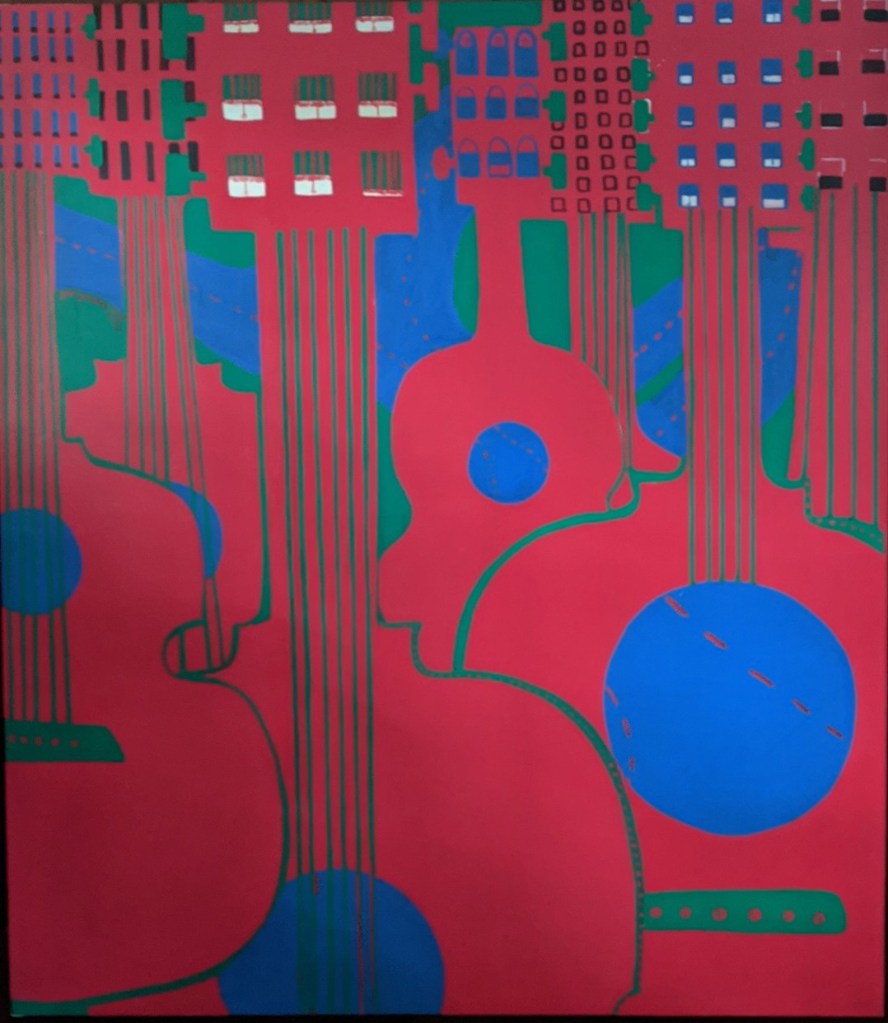
    Margaret Ellen Hackl, City Sounds, 1981, latex house paint on canvas, 60″x57″ in.

    Firstindigo&Lifestyle: What are your influences in different arts of technology, and the systems, which have an impact on your creation?

    EHF: For me, Color Field suggests an immersive experience of deep looking. Color Field has been a part of my development as a painter since 1981these paintings from 1981 are both full body size, which put me in full contact with responding to these contrasting colors when painting them, they literally would throw me off the easel as my eyes were having ocular severe reactions. I nicknamed them “retinal eye bouncers” for the punk era, these were a sympathetic relative to the music I was seeing live so colors spoke of sound, from the moment I began working in a flat, graphic style. Pop Art and Punk graphics were also a major influence at this time.

    EHF: My influences from technology all source from music since 1981. I have referenced punk music, early pioneers of abstract, electronic music like Morton Subotnik, the fluxus influences dating back as early as Dada and Schwitters to John Cage, to Frank Zappa, to Brian Eno and David Byrne. The systems tend to be based in the arts, but many have application in the sciences as well. 

    Firstindigo&Lifestyle: How about the collaborations you have created with musicians and composers?

    EHF: These collaborations have come to me since 1981 as well. Most composers/creators of music, see a relationship in my work to sound and are always eager to join me in my projects, musicians are natural collaborators, so it has been a path rich with artists to work with. 

    Firstindigo&Lifestyle: I remember you having an installation at the New York Public Library, how did this project succeed in terms of audience response?

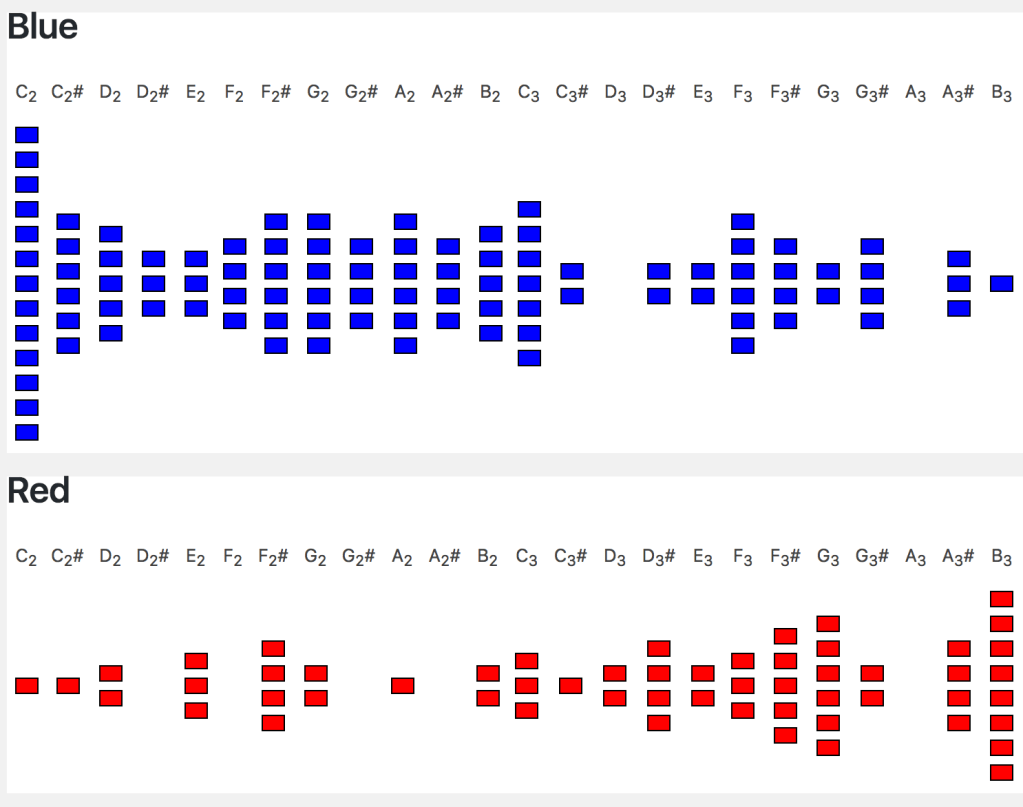
    EHF: I was invited to share a panel with two guest artists, of my choosing. As we all focused on the relationship of sound to color, and vice-versa, I asked the audience to play the Reverse Color Organ all together. We focused on blue and their responses when asked to pair a sound to the color looked like this, then I asked for red. You can see their results pretty much feels like common sense. I would like to collaborate with an institution or a person to gain a lot more viewer input  for the Reverse Color Organ

    Ellen Hackl Fagan, Riverse Color Organ.


    Firstindigo&Lifestyle: Your interest is very much also in the musical and sound aspect of the work. The blue color can have almost symphonic qualities. Do you feel this way?


    EHF: Yes, I am a product of a long history of rock and roll, punk, and some dabbling in jazz and world music especially growing up seeing punk bands and following certain bands over the past three decades. Music is a direct influence in my work.

    Firstindigo&Lifestyle: Could you tell a little more about your recent exhibition, and a project called Helpless?

    EHF: I was thrilled to be invited to create a solo exhibition for Five Points Center for the Visual Arts. I was asked a year ago. As COVID-19 took over our lives and the galleries and museums all closed, it wasn’t certain when this exhibition would open. I give them a ton of credit for staying on time with their programming during all this chaos. It has been a great experience working with them. 


    For Helpless, I began working in the studio in early May in the early night sky there was a congruence of Jupiter, Saturn, and Mars. This was visible to me when we took a Mother’s Day hike in a local park where we were finishing up as it grew dark. We all talked about which planets these might be, etc. These burned in my visual memory as I was painting, and then the song Helpless flooded my mind as well. It became a meditation of sorts, and the title felt right for the exhibition. I’m a real fan of Neil Young’s music, since my teens, it was comforting having his voice in my head. 

    Firstindigo&Lifestyle: COVID-19 has changed a lot of the daily practices. How have you experienced this time in your life?

    EHF: I run a gallery, which has now morphed into three distinct new projects, in addition to my solo work. If given a full time assistant, I’d really get on top of my work load. Mainly, I miss having the freedom to get together with family without a litany of interview-like questions but we’re working it out. I’m finally going to see my mother, who lives in the Midwest, and I continue my work commitment in and out of our recent quarantine periods. Otherwise, I’m staying healthy and patient that we will get through this pandemic. I paint in my garage, and am happy to have carved out this work space last summer. It is my source for happiness, the studio, and I’m thankful for this.

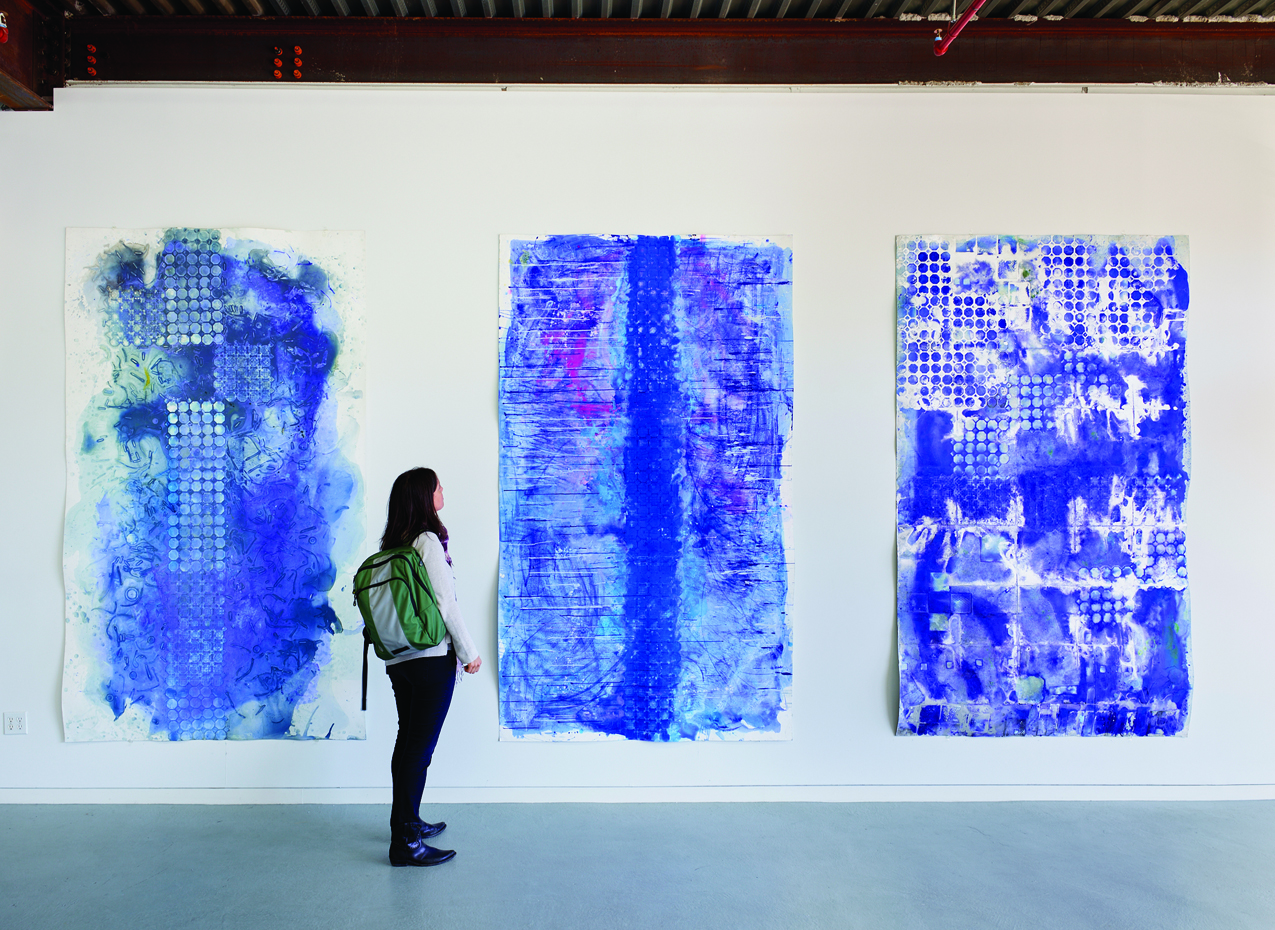
    Ellen Hackl Fagan Studio view. Seeking the Sound of Cobalt Blue, Big Blue, 2020, pigment, acrylic, museum board, FV, 108 x 60 in.

    Featured image: Margaret Ellen Hackl, The Floozies vs the Force, 1981.

  • Sirkku Ketola: The artistic process of performing Paula

    Sirkku Ketola: The artistic process of performing Paula

    Finnish artist Sirkku Ketola had her performance project A Body Called Paula at the NARS Foundation Gallery in Brooklyn in November. In Finnish the word paula means a ribbon, something to tie or to be enchanted with. It is also a synonym for a trap. Globally Paula is known as a female name, originating from the Greek word ‘Paulus’, which means small.

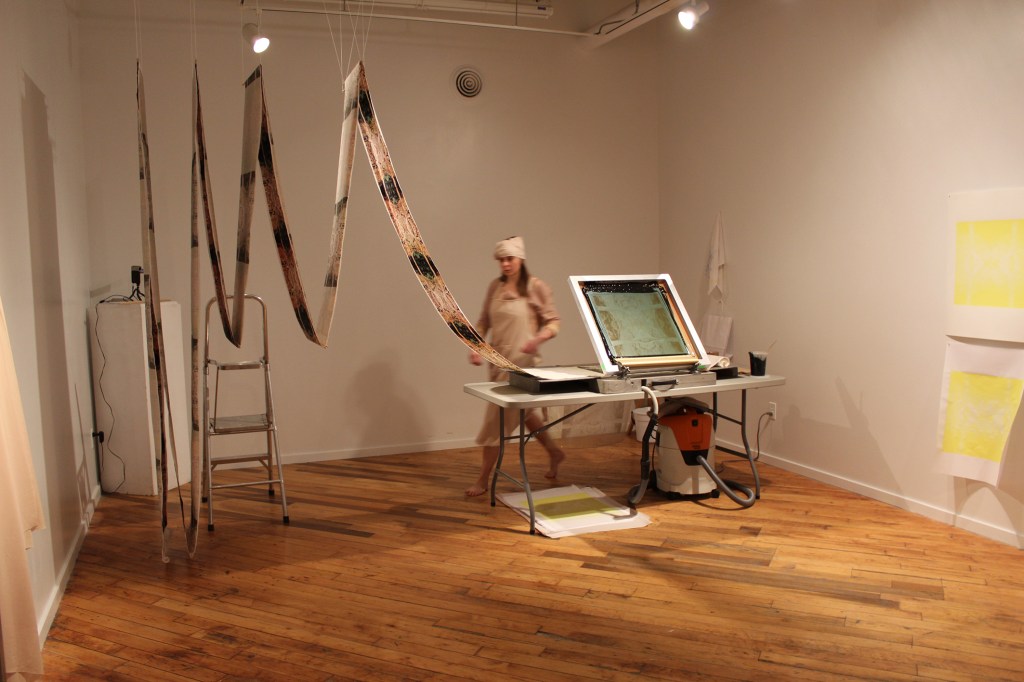
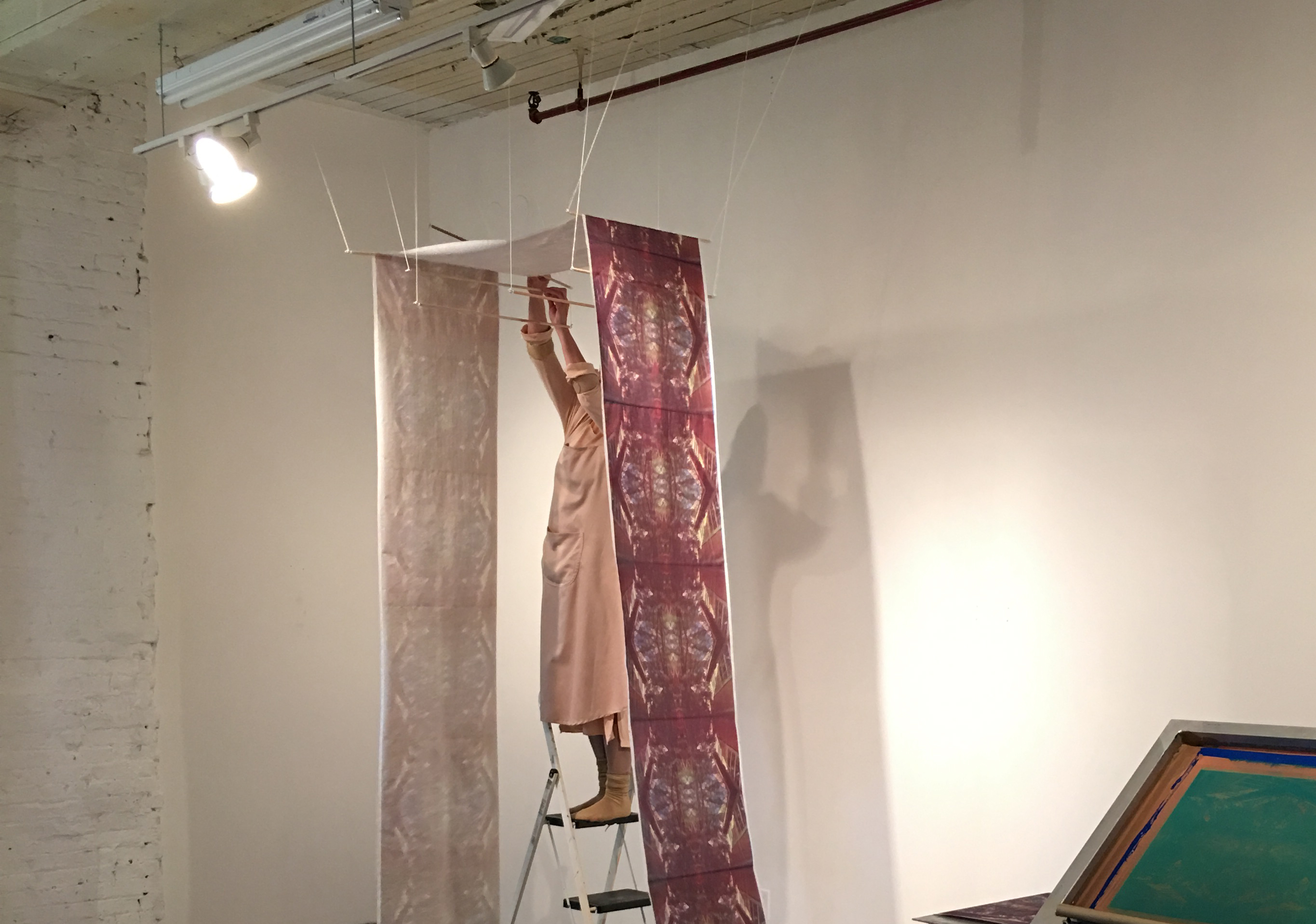
    In her current project of ten years, Ketola creates an installation that mixes screenprinting with performance. Part installation, part performance, A Body Called Paula is a piece that develops over the days of the installation through long-duration printing sessions. The movements and their soundtrack create an enchanting, sensual machine with the main themes of time and temporality, pleasure, and the meditative process of working.

    The narrative story behind the performance hunts beauty through the themes of light, passion, knowledge, reality, and depth, finally balanced out by darkness. What is the measure of time? Ornament is a universal form of visual art in every culture. The installation at NARS is part of Sirkku Ketola’s long-term project. For the duration of ten years ‘A Body Called Paula’ produces hand printed ornaments, or ribbons.


    Paula prints by Sirkku Ketola.
    Paula prints by Sirkku Ketola.

    Firstindigo&Lifestyle: What comes to mind, when you think about your project Paula is that it is so clearly beyond the visual practice, or enhances the physicality of the practice. What is so intriguing is how you dive into the embodiment and stretching of the paper. Is it that the body becomes a continuation of the paper in the printing process, as if being one with the paper? What kind of metaphors would you like to highlight, or are being evoked in the process?

    Sirkku Ketola: I guess I need touchable material to support thinking and understanding. In this case the handling of color and paper together with challenging technical crafting, tune us as one organism, where the tempo is being set in the cohesion of the qualities of the all included matters. The strength of the body, the sensitivity of the hands and the exactness of the eyes, are sensing constantly the fragility, stretching, moistening and drying of the paper, and the consistency and volume of the ink. The local, or should I say site-specific humidity and temperature effect strongly to the functioning of this paper/colour/body formed sensual machine. Also the instant substance of the body, the general vitality, the emotional ambiance, and for example the daytime, give all some special marks, first to the performance, and second to the visual appearance of the ribbon in progress. Imprint is different during mornings and evenings, also in the beginnings and the ends of the ribbons. I have chosen the long and fragile paper to be forced to lose control. The process is too tiring to hold on it. During the series of the performance the same paper roll goes by my hands 12 times so it is impossible to dominate the quality or the crossing effects of different layers. I just must be humble, and let the ribbon teach me. Maybe the greatest thing is that the ribbons still surprise me even though I’ve been working with the same materials for years. The major errors have been avoided, but the danger of errors are constantly present – everything can be irreversibly spoiled even in the last round of printing.

    Sirkku Ketola performing Paula.
    Sirkku Ketola performing Paula in Cable Factory, Helsinki, August 2017.

    Sirkku Ketola: The ornament arises on paper in stages from light to darkness. The colours (yellow/magenta/cyan/black), except being common from every home printer symbolize light, passion, knowledge, reality, depth and darkness. Step by step these colour layers, as named the elements of beauty, while mixing and uniting approach the truth, the code of life or would I say the mystery.

    The hand printed ornament reminds somehow of the DNA. Basically with the repetition of same patterns, the motif is being affected continuously by the changes of the circumstances. All the variations show together endless amount of visual possibilities and diversity. At the same moment the so-called mistakes come part of the entirety and open up routes for the new beginnings.

    Today we talk a lot about unmaterialized art, light and it’s different digitalized reflections. I am blown away by it also, the transfer of energy from one equipment to another accomplishes wonderful outcomes. In my own work process the need of touch, the acception of the tardiness of the body as the part of the thinking self, in other words handling with hands, have so far helped me to the deeper knowledge. I choose to cherish this special bodily tempo – it might be good for human species. When one forces oneself to stop by the slow repetition, one might also have time to understand something essential.

    Sirkku Ketola performing Paula in New York, November 2017.
    Sirkku Ketola performing Paula in Helsinki, August 2017.


    Sirkku Ketola: To be able to do the metamorphosis to become a sensual machine I had to create a role. My character Paula is simultaneously enraptured and trapped (in Finnish there is a sentence with both meanings, derived from the word ‘paula’ which also is a ribbon). She is a metaphor of a small human in cosmos. The name Paula comes originally from the Greek name Paulus which means small. So my Paula works with paula, with her special ribbon. Her job is to communicate visually by printing this repeating and overwhelmingly beautiful ornament. She wanders globally and communicates of the seen beauty. The previous place sets the next pattern, for example the New York effects to Paula will be seen next spring in Helsinki, Finland.

    The machine is slow and time bending. It is a factory that is able to work without problems approximately four times per year. The doctor’s order has set the limit. I forget the rules always in the beginning of the new project, but now, when the Brooklyn ribbon has been finished, the pain in my hands is there and that makes calming down easy. By respecting this manual of the project, it will be possible to enjoy after ten years from now about the yet unknown massive installation, which is made of these forty different and international printed ornament ribbons.

    I feel extremely privileged to be able to define the speed of the assembly line. For that reason the pleasure is an important part of the performance. Paula enjoys her movements and the choreography set by the printing process. The ink flows and the paper glides with the hands accepting to follow the weight of the body. The touch varies from strong to gentle and the rhythm beats with the working steps. The birth of the image feeds the will to come along to the anonymous destination. The possibility for sudden challenges forces the printer into the extreme concentration and to overcome difficulties and accept the errors. With the physicality, the mental part is also reacting all the time to the present. The chosen repetition grows thinking and developes strong pleasure.

    Sirkku Ketola: Feedback, 2016. Handprinted silkscreen on wood. 81 x 105 cm. Process picture.
    Sirkku Ketola: Feedback, 2016. Handprinted silkscreen on wood. 81 x 105 cm. Process picture.

    Firsindindigo&Lifestyle: How do you prepare for the performance of this scale, which is almost a marathon? What is the preparatory phase like, and what happens during the performance aftermath?

    Sirkku Ketola: During the performing period I take specially good care of myself. I try to do the outdoor activities daily, sleep enough and eat healthier. I try also to avoid the evening happenings and alcohol. The preparation for the performance takes mentally the whole day, but the most intense are the two hours before the show. The soundtrack of the performance follows me since morning. I’d like to highlight, the sound scape of my music and the noise of the printing table are essential elements of the performance. When arriving to the show space I tend to eat lightly and drink a lot of water. After it is time to check all the technical equipments and to mix the printing inks, the hue and the saturation needs to be done carefully. I have a special ritual order to do this. After this, I isolate myself, warm up and slowly become my transformation to the role. Thirty minutes before the show it is time to change the costume and become Paula. She doesn’t speak. The aftermath of the show is quick, washing the make up and changing the clothes are rapid, so I’m soon ready to communicate with the world again as myself. Before leaving I clean the colours and check all the technical details for the next day. When arriving home I stretch well and take a warm shower, except in Finland my choice is sauna.

    Paula performance in Nars foundation Photo Nov 17, 3 38 57 PM
    Ketola performing at the NARS Foundation in New York, November 2017.

    Firstindigo&Lifestyle: How is New York as a place different, and this performance venue special, in terms of what is their impact on the quality and outcome of the work? How is the location different from the rest, say, Canada or Finland where you also created this performance piece?

    Sirkku Ketola: The place impacts mainly how the performance is being installed. I like different spaces because they challenge the art work and keep it impossible to predict. The space in NARS in Sunset Park in Brooklyn is many ways special. First, it is near the Finntown, where there was a strong community of Finnish emigrants. During today’s new emigrations flow it felt important to mark the difficult roots of my own country. Second, the size of the gallery was perfect for the project. It fit there well, both visually and functionally. Third, the space is in the building, which is full of working artists, situated in the middle of the industrial Brooklyn. Where else should the sensual machine be? I came to New York as a visiting artist-in-residence of Finnish Cultural Institute for two months. My main goal was to research the structures of the money and power in the contemporary art scene. Beyond A Body Called Paula –project I started to sketch the new large-scale print installation referring to this research theme. The work will be produced during next three years. My colleagues in Brooklyn taught me a lot about independent artists’ living at the capital of contemporary art (NYC).

    Paula, NARS foundation.
    Paula performance, NARS Foundation in New York, November 2017.

    The physical dimensions and the quality of the NARS space gave the rhythm for the installation when growing during the performances. The intimate gallery of the Sunset Park made possible to the paper ribbon to take a shape of a visually fine zig zag when it landed to dry to the perches I mounted. Also the rest of the visual elements of the performance found their places to create a dynamic composition. There was space for Paula to move and the audience was able to have several standpoints. The space was also photogenic with A Body Called Paula – and that’s important in our social media time.

    This was the fourth time and the fourth place for Paula. In Toronto it was seen in a gallery with the long hallway. There the magic of Paula worked like in the story of the Pied Piper, when people saw the action from far, they just had to reach to the space. In Helsinki Paula measured the huge hall in Cable Factory during the five hours marathon performance. And in Turku, Finland she worked behind the lightened window in the darkness of the first autumn evenings by the riverside. And in Brooklyn she captured the industrial space around the other artists. I believe that during the next ten years, Paula can capture many different structures and spaces as rich as she has done in her first year of the process. The big scale quality will be seen in the end of the whole process. All in all, these places are valuable treasures for me, and will affect the final installation.


    — — —
    Next time A Body Called Paula will be seen in Helsinki in March 2018. After that Sirkku Ketola travels mostly in Central Europe. She will be back in New York City during autumn 2019.

    — — —

    The screenprints made in New York have been prepared at the Robert Blackburn Printmaking Workshop: http://www.efanyc.org
    More information:

    Introduction: http://sirkkuketola.com
    Previous exhibitions: http://www.la-bas.fi/ketolaeng.html