
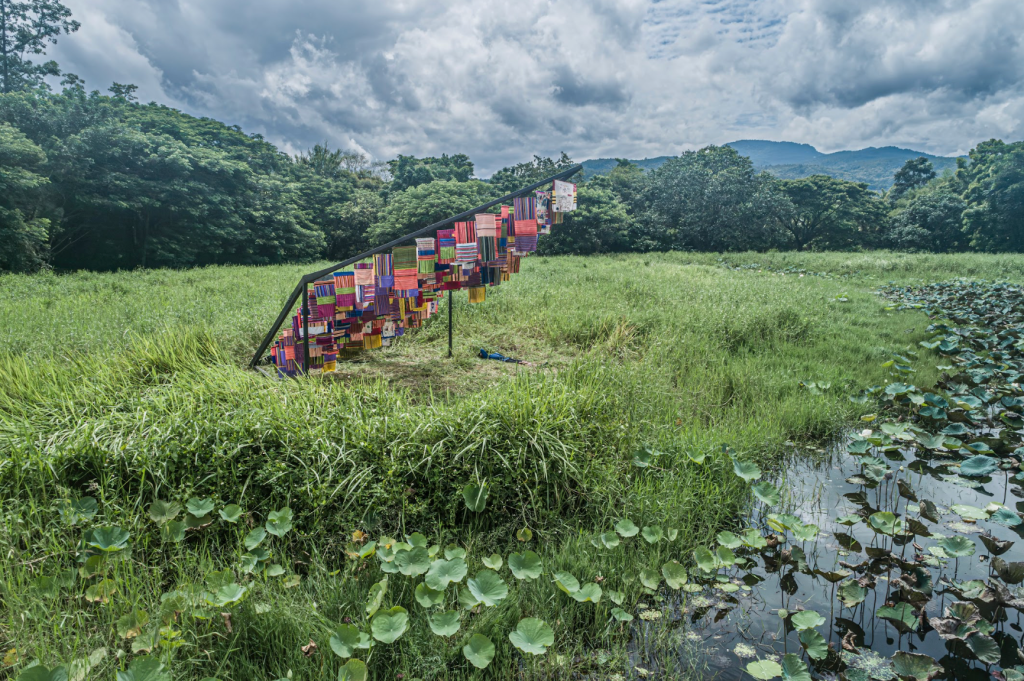
A historic Venetian palazzo is a stage for the Southeast Asian artists to showcase during the 20204 edition of the Venice Biennale. The palazzo is located in the Cannaregio district near the grand canal and hosts an exhibition “The Spirits of Maritime Crossing”. A group exhibition by artists from Southeast Asia, examines topics of displacement, the diaspora, and colonialism using the ocean as a metaphor. The exhibition is on view from 20th April to 24th November 2024 at Palazzo Smith Mangilli Valmarana. The space hasn’t been accessible to the public for 11 years.
Prof. Poshyananda created a film which brings the East and West together. The film features well known performance artist Marina Abramović together with Thai dancer and choreographer Pichet Klunchun. Southeast Asian artists share many similarities, while also differing in ethnicity, religion, and their languages. This can create a sense of ‘foreignness’ among the artists. The legacy of each of them, however, resonates with a notion of a ‘cultural hybrid’, as among them are also refugees, immigrants, and stateless people, who create new identities in the diaspora. Photo credits: Jakkai Siributr, There is no Place, 2020. Courtesy of the artist. |
Tag: Asian arts
-
Southeast Asian voices in Venice Biennale
-

Flowers on a River: The Art of Chinese Flower-and-Bird Painting 1368-1911
On March 23, 2023 China Institute Gallery in New York is reopening to the public afer a renovation. The new exhibition in the galleries celebrates Chinese flower-and-bird paintings. On display are masterpieces of Chinese paintings that span over five centuries. The museum is the only in the United States to exclusively exhibit Chinese art, and this exhibition is the largest survey of its kind outside of China. The works are from Tianjin Museum and Changzhou Museum respectively.
Flowers on a River: The Art of Chinese Flower-and-Bird Painting 1368-1911, includes more than 100 masterworks from 59 artists. The works were created during a 500 year time period between the Ming and Qing dynasties. Not only the individual styles of the artists are highlighted in the exhibition, but it will also detail the academic and literati aspects of the works.
With these paintings we can escape to nature and imagine the natural world, which has inspired artists throughout centuries everywhere. The imagery of the paintings communicate a deeper meaning of art. In Chinese thinking, the humanity is resilient when it connects to the natural world, living in harmony with its diminuent details and magnificent forces.
Yun Lanxi (dates unknown) and Zou Yigui (1686-1772) Eight Immortals in the Flower World Album of 8 leaves; ink and color on paper 12 1/8 x 19 in. (30.8 x 25.2 cm) Tianjin Museum (Leaf 3)
“Flowers on a River will explore the natural world in the context of the human experience. revealing links that tie the genre’s imagery and the country’s everyday life and social customs.”
Traditional Chinese painting has landscape and figure at its center. The flower-and-bird motives are in their own category. The exhibition will be presented in three parts: Precious Plums of the Palace: Academics and Court Artists; Fragrant Plums in the Wild: The Literati Art, Painters and Painting Schools; and Vitality of Nature: Flower-and-Bird Painting and Social Customs.
What is really advanced curating in the context of this exhibition is the inclusion of so many women artists. The Ming and Qing periods saw the rise of women artists. They excelled in flower-and-bird painting. The exhibit will display works from eight women artists. Among others, there are scrolls by two of the most acclaimed, Ma Quan and Yun Bing. During Qing dynasty, they were noticed by their talent; and as was typical to those times, through the legacies of their fathers and grandfathers.‘Flowers on a River’ is curated by Willow Weilan Hai, China Institute Gallery and guest co-curators Chen Zhuo, former Director of Tianjin Museum; Lin Jian, Director, Changzhou Museum; and David Ake Sensabaugh, former Ruth and Bruce Dayton Curator of Asian Art at Yale University Art Gallery. The exhibition is organized by the China Institute Gallery together with the Tianjin Museum and Changzhou Museum.
“We are enormously excited for the reopening of China Institute Gallery and are honored to present some of Chinese art’s greatest treasures.” – Willow Weilan Hai, Lead Curator of the exhibition, Director and Chief Curator, China Institute Gallery.
The 42-foot horizontal scroll by Zhu Da, one of the greatest artists in Chinese history, is taking the center stage. It is considered one of the masterpieces of Chinese painting. Zhu Da (1626-1705) is also commonly known as Bada Shanren. His large painting was last seen outside of China in the 2013 exhibition of Masterpieces of Chinese Painting at the Victoria & Albert Museum in London.
“Bada Shanren pushed the expressive possibilities of monochrome ink and brush to the extreme, resulting in incredibly rich effects with an unmistakable individual character,” -Willow Weilan Hai.
The exhibition is accompanied by illustrated bilingual catalogue featuring commissioned scholarly essays and detailed exhibition entries. China Institute Gallery is featuring a series of events including lectures, an international symposium, and other programs.
The artists in Flowers on a River include: Lin Liang, Lü Ji, Shen Quan, Hu Mei, Yuan Jiang, Yuan Yao, Gao Qipei, Jiang Tingxi, Qian Weicheng, Miao Jiahui, Chen Lu, Chen Hongshou, Ma Shouzhen, Wen Zhengming, Tang Yin, Zhou Zhimian, Lu Zhi, Chen Chun, Wang Guxiang, Xu Wei, Xiang Shengmo, Zheng Xie, Jin Nong, Hua Yan, Li Shan, Huang Shen, Luo Pin, Gao Fenghan, Bian Shoumin, Shitao, Zhu Da, Yun Shouping, Tang Yuzhao, Ma Yuanyu, Ma Quan, Yun Bing, Yun Lanxi, Zou Yigui, Yun Guangye, Li Jue, Tang Shishu, Zhao Zhiqian, Pu Hua, Xugu, Ren Yi, Zhang Xiong, Wu Changshuo, Tang Luming, Zhu Cheng, Leng Mei, Chen Zun, Fan Qi, Wang Wu, Zhang Cining, Wang Caiping, Li Boyuan, Zhang Sheng, Sun Di, and Aisin-Gioro Yuying.
-
Why to love Hokusai
The Japanese artist Katsushika Hokusai (1760–1849) is usually recognized for a single image—Great Wave Off the Coast of Kanagawa, which is an icon in the global art world. When we recognize the work, it is as if the unpredictability of the sea holds our attention when a mighty wave breaks against the beach. We are lucky, since The National Museum of Asian Art has had a commitment to build its Hokusai collection. The institution is now showing an exhibition Hokusai: Mad About Painting in the museum’s Freer Gallery of Art.
In commemoration of the centennial of Charles Lang Freer’s death in 1919, the Freer Gallery presents an exploration of the prolific career of the artist Katsushika Hokusai. Freer himself recognized the richness of the artist’s works assembling the world’s largest collection of Hokusai’s paintings, sketches, and drawings.
Like the Great Wave, many of Hokusai’s paintings convey his interest in the every-chancing ocean in motion, including its fishermen and sea creatures. The artist created thousands of works throughout his long life. He worked mainly in Edo (modern Tokyo) period with a proximity to the Pacific Ocean.


Above on the left, we see one of the wave paintings Breaking Waves (Edo period, 1847), created by Hokusai. It is apparent how the rough curving motion really brings the sea to life. The artist was able to masterfully capture the ocean’s free spirit making it the focus of his works. On the right, another Japanese artist of Edo period, Utagawa Hiroshige (1797-1858) depicts Edo landspaces in his work consisting of six panels. A detail of his work Famous Sites of Edo, spreads in the screens in which each panel has a separate painting that is mounted to one panel of the screen. The coastline and sea are visible through these panels illustrating landscapes. Interestingly, during the life of the two artists, by the early nineteenth century, the city of Edo had grown to a metropolis with a population of more than one million.

Hokusai, Egret on a Bridge Post
Edo period, ca. 1801-1802
Japan
Ink and color on paper
H x W (image): 85.8 × 25.5 cm (33 3/4 × 10 1/16 in)
Gift of Charles Lang Freer
Freer Gallery of ArtHokusai showed interest in nature through many of his works. One of them, Egret on a Bridge Post, shows a white egret at night with moonlight illuminating the bird’s pale form. He illustrated the bird on top of a bridge post. Egrets are still seen in Japan’s rivers looking for food.
The works in the exhibition, including Hokusai’s humorous manga about the everyday life, activities and faces of Japan, shows the vastness and the creative mind of an artist, who thought he might achieve a true mastery in painting, if he lived to the age of 110.
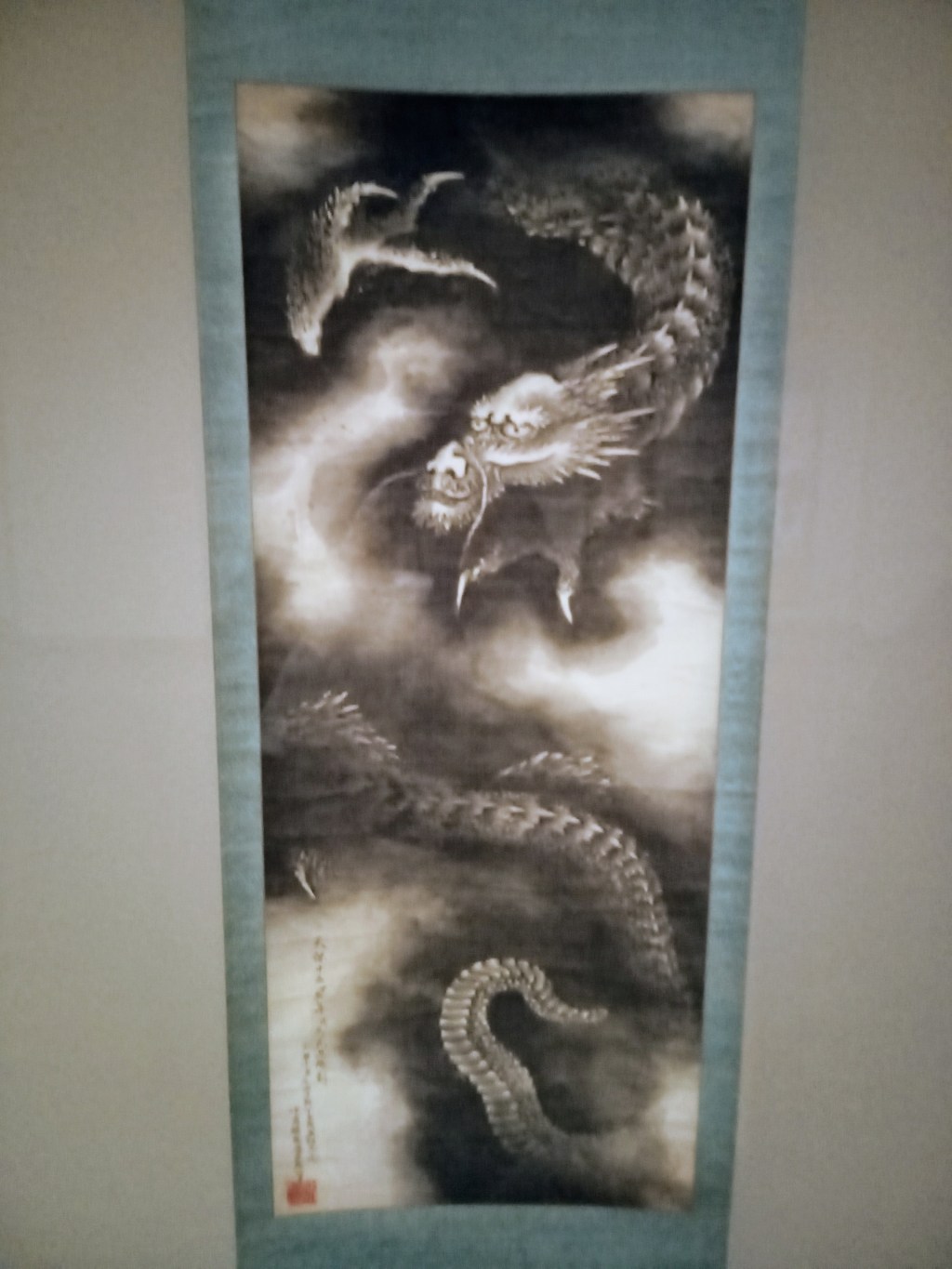
During his eighties, Hokusai painted several mythical creatures known as dragons. The ultimate interest for him might have been in the character’s energy as the artist himself was ageing.
One of these works, Dragon and Clouds (Edo period, 1844), was painted when he was at the age of eighty-five. The painting shows energy and vibrancy in the form of mighty mythical creature. The work is an important addition into documenting Hokusai’s life and art.

Hokusai, Dragon and clouds
Edo period, 1760-1849
Japan
Ink on paper
H x W (image): 88.2 x 35.6 cm (34 3/4 x 14 in)
Gift of Charles Lang Freer
Freer Gallery of ArtVisit and explore more about the exhibition: Hokusai: Mad About Painting

 Firstindigo&Lifestyle