Re:visioning HANJI exhibition showcases artworks made from Korean traditional paper hanji. Two artists, Ran Hwang and Aimee Lee, have each developed their own contemporary aesthetics and styles based on the traditional modes of mastering the paper in artistic forms. The exhibition is on view until March 31 at the Korean Cultural Center in New York, and connects to the Asia Week New York.
In the old days, the masters of the Korean paper manufacturing were called jijang. This profession was proudly inherited and passed on to the next generation. The art of Korean paper making is a complex production process starting with a fiber of mulberry tree. It has developed into multiple use of materials and techniques that are still valid today. Historically, paper was not only applied into books, but its role was more daily as functional material in architecture and clothing. It was also part of making calligraphy, painting, money and armor. The remarkable part of early Korean paper manufacturing was connected to Buddhist scriptures.
The paper process starts with harvesting. A year old mulberry fiber is harvested during the time of November – February, when the plant has enough moisture and the fiber is soft. The skin gets steamed right after harvesting to make a peeling process easier. The entire making is ecological and does not harm nature in any way. After washing and drying, boiling, and peeling cycle, the fiber is used to make hanji. Then the project involves beating the fiber so paper will become thinner and tougher. Finally, the fiber needs to be dissolved and sieved into paper.
Jiseung is an indigenous art form that Koreans have practiced for hundreds of years. It evolved from hanji; when books were printed and bound, the trimmed edges were saved and used further in making baskets and decorative items. The paper rope became popular, because it was softer than straw, but as strong, and available for use. Many of the traditional pieces have gotten lost through wars and modernization. Yet woven hanji artifacts still include everyday items such as shoes, baskets, wallets, backpacks, and lanterns. For young Korean-American artist, Aimee Lee, the idea of 100 percent hanji includes making the paper herself. She then weaves and naturally dyes the materials used in the artworks. Eventually her objects take a form from the traditional dimensions, gestures and environments. Lee says that her pieces borrow from the historical artifacts. The wedding ducks, which were traditionally given to Korean bride and groom, are one example of this long history. The artist plays with the proportion and shapes creating unique contemporary versions of the objects. She states that none of the original materials went to waste, because paper was so durable and labor intensive to make. Repurposing the paper is a way to connect to the tradition and stories. Paper was carrying secret messages during war. People made sandals out of civil service examinations and other certificates.
My main material is paper and my central concern is how we use it. I make paper with abundant native and invasive species, which involves harvesting plants, stripping and cooking, processing into pulp, forming sheets, and drying. With this paper, I make thread, sculpture, books, drawings, prints, installations, and performance components. Aimee Lee
Aimee Lee, objects from Hanji Ducks and Pot -series. Corded and twined hanji.Aimee Lee, objects from Hanji Ducks and Pot -series. Corded and twined hanji.
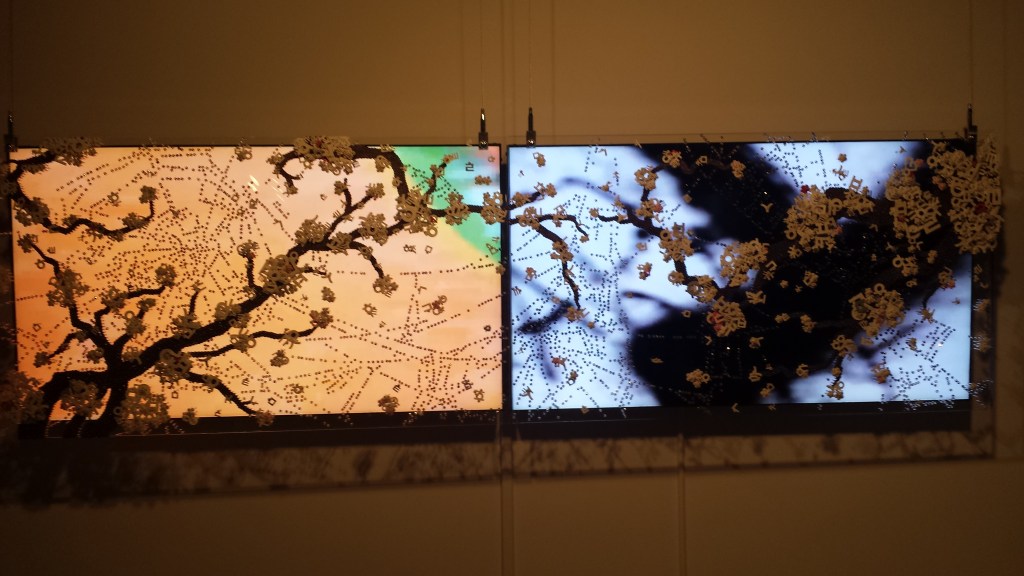
Korean-born, internationally acclaimed installation artist Ran Hwang creates poetic pieces out of materials that are deployed in fashion industry. She uses handmade hanji buttons to create monumental pieces in installations that display iconic images. Her 9 feet tall work that displays Eiffel Tower and Triumphal Arch, required hours of securing handmade materials on plexiglas panel. The Beginning of the Bright piece, includes also Hangeul, the Korean alphabet. The work was displayed in Paris at the UNESCO headquarters to celebrate Hangeul’s designation as world cultural heritage. For Hwang, the lengthy hours of making the works means hammering each button on pins for approximately 25 times. The work is like meditative ritual similar to those of the zen-masters who concentrate on their practice for hours at a time.
Ran Hwang, The Beginning of The Bright. Hanji Hangul Buttons, Pins on Plexiglas, 2015. 86.6 x 106.3 inches.
Hwang creates three types of series, including, the plum blossoms, the birds and spiders, and architecture. The blossoms refer to ephemerality, to the endless circulation of life, which flowers depict when growing and falling. Architecture, like palaces, are symbols of power, which in the art also imply tragic events like invasions and deaths. The small creatures, birds and spiders, represent states between restriction and freedom, implying a constant flux and wandering in life. The artist states that all her work is in a state of fluidity. Nothing is fixed or permanent. The art evokes a dialogue between fleeting and the eternal.
Ran Hwang, Contemplation Time, Paper Buttons, Beads, Pins on plexiglas, 2014.
The combination of endurance and ephemerality is at the heart of my choice of using buttons as the primary medium. I hammer thousands of pins into wooden or acrylic panels with my bare hands. The process of creating these large installations is time-consuming, repetitive, and labor-intensive. Thus, the production process is a meditation for me to visualize a cosmological amount of time, and de-installation process is to end the cycle of life and start a new cycle. Ran Hwang
Chinese artist and activist Ai Weiwei’s exhibition opened in Helsinki in September 2015. Ai Weiwei @ Helsinki will be on view through the end of February 2016. His first solo exhibition in Finland features 25 works from 1985 to the present, including selection of wooden sculptures and installations, and taking materials from antiques and building structures of old temples. Ai Weiwei’s exhibition is connecting to historical China, raising contemporary questions and speaking of the critical voice, which requires to be heard. The exhibition narrates of the personal and the cultural, weighting the nuances that the artist has tested in practice.
Ai Weiwei is the artistic figurehead for thinking how today’s east meets west in many forms. I call my perception of the works ‘massivity of matter’. Firstly, the amount of matter in a museum space probably recalls any sculpture display as the intervention of matter over the space. In this exhibition, however, the sculptural speaks together with the space, the airy high ceilings are breathing with the objects. Second, the massivity of matter is more of a feeling that comes with the lack of scripture between the works. An echo of Chinese contemporary art, in which ancestral is disconnected from the line of reproducing the artifacts?
Ai Weiwei, Map of China (2008) installation view.
Map of China (2008), is Ai Weiwei’s large opening piece to the exhibition. The sculpture is tall, hard to measure, and made of tieli wood fragments that come from ancient temples. This material is centuries old and told to be very rare today. Map of China is made with traditional Chinese woodworking technique bringing the pieces together. The challenge was to create the work without any visible seams. The configuration has the shape of the country showing how there was not a single history or culture in the first place, but only a forced effort to fit all the richness into a one state.
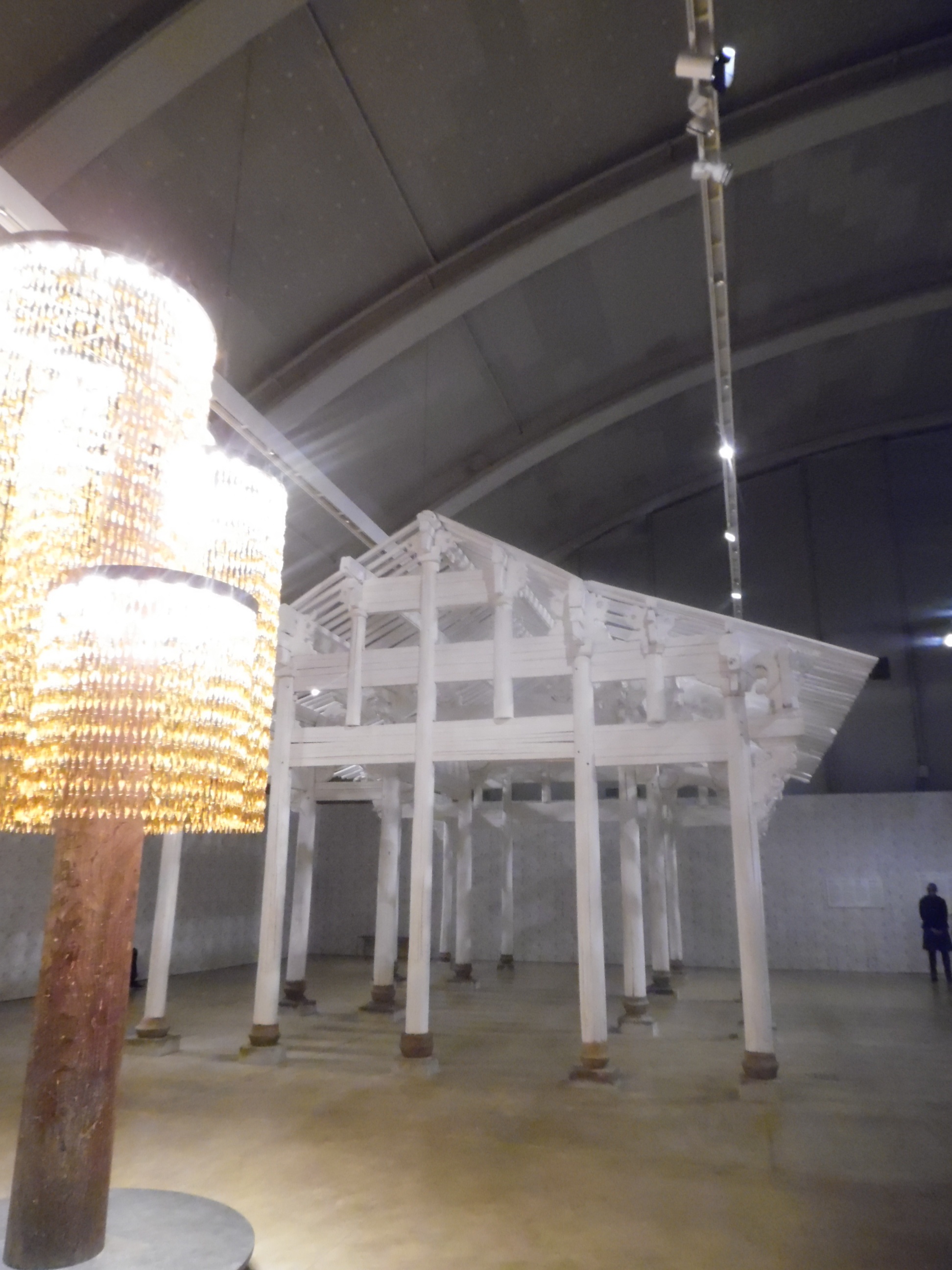
Ai Weiwei, Traveling Light (2007) & White House (2015) installation view.
So a question arises, how to connect historical meaning and the general meaning of the past to those issues that define a contemporary consciousness of a man, after he had to struggle with the fascist propaganda and denial? I am not proposing this question as an individualist concern, but more as a rhetorical phrase to speak of a multiple choices. The artist can mirror his personal position on the power/to shed light on the power, which one-sidedly and univocally has taken over all the other voices, eventually starting to represent masses of voices. This is where massivity arises in artistic aesthetics. And perhaps this is why there is no single narrative imposed in the exhibition, because bringing together all the objects would already be a lot. They would utter so strongly, so let them escape the definition, and let the cacophony sing its well-orchestrated noise. Needless to say, as the wood is concerned, the aesthetics is well rehearsed, well mounted, the sculptural is well organized in groups, following up the international sculptural aesthetics of the moment. Working with wood, and collecting pieces that come from a cultural place with this huge time span; say, goes far beyond our contemporary time. This makes the works epic for today. Historical load is apparent. History arrives with the same massivity, as the ancestral would drive you over.
To be a political artist is not easy from the point of view of artistic aesthetics. Our art world needs the voices to break silences, but often the politics becomes massivity. It would perhaps be different to subtly speak without ruins taking over, as objects do have their own weight without us directly attaching them to ‘art’. In this case, the objects are not simply cultural artifacts as they appear in the art museum context, however they connotate in the form of temples, for instance. Some pieces come from temples – that is the shrine nature of a house, narrating about ancestry and patriarchal dominance. These fragments are ultimate references to the age of property, practice, and material attachments.
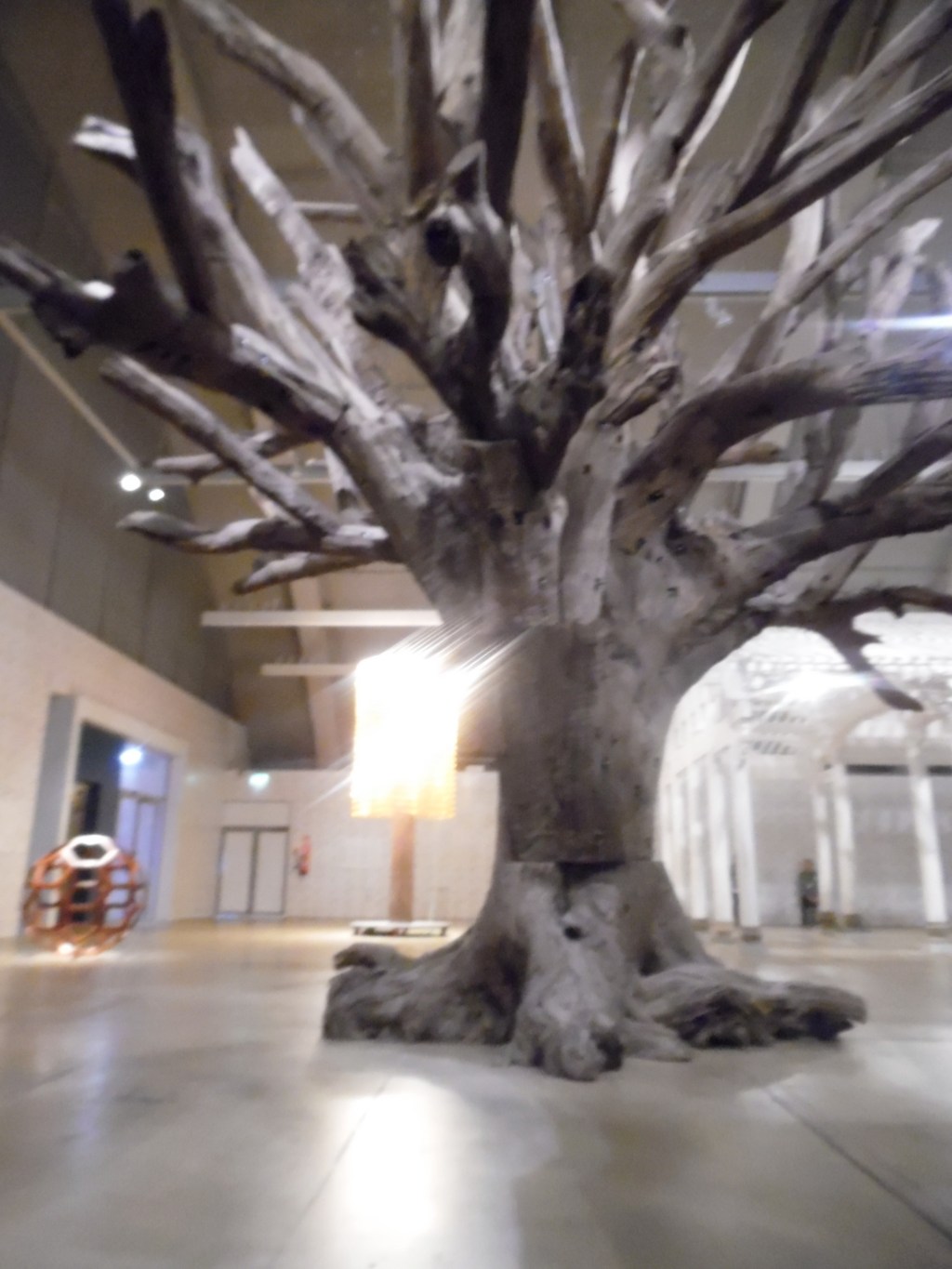
Another sculptural work by Ai Weiwei, is called Tree (2010). It is an assemblage of different woods deriving from individual trees. The dead tree trunks were collected from various locations in the mountains of South China. Differences between components is left visible intentionally:
‘We assembled them (the parts) together to have all the details of a normal tree. At the same time, you’re not comfortable, there’s a strangeness there, an unfamiliarness. And it’s just like trying to imagine what the tree was like.’
Wood as artistic material is so much about nature. Tree as a material is beyond our dominance. It exists and grows without our appropriation. But we did cut trees, we destroyed their existence, and we were cutting down entire forests. In the exhibition, the tree-sculpture is made from pieces to look like a whole tree, an original, yet at the same it is not. It is a look-alike, a not exactly, and a make believe of a tree, a form of a tree, a powerful signifier of a tree, of nature, of origin. It is quite interesting how this sculpture ended up being the center, as other objects are made of wood as well, representing crafty continuation of the artifacts as man made materiality, a continuation of time, which was before mass production.
The modernity of artificial materials, known as the mass-production is another question. Mass production creates massivity. Perhaps the ancestral places speak in the same manner as the modernity. The history is long; we communicate and paraphrase with it. Perhaps this exhibition communicates beyond art, becoming dynamic battlefield for matter and spirit, proposing final materiality in art. Where do we stretch the line between the materials that make the essence of an artwork? We draw from culture, bringing cultural objects into museum to speak for the culture. And this takes place ultimately not in the name of individual subjectivity but for all the collective consciousnesses.
After all, the dialogue between poetic and anti-poetic is what we are looking in the massivity. Poetry does not speak with the loudness unless it was dried out of mythological meaning and it communicates more with the naturalist approach to speak with metaphors. Metaphor can be standing for something, which is not invisible, and stands for something apparent, showing the evidence, creating presence of the political as inevitable. It is standing, yet changing?
There is an evident need for change in the cultural. The aesthetic is more of a repetitive force that takes form in the massivity. The criticism toward west comes in the undertone of the material in consumption, as enlightening force. The materialism is our new religion?
Traveling Light (2007), is a sculpture mounted on a temple pillar, appearing as being a gigantic table lamp or crystal chandelier. Ai Weiwei became interested in light as an object from the point of view of illumination and environment. The large sculpture stands for the idea that objects are close to human scale to be experienced physically.
Divina Proportio (2012), is composed of huali wood, referring to the golden mean, and as mathematical proportions to geometry in the Renaissance.
The exhibition includes two previously unseen works, White House, and Garbage Container, the former speaking of China’s developments and urbanization, the latter about five homeless boys who died tragically.
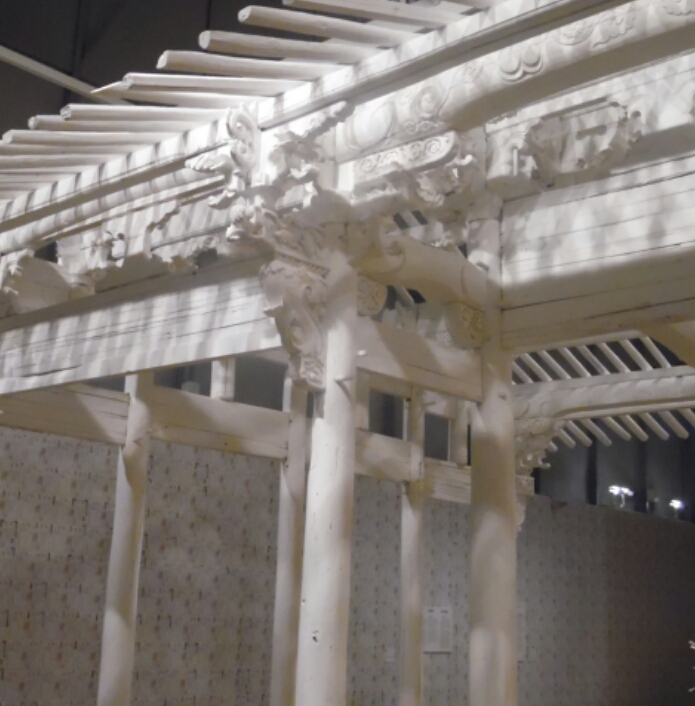
A new piece in the exhibition titled White House (2015) is an entire residential house of the Qing dynasty. The composition includes different woods and is constructed traditionally using nail-less joints. The work stands for the heritage, as the new developments in China have pushed away the traditional. The new white paint on a wooden surface creates questions about past and present, authenticity and change.
Ai Weiwei, White House (2015), detail.
But cultures change slowly. The anthroposcience of human life shortly lived, continues in the legacy of a son who outlives his father (in a natural cycle). The artifacts have a longer life than we do, and this ends building the culture as fluid and as anatomically tilted. Objects lend to the patriarchal order creating legacy and interdependency. Objects echo about history, so in the name of the poetics and dialogue whenever they are on display there is an underpinning of voices that mesmerize with their presence.
The exhibition architecture divides the show into two large rooms. On the other side there are objects, which call much of the legacy that is darker, even more personal than the first exhibition space. Ai Weiwei became a prisoner after he was arrested in 2011 at the airport in Beijing. He was sometimes handcuffed to a chair while questioned. He also kept washing his one set of clothes while in prison, drying them on a hanger.
The art in this case becomes a historical conscience of a collective. It necessarily opens as a voice for the people whose history it is part of. The objects, their material consciousness and presence appear as inevitably non-corruptive, with presentation and physical presence, as non-poetic solidity. The substance is speaking through the stone, or the stones would shout, in this case wood objects.
Ai Weiwei’s role as a seer or visionary, means a hard position at home in China. His work Through (2007), is composed of tieli wood once again, having fragments of old temples from Qing dynasty. The scale is massive, and piercing, the tables and pillars form an almost cage-like atmosphere.
He says: ‘Artists are not in a position to decide the conditions imposed upon them but they can make statements about these conditions.’
Ai Weiwei, Through (2007) & Frames (2013) in the background.
Artists have their own life, their own existential power, their own presence and saying. When it comes to power propositions with artwork, let’s say this. It is hard to assume that the artist proposes his artwork knowing that the entire nature of the artwork would stand for the resistance of power. Cultural legacy changes in a moment, when it becomes ‘art’. The objects are in a terrain of global and international exchange of matter. When it comes to materiality in the sense or meaning, would not the objects have a saying only inside their cultural reference? Legacy or cultural speaking of the history changes with the art market. When legacy becomes art, it has become layered with different meaning; yet the objects are not entirely free of their cultural origins.
The Garbage Container (2014), impresses as a valuable huali wood piece, reminiscing of a cupboard, and looking like a container when it turned on the side. Another impressive piece is the architectural installation titled Ordos 100 model (2011), which was built together with Swiss architect firm Herzog & De Meuron. Made of carved pinewood, an uncompleted, miniature city was planned to be build in Ordros. Treasure Box (2014), is another construction made of huali wood. interestingly, all the objects seem to highlight the wallpaper, titled as IOU Wallpaper (2011-2013), which has decorative appeal, yet a message that makes everything seem unconventional.
Ai Weiwei, Treasure Box (2014) with IOU Wallpaper on the walls (2011-2013)
Ai Weiwei’s exhibition atHAM Helsinki in on view until February 28th, 2016.
Cho Kuwakado is a Buddhist priest and director of Lumbini Kindergarten in Saiki City in Japan. He is an Arts educator together with his team that makes Chara-Rimpa mural projects in Japan and abroad. The most recent international collaboration was for the opening event for the celebration of Colegio Madrid’s 75th anniversary in Mexico. In the interview, Cho discusses the background of these projects, and encourages us to think together with his educational philosophy, which is rooted in the history of Art and in the Buddhist thinking.
There are two levels of nature in my thinking. One is a superficial level like weather, vegetation, and ecosystem. Another is a cosmological level from which the superficial workings of nature emerge. Valuable works of art for me entail some elements of nature at a cosmological level. I think that is the source of the universal appeal of fine art work.
Chara-Rimpa is an art project initiative with a global production perspective, how did it get started and when?
It started in Spring 2013 when I began planning for our kindergarten’s 50th anniversary event. I contacted Dr. Yasuyuki Sakura, a graduate of our school and an established artist based in Tokyo, to ask him to be involved in our celebration event. Dr. Sakura agreed to be the art director of our kindergarten as well as to be a co-planner of our anniversary celebration- this was the initiation of the Chara-Rimpa project.
The global production idea came up when teachers from our sister school in California visited our school in Saiki. They were quite attracted by the professional work of Dr. Sakura and in the large mural in our school play yard that was created with 64 kindergartners in one day. I then thought about the possibility of doing a Chara-Rimpa art project in California and was interested to see how it could be carried out. I made a proposal to one of the teachers, Sarah Clark, to visit her school with my artist team. Then we started to talk about the details of a possible mural making project in California. After six months, in June 2014, we visited the town of Burney, CA where the movie “Stand by Me” was filmed. We worked with the sixth graders of Burney Elementary School. Our Chara-Rimpa project in Burney was a great success.
I’m very curious, what is your own background in the intersection of the arts and community involvement/community work?
My family has resided in Saiki City, Oita Prefecture, Japan since the 17th century as a hereditary Buddhist temple chief-priest/caretaker family. I am the 17th head priest of a Shin Buddhist temple, Zenkyoji, as well as the director of its kindergarten. As I grew up, I often looked into the writings and possessions of the former head priests, and I learned that india-ink painting, calligraphy, and mastery in classical Chinese poetry were common practices of former Buddhist priests until a century ago. Nowadays some limited groups of priests do continue these traditional practices. My interest in art came from my predecessor’s interest in Chinese art culture.
With 1500 households belonging to my temple, I think it is an important part of my responsibility to serve our community. Planning art events and workshops building relationships between children and adults is one of my community commitments.
Where did you study, and how did you find your international networks?
I was trained in Buddhist practice at my temple since the age of five. I studied social anthropology at Claremont Colleges (Pitzer) in Southern California, University College London, and Cornell University. My father was a Buddhist priest and a child education specialist. He studied in the US for one year. He developed a scholarly network then, which later led to my interest in studying at a university in the US. When I was a student there, I was fortunate to make friends from various countries, though I lost contact with many of them after graduation. However, through Internet SNS, mainly Facebook, I have reconnected with many friends that I studied with in the US and the UK.
Your recent project took place in Mexico City, how did the murals come about? How do you feel, what was the impact at the local level? Do you use multicultural tactics?
Dr. Sakura and his partner Toshie Yoshioka worked together to develop the design theme of the mural. In a photograph of the elementary school wall, they noticed a water fountain in the lower central part of the wall. The shape of the water fountain resembled a plant pot and they decided to draw a big tree growing from ‘the pot.’ It came out incredibly vibrant and beautiful and the impact of the mural was greater than I had expected. It was an opening event for the celebration of Colegio Madrid’s 75th anniversary. About 20 teachers and 70~80 students participated in making a giant mural on its elementary school building wall. I felt the power of the artists’ imaginations, which enabled many people to work together for the same purpose enthusiastically. The directors, teachers, students, and invited guests all looked happy and marveled to see the beauty of the completed mural. We also organized and ran workshops which incorporated elements of traditional Japanese culture. Our photographer took photographs of Mexican people in “on the job/off the job” style to be used for later workshops in other countries.
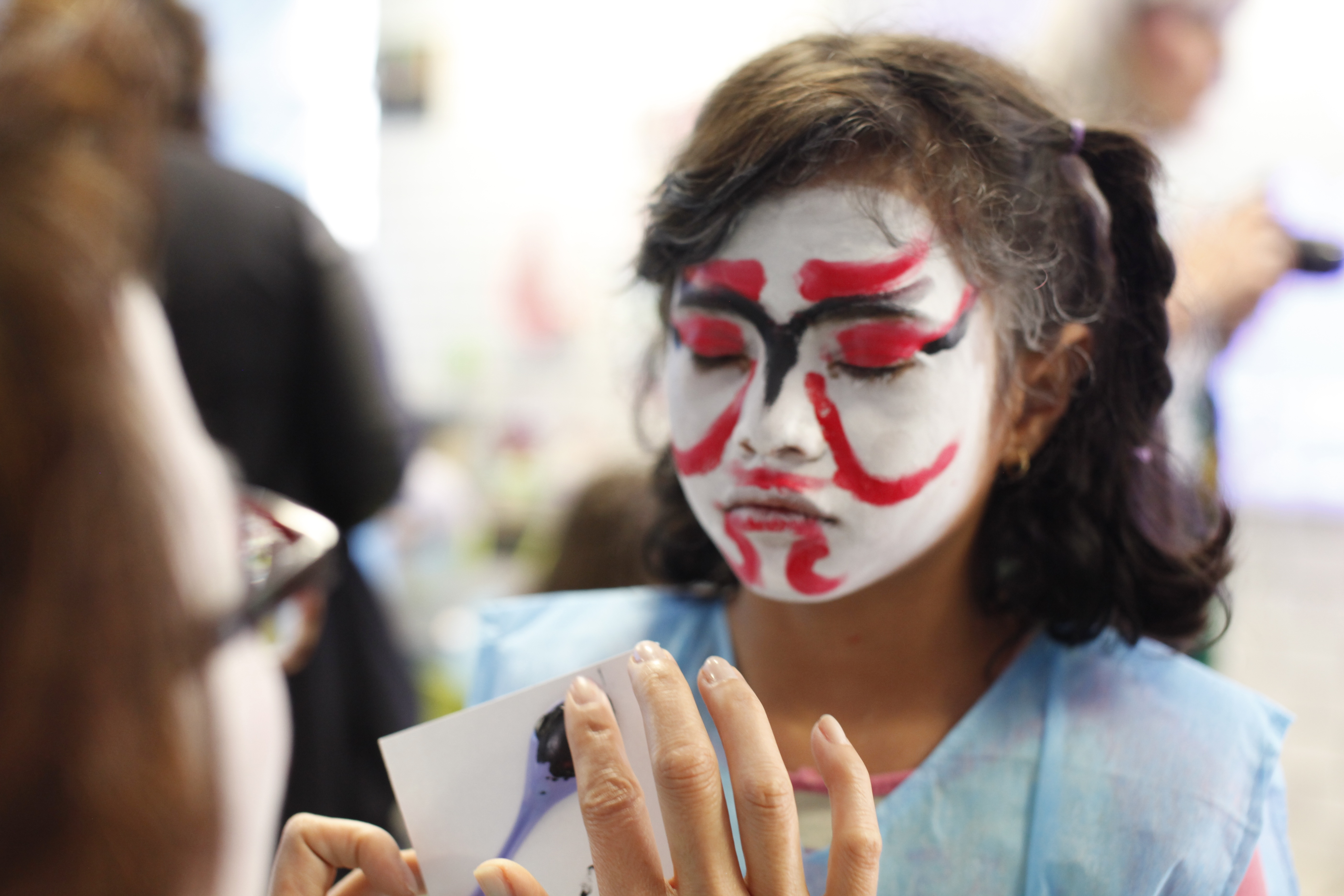
Chara-Rimpa facial painting in process
Donna Sylvester is a Chara-Rimpa collaborator
Chara-Ripma’s president Kudo Hideyasu has multiple roles
Chara-Ripma artists and collaborators come with creative ideas
Who are your greatest influencers in terms of the arts and creativity?
I have always been influenced by the thoughts and activities of Ryuichi Sakamoto (Japanese composer/musician), Levi-Strauss (Claude) for his work “La Pensée Sauvage,” and the Vienna Secession for their quest for freedom in art, departure from historicism and conservatism.
Could you tell us about your most important collaborators, who are they and what is their role in the projects?
Dr. Yasuyuki Sakura is the key artist of our project, conceptualizing the overall plan. His partner Toshie Yoshioka is a splendid designer who creates our workshops and mural design. Hiroaki Seo is our indispensable photographer who records the process of our activities, the finished work, and also captures the fleeting expressions of the participants. Hiroaki is responsible for all those vibrant images of the project and the people involved. Hanako Suro, our writer, communicates in a friendly and warm style to share information about our projects for a Japanese audience. Keiko, my wife, helps me making plans and doing projects. Kate MillingYonezawa always helps me with English wording. Hao Phan, my friend from Cornell University, has been very helpful in planning overseas projects. It was thanks to Hao that our project in Mexico was so successful. I am very appreciative of Hao’s support with her global network. Another Cornell alumna, Young Ju Kwon, owner of the sushi restaurant YUZU, is helping us with possible project development in New York City.
When we plan our overseas projects, it is crucial to have a devoted, experienced person in charge of the art project. Sarah Clark in Burney and Laura Gilabert at Colegio Madrid were such teachers. We were very lucky to have Sarah and Laura in charge of the project at each school.
Do you have a specific education philosophy that gives you guidelines? Does being Japanese implement ideas that you think are unique, and that the world should learn about?
My education philosophy has its base in Buddhism; every individual’s potential is valued equally and is educated accordingly, everyone needs to play a role for a peaceful society.
A former professor of Tokyo University of Arts, art critic Hideto Fuse points out that one of the distinctive characteristics of Japanese art throughout its history is to cultivate “the mind of children” as expressed in the facial beauty of Buddhist statues. I agree with him that the Japanese art tradition valued “the mind of a child” in the sense that Picasso expressed, “It took me four years to paint like Raphael, but a lifetime to paint like a child. “ I think that if there is something Japanese artists can offer to the world, one thing is its artistic tradition of expressing “the mind of a child” in art forms as can be seen in the contemporary works of Takashi Murakami and Yoshitomo Nara.
Do you have a favorite art form, performing arts or visual arts, what does being so multidisciplinary mean to you?
Visiting museums is always a treat for my mind. I was fascinated by William Turner’s work in London. I love music very much. A solo performance by Rostropovich that I attended at Cornell Concert Hall was one of my most fortunate experiences. A Sankaijuku dance performance that I saw in LA was impressive. Form itself does not define my preference. I am more attracted to the spirit expressed in any kind of art form. I think multidisciplinary is a very stimulating concept. It is a very effective approach to reach more audience in the context of technologically progressing diversified modern society. I think our art project can be viewed as a type of participatory art or relational art, which is usually, categorized as multidisciplinary art.
What kind of role does nature play in your thinking? Are there any specific metaphors in the nature that are important for you personally, and in your creative process?
There are two levels of nature in my thinking. One is a superficial level like weather, vegetation, and ecosystem. Another is a cosmological level from which the superficial workings of nature emerge. Valuable works of art for me entail some elements of nature at a cosmological level. I think that is the source of the universal appeal of fine art work.
What kinds of projects you have in mind for the future in Japan and overseas?
Dr. Sakura and I are planning mural making projects in Japanese towns. We are also planning another overseas art project for the next year involving mural making and cultural exchange art workshops. The mural design and the workshops are planned taking into account the project location and the country’s unique culture and traditions.
We are also planning to partake in a local festival here to attract more people and to create an improvisational call-and-response singing event. We are hoping that more people will experience and enjoy the spirit ofChara-Rimpa.
The mural design and the workshops are planned taking into account the project location and the country’s unique culture and traditions.








 Firstindigo&Lifestyle