Japanese artist Nakajima Mugi’s works open into a world of intense color and detail, and are filled with nuances and interactive play around the hues of the natural world. The artist often thinks and displays his works in pairs, as a group of three, or even in large groups on the wall. Putting the art pieces together changes the atmosphere of the space. What attracts me in his style is probably the technique of letting the color drop on canvas while in the process, which results in a possibility of chance, or accident. Yet the control of the colors and their order in the palette is made by the artist who masters the materiality of his vision. A series of paintings ‘blue on blue’ represents chaosmos paintings which are abstract (chaosmos: chaos and cosmos). The vivid colors of acrylics show off the surfaces of plastered paint. The ‘cosmos’ means order where accumulation of drawings create an entire landscape. The outcome comes close to patterned design textiles that expose bold attitude. Japanese and Finnish design and art worlds have something very similar in their approach, whether they meet in minimalism paying attention to detail and form, or stand for an oasis of calm. The interpretation of nature is present.
Nakajima Mugi
The artist uses different techniques to enhance his vision. ‘Blue on blue’ series includes two types of paintings of different techniques and textures. In one the fluid colors run on canvas as mentioned above. The other is a quiet one-color painting. Nakajima Mugi’s color-drop style recalls art informel and abstract expressionism. Solid color, then, reminds of Hard-edge paintings (Ellsworth Kelly) or Color field paintings (Barnett Newman). When Mugi’s works are arranged side by side the combinations do not follow strict rules but form an installation. The cosmos is ever-changing its rhythm, and the works show seasons and time. ‘Blue on blue’ changes according to exhibit space aiming to demonstrate the polyphonic of the paintings.
Nakajima Mugi3
Nakajima Mugi5
Nakajima Mugi4
Nakajima Mugi2
Nakajima Mugi was represented at the New City Art Fair in Chelsea, New York City in March of 2014 with the Gallery OUT of PLACE which is located in Nara and Tokyo. The gallery presented variations from his ‘blue on blue’ series. It also showed his other works that communicate well with urban and architectural environments. The artist has created installations with spatial variation including traditional Japanese houses as well as urban window-displays which communicate both inside and outside.
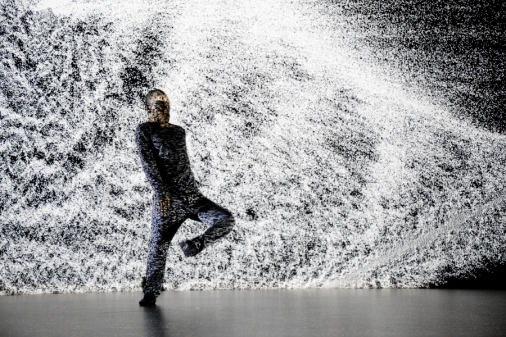
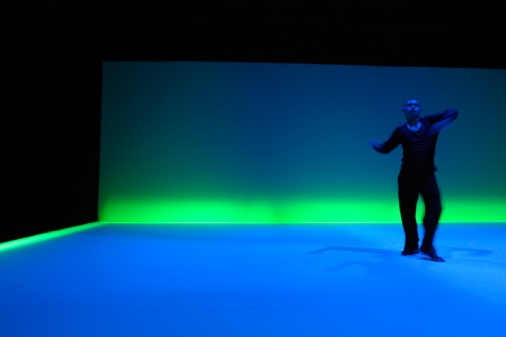
Japanese contemporary choreographer Hiroaki Umedarecently presented his new choreography Peripheral Stream withL.A. Dance Project at Théâtre du Châtelet in Paris. in 2013, he worked with an ensemble of 11 dancers from GöteborgsOperans Danskompani in Sweden. In the piece, Interfacial Scale, Umeda created the choreography, set, costume, light and sound design. As well as being a choreographer and dancer, Umeda is a visual artist, photographer and video artist. He established his own company S20 in 2000. Umeda has entered the international scene with his multimedia performance works that employ his own body and self-created video images, music and lighting designs. These are recorded on a single notebook computer.
(On the video Hiroaki Umeda talks about the Interfacial Scale which he created for the GöteborgsOperans Danskompaniin Sweden in 2013)
Since he first drew attention at the 2002 Yokohama Dance Collection R, Umeda has gone on to win praise of dance professionals around the world for the way he wraps his improvisational body movement in intricately woven spaces defined by light (video) and music with the beauty of an art installation. (Tatsuro Ishii for 国際交流基金 / The Japan Foundation Performing Arts Network)
FIRSTINDIGO&LIFESTYLE: You are known for your own choreographic language that has influences from different styles, and, from the movement point of view is highly flowing and gestural. Is there a way to trace the evolution of it, how did the movement develop?
Hiroaki Umeda: I started to dance at the age of 20, which is very late in general. At the beginning, I took some dance classes, such as Ballet, Hip Hop and etc. After a year of taking some dance lessons, I realized that there is no specific “dance style” that I want to learn: the dance I wanted to pursue had in fact not existed yet. Plus, I found that what is interesting for me in dance was, not the style, but what lays beneath those styles which is the “principal of movement.” So I started figuring out and understanding the principal of movement by myself, then I applied that principal to my body movement. I would say that my dance should be addressed not as dance but rather as a movement, since I focus on, again, what lays beneath the system of dance, which is the system of movement.
HIROAKI UMEDA: “Haptic.” Photo: Shin Yamagata.
You are a Japanese contemporary choreographer, can you describe the dance scene in Japan?
HU: I have been accepted more abroad than in Japan from the beginning of my career, so I cannot say much on behalf of the Japanese choreographers about what you are asking. However, I personally feel that contemporary dance scene in Japan has not been developed enough yet. The scene is very closed. But on the other hand, it is also true that because of the close-knit circumstances, it has developed very idiosyncratic styles. I cannot say if this close-knit condition is good or not good for the Japanese contemporary dance scene. Anyway, in Japan now, there are so many people who have been struggling and working hard to develop and open-up the scene more; that is a really big hope for me and I thank them a lot.
You started your artistic career with photography, and then moved towards dance, how did this transition happen?
HU: I was looking for an art style, which can accept real-time expression, thus, more than photography, I found that dance could be suitable for what I want to express. Dance is an art form in which I can physically put myself into in real time. In photography, on the contrary, it was really hard for me to materialize a piece in real. That is why I shifted to dance from photography. However, I have not totally detached myself from the photographic art form since I have been taking a standpoint throughout that dance can be a form of visual art. Lighting design, which I learned in photography, is now an essential factor for a dance piece.
The way you construct your choreography seems multidisciplinary. The sound and lighting design, and the visual dimension is crucial in your composition? Can you even differentiate which comes first?
HU: In practice, I start from abstract drawings, in fact, just lines. This drawing expresses my image of the tension of space, and it functions like the score of the piece to become. According to the drawings, which envision the whole image of the piece, I put together all materials, such as sound, light, dance and etc.
The visual addition or sometimes ’distortion’ makes your compositions also appear aesthetically ’charged’, could you say something about it?
HU: In my work, I focus a lot on how the bodily sensation could emerge from the space, and how, in turn, the bodily sensation could change the tension of space. That is, first and foremost, what I am interested in. The basic composition of my piece is always based on choreographing the tension of the space. By acutely tuning into the space, it is possible to attain a lot of stimuli that can provide you with physical sensations.
What does it culturally mean to be a Japanese choreographer now, from the point of view of globalization?
HU: have not been working consciously as a “Japanese” choreographer. I have been working as just an artist, focusing on how to bring my pieces to more people all over the world. I think that it is more important to be one of the many artists of the world, than just a Japanese artist.
Does Butoh as art movement mean anything to you? How about Kabuki, Gutai, and action art? They have also called you ’’avant-garde’’?
HU: I really appreciate their art works. But actually I am not so close to those Japanese avant-garde cultures. And I cannot tell if they have called me as “avant-garde.”
What role a nature and technology play in your mind-set?
HU: Nature and technology are not oppositional concepts for me. As a matter of fact, technology is a tool to understand and approximate nature. By the same token, I think that human beings and art, which human beings create, are a part of nature.
Where did you grow up? Where do you work these days?
HU: For the last several years I have been traveling almost all year round. I grew up in Tokyo, and I consider Tokyo as my hometown. But I have been working everywhere in the world. I think that what I do in my art is not connected to any specific country, city or place, so actually I don’t mind working any place in the world.
You did a work for Gothenburg Dance Company (GöteborgsOperans Danskompani). How was it to work in Sweden, also in terms of cultural exchange? Did dancers like the movement?
HU: Dancers of the company were from all over the world. They were really skillful and had great intelligence, and were very professional. To start off with, I gave them a system of movement which becomes the under layer of my choreography, and the dancers tried to find their own movements from tapping into that system. I am sure that I enjoyed seeing their movements develop from my system, even more than they enjoyed learning my system. At the moment, I have limited experience as a choreographer for big companies so the dancers helped me a lot and I learned so much from them. I would say that the process was more of collaboration, rather than providing choreography to the dancers.
In terms of the cultural exchange you are asking, the company was too international to feel any specific cultural differences. I would say that working with them was rather like a kind of universal project, working in various mixed cultures.
How was it to collaborate in Benjamin Millepied’s LA Dance Project 2? How was the audience response in Paris?
HU: Compared to LA Dance Project, the Gothenburg Dance Company was strict in terms of working procedures and time schedule precisely because they are a huge public company; I needed to follow their administrative schedule in terms of creative process, which I totally understood. On the contrary, Benjamin’s LA Dance Projectis, although they have diverse range or repertoire, still small in scale as a company. For this reason, I could work more closely with the dancers and staff that enabled me to go further and experiment more in the piece. To be very honest, I didn’t expect a good response from audience in the Châtlet. Surprisingly, however, the Paris audience quite openly accepted and appreciated my piece. I was impressed by their open-mindedness.
Can you name some of your influence or mentors, colleagues?
HU: There are too many names to list up here.
What are your plans for the future, and dreams?
HU: From last year, I have started making choreography devoid of human body. For me, human bodies are not the only elements for choreographic consideration. In fact, I want to really challenge choreographing anything with “movement,” and develop a dance piece with various elements. One of my dreams now is to choreograph water.
What kinds of projects have you been working on recently?
I began a new work during a residency at The MacDowell Colony (Peterborough, New Hampshire) last fall. I just started creating content loosely, on my own body, without any set parameters. I found that I was still thinking a lot about a piece I made in 2007, “Cult,” a duet for myself and another woman, that still had a lot to offer. I never want to name the “aboutness” of a dance because I don’t believe that’s what the form has to offer, but there is something about a fucked-up relationship between two women who have a relationship that’s too intimate, in that work. I wanted to return to that land because I knew there was more to mine.
I knew I didn’t want to make a solo, so I held an audition to find performers. This was a strange move for me, if only evident to myself. I think it’s not the downtown dance way of doing things, but I was really interested in seeing how the field had changed, in finding some gems without established reputations. I was interested in being very dry and pragmatic with that part of the process.
Next came a residency in the spring atBaryshnikov Arts Center (BAC), which was a compact and intense work period with the three women I hired. So, whatever I had started conceptually at MacDowell had snapped to in the form of a trio. I’ve taken note that the way I work with myself is utterly divorced from the way I work with other performers, so in that sense, there’s still this other battery of ‘stuff’ that I’m only comfortable putting on myself for now. I’m not sure where that material goes just yet.
Two weeks after the BAC residency I flew out to the Bay Area to be in residence at Djerassi. Djerassiis situated on a mountain on a former cattle ranch in the Bay Area, though incredibly secluded and remote. It seduces you into thinking you have the world to yourself. That was conducive to making my art.
I was alone again so I continued to make material intuitively, working with a discrete set of objects as content instigators: bed, mirrors, wine glasses and nylons (on legs and to cover the face) to build the choreography. I responded to these objects as talismans as I moved through an improvisational score based on incanting.
What do you say about the themes you have been working on during the past year?
I’m finally acknowledging to myself that I am fundamentally interested in women: women’s bodies in the form of dance. Women are mysterious to me, maybe at their most compelling in relationship to each other. I’m just drawn to strange and powerful and frightening relationships between women. There are a slew of films that come to mind as touchstones in their treatments of strange relationships between women: “3 Women,” “The Bitter Tears of Petra von Kant,” Breillat’s “Bluebeard,” “Mulholland Drive.”
I’m also drawn to the nature of ritual–what it means to enact certain rites, to supplicate, to reveal something intimate that’s not intended for anyone else’s eyes.
You are a conceptual choreographer, how did your thinking shift, in relation to your artistic development, how about your identity?
I’ve always understood, fundamentally, for me, that dances hang on form. But as I grow older and my eye gets sharper, I actually put that more and more into practice as opposed to getting hung up on any specific content, or getting really militant about execution. It’s all about proportion with the fundamental elements of choreography: time, space and bodies. And how I organize these things with and against one another, undermine the content, etc. I value ideas first and foremost, and then rigor in the execution of those ideas. I am not engaged with issues about idealized and beautiful bodies in dance.
Name your most important influences in the dance field? How about other influences, and mentors?
When I was 19 or 20 I saw Pina Bausch’swork for the first time at BAM. Not to sound overly dramatic, but it changed my life. My sense of what was possible in dance and art just exploded in magnitude. Merce Cunningham. RoseAnne Spradlin. Tere O’Connor. Visual art, fashion, music, literature. Always film.
I don’t know if I rely so heavily on what I see in dance. What seems to be more instructive and inspiring for me is to see how artists in other forms solve problems relative to their forms.
What visions do you have for the future, how do you see other activities (your board work and writing) in relation to your choreographic practice?
I am continuing to work on this new trio within the framework of two additional residencies in NYC (I’m not at liberty to say what they are at this time) that will take place over the next two years. They are completely process-oriented, however, there will be showings.
As much as I resist it, writing about what I’m doing can help clarify to myself what I’m doing. I can actually learn something. Writing about making dances tortures me, but I secretly enjoy the torture, too, because it is a concomitant, compositional act to choreographing. You organize information and you try to make the best choices to express what you want. It makes me a better thinker, and hence, a better artist.
I’m no longer on the board of DTW since it’s now NYLA and a completely different organization altogether. I’ve never had a feel for any kind of activity that can become the least bit bureaucratic. I can be an insanely stubborn purist, so what feeds my choreography is entirely separate from any organizational activity.
Do you want to say something about the NYC dance scene?


 Firstindigo&Lifestyle