Dip the fabric in a bath of onion skins, like she did. Let the dye cling like her ghost clings to me and to her old furniture, which has become mine, the headboard shaky as names being called, my name over and over. I cannot answer to it. Dip the fabric in a bath of onion skins. I cannot forget her ghost in front of the mirror. I realize her face is framed by my hair. She wanders the maze of armchairs. I fold my body over hers on one of the cushions. She clings to me. There is the end table that was carried with her from the farm where they first settled. Then she opened the window for the first calm in a long time. She felt the discomfort of knowing her family was not part of her peace. This scared her and so did the way their ghosts cling.
I work with art in reaction to poetry. I find textiles work best since they are malleable and react to embroidery, dye, and wax. This helps me focus my poetry. Sometimes I rework the poetry after the textile is completed to create a stronger connection. -Olena Jennings
The idea begins here with collecting onion skins for about a year. They crackle and crunch against each other as thin as a spirit.
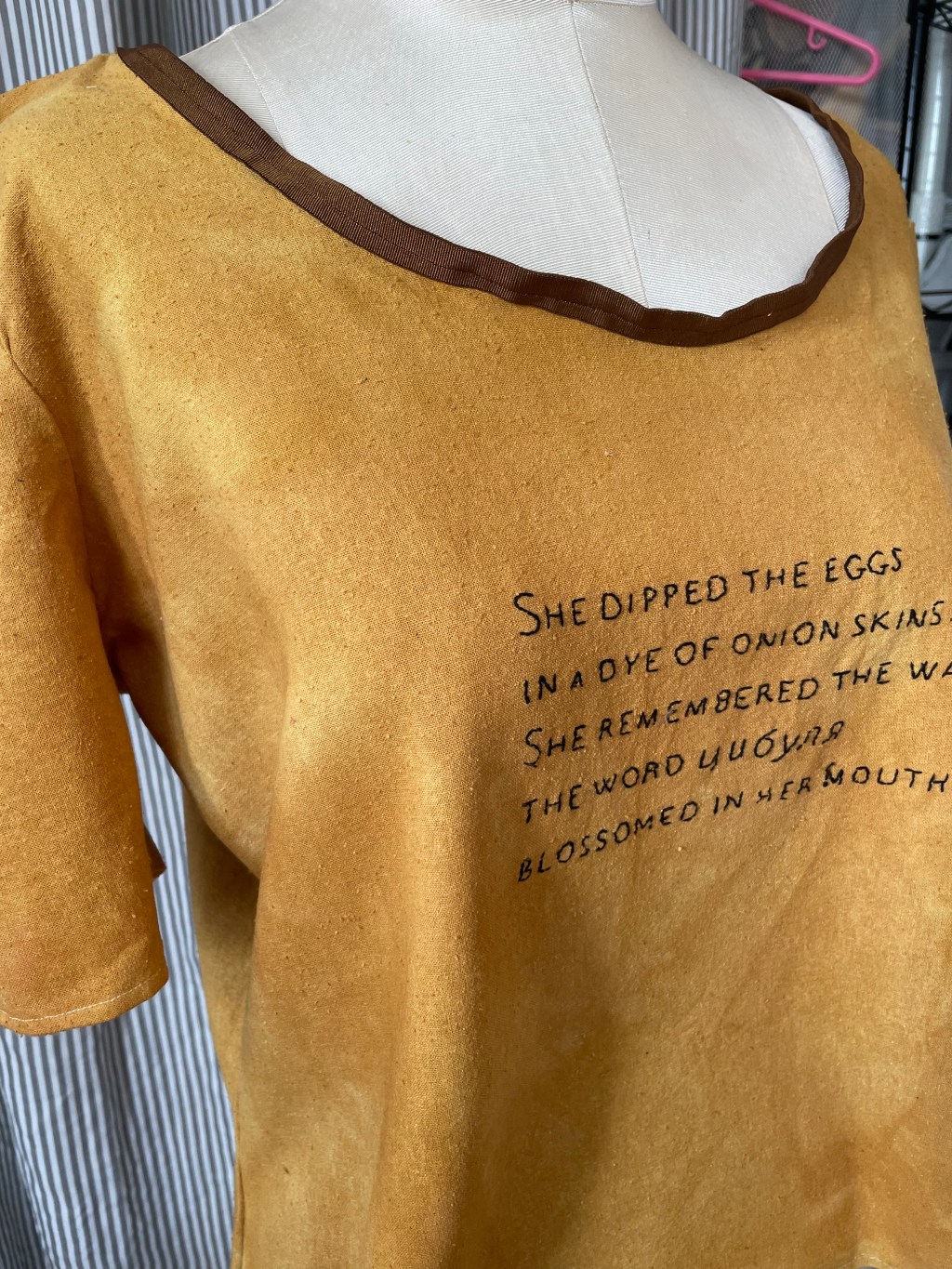
The title of the poem “Historical Arrangement” is about the ghost who is a deceased family member, and the voice in the poem is becoming one with history. What is remarkable is that the voice has her furniture and is taking on her features.
The art, a woman’s shirt, is part of the poem because this family member is dyeing with onion skins. The voice in the poem is repeating her acts. My ancestor used onion skins to dye eggs, but I carried the process into my present by dyeing fabric.
_______________
Olena Jennings is a New York City based writer and translator. She is the author of the poetry collection The Age of Secrets (Lost Horse Press, 2022) and the novel Temporary Shelter (Cervena Barva Press, 2021). Olena Jennings has been a translator or co-translator of collections by Ukrainian poets Iryna Shuvalova, Kateryna Kalytko, Vasyl Makhno, and Yuliya Musakovska, among others. She also founded and curates the Poets of Queens reading series and press.
Meditation as a practice implies self-awareness. Finding about inner strength, intuition, thought processes and wishes. Otherwise, putting things in the background while finding the inner focus to clarify and perform. All these aspects create the assurance of different levels of balance. One might believe that meditation is a pure focus, while the contrary is in fact true.
Mindfulness as a concept, a reality of nourishing the mind and soul by turning into more quiet time. Quieting one’s mind in order to listen to inner atmosphere of feelings and emotions. Why not to discover the universe that is within us? Replacing negative thoughts with appreciation of ourselves, of others and the world.
Breathing
It is not only about tuning into balancing acts, but also inspiration and self discovery. We are full of emotions and feelings, which are positive and not at all negative; and even some of the negative ones may turn into new energy and offer insight. Meditation implies a pause, opening a pathway to our inner thoughts.
A truthful path includes maintaining a certain level of anxiety and uncertainty when it comes to specific problems like climate change. If we sit back and relax, wash away our mind with calm waters of emptiness, we won’t have the energy required to fight the problem. Where our attention is needed, where frustration isn’t supposed to be solved by simply relying on our positive energy.
Collage: Firstindigo&Lifestyle @polyvore-designs
For the overachieving among us, stretching beyond our everyday selves is not the biggest question. Finding treasures in the more simplified notions of our inner powers might be. Not all progress is necessarily meaningful. But finding answers in more everyday actions, in nature, in the natural world, and in those encounters with others.
Sometimes there is time to learn compassion for ourselves, in order to better listen and pay attention to the natural world. Compassion is the key turned into caring on a deeper level about anything important. In meditation this manifests in being attentive to breathing, keeping the mind and body aware of the breathing. Step by step this awareness opens up into something deeper, reaching outside the limitations of us as humans.
Our consciousness can open up to thoughts where breathing becomes part of the universal rhythm of breathing together with this planet. The natural world requires our attention to the actual concept of breathing. We are all living, palpable things. Over consumption, unnecessary interruption of the natural course of life, creates chaos over rhythm of breathing in all living things. Planetary destruction is emblematic of bodies that have moved away from their breathing.
Meditation can be motivational, it can energize us to think more deeply about ourselves and others. This planetary home of ours calls for our attention into our breathing. Meditation is about becoming aware of how the parts can fit into the whole, and how that whole can mend the individual parts.
Between East and West
French philosopher Luce Irigaray’s literary work “Between East and West: From Singularity to Community”, investigates Eastern practices and philosophy from the point of view of the body, in which breathing has a central role. After herself practicing yoga and meditation, her research implies a personal awakening that has manifested through practice of the conscious breathing. Following ancient Eastern practices of breathing and yoga, Irigaray argues that both humans (women and men alike), nature, and the natural world including the spiritual life, are part of a bigger plan of discovering our being in here.
In this writing Irigaray examines the Western tradition through ancient Eastern disciplines. It is the meditation that teaches us to breathe. Yogic traditions, according to Irigaray can offer us a meaningful way to reconnect our human and planetary pasts with its futures.
In Jewish Kabbalah, which also is an ancient tradition, there is a lot of thought put into spirituality and our collective well being. We should gain more compassion for one another, and understand that ultimately we are all creatures essentially bound up with other creatures. All levels of the creation and the preservation of the planet is a common goal for us being here.
From this perspective, our meditative approach can lead to a child-like approach when it comes to life; the wonder that locks our inner core into things beautiful and wondrous. When we grow up, we tend to forget how things in nature put a smile on our face, how literally everything that grows out there can feel exciting and worth exploring. Nature’s mysterious part is also something that can open to one who will pause, sit back and absorb its presence. Listen to a birdsong, look at the trees behind the brick wall in the midst of urban life. We can imagine going back to nature anytime. Meditation is one key to acknowledging that this is possible.
The Natural world can lead us to believe in higher beings, in something more universal than our mundane lives. Species and subspecies come from somewhere, the universal energy and movement can lift us to have faith in the worlds that are often invisible.
Sparkles and a vessel as a thought introduced in Kabbalah. Our divine task to help ‘creation’, to correct errors in nature. To make the world a better place for all living things. There is something divine in the sun with the radiance that it wakes us up to each new day. The universe that keeps repeating the same mantra of coming back fresh every single day. We haven’t been able to stop the sun from rising, even with all our destructive human behavior. Even when sun stays in the clouds.
Climate change
It is more and more discussed how climate change can bring disturbance to our lives and shake our balance. The World Health Organization published a study about how climate change can have an impact on our overall health.
“The principal reason for the global increase in temperatures is a century and a half of industrialization, with the burning of ever-greater quantities of oil, gasoline, and coal; the cutting of forests; and use of certain farming methods.” (https://www.who.int/heli/risks/climate/climatechange/en/)
Global warming will certainly have consequences where our health may be at risk. In terms of changes in our ecosystems and as catastrophic weather phenomena, climate change can create new emergencies.
When we meditate, we can learn to appreciate each new day. And think how we can better meet the challenges. Climate Change is adding another layer that intensifies patterns and experiences that are abnormal, when the future holds more extreme rainfall, floods, tropical cyclones, droughts and heat waves, in addition to the increase in the frequency of calimas and atmospheric dust. (https://www.una-climateandoceans.org/448491047)
One of the nature’s emergencies is called calima. The calima is caused by a storm or change in weather impacting the Saharan Air Layer. Climate change will cause more of the phenomena. The hot, dry and dust filled system is located above the Sahara desert. It meets the more humid and colder system that linger over the Atlantic Ocean.
Reference: Luce Irigaray (2002): Between East and West. From Singularity to Community. Translated by Stephen Pluhácek. Columbia University Press.
Bells, tools and meditation are all ancient. When it has been confirmed by historic research, that tools and weapons were among the earliest bronze objects in China, the bells also now belong to this bronze age era. The meditative component has eminently added value and appreciation among the Asian arts. People are looking for nurture from art, and statuesque buddhas seem nurturing, even healing with their meditative poses. Massive sculptures are surrounded with the calm that is often lacking from the demands of the everyday life. The journey inwards requires little more participation.
Chinese bells have a special form that calls for a closer investigation. They are emblems of music, and when tried, the sound can be interestingly different from the Western terms of bell-sound. The church-bells have varying melodies, yet Chinese bells embody tones that are thousands of years old. It is believed, that the sound has not changed since they were casted. Bells still narrate of ancient technology as a soundsystem.
Chinese bells Free Gallery of Art & Arthur M. Sackler Gallery
With the global travel, the world has shrunk, and meditation practices have become increasingly popular. We are at the moment pushed to scrutinize ourselves into increased indoor dwelling, so discovering new possibilities of meditative practices might be useful. Sound is one way to go, listening to music with new awareness, concentrating fully into music or sound may turn the focus into a particular matter. A ‘look’ inwards may be rewarding.
Meditation is a bodily practice of a mind as operator. A word techne would also fit with its stance of the world. Techne is a philosophical term, which includes knowledge at its core. By using it in reference to bodily practice, it might as well connect to understanding your meditation approach. Learn to meditate by meditating, gain knowledge of meditation by doing it. Knowledge is coming from the act and art of doing.
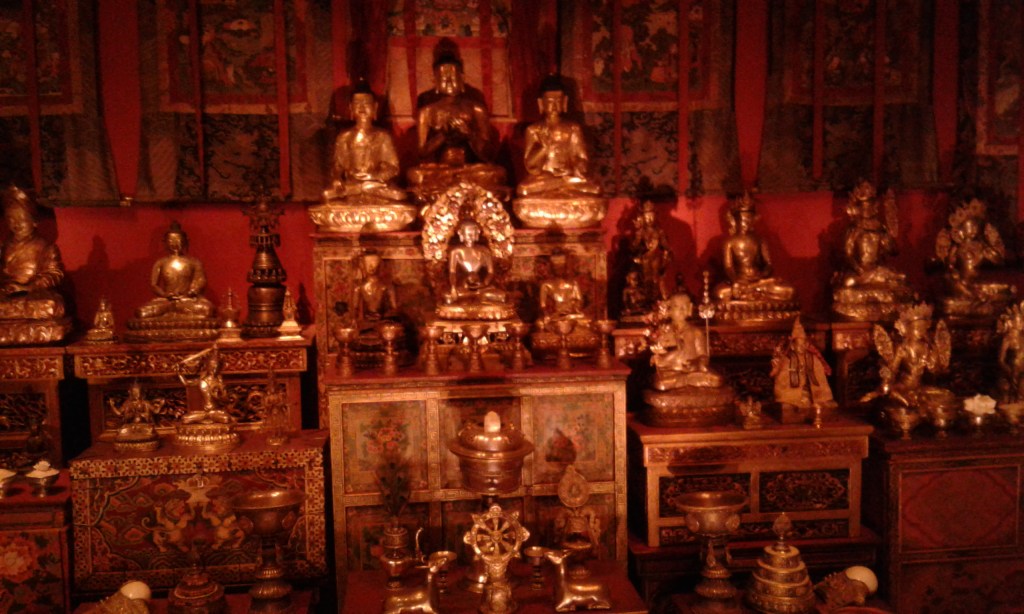
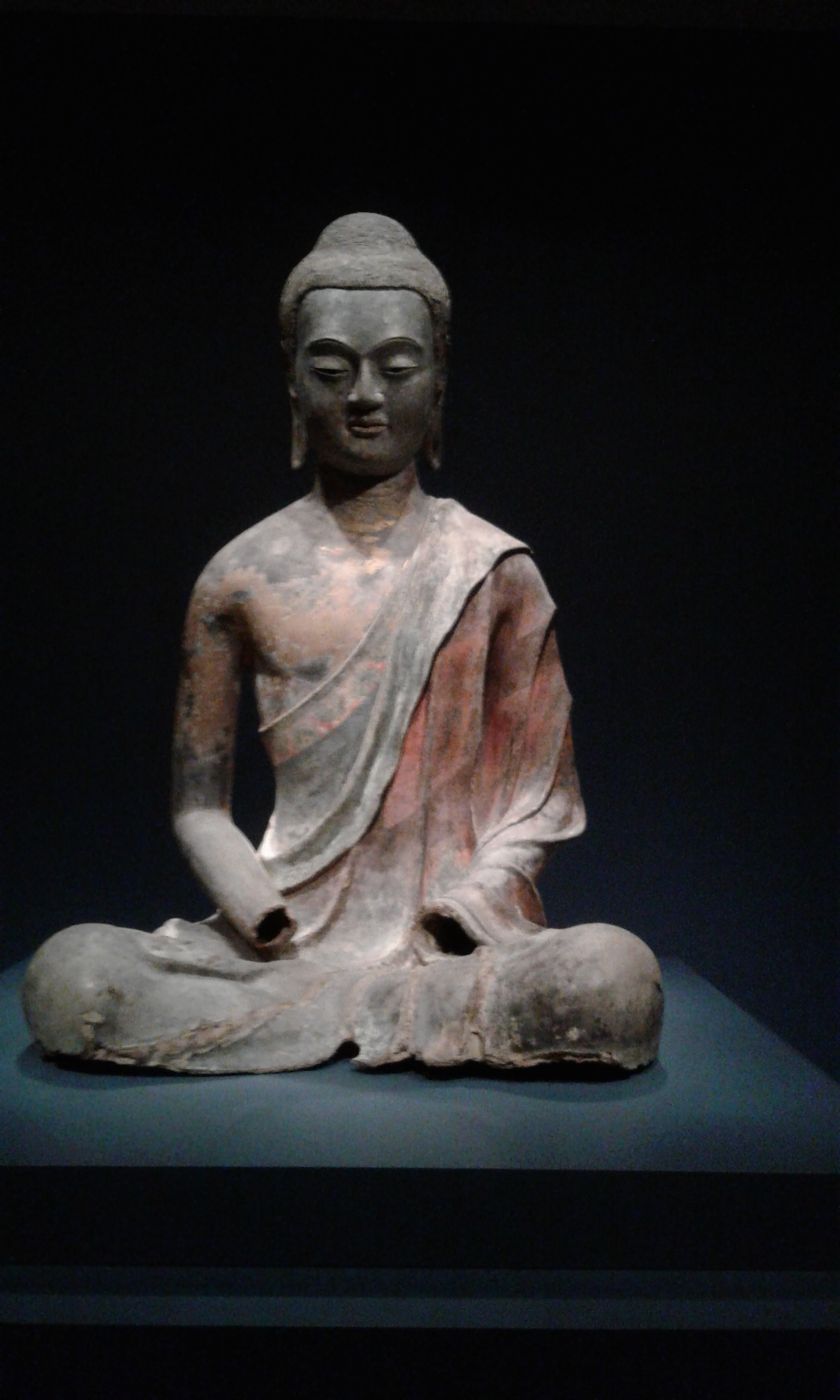
Sitting buddhas are art works that meditate, giving out a pose with a silent approach that is almost demanding us to participate in a technology of looking inwards, of stopping our other activities, breathing with the sculpture. The art stimulates the senses into a sole pattern of sitting with a more disciplinary attitude.
Buddha sculpture at the Free Gallery of Art & Arthur M. Sackler Gallery.




 Firstindigo&Lifestyle