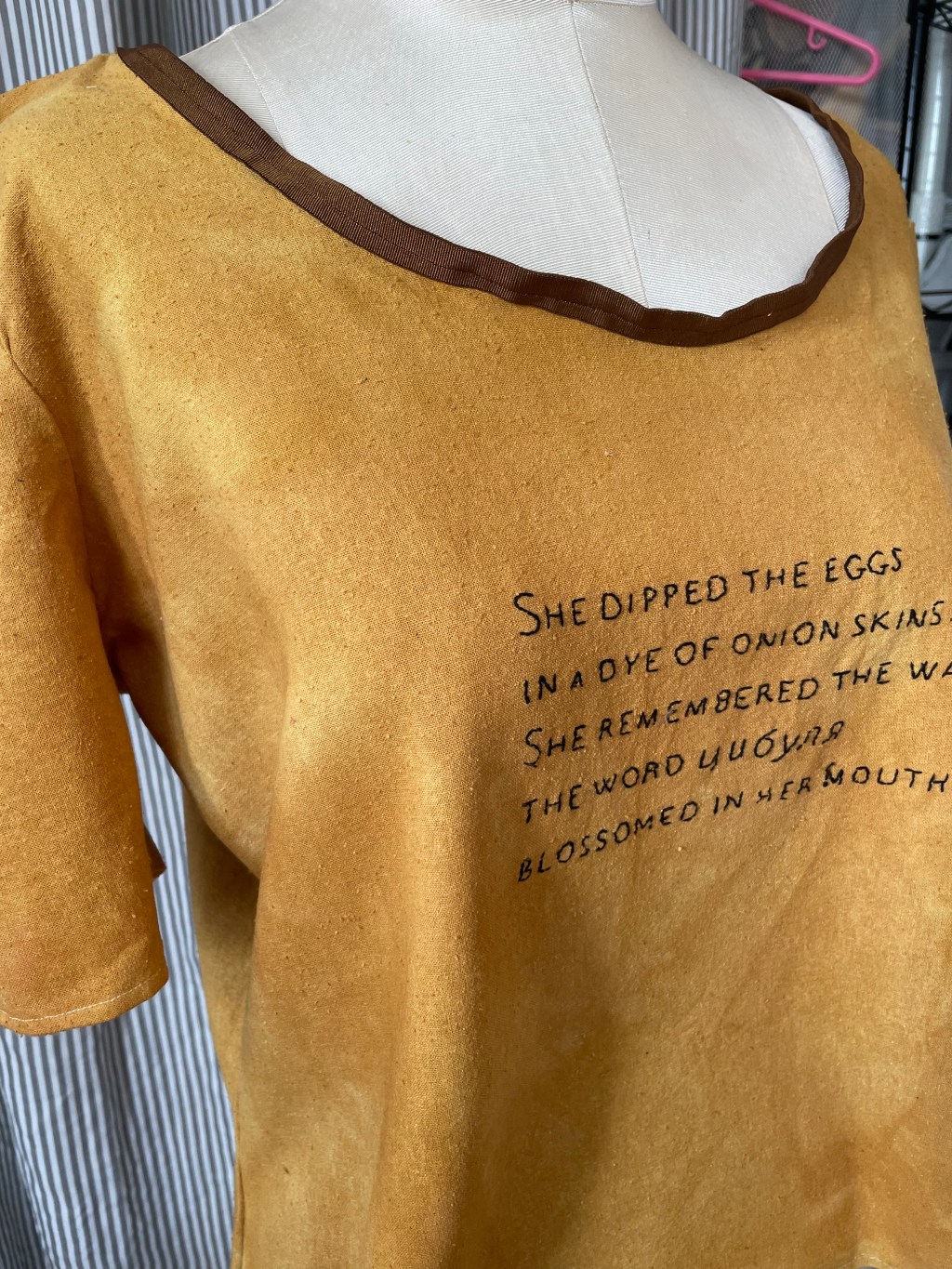
Dip the fabric in a bath of onion skins, like she did. Let the dye cling like her ghost clings to me and to her old furniture, which has become mine, the headboard shaky as names being called, my name over and over. I cannot answer to it. Dip the fabric in a bath of onion skins. I cannot forget her ghost in front of the mirror. I realize her face is framed by my hair. She wanders the maze of armchairs. I fold my body over hers on one of the cushions. She clings to me. There is the end table that was carried with her from the farm where they first settled. Then she opened the window for the first calm in a long time. She felt the discomfort of knowing her family was not part of her peace. This scared her and so did the way their ghosts cling.
I work with art in reaction to poetry. I find textiles work best since they are malleable and react to embroidery, dye, and wax. This helps me focus my poetry. Sometimes I rework the poetry after the textile is completed to create a stronger connection. -Olena Jennings
The idea begins here with collecting onion skins for about a year. They crackle and crunch against each other as thin as a spirit.
The title of the poem “Historical Arrangement” is about the ghost who is a deceased family member, and the voice in the poem is becoming one with history. What is remarkable is that the voice has her furniture and is taking on her features.
The art, a woman’s shirt, is part of the poem because this family member is dyeing with onion skins. The voice in the poem is repeating her acts. My ancestor used onion skins to dye eggs, but I carried the process into my present by dyeing fabric.
_______________
Olena Jennings is a New York City based writer and translator. She is the author of the poetry collection The Age of Secrets (Lost Horse Press, 2022) and the novel Temporary Shelter (Cervena Barva Press, 2021). Olena Jennings has been a translator or co-translator of collections by Ukrainian poets Iryna Shuvalova, Kateryna Kalytko, Vasyl Makhno, and Yuliya Musakovska, among others. She also founded and curates the Poets of Queens reading series and press.
The Eye of the Beholder: Julia Pastrana’s Long Journey Home is a new book edited by Laura Anderson Barbata and Donna Wingate. The essay collection sheds light on the life of historic sensation, Mexican international performer Julia Pastrana, expanding the storyfrom anthropological and art historical perspectives. The book can also be viewed as a personal story of discovery. Artist and writer Laura Anderson Barbata remembers her own process of starting the project that eventually led to this book. How she got engaged in the controversial subject propels ideas of activism, and a passion to rewrite Pastrana’s history from new humanitarian and feminist points of view.
Firstindigo&Lifestyle: How did you originally get interested in Pastrana’s life?
Laura Anderson Barbata: In 2003, Amphibian Stage Productions, a theater company directed by my sister Kathleen Culebro, invited me to collaborate with designs for a play that they were about to premiere in New York: The True History of the Tragic Life and the Triumphant Death of Julia Pastrana, the Ugliest Woman in the World, by Shaun Prendergast. This is how I learned about Julia Pastrana. The story, unfolding in complete darkness, details the life of Julia as she traveled through Europe, a performer in a freak show, until her death in Moscow. It also briefly recounts the fate of her mummified body, and that of her baby, until they were added to the Schreiner Collection of human remains in the anatomy department of the University of Oslo. Upon hearing her story, I felt that my duty as a Mexican artist, and as a human being, was to do everything possible to have Pastrana removed from the anatomy collection and returned to Mexico, her place of birth—where she was at the time practically unknown—to receive a proper burial.
After nearly ten years of effort, Julia Pastrana was finally transferred to Mexican officials in Norway; I represented Mexico. After more than 150 years of being exhibited for her unique physical condition, Ms. Pastrana (1834–1860) was repatriated to Mexico and buried in Sinaloa, Mexico in 2013.
Firstindigo&Lifestyle: It’s been really a longitudinal project for you personally. How did you get others to get involved?
I was not the first person to request the burial of Julia Pastrana and have often asked myself, why was I able to succeed? Why did other efforts fail? What did I do differently? I think the answer lies in the fact that I am an artist and therefore my methodology was radically different from all others from the start. My extensive collaborative artistic experiences in Mexico, Venezuela, and Trinidad prepared me for a project of this magnitude that ultimately involved international institutions, government officials, various organizations, and scientists.
LAB: The ten-year plight for Julia’s return for burial began with letters I wrote to the National Research Ethics Committee for the Social Sciences and Humanities, the National Committee for Ethical Evaluation of Research on Human Remains of Norway, the Governor of Sinaloa in Mexico, the Foreign Affairs Department of Mexico, the University of Oslo, journalists, artists, anthropologists, individuals, and various institutions that I reached out to for their professional opinion, advice, and guidance. During this process, they became deeply involved and invested in the outcome. Each one was fundamental for the success of the repatriation and I consider them to be my collaborators.
Firstindigo&Lifestyle: How many authors are participating in the publication that is coming out now, and what perspectives do they cover from visual and historic perspectives?
LAB: I edited the book with Donna Wingate, and it includes texts by Jan Bondeson, Rosemarie Garland-Thomson, Grant Kester, Nicolas Márquez-Grant, Bess Lovejoy, and myself. Donna and I researched and selected more than fifty illustrations from the public domain, library collections, archival materials, and works commissioned especially for the project.
The Eye of the Beholder: Julia Pastrana’s Long Journey Home, book cover.
The authors are as follows:
Dr. Jan Bondeson is a Swedish-born rheumatologist, scientist and author, working as a senior lecturer and consultant rheumatologist at the Cardiff University School of Medicine. Outside of his career in medicine, he has written several nonfiction books on a variety of topics, such as medical anomalies and unsolved murder mysteries.
As an expert on Julia Pastrana, Bondeson contributed two chapters to the book; the first is a general introduction to the story of Julia Pastrana, and the second recounts how he found her remains in the basement of the Forensic Institute of Oslo in 1988, and how his extensive research established that she suffered from hypertrichosis terminalis rather than hypertrichosis lanuguinosa, as previously believed.
Dr. Nicholas Márquez-Grant is a Specialist Forensic Practitioner in Anthropology and Archaeology at Cellmark Forensic Services, Abingdon, UK. He is also a Research Associate of the Institute of Human Sciences, University of Oxford.
His text addresses the history of collections and the anthropological framework of the nineteenth century; the ethics surrounding human remains; the case of Julia Pastrana’s repatriation and its significance; witnessing Pastrana’s body in the chapel during the repatriation process.
Rosemarie Garland-Thomson is Professor of Women’s Studies and English at Emory University. Her fields of study are feminist theory, American literature, and disability studies. Her work develops the field of disability studies in the humanities and women’s and gender studies.
Dr. Garland-Thomson’s essay considers the ways that the public display of Julia Pastrana both reinforces and challenges the lines between the self and other, human and non-human, ordinary and extraordinary, that such spectacles rely upon. By analyzing how Pastrana’s display and recent repatriation and burial in Sinaloa invest her body with different meanings, it traces the processes that socially mark human bodies in order to reveal and explicate the inner workings of representational systems, such as race, gender, ethnicity, and disability.
Grant Kester is Professor of Art History, and Director of the University Art Gallery at the University of California, San Diego. Kester is one of the leading figures in the emerging critical dialogue around “relational” or “dialogical” art practices.
Dr. Kester’s text discusses how European colonizers were unable to attach specific meaning to the objects they acquired through colonization and thus developed larger meanings for art more generally. Recovering Pastrana’s remains becomes an act of restitution that encourages a confrontation with the historical status of “stolen” objects and encourages a renegotiation of and reconnection to the understanding of the past.
Bess Lovejoy is a Brooklyn-based writer and editor. Ms. Lovejoy’s essay contextualizes Julia Pastrana’s afterlife by considering a number of other notable individuals whose bodies have been preserved in museums. Like Pastrana, many of these individuals possessed bodies that differed from the European norm, either because they were born with physical abnormalities or because they were of non-European ethnicities. Her chapter considers how scientific and ethical considerations complicate the collection and display of such bodies, and how some of these bodies have been the focal point of successful repatriation campaigns, while others have not.
Laura Anderson Barbata
My essay describes my own journey: the process, challenges, and partnerships that were formed as I worked for ten years for the repatriation of Julia Pastrana.
Books by Laura Anderson Barbata. Images by Firstindigo&Lifestyle.
Laura Anderson Barbata in her studio.
Firstindigo&Lifestyle: Your own artistic research work on Pastrana has included performative phases, how are you implementing this approach on the book?
LAB: While Julia Pastrana was billed as “The Ugliest Woman in the World,” what is most important to mention is that she was a gifted mezzo-soprano and dancer—she was a very successful performer during her lifetime. Julia Pastrana’s life story and the fate of her body after her death (including her successful repatriation) brings to light issues that remain deeply relevant: beauty, ownership, science and racism, commercialization, objectification, exploitation, human rights, public versus private, international law, colonialism, sexism, respect, responsibility, indigenous rights, memory, sensitivity, the physical body, and the spiritual body.
In order to unpack all of these subjects, I felt that they must be addressed through different mediums. First, it was important to create a publication to gather the most significant material concerning her life with critical essays from different scholars. Donna Wingate and I worked on this book for over four years—researching archives and discussing the various lenses through which we could gain a deeper understanding of Julia Pastrana. At the same time, our goal was to present a full account of Pastrana as a person, a woman, and an artist, with the dignity she had been denied during her life and after her death. The book includes images of my artworks—works on paper and performances—based on the story of Julia Pastrana.
Firstindigo&Lifestyle:How would you describe the cultural life in Mexico at the time of Julia over hundred years ago? Also, what was the context that she was surrounded by that addressed her as a celebratory oddity?
LAB:Julia only lived in Mexico for the first twenty years of her life. She was born in 1834 in the State of Sinaloa, and according to popular legend, was born in the indigenous village of Ocoroni—or thereabout—in 1834. Today Ocoroni belongs to the municipality of Sinaloa, in the state of the same name, and is located in the foothills of the Sierra Madre Occidental.
In the decades of the first half of the nineteenth century, Mexico was searching for its own destiny and independence. Since the establishment of the first settlements by European Hispanics in the sixteenth century until the early nineteenth century, the territory of Sinaloa was mainly a mining state. The population, therefore, settled in the mountains and in the valleys. Mining camps and towns were established throughout Sinaloa for the search and exploitation of metallic resources that were coveted by the monarch of Spain.
Nothing is known about Julia’s parents or siblings, and there are no documents of her birth or baptism. It should be noted that the Office of Public Records (Registro Público) had not yet been created in Mexico; it was legally established on January 27, 1857. Little is known about her childhood, although it is said that an uncle took charge of her after the death of her mother, and in an effort to make a quick buck, sold to her to a small traveling circus—the kind that occasionally passes through these remote villages. Sometime around 1836 until April 1854, Julia was a maid in the residence of Mr.Pedro Sánchez, who had been in charge of the government of Sinaloa from September 28, 1836 to June 3rd, 1837. It is possible that he purchased Julia from the circus that had exhibited her throughout the northwest of the country.
We believe that her training as a mezzo-soprano and dancer began when she lived at the governor’s house, and he likely presented her before audiences. She spoke four languages: English, French, Spanish, and Cahita, her native tongue. She was taken to Guadalajara to perform in 1854, and news of her reached the United States, as we found in an article in the New York Post. This must have been what sparked the interest of the American Theodore Lent, who worked for Barnum and Bailey and later became Julia’s husband. He traveled to Mexico to meet with Pedro Sánchez and Francisco Sepulveda to discuss a business venture that involved the sale and purchase of Julia Pastrana.
Firstindigo&Lifestyle: As a phenomenon she became extremely internationalized so to speak. How would you explain this to contemporary audiences, from the perspectives of art, science, and women’s history?
When Julia Pastrana left Mexico and traveled to the United States with Francisco Sepulveda to meet Theodore Lent to complete a business transaction between Sepulveda and Lent, Theodore Lent secretly convinced Julia Pastrana to marry him, and he immediately became her manager. He presented her to audiences and billed her as the Bear-woman, the Nondescript, the Ape Woman, the Female Hybrid, the Wonderful Hybrid, and Baboon Lady, among other sobriquets.
LAB: Julia Pastrana was taken to perform in Boston, Philadelphia, Cleveland, and New York, among other cities. After a number of presentations in the US and Canada, Lent decided to take his show to Europe. They traveled to London, and extensively throughout Germany, Poland, and Russia. Julia Pastrana’s shows were very successful, and newspapers throughout Europe wrote about her.
Julia Pastrana’s story is a reminder that what happened to her is not an experience exclusively from the past—today there are far too many cases of exploitation, abuse, neglect, cruelty, human trafficking, and discrimination. Julia Pastrana is a reminder that we urgently need to forward women’s rights, indigenous rights, children’s rights, and eliminate human traffic to start. We must end gender discrimination, defend the rights of people with differences, protect religious choices and end the voracious dehumanization of people in the name of political, commercial, religious, and scientific purposes. For me, it means that I continue working on the topics related to her, the injustices she lived and how they are still relevant today.
LAB: Among the works are: a performance piece that is continually evolving, a series of zines that address different topics related to Julia Pastrana such as: repatriation of human remains, museum ethics, exhibition practices, the objectification of people and women, human traffic, beauty and the commercialization of women’s bodies, feminism, animal rights, love, circus arts, among others; in addition, we are working towards an Opera about Julia Pastrana in collaboration with the artist collective Apparatjik, Concha Buika, and Void Design.
Firstindigo&Lifestyle:Do you think she is appreciated in Mexico today, and how will the book contribute to that?
LAB: The repatriation of Julia Pastrana sparked a great interest worldwide and in Mexico. Since Julia Pastrana’s repatriation there have been at least three plays written and performed in Mexico about her, and I understand there is a feature film in development by a Mexican director. I have also learned about a woman’s health center that opened recently in Argentina that is named after Julia Pastrana. Because of my work on the repatriation of Julia Pastrana, I recently received an award by the Instituto de Administración Pública of the State of Tabasco, Mexico for the Defense of Human Rights.
It is clear to me that all of these responses show that Mexico is embracing Julia Pastrana and is working towards restorative actions for her memory, for the promotion of dignity and justice, and in humanitarian efforts to defend the rights of all.
photo: Wilma Hurskainen: “He Doesn’t Like Water”, 2012
The book Training artist for innovation: Competencies for new Contexts was published in 2013, (the Theatre Academy of the University of the Arts in Helsinki in Finland). It discusses the topic of artists who are trained for creating innovation in various contexts outside their own artistic practice. The book is based on a project, which gathers together different agents in European countries, who are leading artistic innovation. Kai Lehikoinen and Joost Heinsius are the editors of the book.
The book-project brought together artists, companies, organizations, universities and cities, which have experienced artists working with them. The idea for the publication came from the challenge that both society and businesses need new solutions and interventions, as they face changes. Professional artists with artistic interventions can respond to challenges of today, bringing in new questions and ways of thinking. Artists “offer contradiction, as well as confrontation and friction, and they provoke new ideas.”
Training Artists for Innovation: Competencies for New Contextsargues that artists who take the challenge for artistic interventions need specific training to establish their artistic know-how for new contexts. Artistic competencies can be trained, so to speak. Innovation can occur where artists, with their own practice and methods, contribute to the arts sectors and organizations, to the business world and sectors, where societal policies are made. The book responses to a framework of European context, but the idea can be shifted to other parts of the world.
A very basic question; are artists not innovative by nature, opens up a dialogue between artists and new contexts. According to editors Heinsius and Lehikoinen, “A gap has risen between the arts and society that needs to be bridged and closed” .
Art can intervene not only on the walls of office spaces, but it can come to peoples’ working life as well. This statement is inspired by models learned from community art, and by the experience coming from social and health sectors, where art has always been respected as part of human life. The new innovation comes in the intersection, where businesses and organizations want to raise their creativity, and understand their creator capacity in conjunction to human-based factors. As the book shows, the arts can add value, for example, by bringing in emotional and aesthetic dimensions. Artistic interventions can boost creativity and raise energy, bring in new ways of listening, managing, and interacting with others. The book emphasizes that the term artistic intervention is understood as “interdisciplinary professional practice that takes places in business settings and involve professional art-making and creative arts practices”.
What are, then, the issues that interventions can tackle? Topics and issues of course vary, and depend on each context. Artistic interventions can be connected to strategy and concept development, to work processes, to team-building and social interactions, and to public relations, for instance. In the level of cultural policy, the arts have a key role, together with other creative sectors, to add into the diversity of society. In a larger societal (European) policy level, the following seems very relevant and welcomed, when thinking of the creative economy:
“At the national level, the starting points differ from country to country. In some countries, it is the perceived gap between the arts sector and the rest of society that needs to be acknowledged – that is, the need for the arts to appear as relevant to other sectors in society. In other countries, innovation development welcomes the arts as the perception of shifting from technological innovations to social innovations and creativity.”
Training Artists for Innovation: Competencies for New Contexts is a book that asks a relevant question of, how to do it with the arts. It gives several examples of the relevant competencies that artists can embody for their interventions. Gerda Hempel and Lisbeth Rysgaard, from Danish Artlab, write in their chapter Competencies – in real life, about their own model of working with artists and businesses. What they suggest is that artists need to manage a variety of specific tasks that relate to understanding the culture of the organization: such as developing and describing the concept, knowing how to sell and negotiate, and,“how to engage and conduct the process, how to extract learning and evaluate, and how to support the implementation within the organization.”
Their chapter reveals that when artists share a common denominator, the artistic base, methods and tools vary in different art forms. For example, a violinist in the opera house has a different approach than an avant-garde performer who works in an experimental performance space.
Artlab founders and consultantsGerda Hempel and Lisbeth Rysgaard bring in the artist perspective of working with businesses. They open their Artlab Entrepreneurial Model (that is based on their 12-year experience in the field) and reflect this in relation to real artists, who they interviewed. This shows how artistic interventions function from the artists point of view. The model itself is like a metaphoric artistic house, which includes 4 interactive work spaces and a storage. Its aim has been to help professional artist who want to go entrepreneurial and find new job opportunities, or look for new management skills for their career. The house allegory with 4 spaces includes: The Shop/Back office, The Workshop/Development, The Scene/Artistic intervention, The Shop/Front office, and Storage/place for new ideas. Artlab’s model functions as a visual guideline to see parallel tracks. It offers artists a tool to plan and prioritize their work.
Training Artists for Innovation: Competencies for New Contexts has a message for everybody working in creative industries. It offers chapters with real examples, and discusses how real artists have solved their tasks, approached different organizations and worked with businesses. The book is a guideline to discussing competencies that artists need in order to work with various sectors. It clearly opens a discussion, which goes to two directions. 1. Artists need more than ‘just’ their own artistic skills and competencies to go outside their craft. 2. Yet, artist have special skills and innovative qualities that (only) come from their artistic work and expertise. To bring these two to meet; some common ways can be created.
In summary, artists need special qualities to work with organizations and companies; this includes knowledge of those cultures. They should have pedagogic competencies to set up methods and approaches for intervention. Artists also benefit from research competencies to find information, and to critically view the information and other collected material. What artists also should learn about, are skills in project management and marketing.



 Firstindigo&Lifestyle