Tag: climate change

  • Ocean Space in Venice meets indigenous art

    Ocean Space in Venice meets indigenous art

    During the opening week of the Venice Biennale, there are multiple programs of artist talks and performances taking place. This is also true in the Ocean Space-an art and scholarship incubator that was established in 2011. It has supported artistic production and environmental advocacy, bringing together collaboration and creating knowledge that is often missing in mainstream science.

    In the decade of ocean, while many conservation efforts are taking place across the world’s oceans, it is timely that Biennale in 2024 will have a program around the ocean. Playfully coined in the program’s title “Re-stor(y)ing Oceania“, the new exhibition and performance series in Ocean Space may just do that, restoring and mending broken practices. In a multidisciplinary artistic way, two new site-specific commissions by indigenous artists who come from the Pacific worked with a curator Taloi Havini, who is herself an indigenous artist from the Pacific. The new commissions by artists Latai Taumoepeau and Elisapeta Hinemoa Heta combine performance, sculpture, poetry, and movement. Bougainville-born curator Taloi Havini returns to Ocean Space after her own 2021 solo exhibition there.

    Ocean Space is part of TBA21–Academy, which as an educational branch of TBA21 (Thyssen-Bornemisza Art Contemporary) is a center for research initiatives. Ocean Space fosters a deeper relationship with the ocean and waterways, using art to inspire action. The center has been bringing art, science, policy and conservation around the same table.

    TBA21–Academy’s Ocean Space reopened “doors of the Church of San Lorenzo” when inaugurating their home in Venice few years ago. It has become a global incubator presenting and creating action and literacy about the ocean, creating programs and events around different artistic practices, design, architecture and research. Education programs, exhibitions and performances, also open the season of Ocean Space during the 60th Biennale Arte.

    Curator Havini’s vision is guided by an ancestral ‘call-and-response method’. She uses the concept as a vehicle to find solidarity and kinship in times of uncertainty. When exploring knowledge, she is focused on production, transmission, inheritance, mapping, and representation. Havini examines these in relation to land, architecture, and place. “Re-stor(y)ing Oceania” opened in Ocean Space on March 23, 2024, and will be on view through October 13, 2024, during the Venice Biennale.


    Real threats to life call for the need to slow down the clock on extraction and counter this with reverence for life of the Oceans.

    The Pacific Islands are one of the regions most impacted by the damaging effects of climate change. The area has many Indigenous leaders and entire communities who have participated in the call for action on the rising sea levels, and have advocated for the climate emergency that the planet is facing. There is more study of the crisis now, and there is a greater awareness of what is going on in terms of urgency, risk mitigation, and what it means to be vulnerable when it comes to the future of ocean-front communities. The indigenous artists have a voice in this continuum-their perspectives from across Oceania, Australia, and the Asia-Pacific, including the Diaspora, bring exchange and conversation. These voices create the meeting point around which the performances and exhibitions take place.

    The conversations and happenings in Ocean Space include three days of live performances held over the Venice Biennale vernissage week (April 16–20, 2024). These will also remain accessible online after the events. There will be a new archive of stories, including voices from the First Nations artists, curators, writers, community leaders, poets and musicians. Additionally, collaborators include navigators, sailors, fisherfolk and scholars, who will navigate the world’s oceanic spheres, and create further understanding about ocean’s existence.

    For the new commissions, curator Havini invited artist Latai Taumoepeau, who uses faivā (performing art) grounded in Tongan philosophies of relational vā (space) and tā (time). Taumoepeau is 2022 ‘ANTI Festival Live Art’ (Finland) Prize winner.

    Centered in the body, faivā cross-pollinates ancient and everyday temporal practices to make visible the impact of the climate crisis in the Pacific. In the artist’s own words, ‘The more ancient I am, the more contemporary my work is’. The artist’s commission addresses deep-sea mining in a new choral work. Her resistance is shown in a poetic way, using songs that share a power to store histories and carry values and knowledge in Taumoepeau’s homeland of Tonga. The newly commissioned work, Deep Communion sung in minor , “ArchipelaGO, THIS IS NOT A DRILL”, engages audiences in the process of giving Pacific islanders an opportunity to be heard in front of diverse audiences.

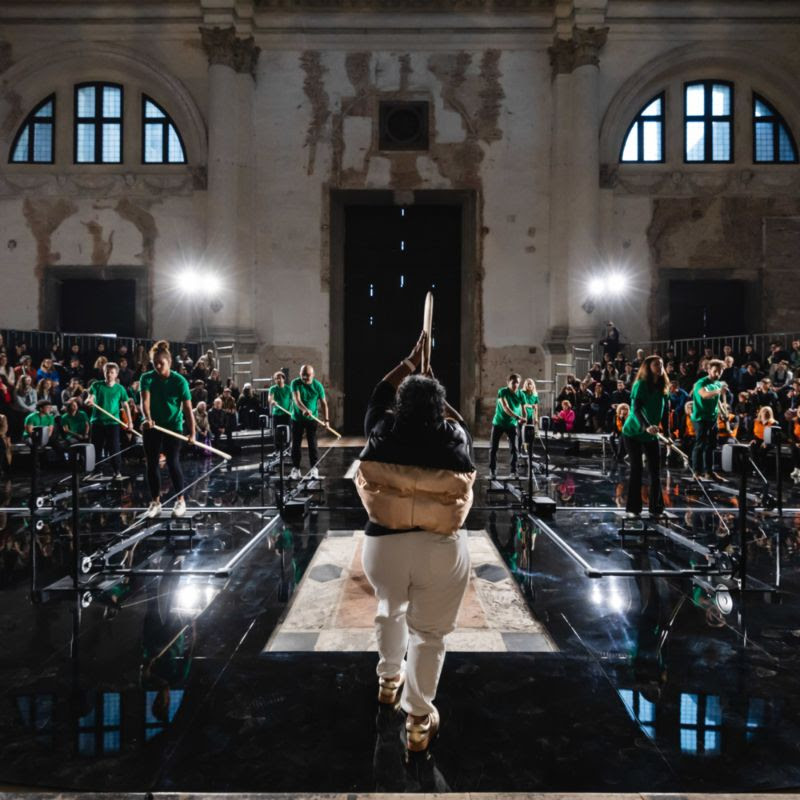
    There are sculptural and interactive machines installed in Ocean Space, which provide audiences with opportunities to engage with the Deep Communion sung in minor. Participants can either activate the installation – which will trigger part of the musical score – or take a seat in the surrounding bleachers to witness the performance. The work is being perfomed by local sports teams in live performance events.

    In response to Taumoepeau‘s new solo commission, a live project space has emerged at Ocean Space that was created in collaboration with architect Elisapeta Heta, a Māori, Samoan, and Tokelauan leader and advocate for change. Her imagination has provided Maori and Pasifika perspectives on the importance of place to design and cultural identity, and brought that knowledge to Ocean Space.

    As her response to the exhibition, the architect includes a new installation that uses a multisensory embodiment of ‘The Body of Wainuiātea‘. This title of the work means a ceremony combining ritual and a ceremony guided by the Māori concept of tikanga. She comes from Aotearoa, New Zealand, using the concepts from her ancestral lands alongside those from across the Te Moana-nui-a-kiwa.


    Tikanga is derived from the Māori word ‘tika’, which means ‘right’ or ‘correct’, so to act in accordance with tikanga is to behave in a way that is culturally proper or appropriate.

    The space is welcoming visitors and audiences, as it is also designed for exchange and collaboration. The space is formed around the ancient way of knowing and relating through story, and waiata (song). The goal is to connect to a greater awareness of atua (the gods’) connections to the Ocean. The tapu (sacred) is very much needed by current environmental and scientific campaigns, which seek to protect the life of the planets’ largest bodies of water.

    Hosting guests through various forms of storytelling, is a common practice in the Pacific communities. Heta’s work, The Body of Wainuiātea, is a safe space for a network of artists, curators, writers, community leaders, poets, musicians, as well as ocean-professionals and scholars to come together. Collaborators include Dr Albert Refiti, Hiramarie Moewaka, and Rhonda Tibble.

    The program is commissioned by TBA21–Academy and Artspace, Sydney, and produced in partnership with OGR Torino culture and innovation hub.

    — — —

    Curator Taloi Havini (Nakas Tribe, Hakö people) was born in Arawa, Autonomous Region of Bougainville and is currently based in Brisbane, Australia. She employs a research practice informed by her matrilineal ties to her land and communities in Bougainville. This manifests in works created using a range of media, including photography, audio – video, sculpture, immersive installation, and print. She curates and collaborates across multi-art platforms using archives, working with communities, and developing commissions locally and internationally.

    Latai Taumoepeau (b:1972 Gadigal Ngura (Sydney), Australia) makes live-art-work. Her faiva (body-centred practice) is from her homelands, the Island Kingdom of Tonga and her birthplace, the Eora Nation. She mimicked, trained, and un-learned dance in multiple institutions of learning, beginning with her village, a suburban church hall, the club, and a university. Latai engages in the socio-political landscape of Australia with sensibilities of race, class & the female body politic; committed to bringing the voice of unseen communities to the frangipani-less foreground. Latai has presented and exhibited across borders, countries, and coastlines. Her works are held in private and public collections, including written publications. Latai is the 2023 recipient of The Creative Australia Emerging and Experimental Arts Award following her win of the 2022 ‘ANTI Festival Live Art’ Prize in Finland.

    Elisapeta Hinemoa Heta (Ngātiwai, Ngāpuhi, Waikato Tainui, Sāmoan, Tokelauan) is a multidisciplinary artist, designer, and mother, living and working in Tāmaki Makaurau, Auckland, Aotearoa New Zealand. Elisapeta’s career has spanned architecture, art, writing, film and performance, teaching and research and has resulted in a rich tapestry of collaborative works and projects that are centered on indigenous mātauranga (knowledge and ways of knowing) and tikanga (protocols and ceremony). In working through multidisciplinary practice, Elisapeta creates experiences that make visible our stories, many of which have been hidden, with a focus on indigenous and wāhine (women) centered story-telling. Through her art practice, Elisapeta, in collaboration with photographer John Miller (Ngāpuhi), took the exhibition Pouwātū: Active Presence to the 22nd Biennale of Sydney: NIRIN 2020, and brought it home to Objectspace Gallery in Tāmaki Makaurau (March – May 2021)

    Program in Ocean Space: March 23-October 13, 2024.
    Address: Chiesa di San Lorenzo
    Castello 5069, Venezia

    Photo: Latai Taumoepeau performing her work ArchipelaGO, THIS IS NOT A DRILL with local sports team in Ocean Space.

  • Natural world, meditation and climate change

    Natural world, meditation and climate change

    Meditation as a practice implies self-awareness. Finding about inner strength, intuition, thought processes and wishes. Otherwise, putting things in the background while finding the inner focus to clarify and perform. All these aspects create the assurance of different levels of balance. One might believe that meditation is a pure focus, while the contrary is in fact true.

    Mindfulness as a concept, a reality of nourishing the mind and soul by turning into more quiet time. Quieting one’s mind in order to listen to inner atmosphere of feelings and emotions. Why not to discover the universe that is within us? Replacing negative thoughts with appreciation of ourselves, of others and the world.

    Breathing

    It is not only about tuning into balancing acts, but also inspiration and self discovery. We are full of emotions and feelings, which are positive and not at all negative; and even some of the negative ones may turn into new energy and offer insight. Meditation implies a pause, opening a pathway to our inner thoughts.

    A truthful path includes maintaining a certain level of anxiety and uncertainty when it comes to specific problems like climate change. If we sit back and relax, wash away our mind with calm waters of emptiness, we won’t have the energy required to fight the problem. Where our attention is needed, where frustration isn’t supposed to be solved by simply relying on our positive energy.

    Collage: Firstindigo&Lifestyle @polyvore-designs

    For the overachieving among us, stretching beyond our everyday selves is not the biggest question. Finding treasures in the more simplified notions of our inner powers might be. Not all progress is necessarily meaningful. But finding answers in more everyday actions, in nature, in the natural world, and in those encounters with others.

    Sometimes there is time to learn compassion for ourselves, in order to better listen and pay attention to the natural world. Compassion is the key turned into caring on a deeper level about anything important. In meditation this manifests in being attentive to breathing, keeping the mind and body aware of the breathing. Step by step this awareness opens up into something deeper, reaching outside the limitations of us as humans.

    Our consciousness can open up to thoughts where breathing becomes part of the universal rhythm of breathing together with this planet. The natural world requires our attention to the actual concept of breathing. We are all living, palpable things. Over consumption, unnecessary interruption of the natural course of life, creates chaos over rhythm of breathing in all living things. Planetary destruction is emblematic of bodies that have moved away from their breathing.


    Meditation can be motivational, it can energize us to think more deeply about ourselves and others. This planetary home of ours calls for our attention into our breathing. Meditation is about becoming aware of how the parts can fit into the whole, and how that whole can mend the individual parts.

    Between East and West

    French philosopher Luce Irigaray’s literary work “Between East and West: From Singularity to Community”, investigates Eastern practices and philosophy from the point of view of the body, in which breathing has a central role. After herself practicing yoga and meditation, her research implies a personal awakening that has manifested through practice of the conscious breathing. Following ancient Eastern practices of breathing and yoga, Irigaray argues that both humans (women and men alike), nature, and the natural world including the spiritual life, are part of a bigger plan of discovering our being in here.

    In this writing Irigaray examines the Western tradition through ancient Eastern disciplines. It is the meditation that teaches us to breathe. Yogic traditions, according to Irigaray can offer us a meaningful way to reconnect our human and planetary pasts with its futures.

    In Jewish Kabbalah, which also is an ancient tradition, there is a lot of thought put into spirituality and our collective well being. We should gain more compassion for one another, and understand that ultimately we are all creatures essentially bound up with other creatures. All levels of the creation and the preservation of the planet is a common goal for us being here.

    From this perspective, our meditative approach can lead to a child-like approach when it comes to life; the wonder that locks our inner core into things beautiful and wondrous. When we grow up, we tend to forget how things in nature put a smile on our face, how literally everything that grows out there can feel exciting and worth exploring. Nature’s mysterious part is also something that can open to one who will pause, sit back and absorb its presence. Listen to a birdsong, look at the trees behind the brick wall in the midst of urban life. We can imagine going back to nature anytime. Meditation is one key to acknowledging that this is possible.

    The Natural world can lead us to believe in higher beings, in something more universal than our mundane lives. Species and subspecies come from somewhere, the universal energy and movement can lift us to have faith in the worlds that are often invisible.

    Sparkles and a vessel as a thought introduced in Kabbalah. Our divine task to help ‘creation’, to correct errors in nature. To make the world a better place for all living things. There is something divine in the sun with the radiance that it wakes us up to each new day. The universe that keeps repeating the same mantra of coming back fresh every single day. We haven’t been able to stop the sun from rising, even with all our destructive human behavior. Even when sun stays in the clouds.

    Climate change

    It is more and more discussed how climate change can bring disturbance to our lives and shake our balance. The World Health Organization published a study about how climate change can have an impact on our overall health.


    “The principal reason for the global increase in temperatures is a century and a half of industrialization, with the burning of ever-greater quantities of oil, gasoline, and coal; the cutting of forests; and use of certain farming methods.” (https://www.who.int/heli/risks/climate/climatechange/en/)

    Global warming will certainly have consequences where our health may be at risk. In terms of changes in our ecosystems and as catastrophic weather phenomena, climate change can create new emergencies.

    When we meditate, we can learn to appreciate each new day. And think how we can better meet the challenges. Climate Change is adding another layer that intensifies patterns and experiences that are abnormal, when the future holds more extreme rainfall, floods, tropical cyclones, droughts and heat waves, in addition to the increase in the frequency of calimas and atmospheric dust. (https://www.una-climateandoceans.org/448491047)

    One of the nature’s emergencies is called calima. The calima is caused by a storm or change in weather impacting the Saharan Air Layer. Climate change will cause more of the phenomena. The hot, dry and dust filled system is located above the Sahara desert. It meets the more humid and colder system that linger over the Atlantic Ocean.


    Reference:
    Luce Irigaray (2002): Between East and West. From Singularity to Community.
    Translated by Stephen Pluhácek. Columbia University Press.

  • A shock of an image: Are we going backwards?

    A shock of an image: Are we going backwards?

    There is a test for a humankind, which is almost beyond measure. Health crisis with the current pandemic, too little or complete lack of solidarity for the #blacklivesmatter, environmental crisis, climate emergency: you name it, we almost seem to be moving backwards. To try to locate it in a visual-literacy sphere, it appears like a shock of an image. A complete inaccuracy of any portraiture of a situation. Yet we must.  We need to find new images, create new existence for love and peace, and keep on finding creative solutions for our planet.

    Artistic practices and curatorial interventions are still valid ways to express movement forward. They show legitimate approaches to voices speaking against structural injustice and discrimination. The power of art is that it can change our perceptions and attitudes. It can inform us. It can take a stance, which is strong, shocking, and informative at the same time, for example about refugees in the world. In the #blacklivesmatter movement, new curatorial openings can be made, and more voices will be put on center stage, so stories will be heard and seen. Not forgetting that gender equality is still a dream in the global art world.

    The environmental crisis needs more of our attention as well. How to navigate a jungle of opinions in this world and speak in a creative, artistic and curatorial manner about the climate emergency. Relying on ‘safe’ structures, and displaying ice cubes that are melting on concrete in front of our eyes. Are we running out of ways to create imagery of a crisis? ‘A shock of an image’ of something that would be a gathering of species dying, a globe that was burnt, and/or left behind without mankind, a nature that is not natural as we know it, but could be imagined as anthropocene. We did it already.

    Water crisis, a water scarcity and the inequality that it creates in the world is almost unparalleled. A Quarter of Humanity Faces Looming Water Crises, is a great article published in New York Times giving an introduction to the problem.  Climate change creates a high risk to water resources in places that have experienced enduring droughts. Water reserves are running out in hot and populated industrialized areas. For example, the clothing industry uses groundwater in Bangladesh, and creates a severe problem for its people. Mexico City is sinking after using its relied water resources. In Mexico City, the Zócalo, the main square in the historic city centre, is at a lower elevation than ancient Lake Texcoco; the city was built on its basin.

    Global fresh water scarcity can be caused by droughts, a lack of rainfall or simply pollution. Will our experience economy stop from creating more pollution in the future? ‘Backwards’ is a metaphorical attest to imply that shock doesn’t come without imagery.

    This year, World Environment Day on June 5, 2020, celebrates biodiversity. The mission is to educate people that with one million species facing possible extinction, it is now time to focus on biodiversity. Biodiversity can be imagined in the world’s forests or oceans, for example. We can safeguard the nature they provide, and prevent extinction.