Tag: curating

  • Curator Dalaeja Foreman’s recent interventions

    Curator Dalaeja Foreman’s recent interventions

    Dalaeja Foreman is a curator, community organizer, first generation Caribbean-American and Brooklyn native. Her curatorial practice seeks to combat misconceptions of oppressed people and resistance through direct action, cultural esteem and the arts. She is a graduate from the Visual Presentation and Exhibition Design program at the Fashion Institute of Technology. Dalaeja is also alumni of No Longer Empty Curatorial Lab 2015. In January-February 2016, she co-curated a show ‘Speak Out’ for the BronxArtSpace. The exhibition addressed legacies of injustice and practices of institutional racism, offering alternative views and acts of empowerment for the artist in their communities, creating realities that affirm that #BlackLivesMatter.

    Firstindigo&Lifestyle: You co-curated a show ‘Speak Out’ for The Bronx Art Space. Could you tell about the roots for establishing that collaboration?

    Dalaeja Foreman: That I have! Alongside Linda Cunningham and Eva Mayhabal Davis.

    After working with her on a No Longer Empty curatorial fellowship exhibition, Linda (Director of BronxArtSpace) asked me if I would be interested in co-curating an exhibition she was conceptualizing. An exhibition about institutionalized racism, as a white woman, Linda did not feel as though this was an exhibition she should be curating without the voice of a person of color (A decision I respected and cherished deeply, giving me the assurance of her allyship ). After meeting with one another and having a long conversation about the significance of this discourse she told me she would give me curatorial license over the exhibition and asked if I would want to work with anyone. I suggested we work with another No Longer Empty fellow, Eva Mayhabal Davis.

    Firstindigo&Lifestyle: The concept had several outcomes as art works, performances, and community events. Could you tell how it all came together and succeed?

    Dalaeja: The exhibition was submission based, inspired by the Respond exhibition at Smack Mellon Gallery. Linda selected a panel of artists (including Eva and I) to review the 80+ submissions. Once we selected the works,  Eva and I thought very thoroughly about the themes and counter themes in each selected work and put them in conversations with one another accordingly. We decided it would be best to give extended labels to the works to give our audience as much contextual knowledge as possible. Since the Mott Haven area of the Bronx is heavily Spanish speaking, we also provided the labels in Spanish.

    As a strong believer in activating art spaces for radical acts, I wanted to be sure the exhibition had as many programs that responded to the many intersections of racism in our society as our capacity could handle. These themes varied from the criminalization of black and brown youth to the celebration and use of black love and Black Girl Magic as a radical acts.
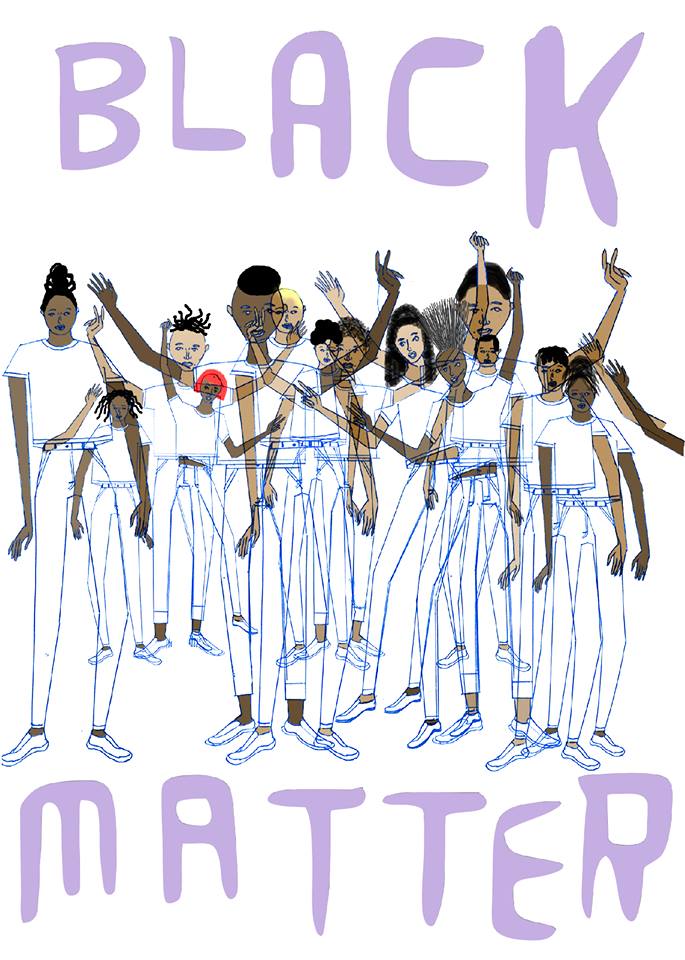
    'Speak Out' -exhibition poster in Bronx Art Space #blacklivesmatter
    Illustration by Rafael Melendez

    Firstindigo&Lifestyle: How was your experience in Bronx, in comparison to Brooklyn, where you are from?

    Dalaeja: Aside from being a Curator and Arts administrator, I am a first generation Caribbean-American, community organizer and Brooklyn Native. As an organizer, I have done a considerable amount of work around the mass-displacement of working-class communities (most often communities of color) in Brooklyn. Sadly, Art has been used as as a catalyst for what I consider the cultural erasure of my native borough.

    I see the arts as yet another tool for social change, and art has been used historically to work as ancillary support for communities of color. Whether it be thru healing or practical solutions for community issues. Although this is a truth for Brooklyn’s artistic history, I feel as though this concept has been stronger in Bronx history due to the many ways State and city institutions have historically neglected Bronx county.

    Artists can use their talents for exposing truth for the benefit of their communities and this seems to be particularly weaved into the fabric of the artistic history of the Bronx. A history I have incredible respect for, that continues on.


    Firstindigo&Lifestyle: How important was the role of social media in creating networks, and establishing new audiences?

    Dalaeja: Eva is more of the social media wiz. I was more concerned about the ways in which we could ensure the community members knew about the exhibition and we’re involved in our programming. This outreach included, working with the BronxArtSpace interns to outreach to local high schools, doing physical flying for the exhibition, dropping flyers off at local bodegas and restaurants. As well as dropping information of at local libraries and speaking/building relationships with community members. Some of whom were artists in the exhibition, which made me soon happy!

    Firstindigo&Lifestyle: What is your ideal audience for the art?

    Dalaeja: Since I truly see art as a tool for inspiring radical action, my ideal audience is always working-class people (some of whom also happen to be artists and art enthusiast). Especially in the case of the ‘Speak Out’ exhibition because, it took place in a working class community. If these spaces aren’t intended for their own communities, why should they exist there? This is a concept Linda truly understands which is yet another reason I LOVE working with her.

    Firstindigo&Lifestyle: What is your background in coming to curating arts?

    Dalaeja: I began working in the arts as a part-time Gallery Assistant at the Milk Gallery then began working as an exhibition manager for a small gallery that specialized in 20th and 21st century counter-cultural ephemera (say that 10 times fast. bahaha). This experience helped me realize the significance the arts have had on social movements of the past and inspired me to pursue curation.  I began taking online course with Node Center to learn more. After the gallery lost funding and I lost my job I decided to use the little bit of money I had saved to invest in my interest and started applying for fellowship programs. After my incredible experience with the No Longer Empty fellowship, I decided this is surly a way I could use my interest in the arts pragmatically to help plant the psychological seeds for social change. I still have so much to learn to pursue my practice as radically and community-collaboratively as I can, and am currently a Create Change Fellow with the INCREDIBLE Laundromat Project.

    Firstindigo&Lifestyle: How did you education support your current directions and help you to develop your vision?

    Dalaeja: I studied Visual Presentation and Exhibition design at The Fashion Institute of Technology, this experience helped me truly understand my love of space and it’s possibilities. I minored in International politics which further introduced me to the ways in which politics (on a community level) and exhibitions/display can merge. Most of my curatorial focused knowledge has been from lived experience, work experience and continuing education programs. As a lover of knowledge, I am interested in perusing a Masters degree in Contemporary Art and Art Theory of Africa and Asia.

    Firstindigo&Lifestyle: How do you develop your curatorial concepts, is there a phase of writing or visualizing things in a specific manner, or talking?

    Dalaeja: It is a bit of all of those things. I am a ranter by nature so that really helps with getting concepts across that I believe are worth exploring.

    Often I am inspired by the political education meetings with the organization I am a part of (The People Power Movement) as well as my friends and family members. Or I may have a design concept in mind that I think is worth collaborating with artists one. BUT most importantly, I am inspired by the Art work and the concepts that artist is exploring.
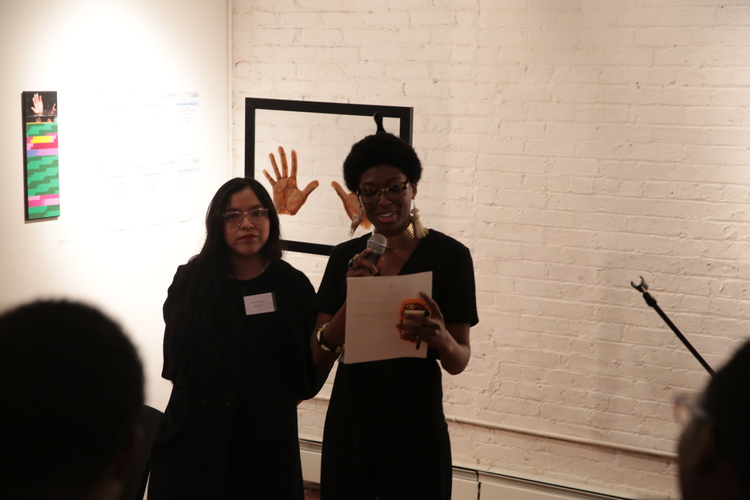
    Dalaeja Foreman at the 'Speak Out' exhibition.
    Dalaeja Foreman (right), at the ‘Speak Out’ -exhibition. Photos: Alex Seel. Courtesy of Order Vision Productions for Bronx Art Space.

    Firstindigo&Lifestyle: What do you think is a role of a curator in society in large, in other words, how do you think the micro ideas meet the macro levels?

    I believe Curators have a powerful platform, giving us the ability to work with artists and communities to push narratives into the mainstream consciousness. These narratives can help people critically think and sympathize deeply about concepts in which they weren’t even aware of. This is a responsibility of utmost importance, one with the opportunity to empower a community, a people and a generation. -Dalaeja Foreman


    Firstindigo&Lifestyle: Your political activism has a mind of a movement, in which people power takes a different stance. Does New York City represent a special place for activism to you?

    Dalaeja: New York City means a great deal to me in regards to activism, but that is because it is the only place I’ve ever known as home. Although a wide array of injustices are happening in my city, they are also happening everywhere in the country. A political revolution could be sparked anywhere at anytime, the important thing is that we support one another’s actions and grow together using people power and a thirst or justice as our binding force toward a political system that works for the majority.

    Firstindigo&Lifestyle: Do you have favorite art forms, or is the medium secondary to other things that matter?

    Dalaeja: I do, I love sculpture and painting, textured art objects and photographs. I’m trying to challenge myself to work more with performing artists since it’s not my go-to. However, content that compliments aesthetics and artistic merit (according to my opinion of those concepts) are of most importance.

    Firstindigo&Lifestyle: How do you identify and experience yourself as a black woman art professional in NYC art community, or does that resonate in a professional level to you personally? 

    Dalaeja: My Black woman experience is at the forefront of all of my experiences because it is the only lens in which I can see the world and is often the most determining lens in which the world sees me.  With that being said, as a young arts professional I believe it is my duty to ensure that people who are marginalized (like myself) demand their voices heard in institution that effect our lived experiences. Whether they be our schools, museums or workplaces. And MOST IMPORTANTLY create our own institutions that work for us from conception onward.

    Firstindigo&Lifestyle: What is your next dream of consciousness, where are you heading to collaborate next?

    Dalaeja: As an Art Administrator in the Bronx, I am really excited to learn more about what artists are and have been doing in the borough and figuring out how I can best support them and the communities they collaborate with. As well as, continuing and improving my organizing and hopefully trying to figure out some more schooling while doing all of that (inside and outside the education institutions).

    Dalaeja Foreman’s website: http://www.dalaeja.co/

  • Visiting Linda Cunningham’s studio

    Visiting Linda Cunningham’s studio

    Last month, New York based artist Linda Cunningham showed me her art studio in the Bronx, where she lives and works.  It is located next to the Bronx Art Space that is fostering arts education and collaborative artistic projects. She told me stories behind the art works, both the sculptural works and the collages that combine drawing and photography.  The studio is in a newly renovated building nestling at the heart of the historic urban Bronx.

    Firstindigo&Lifestyle: Linda, you were one of the first artists to come to this location, how was the neighborhood back then, it’s been now a good fifteen years? You did a series of artwork digging into the Bronx history, in which immigration was a theme or a subject. There seem to be real person’s story involved, including documents, such as passports with photos. Could you tell about the project that was exhibited at the Andrew Freedman house in 2012?

    LC: When I first moved to this historic landmarked area of the South Bronx, I began photographing the now renovated 19th Century row houses with brownstone trim, the contrasting graffiti walls with the shopping carts of the homeless. The barbed wire and I merged those images with a young Jamaican’s poetry and rubbings from the historic signage telling about Jordan’ Mott’s iron foundry. Later I was invited to create a large installation in No Longer Empty’s exhibition at the Andrew Freedman House, an amazing building designed like a Renaissance Palace, left from the early 20s when the Bronx was blossoming. My installation was constructed like an open book from broken drywall panels and broken old wood frame windows with each panel referring to an era of Bronx history. I along with other artists scavenged in the water soaked ruins, excavating the papers representing early 20th Century history of the Bronx. Including among them was the unusual passport of a resident of the house with two different last names, both apparently Jewish heritage, along with her photos. She had traveled all over Europe 1936, and through the Third Reich and into Switzerland several times, so her story suggests that she might have functioned as part of an underground.

    Linda Cunningham_bronzesculpture
    Bronze at Linda Cunningham’s Bronx studio

    Firstindigo&Lifestyle: You recently attended an Art Fair in Harlem, titled FLUX art fair in May 2015; do you have any specific notes in regards to engaging with the community during this festival?    

    LC: This was such a lively engaging event during which I enjoyed most interesting conversations about my work. The artwork displayed in this art fair was tough and engaging and in general more accessible than in most other art fairs

    Firstindigo&Lifestyle: What captured my attention was your rich methodology of juxtaposing various elements. Your artwork depicted ancient olive trees in Italy that are approximately 800 years old by now. These trees got bacteria from Costa Rica somehow. Did the local community got involved in saving them? 

    LC: I don’t know anything about the local community. I just read about it in the Times saying that “they” are trying to contain the epidemic.

    Firstindigo&Lifestyle: What you did in your collage was that you implemented the trees together with post-industrial photographic scene of Ruhr in Germany. This area used to be a center for coal, and now it’s gone. Tell, what is the particular message behind this juxtaposition?

    LC: Both of these astonishing entities are vulnerable, but these amazing ancient trees will continue being productive and useful for centuries, whereas, the astonishing human designed technology is obsolete in 75 years or less and falls into ruin.

    Linda Cunningham_Collage

    Firstindigo&Lifestyle: You have worked with sculpture. The bronze in them comes from ’recycled’ old weaponry from the Pennsylvania army base. The story behind the material is so intriguing, and the fact that you wished to turn the weapons into ’vegetal’, so the forms are like plants.  The texture of your sculptures remind of natural formations appearing rough, in some parts they are smooth, as if ironed.  Could you tell a little bit about the process, how did you find them, and how was it to work with the material?

    LC: The bronze came from military scrap, which I obtained with some difficulty through a not-for-profit institution where I was teaching for a number of years, Franklin and Marshall College. The scrap bronze, which mostly came from ships, military ships, which are not really weapons. The bronze was smelted and poured into a defined shape in flat, oil-bonded sand molds.  The cooling of the hot bronze creates the rough surfaces as the bronze is poured. I am doing some casting currently.

    Firstindigo&Lifestyle: Another element in your sculptures comes from nature. It’s fascinating how some of the rocks you have in the studio are from the ocean. The nature has worked in them so that the huge pressure in the floor has pressed the shells to attach into the stones. One of the rocks is also volcanic, and comes from the Californian coast. Do you have a specific relation to ocean and water in your artistic thinking, as I see the ocean appear in many of your collages?

    LC: I have always been drawn to the eternal rhythm and power of the waves, but in my youth I had read Rachel Carson’s “The Sea around Us”, a beautiful factual narrative about the origins of life and the vulnerability of the life giving sea so essential to our survival.  Then super storm Sandy gave my early interest a new focus.

    Linda Cunningham_Collage2

    Firstindigo&Lifestyle: Also the technique in your collages is interesting, you are drawing and then adding laser photo transfers to paper. Even the surface has layers, cement or metal appears on the surface of the paper adding three-dimensionality. Could you tell more about this appeal? 

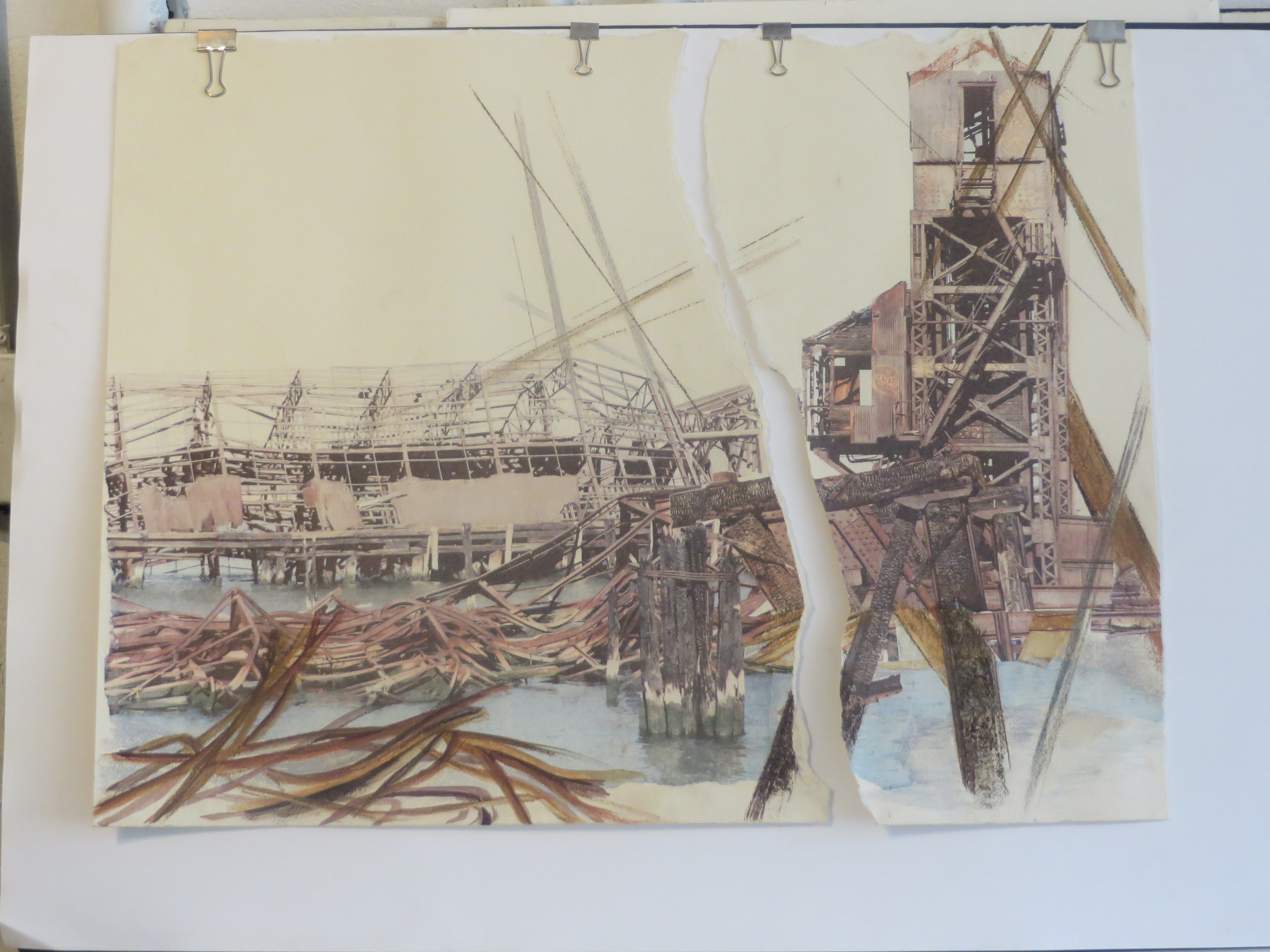
    LC: I have worked as a sculptor, and even when I am engaged with these large drawings I am drawn to include appropriate resonant texture and sensibility.  Even though photography can be manipulated it is essentially documentation and convincing as reality. The veracity of photography seems essential. My exhibition will be at Odetta Gallery in Bushwick in November 2015, and I will include especially drawings fused with sculptural elements. I was working on creating some new spectacular bronze forms that will be included in the show. I work on torn irregular shapes because reality doesn’t fit neatly inside a rectangle shape, rather it’s discontinuous, fractured etc. I work from places I have been, responding to particular environmental and historical issues raised e.g. from flooding of Venice, and a jungle growth strangling Ancient Cambodian temples. I built the installation with the Hebrew text some years ago after I spent a year in Berlin on a Fulbright scholarship. I did an installation In Kassel for an alternative documentary, and obtained many of the elements from the former East/West border known as the Berlin Wall.

    Linda Cunningham_Collage3
    Linda Cunningham’s collage depicting trees and Ancient Cambodian temples

    I have always been drawn to the eternal rhythm and power of the waves, but in my youth I had read Rachel Carson’s “The Sea around Us”, a beautiful factual narrative about the origins of life and the vulnerability of the life giving sea so essential to our survival. Then super storm Sandy gave my early interest a new focus. -Linda Cunningham


    Linda Cunningham_Berlin Wall
    Elements from the Berlin Wall at Linda Cunningham’s studio


    ***

    Artist website: http://www.lindalcunningham.com/

    Check also Bronx Art Space

    All images: Firstindigo&Lifestyle

  • Leah Oates in spotlight: artist, curator, gallerist

    Leah Oates in spotlight: artist, curator, gallerist

    A woman to watch now in the art world is an artist with multiple roles. Leah Oates runs her own art gallery Station Independent Projects in New York’s Lower East Side. In the interview she sheds light on how she found her path. 

    Firstindigo&Lifestyle: Your photography reflects multiple textures, showing light, contrast, opening up to magical worlds, how did you find your own medium?

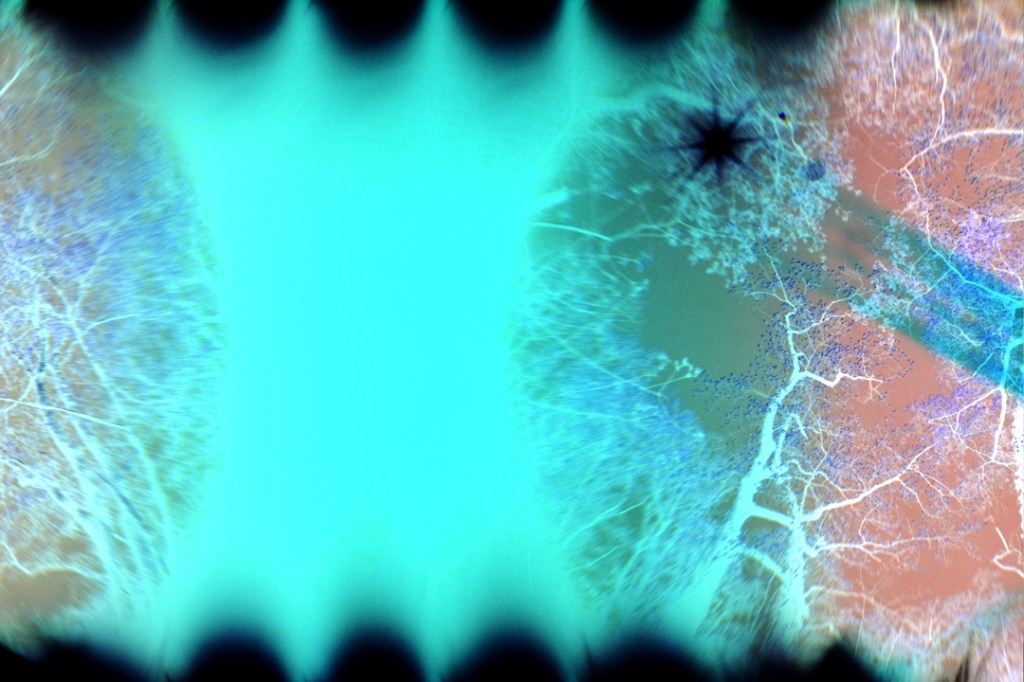
    Leah Oates: I started as a painter and printmaker, and I still see the influence of both in my current work with the layering and density of color and light. The common thread with my past work in other medias was always photography as I painted and printed from photographs but in the past I saw the photos I took at support materials or documentation. At some point I realized that the photography was the main and most continuous thread in my work so transitioned to how I work now.

    Firstindigo&Lifestyle: Do you feel that memories, or where you come from resonates in your art?  Your works have been also exhibited overseas, how was the experience in China, for instance?

    LO: Where I was raised and my specific family definitely connects to my current work. My grandmother is a biologist who studied at Harvard and one of my uncles worked for the Environmental Protection Agency (he is now a private consultant on environmental issues) and another worked for the Army Corp of Engineers. Thus there was a lot of dialogue about the environment, nature, human rights and politics.

    My mom, brother and grandmother are painters and my grandfather was a painter and photographer who ran a photo studio when he was young taking family, wedding and baby photos. He later became a real estate lawyer with a big Irish Catholic brood of six kids including my dad Danny who was a writer and carpenter. I have an uncle who is a successful ceramic artist in Maine and an aunt who is a glass artist in Massachusetts.

    This mix very much informed my work as well as growing up in the city of Cambridge, Massachusetts and in rural town in Sanford, Maine where my family goes back in both states to the 1600s.

    Being and working in China was amazing. We all absolutely loved it there from the street culture to the food to the parks to the incredible energy there. It was wonderful to photograph there and yes its polluted and yes it can be messy but the light is wonderful and the people are friendly, sweet and almost old fashioned. We would go back in a heartbeat.

    With China I had a lot of reverence for their history beyond Mao and the revolution etc. China is an ancient place and much older than the US or Europe with so much amazing history. China is a work in progress and like all places has things to work on but it’s a really vibrant, alive and interesting place.

    My work there dealt with the changes happening in the culture related to climate change, random urban planning that is erasing local culture and customs and how nature reacts to all of this within a rapidly expanding urban setting.

    This slideshow requires JavaScript.

    Firstindigo&Lifestyle: Could you describe in few words how did your road lead to New York?

    LO: My husband Pierre traveled to NYC on a few business trips and instantly loved the NYC. We where living in Chicago at the time and liked it but NYC is closer to both our families in New England and Canada and it has a thriving and large art community so we moved here when I finished up my MFA.  At first I was not sure about living in NYC for that long but gave it a try.

    I began ironically to love NYC after September 11th as the city just melted ones heart. I saw how the city came together in a way I would not have imagined as you know normally is like ‘get outta my way’, or ‘move it fast’, on a daily basis here.  But the thing about New Yorkers is that in a crisis situation they have your back and this is what I learned about NYC that made me really fall for this city.

    And the art community is the best I’ve experienced. People are energetic, they work hard and like to do so, are open to new things and they make things happen and quickly. It’s a hopping, creative, and no nonsense art city. Yes there is the regular nonsense you have in any city but things really get done here and in high volume and at top quality too.  You see the best here and yes the worst too but here we move so fast that there is no time for that stuff. It’s a very discerning crowd here.


    I’ll give an example. Pierre, my husband has shot films in other cities and it always move so much slower than in NYC and he often hits walls initially either from unions or agents etc. In NYC it’s the total opposite where he finds what he needs easily and hears yes a lot! It gets done here without the baloney. Here it’s a YES lets do it mentality which I really like, and opens things potentially for innovation, creativity and hybrids. I now cannot conceive of living anywhere else, and I’m now head over heals in love with this city.

    Firstindigo&Lifestyle: It’s quite easy to imagine that last few years have been truly busy in leading your own art space. How do you feel the transition has been in terms of becoming a gallerist?

    LO: I love running a gallery, and working with my artists to plan their shows.  I’m really happy about the quality of the shows, level of press and number of curator visits and attention that the gallery shows have received and sales have been good.

    It’s been an amazing experience all around. The first few months when I initially opened where very exciting and there was a bit of anxiety about how it would impact our family. Mainly it was our son Max who wanted his mom to be around 24/7 but he really got behind the gallery when he saw the space and saw that it made me happy. He even wanted to serve drinks and where a suit which was so cute! There has been a good balance between family, the gallery and my studio practice for quite some time now so it all good.

    Firstindigo&Lifestyle> What is your secret in balancing between different roles in the art world?

    LO: Most artists or art professionals have jobs so it’s the norm in most cases unless you’re very rich.

    A quote I like is ‘A good artist studies art and a great artist studies everything’. My dream is to be an artist, curator and gallerist, so I’ve followed this to see where it leads. It’s an interesting and rich journey that is worth taking. What I’ve learned too is to plan out the week and get the work done. Just do it and don’t think too much about it. Get your self into studio and get working as through the work interesting stuff happens and if your not there it’s less likely to happen. The same goes for running the gallery.

    Additionally, trust yourself and go for it, plan strategically and it’s ok to say no, rest when needed and spend time with those that make you feel good and even better loved.

    Firstindigo&Lifestyle: You have also featured artists in the art fairs; do you find attending art fairs rewarding?

    LO: The gallery participated in Pulse NY last year and it went really well with sales and press, work placed in a corporate collection and several private collections and so much great feedback and contacts. It was a complete buzz and reinforced that the gallery artists and program was as good as I thought it was. People who visited our booth loved it and where so positive. But with all of this great stuff we only broke even and fairs are expensive to do. But they are now so much a part of the art world that it’s a must to do them as a gallery and again I think it best to be strategic with this and keep to a budget. I have only good thing to say about Pulse from a gallery perspective. This fair is run very professionally and everyone is super nice and efficient. Everything they promised they delivered on.

    As an artist I’m not a huge fan of fairs overall but I do love Pulse, Spring Break and The Independent art fairs. They are so different as fairs but seem to push the dialogue forward and are visually interesting.

    As an artist at fairs I like running into so many people and taking about art but think that fairs can be too formulaic and favor art that is easy to process with too much surface and not enough depth.  As an artist I think fairs are a survey of trends, are about status and art world hierarchy and not so much about art or pushing the dialogue ahead. But again as a gallerist, curator or as an artist participating in a fair you have to do it as it’s for the potential for so much attention in a short period of time and in a condensed fashion.


    Firstindigo&Lifestyle: It is very delighting that Station Independent features Finnish artists. Could you tell in few words about the Finnish collaborations that are coming up this summer?

    LO: Yes I’m pleased that the gallery will be hosting two guest curated shows this summer by Ilari Laamanen and Leena-Maija Rossi both from Finnish Cultural Institute.

    Ilari has curated a group show of Finnish artists called  ‘The Powers That Be’ which is on view from July 17-August 9th. This show is part of FCINY’s 25th Anniversary year’s program on Urban Nature and explores human’s relationship to the environment.

    Rossi has curated a two person show that explores shifting ideas on dwellings in urban space called  ‘(Un)livable’ with work by Kari Soinio and Janet Biggs which opens August 13th and is on view through September 6th.

    Firstindigo&Lifestyle: How would you define your own curatorial motto?

    LO: My curatorial motto is to not follow trends but to follow art and artists. I’ve been following the gallery artists from between 5-25 years. Also, it’s important to love the work your showing and to choose work based on its merits and not on if it’s easy to sell. It’s all about the artwork itself and about dialogues about art within a larger context of the past, present and future.

    ***

    The gallery and artist websites:

    www.stationindependent.com
    www.leahoates.com