Danish designer MargretheOdgaard’s exhibition was on view at the DesignMuseum in Helsinki during this summer. An introduction to her work put the creative aspect of design in focus. Odgaard’s study of color and the cultural signification of it is very relevant and timely for innovative design conversation, in which we are looking for perspectives that see beyond the pure form.
It feels timely to give design process a platform, which naturally builds discussion about contemporary creative culture. In the world of high tech platforms, we may say that the DNA of design can be found in those practices, which designers organically share with the world in which they live. Without the personal and playful approach, perhaps the future of design would find itself in trouble.
The Helsinki exhibition featured MargretheOdgaard’s collaborations and use of materials bringing forth an idea of process. What it highlights is that design should not abandon creativity and art. MargretheOdgaard was assisting late LouiseBourgeois in the artist’s large scale work, which she created for MoMA in 2005-2006. The young designer learned from this experience with the famous artist. Bourgeois shared an approach that artist has to believe 100 percent in the work, even if the outside world is not able to see the same thing. According to her, ideas and vision come with a careful attention to detail, and from a non-compromising attitude.
In the future, Odgaard hopes to work more from her own studio base, and focus on the quality of the materials and colors. There is still huge call for colors in our contemporary cultural environment. Tactility of design does not come to mind as a top priority, and the colors still belong to a neglected area in the design world and architecture. Odgaard’s dream is to bring colors back to the black and grey field of architecture, which she frequently collaborates with.
Odgaard’s design can appear as minimal, yet playful, featuring bold ideas and patterns. It is important for her that the work has emotive response from various audiences. She hopes that the designs bring comfort and energy to our everyday life. Colors have so much potential to give birth to moods and create different atmospheres. Odgaard has focused on the cultural context of colors. She traveled to Japan in 2015, and to Morocco in 2016 investigating culturally specific domains for colors. The designer aimed to find out if there are specific ways to code the local colors from architecture and objects that are attached to particular places.
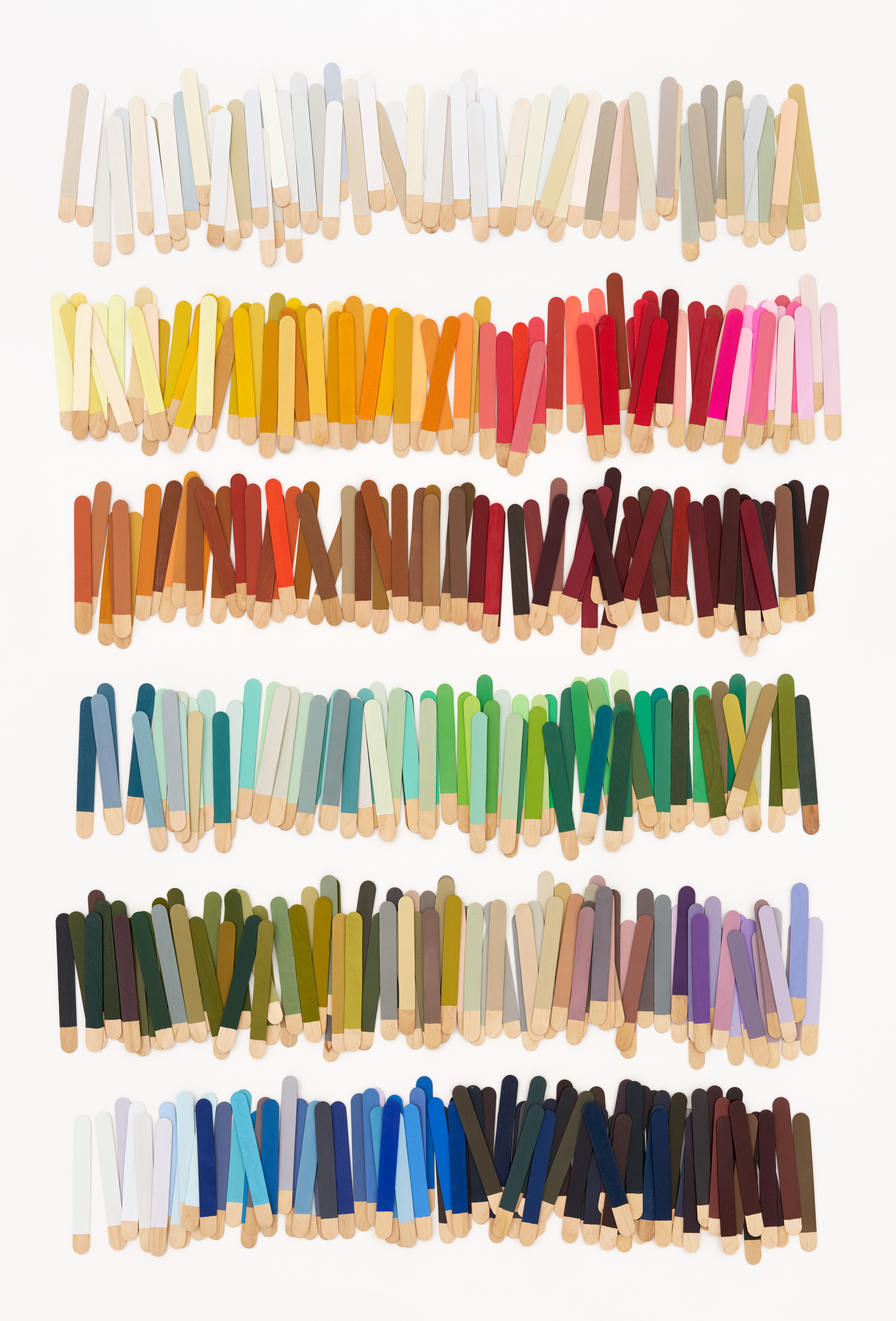
Odgaard trusts that as a younger generation Scandinavian designer, she is aware of the craft that carries a long cultural history. This means that she is able to add on the existing knowledge, and offer solutions to design questions and problems, which can be both beautiful and functional. At the heart of her color thinking is ThePopsicleIndex, which she created as a tool. It comes out in rich color hues that appeal to the senses and relate to the body.
Margrethe Odgaard wanted to create a color system as an alternative to Pantone color system.
Copenhagen based Odgaard studied at the RoyalDanishAcademyofFine Arts and the RhodeIslandSchoolofDesign in the United States. After graduating in 2005, she worked as a textile designer in Philadelphia. Before opening her own studio in Copenhagen in 2013, she also designed in Paris. In 2016, the designer received a prestigious TorstenandWanjaSöderbergPrize, which is the largest design prize in the world.
Margrethe Odgaard sates that colors and textiles can make together strong combinations, leaving an impact that is speaking to feelings as much as to eyes.
The textile designer looks for the purpose behind the design, and confirms that it should be always clearly attached to the process. The product is the end result of what the process entails. MargretheOdgaard keeps diary of the colors which are inspirational for the designs. Details of colors have become a crucial part of her process. Nuances are extremely important, and the diary is a great tool as part of the investigation. Results are far away from being shy. It is truly a matter of sharing as well.
“Share your knowledge, ideas and skills without hesitation. Be specific to order to become general. Use good tools and create new if necessary. Think through your hands. Free yourself from the limits of coolness. Allow things to evolve in their own pace. Listen. Laugh. Dance.” – Margrethe Odgaard.
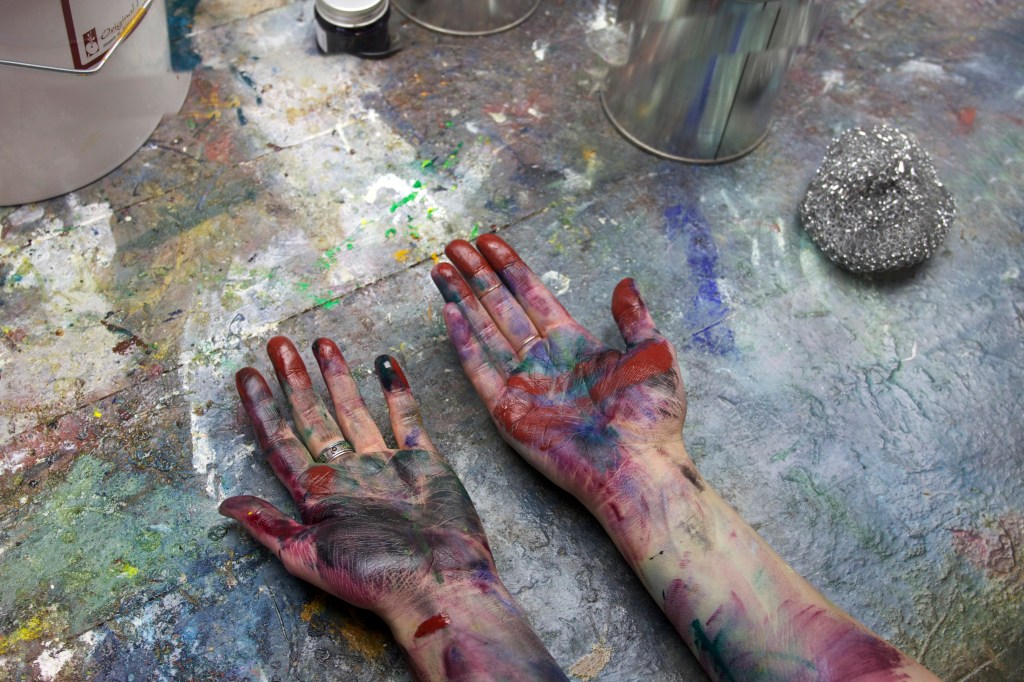
The designer investigates colors.
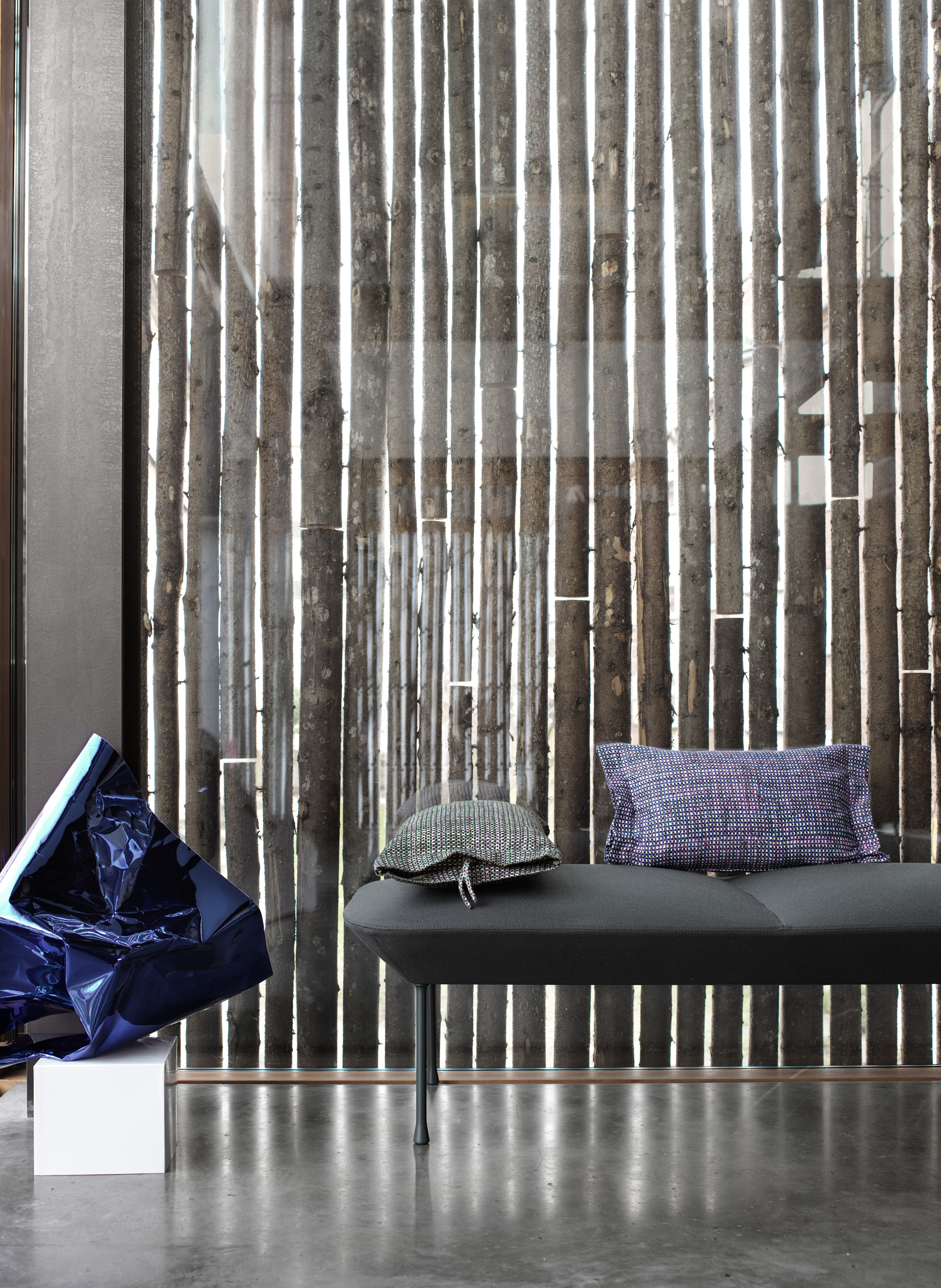
For Odgaard wood can offer pattern and color combination to textile ply.
MargretheOdgaard’s exhibition was on view until August 28, at the DesignMuseum in Helsinki, more info:
With the current exhibitions focusing on the historic works of Tyko Sallinen and Tove Jansson, The Helsinki Art MuseumHAM draws attention to modern Finnish art. Both exhibitions opened in January 27, 2017. Sallinen’s exhibition will run until the Fall of this year, and Tove Jansson’s frescos will remain on a permanent display in the museum.
The exhibition of Tyko Sallinen (1879–1955), explores works of a Finnish modernist pioneer in painting who is also a representative of expressionism in art. The exhibition consists of 50 works from the artist’s most important period, the 1910s. Tyko Sallinen’s expressionist works had a meaningful impact on Finnish art in the beginning of the 20th century. He and some other like-minded artists introduced new ideas into the Finnish art field, as their approach met open opposition and critique from the older generations of artists.
Sallinen was painting portraits of people, which became a signature marker of his often personal and intimate works. These one person and group portraits were also considered scandalous in their time because of their expressionist and emotive approach to people. Yet, many of his landscapes create a similar sense of strong moodiness. The landscapes imply that the role of nature was close to the artist’s thinking. The brushwork across different canvases come out with delicate movement, composing trees and horizons with earthy tones. The works bring forth viewer’s personal approach and feeling to the surroundings. Sallinen’s landscape compositions are both classic and reflective, confirming that human mind wishes to connect with its nature with intuitive touch and reflection. Simple blue and green hues of the two landscapes (pictured) convey messages, being poetic with a strong stance.
Tyko Sallinen, Tuulinen huhtikuun päivä, Windy April day, 1914. photo HAMHanna Riikonen.
The other Finnish modernist artist receiving the exhibition in the HAMArt Museum is Tove Jansson (1914–2001). She is famously perceived as a creator, writer, visual artist and illustrator of the Moomin books. With a substantial global recognition, the Moomin characters are now more popular that ever around the world. It is no wonder that Tove Jansson’s visual compositions are among the most loved works in the HAM collection. The art museum has dedicated some of its galleries to an exhibition celebrating the artist’s entire life and works. These include also her less well known frescos, which she originally created on site for several public institutions. Tove Jansson stands out as an impressive woman with a long career as an artist and influential thinker. She was a skilled painter, writer of many genres, a comics artist and illustrator with a humorous larger than life approach, and a script writer. The exhibition shows the history of words and pictures bringing forth her richly illustrated stories.
Tove Jansson and Niilo Suihko paint the fresco Juhlat maalla, Party in the country, at the Helsinki City Hall Restaurant, 1947.
Among the exhibition works are Jansson’s frescos titled Juhlat kaupungissa, Party in the City and Juhlat maalla, Party in the Country (the latter pictured above);and sketches of murals which the artist made for the Aurora Children’s Hospital (Leikki, Play I-III; Play II illustrated below) in Helsinki. The Play I-III series was created in 1955-57 for the walls of the staircases in the Aurora Hospital, and it features several Moomin characters running up the staircases. The hospital is now closed, but during the years of its operation, 1 million children were able to enjoy the art.
TheKaupunginkellari restaurant, known as Helsinki City HallRestaurant, opened in 1947 to serve as a canteen for the people working in the City Hall, and as a venue for official functions. ToveJansson painted the frescos Party in the City and Party in the Country duringthe same year for the restaurant. With these colorful works, the artist wished to express a sentiment of the joy of life, which was important for the country after its experiences and losses in the World War II. Jansson’s frescos were added to the restaurant’s interior, and were accompanied by the group of reliefs designed by Michael Schilkin, as well as pictures etched on windows by Yrjö Rosola. The HAM has also added lamps into Tove Jansson’s exhibition of frescos. They are the same lighting fixtures that were used in the restaurant. Their designer is Paavo Tynell (1890–1973), who made lighting designs for numerous public interiors.
From architectural and design point of view, Helsinki City HallRestaurant represented a remarkable example of Finnish modernism of its day. This was a time in the Finnish art history, when modernism in art was highly approaching different genres of artistry and design; bringing art, design and architecture in closer contact and communication with each other. The art and architecture union made peoples’ everyday life happier and more colorful, creating experiences for multiple senses.
Tove Jansson, Leikki, Play II, 1955, courtesy of Moomin CharactersOy Ltd ™. photo HAMHanna Kukorelli.
***
HAM, The Helsinki Art Museum, concentrates on art collections, which belong to the people of Helsinki. The collection includes over 9,000 works of art, and almost half of the works are on display in parks, streets, offices, health centres, schools and city libraries.
Tyko Sallinen’s exhibition also shows works from artist’s first wife, Helmi Vartiainen, and by their daughters Taju and Eva.
Japanese sculptor Yasushi Koyama lives in Helsinki, Finland and exhibits frequently in the local galleries. In this interview, he ponders the aesthetics behind his cute wooden sculptures. The artist brings the two artistic worlds together in his deep knowledge of both Finnish and Japanese cultures. One of his revelations connects to an idea of etic (or ethic), a general belief that influences people’s behavior and attitudes.
Firstindigo&Lifestyle: When did you move to Finland, and how did you decide to go there to study?
Yasushi Koyama: I moved to Finland in Autumn 2007 to study Fine arts in Saimaa University of Applied Sciences in Imatra. In 2006, I met Finnish printmaker Tuula Moilanen and took her art courses in Kyoto Japan. She was a good teacher and gave me some advice for Finnish education and art school. Then I decided to come to Finland to study.
Firstindigo&Lifestyle: What is the best part of having two cultures to live in and with?
YK: The best part is to have another viewpoint beyond one culture. In addition, in my own artwork Finnish culture meets Japanese culture automatically, unconsciously and unintentionally. It is a good mixture of two cultures for me.
Firstindigo&Lifestyle: Do you think that new cultural heritage transforms you?
YK: I am transformed by Finnish culture on a daily basis especially with the sense of nature and with the contemporary culture of art & design in Helsinki. While in Imatra I experienced a lot of nature such as forest, lake, snow, river, waterfall etc. I took many photos of the beautiful Finnish nature during each season. In this point I was transformed to be a person who likes nature. At the same time, it reminded me of how to be a Japanese, because a life with nature is the very style of Japanese culture too. I came to Helsinki in 2012 to have my solo exhibition in NAPA Gallery. In 2012 Helsinki was the world design capital and my exhibition joined in with some events of World design capital 2012. NAPA Gallery had many artists who were related to graphic design. It was very fresh for me. The art of NAPA members inspired my own art language to absorb the feeling of contemporary graphic design into my art. So I am transformed to get the design viewpoint from the Helsinki contemporary culture.
Firstindigo&Lifestyle: You are currently taking part of an exhibition at the Cable Factory in Helsinki. Tell about the background for this particular show.
YK: The show is called “Masters of Saimaa’16”. It is Masters of Fine Arts graduation exhibition in The Saimaa University of Applied Sciences. 9 master degree students have joined in the show. My artworks are 3 works. There are 2 wood sculptures and 1 wood installation from me.
One of the wood sculptures is titled Panda papa and child. It is a large sculpture, 160cm high and weighting more than 400 kg. The artwork is made for my Art for Children project in 2016. People can touch & hug this Panda papa sculpture, so it is interactive art, and the art also connects to our well-being. It is going to be donated to children’s public place as a public art after my upcoming solo exhibition in Galleria AARNI. I have a good memory attached to Panda. When I was 6 years old Panda came to Ueno Zoo in Japan from China. I visited the Zoo to watch the Panda with my father.
Another wood sculpture is titled Walking cat with Katja’s T-shirt – collaboration with Katja Tukiainen. It is 150 cm high and weights more than 200 kg. Artist Katja Tukiainen is my supervisor for my final works of my thesis. Both Katja and I had a similar experience of having cats as pets in our childhood, and we both like cats. Katja Tukiainen has also designed the official T-shirt for the Cable factory. I liked the T-shirts and so got the idea for the collaboration with her.
Then, my wood installation’s goes with the title The horizontal – wood installation. It is composed of 6 pieces of woods that were originally from one large tree (5m high). Each piece weights between 30 kg to 150 kg. It is made from ash wood that my friend gave me. The title is from Eija–Liisa Ahtila’s video work “The horizontal “ to use 6 screen panels to show one long tree in horizontal way. Her video work “The house” was the first contemporary Finnish art that I saw in Tokyo in 2003. Through this work I wanted to express the culture of wood in Finland and Japan, the process of wood sculpting and wood as a material itself. In Finland the forest area is 71% of the entire land area. In Japan the forest area is about 68% of the land area. In the world, the average of forest area is 31%. So in comparison, our countries have a lot of forest and woods. I think that we both have the tradition of wood culture such as wooden buildings, wooden houses, wooden tools, wooden arts etc. So wood is really important material for me.
Yasushi Koyama, Panda papa & child, 2016, birch, oil color, house paint, 162 x 85 x 80 cm.
Firstindigo&Lifestyle: You hear often that Finnish and Japanese cultures have something in common from the point of view of the design cultures. Do you think it’s true and in what ways?
YK: Yes, it is true. As I told, both Finland and Japan have the culture of wood. Both Finnish and Japanese like nature in life. So natural materials have an influence on the expression of our cultures of design, architecture and art. In addition simplicity, clarity and repetitive nature are similar in both cultures.
Firstindigo&Lifestyle: How did you find your artistic expression with the sculpture?
YK: My artworks are animal sculptures described as “Cute, lovely and humorous”. Most of my works are made from one piece of wood by using hand chisels. The rich textures of wood sculpting give people a warm impression. My wood sculptures have the good mixture between traditional wood sculpting and contemporary expression.
I learnt traditional wood sculpturing in Japan, New Zealand, Transylvania and Finland. For example in Finland in school I learnt wood sculpting from Finnish sculptor Pasi Karjula. He cherished the traditional way of wood sculpting using axe and hand chisels as well as other methods.
In the contemporary art context my wood sculptures have the expression of cuteness and positive energy. Finnish painter Katja Tukiainen had an influence on those expressions. And Finnish sculptor Kim Simonsson inspired me with his innocence of cartoonish sculpture. In addition, the graphic design of Marimekko etc., as well as the culture of the Finnish children’s characters, especially the Moomins took effect on me.
At the same time Japanese Manga & Anime and “neo-pop” art by Japanese painter Yoshitomo Nara have influenced my art language of cuteness. The ideas of art works are inspired by animals, natural shape of wood, self-drawing, Finnish art, illustration, textile design and Japanese art & culture.
Firstindigo&Lifestyle: Are your cute animal sculptures loved by both Finnish and Japanese audiences alike?
YK: Yes, I think so. They are loved and sold in both Finland and Japan. The interesting issue is that Finnish people say Yasushi’s works have Japanese feeling, and Japanese people say that Yasushi’s works have Finnish feeling in them. I accept their viewpoints as a good mixture between Finnish and Japanese culture.
Firstindigo&Lifestyle: How do you develop and teach your concepts to kids?
YK: I remember that I was making animal sculptures with clay almost every day when I was between 4-6 years old. My father gave me photo books of animals. After I looked at them I made animals. It was my ordinary life during my childhood. So it was natural for me to make cute animals. Although I was making a human sculpture while in school, after my graduation I remembered my enjoyment with animal sculptures. So it is normal and natural for me to make these cute animal sculptures. After starting to create animals, some friends and gallerists told me that my artworks include concepts for kids. So I will continue developing art based on my own childhood memories.
Firstindigo&Lifestyle: What is your favorite museum or museums in Finland and why?
YK: I have many favorite museums in Finland. It is difficult to tell of all the museums. So I point my favorite 3 art museums with exhibitions in 2016. I liked Ai Weiwei & Yayoi Kusamaexhibitions in Helsinki Art Museum, Ernesto Neto’s exhibition in 5th floor in Kiasma and “Suomen Taiteen Tarina” (Stories of Finnish Art) in Ateneum Art Museum. Ai Weiwei and Yayoi Kusama are top well-known artists in the world. I appreciate HAM to have offered their exhibitions to people in Finland. I also like the space in Kiasma’s 5th floor. Ernesto Neto’s exhibition gave us the participation and experience, the post colonial and interdisciplinary disciplines in the contemporary art context. “Stories of Finnish Art” was very compact exhibition, but at the same time a very profound way to show Finnish art history. I thought it was a great opportunity for tourists in summer to see the exhibition in Ateneum and also for Finland to show their image through Finnish art.
Firstindigo&Lifestyle: How would you describe Finnish aesthetics?
YK: I want to describe 3 concepts of “less is more”, “silence” and “sorrow” as Finnish aesthetics.
When I think about aesthetics, I always think about “etic” of aesthetics. Etic (or ethic) is a general idea or belief that influences people’s behavior and attitudes. I think that Finnish etic are diligent, honest and simple. Finnish aesthetics is the general idea that influences Finnish people’s behavior to understand beauty. So in my opinion one of Finnish aesthetics is about “less is more”. When I see the simple structures of Finnish architectures, it is so obvious.
About “silence” (hiljaisuus in Finnish), and how it is connected to nature. I remember silent landscape of snow in forest during winter. It was very beautiful. One of my Finnish friends gave me the message about nature, comparing sisu to silence (sisu is a Finnish spirit against strong power). “Nature means more than forests or lakes. It means freedom for oneself. Sisu is the most important for Finns. But how can one respect the other’s freedom? To respect one’s own freedom and the other’s freedom, Finns are keeping silent.” It is poetic but precisely showing the Finnish behavior of silence.It says that silence is the expression to respect one’s own and other’s freedom. Silence is one core of beauty related to the idea of freedom in Finnish culture.
About “sorrow” (suru in Finnish). A Finnish pop singer-song writer Kaija Koo says the phrase: Niin kaunis on hiljaisuus, mutta kauniimpaa on kaipaus. It means: So beautiful is silence but more beautiful is longing. So, when a Finn misses another person or a place, they feel sorrow. The sense of sorrow is connected to the feeling of longing and missing. In addition, a Finnish sense of sorrow takes place in the melancholic climate of Finland, such as during cold, dark and snow etc. “Sorrow” is a general and profound concept in Finnish art, film, novel, mythology etc.
Firstindigo&Lifestyle: What does innovation mean to you?
YK: Innovation is the attitude to look for new applications of old knowledge and the one to create new concepts by mixing more than two different concepts and cultures.
Firstindigo&Lifestyle: Who do you collaborate with and where do you work? Is teamwork important to you?
YK: To meet a person is very important for me. So I would like to cherish meeting a person. This time I collaborated with Finnish painter Katja Tukiainen in Cable Factory, Helsinki. I met her in Cable Factory in 2009 coincidentally, when I was walking around the Cable Factory. She was very kind to me even though I didn’t know her at all at that time. She talked to me friendly about Japan and her exhibition in Yokohama, Japan. I think that meeting is sometimes coincidental but often meaningful. I would like to cherish such a meeting. For the collaboration it is important for me to have a similar concepts, and to be able to share ideas. It is important for me to make collaboration beyond your own culture and to create something new from it. I have collaborated with artists such as painters, sculptors and printmakers. For the future I am interested in collaborating with not only artists but also with designers, anthropologists, philosophers, children, and with ordinary people to be transforming my art.
Yasushi Koyama, Walking cat, T-shirt collaboration with Katja Tukiainen, 2016, birch, paint, 152 x 72 x 71 cm.
Firstindigo&Lifestyle: Do you have an opinion about Kusama’s works, she is now extremely popular in the West. How do you like the exhibition in Helsinki at the moment?
In my opinion Kusama’s exhibition includes an important concept of interdisciplinarity, the roles of post colonial and gender in the contemporary art world. So it is natural for the West to accept her art. And her exhibition shows not only art but also an idea to share an experience of her art with visitors. It means that her art works are not only objects but also the image of her art, spirit and that of the contemporary culture. Her exhibition goes beyond art and connects with people in the gallery space to share their experiences. From this point of view, the visitors can participate in her exhibition. And I find that her paintings have an influence coming from native art and aboriginal art. Then, I think that her dot art includes not only pop art but also biological consideration of a cell, Shintoism and neo animism. I imagine that those concepts are fresh and still new to the West. So I admire HAM (Helsinki Art Museum) to have her exhibition.
Firstindigo&Lifestyle: Does Kusama have an approach that can be applied to other things, or could there be a recipe for a good idea to be developed further. There seems to be something that makes people really want to participate in it?
YK: Yayoi Kusama was the world’s most popular artist in 2014. And she is still one of the most popular artist in 2016. I think that the quality of this exhibition is among the top of the world. And her exhibition has been already developed by the point of visitor’s participation, comparing it to her exhibition that I saw in Matsumoto, Japan in 2003. It would be possible for her to use 5 senses to prompt visitors to participate in her art, such as the sense of touch, the sense of smell and auditory sense.
Firstindigo&Lifestyle: Do you think that art should be more sensorial, and available for people to touch?
YK: Yes, at least for me. I think touching art is a much deeper experience than seeing art. I make my large animal wooden sculptures (about 160 x 80 x70 cm) to be touchable and huggable. It is a hands-on way of “interactive art” in a sense that visitors also take action towards the art. And it is also “participation art” as you are touching and hugging a sculpture in the exhibition gallery space or in the public space. The importance of touching art is also connected to the internet period or described as a post-internet period. Although we can see a lot of images through internet, we can’t get a sense of touch through internet as well. So the sense of touch is a strong point attached to my animal sculptures. The feeling of a wood material is little warm and nice to human body. My animal sculptures have been already in some public places as public art. It gives people happiness and experiences in a way that they participate in a society through art.
Firstindigo&Lifestyle: Is there a line between art and design in contemporary art or does there have to be?
YK: For me such a line is not so meaningful in our contemporary time. Design can be art and art can be design. I think that art and design have an effect on each other especially here in Helsinki.
Firstindigo&Lifestyle: What are you planning next, do you have new ideas and exhibitions coming up?
YK: My next exhibition is coming soon 23.11-18.12.2016 in Galleria AARNI in Espoo, Finland. The concept is “Cute” –between SÖPÖ and Kawaii. I mix Finnish cuteness “SÖPÖ” with Japanese cuteness “Kawaii” in my art. In Japan “Kawaii” (= the quality of cuteness) has become a prominent aspect of Japanese popular culture. This term Kawaii has taken on the secondary meanings of cool, groovy, charming and innocent. The book “Kawaii Syndrome” tells “cute” and “neat” have taken precedence over the former Japanese aesthetics of “beautiful” and “refined”. So cuteness is a new cultural wave of Japanese postwar generation especially of the ones born in 70’s and 80’s. This cultural wave has come to Europe particularly through Manga and Anime. For the design of my animal wood sculptures I use Finnish wood, and the Finnish cuteness of SÖPÖ is inspired by Finnish art and design. In the exhibition visitors can see ”Cute” animal sculptures, touch & hug a large sculpture ”Panda Papa & Child”. I am hoping the audiences will enjoy Yasushi Koyama’s world of cute animals in the exhibition coming to Galleria AARNI.



 Firstindigo&Lifestyle