Tag: design

  • Fashion Curating: Unsustainability, gender and class readdressed

    Fashion Curating: Unsustainability, gender and class readdressed

    Fashion Interactions is a multidisciplinary exhibition that explores fashion culture by means of contemporary art, design and media. The exhibited works comment, on the unsustainability of the fashion industry, analyze the relationship of fashion and corporeality, and investigate how people use clothing as a tool for building identities. The exhibition is Curated by Annamari Vänskä & Hazel Clark and it presents works from: Federico Cabrera, Heidi Lunabba, Jasmin Mishima, Anna Mustonen, Nutty Tarts, Timo Rissanen, Salla Salin, Heidi Soidinsalo, Saara Töyrylä and Timo Wright. This exhibition opens on Friday November 15, 2013 in New York City. It is a collaboration with Parsons The New School for Design and the SheilaC. Johnson Design Center, Finnish Cultural Institute in New York, and the Centre for Fashion Studies (Stockholm University).

    Image 

    (Fashion Interactions-exhibition, Timo Wright-‘un fit’ video still)

    FASHION CURATING NOW is a daylong symposium at Parsons The New School for Design on Saturday November 16 9:30 am-5 pm. The symposium reflects the subjects around the Fashion Interactions exhibition focusing on the possibilities and challenges of contemporary fashion curating on a global scale. Critical points of view are stressed, as is contemplation of fashion’s kinship with art, design, industry, performance, and self-presentation. I asked a few questions from Leena-Maija Rossi, who is the Executive Director of Finnish Cultural Institute in New York, about the seminar and other related topics. 

    Firstindigo&Lifestyle: Can you explain the background of the seminar?

    L-M Rossi: The background of the Fashion Curating Now is in the exhibition project Fashion Interactions. It has its origins in the show Boutique, curated by Annamari Vänskä, which was part of Helsinki’s World Design Capital year in 2012. Finnish Cultural Institute wanted to bring a new edition of the show to New York and partnered with Parsons New School for Design in order to do that. The process of “re-curating” an already existing exhibition made us think of curating fashion at large: how to present fashion in an interesting way “outside the  market”? How to make engaging exhibitions on fashion, how to show its entwinement with fine art, how to find new fora for curating, e. g., in the new media? How to make visible the political aspects of fashion?

    Firstindigo&Lifestyle: Finnish fashion and design have gained more international visibility, creating their own trends as well, how do you see current research field is following trends from the industry?

    L-M Rossi: I see fashion research as a developing and dynamic field, especially when it connects with studies on class and consumerism, and, of course, studies of gender and sexuality. I do not know if the task for the research is to follow the trends, I rather see research as a field for critical interventions.

    Firstindigo&Lifestyle: In Finland, it seems that industries have also been able to point to cultural questions, what do you see as current research themes coming from the field/industries themselves?

    L-M Rossi: Sustainability is of course a timely research theme, and the way it intersects with the issue of class. I am also really interested in the potentiality of queer fashion research, and I would really like to see more analysis on gender nonconformity, not so much of equaling queer with identity categories.

    Firstindigo&Lifestyle: Yourself, you have written about advertising, media, gender representations/performance-related, in the contemporary visual culture. What do you see this global exchange is giving to these themes?

    L-M Rossi: I think fashion is a crucial part of visual culture at large, especially because of its border-crossing nature. Gender is being profoundly done by people’s choices of dressing up and wearing their clothes, and these choices are, again, influenced by advertising. So one could say that the fields of fashion and advertising are constantly participating in the global processes of doing and undoing gender.

    Firstindigo&Lifestyle: How well or how do Finnish fashion industries communicate globally? How do you see the branding, would it be more individual voices than a canon etc.?

    L-M Rossi: It seems that many Finnish designers communicate quite naturally in the international field of fashion. Like visual artists, I think they first and foremost present their individual voices; it is very difficult to build a uniform “brand.” But then again, many seem to be thinking of such issues as high quality materials and sustainability. 

     Firstindigo&Lifestyle: Art, fashion, design: How would you speed-describe these together?

     L-M Rossi: Fashion and design are artforms, fashion is an interesting field within design. All of them make difference in everyday life.  
     Image

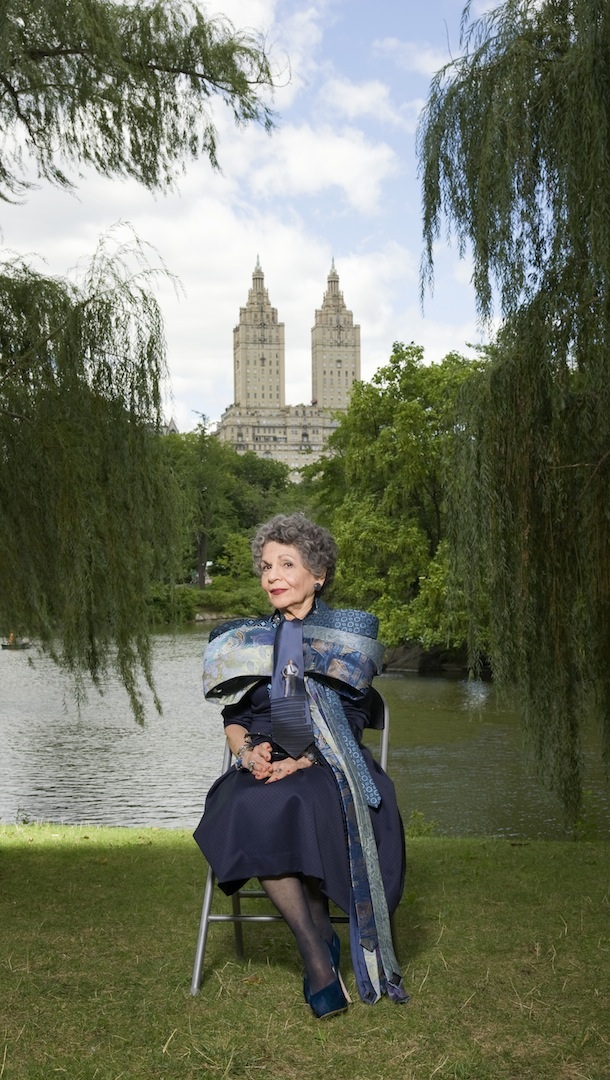
    (Fashion Interactions-exhibition, Nutty Tarts & Heidi Lunabba) 

    /// INFO: FASHION INTERACTIONS ///

    Fashion Interactions-Exhibition

    Opening: Friday November 15, 6pm – 9pm

    November 11 – December 13, 2013

    Open daily 12pm – 6pm

    Arnold and Sheila Aronson Galleries

    Sheila C. Johnson Design Center

    Parsons The New School for Design

    66 Fifth Avenue at 13th Street, New York

    The exhibition is supported by the Finnish Ministry of Education and Culture, Frame Visual Art Finland and Consulate General of Finland in New York.

       /// FASHION CURATING NOW ///
    Symposium, Saturday November 16, 9:30am – 5:00pm

    David Schwartz Fashion Education
    Parsons The New School for Design
    560 Seventh Avenue at 40th Street
    New York

    Finnish Cultural Institute in New York Facebook.

    http://www.ficultureny.org/node/330

    http://www.newschool.edu/sjdc

  • Finnish Paloni designers come to New York

    Finnish Paloni designers come to New York

    MINNA SÄRELÄ is a founder of Finnish design collective PALONI, which is coming to New York this weekend to open a pop-up store during the fashion week. PALONI shop will be open through the end of February at the Ivana Helsinki NYC Concept Store. Their motto is: YOU CAN CALL IT DESIGN, INDIE FASHION, ART OR HANDICRAFT. WE CALL IT PASSION.


    Firstindigo&Lifestyle: Minna, I was so happy to hear that PALONI is coming to New York, tell me little bit about this ‘invasion’?

    Minna: I founded Paloni one and a half years back, and lately started to feel that it’s time for the next step, broadening our scope and doing the first international project. New York opened as an opportunity through another Finnish fashion company Ivana Helsinki. After I got to discuss with their crew, things started going forward very fast. Our designers are very excited about this project and the possibilities it offers. We had a total of 37 Finnish designers joining the project, despite a very tight schedule for the preparations. Now it’s not just my project anymore, it’s something we do together. We have a group of 20 Finnish designers coming personally to New York, and together we will promote Finnish design and fashion know-how, build a pop-up store within the Ivana Helsinki NYC Concept Store. We will organize events and parties, network and build ourselves wider horizons for future dreams.

     
    Firstindigo&Lifestyle: When you started the company-collective, who did you include, was it by invitation and with like-minded people?
     
    Minna:  When I started, I had 45 designers that I represented. Now I’m trying to settle the number at about 80, although there would be much more demand and need from the designers’ side to join this kind of a platform or network. Still, I think it makes more sense both to our designers and customers that we can concentrate on the people we represent.

    At first all of my co-operations with designers started by finding interesting labels or designers, and looking for cooperation. Now I get many requests every week from designers who would like to cooperate. I try to answer them all and to help them all, even if I think there’s something about their line or products they should still work on before going to the market.
    Firstindigo&Lifestyle: HOW INTERNATIONAL IS PALONI?
     
    Minna:
    I see Paloni as “born global”. Even though we’ve only operated in Finland so far, our way of communicating in English, and with international vibes, have brought us international customers and connections, and made our network international. Also our designers come from across the globe, although this New York project concentrates on making Finnish designers’ skills better known.

    Firstindigo&Lifestyle: I learned from your website that you have been participating in eco- and sustainable fashion events, what have you learned about this field, and what are your thoughts about this trend?

    Minna: I really wish it will not be just another trend among others, but rather a chancing force that will make the whole industry into something different and affect our behavior profoundly. I feel there’s much need for making ethically and ecologically sustainable options available and better known. I don’t believe the change comes from pressuring or from being negative. It needs to stem from each one of us. Personally, I feel that wearing a garment I respect in all ways makes me feel more balanced and respected, too. There’s a lot of discussion and information around this issue, and I’ve learned so much about the debates and aspects in the past years. However, I think offering information will not change it very much – we already get too much information every day. I think we rather need some easy and pleasant ways of loving fashion more sustainably. By bringing together tens of designers that represent this ideology and by offering their offerings as a holistic array and experience, we try to build sustainable design in a pleasant way, and include a wide enough collection to be part of it.
    {All photos Paloni: Minna Särelä, captures: Sami Perttilä}

    Firstindigo&Lifestyle: WHAT ARE YOUR NEW PROJECTS WITHIN PALONI, AND YOUR EVENTS?
    Minna: Simply teamwork. By doing things in a committed team and by supporting each others’ potentials we can reach much more than with big money. The word ‘Paloni’ comes from the Finnish word “my passion”. When you have passion for something, it shows. And when it shows, others get excited too. And when that happens, impossible things become possible.
    Firstindigo&Lifestyle: What do you expect from your visit in New York, how many times have you visited?


    Minna: Although I haven’t been in New York many times, it’s one of my favorite cities in the world. I think each one of our designers have big and very different expectation. Personally, I expect networking, finding new inspiration and ideas, -these two things combined can lead the way to something new and unexpected.

    Firstindigo&Lifestyle: Is Paloni hoping to bring the products here, or will operate via the e-shop?

    Minna: The Paloni pop-up will be open inside Ivana Helsinki NYC Concept Store from February 11th until February 28th. This is a good chance to see, feel and try on the products in person. However, we also have an online store through which we have worldwide shipping at all times. The collection we’re presenting in New York are these designers’ new spring-summer collections. New Yorkers will have the privilege of getting to buy these items first – they will only become available in our Helsinki-store and our online store in March. Our online store has all this information in English, and can be found from www.paloni.fi/store
     
    Firstindigo&Lifestyle: Welcome to New York!

    Minna: Thank you! And welcome to our opening party on Wednesday Feb. 13th at Ivana Helsinki NYC Concept Store! We will have DJ Fiona Timantti playing Finnish music, and you’ll have the chance to meet our designers in person.
    Read also story about Scandinavian Design in this blog

    Check the Paloni website: http://www.paloni.fi/

  • Robin Rapoport: From Alexander technique to design sensing

    Robin Rapoport: From Alexander technique to design sensing

    How to describe living the artistic life? How to live a life surrounded by one’s own art? Making art is so intimately linked into one’s sensing of the world that there isn’t simple answers. In the current research of art, we try to map different kinds of knowledge embedded in the artistic processes. ‘Living’ with the arts is like ‘dwelling’, which in fact implies an old meaning for a house. The doors in the house keep opening and closing as a trespass to new fragments of interiors. The repetitious movement of stepping in and out of the interiors gives even the doorhandles almost allegorical significance.

    Robin Rapoport’s designs at her Conneticut home and studio.

    Robin Rapoport is a sculptor and designer who has been choreographing for her dance company Headless Horse. As a dancer in Robin’s company, the creative process made me reconsider dancing together with the sculptural.  Robin has been looking for a living and forming entity in the sculpture, which could be realized through the dancer’s body and her movements. Another layer came from the Alexander technique, which would bring those two materials even closer together. I asked Robin about this entire connection, wanting to know how the Alexander technique has changed her.


    RR: So funny you should ask that. The other day I was speaking with a magazine publisher of home design who wanted her editor to meet me and I said I have a class for Alexander Technique, but will skip it in order to meet her. I reflected that most people do one thing like designing, and here I spend so much time on another activity perhaps losing accounts because I’m not as available. But if you understand Mr. Alexander’s work it is crucial to one’s sense of clarity. The more I go, the more I discover holding in my body that I need to release, and as an artist I am curious where this will all lead. I know I’m changing so much already. The way I stand, my breathing, and so I am not so hyper. I can make better decisions with a calmer mind. We are for the most part so disconnected from ourselves and from the proper use of the self, which enters into all arenas of movement. I am very concerned with health and maintaining it. I do not want to stiffen up but remain easy and fluid. And I think to be an artist is to think outside of the box, to think ahead, to be perhaps more aware of the dangers our planet presents to us on a daily basis. This Alexander Technique is what I do to combat that.

    ORGANIC FORMS

    Robin Rapoport’s sculptures and sculptural furniture display an array of different approaches to organic forms, which could be labeled, as somewhere between Scandinavian and African, they are modern, natural and primitive at the same time.The sculpture and furniture feels animated and living. In some cases it is almost talking to you, and these pieces are shaping the space. The design presence is not too loud, but the pieces make statements and offer alternative points of view to look at the space. A piece of furniture is standing on its own legs, when it is a floor lamp, for instance. And if it is a bookshelf it can even include eyeballs. You might as well know what I mean: When you talk to plants, you talk to trees. And this design is so ’whimsy’ that you might as well talk to it.

    When Robin takes on the art of creating a house with her interior design, she likes to enhance the warmth of the interior walls. The walls already have imaginative touch in them. Cardboard covered walls with a touch of asymmetrical designs gives them a hint of geometry, and overall, they have ethereal lightness in them. This meditative approach, which she also calls as an art of ‘dwelling’ continues in the wooden sculptures. The sculptures both gather and form the space around them, and they have their own individualistic character. Robin’s interest to form is fluid. Materials appear with fluidity; they are towards rough or process-like, rather, than simply solid or static structures.

    Robin Rapoport, eyeball shelves

    THE HUMAN BODY

    The Dance Company is close to being like a living sculpture, where human body is constantly taking new shapes and testing the space where it moves. The dancing bodies with sculptural elements on stage together with them, is another Rapoport’s take on the theme. Along with the abstract, animated and organic forms are these narratives, which have several underlying layers. These stories unfold themselves in a course of a fairytale, or as a series of otherwise magical happenings.

    Dance, short film, sculpture, and light design evolve from the same source creating narratives without suffocating punctuality. Robin’s events evolve around the form and texture. Sometimes a piece of plexiglass gives an idea to a story that becomes a gesture in the dance performance, or it is part of the furniture created, and the objects found, all made for the home. Home is an evolving space, which is the dwelling. And living one’s home is part of the artistic process. Basically home is living together with art, and art keeps changing, as the interiors get different stories and layers.

    Robin has created her home in the woods of Greenwich, CT, together with her husband Edward L. Milstein, who himself is a painter of geometric color. Both share a passion for the arts, design and architecture. These three-colliding elements are coexisting in their home, where exterior is also mixing with the interior. A visitor who comes to their spatial industrial loft-like house and art gallery encounters the presence of the woodland nature. The house is evidently coexisting with its environment, as the landscape is not too worked, but remains the same type of organic fluidity with the rest of the things around. They collaborated with the Robert Young architects to create their ’Art Barn’. In the summer the house has a wire screen wrapped around it which is covered with wisteria, and so becomes a green jewel box in the woods emerging from a winter cinder block form of grey. It is amazing how a ’green screen’ that is like a living skin over most of the surface make the concrete-block look different. The greenery also adds thermal insulation.

    LIGHT DESIGNS

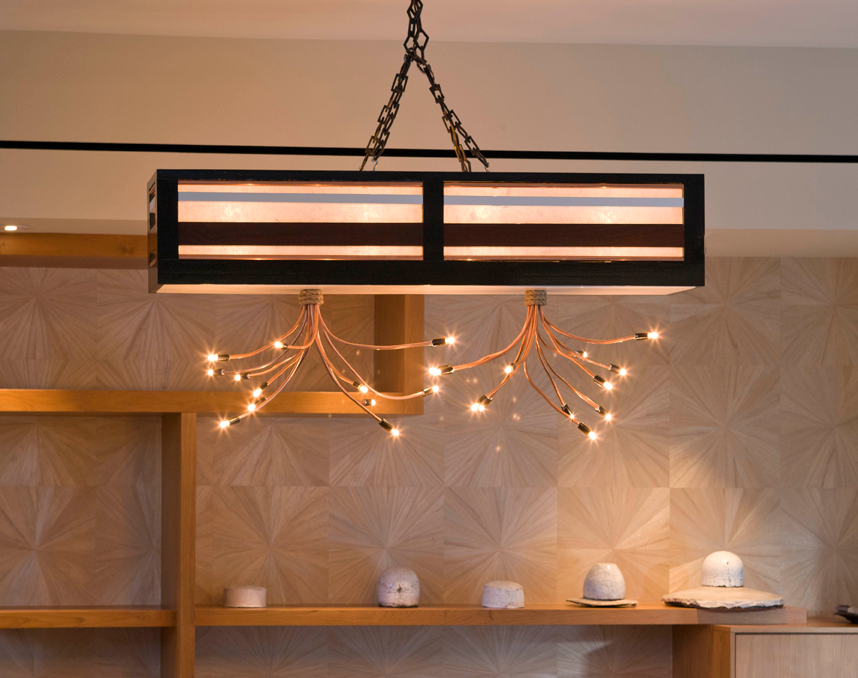
    As of today, Robin has developed Light Designs. She is creating fixtures that come from the sculptural roots of using wood, copper and paper. Interesting ceiling lamps are the ones like an octopus or simply ‘branchy’ wired designs, which are light weighted structures for the ceiling. Ceiling lamp can contain one long rectangular design that has two branchy-designs attached to it, or it can be a smaller sculptural design having one wire inside them.

    {photos:courtesy of robinrapoporthome.com}

    I asked Robin few more questions. I wanted to know how living in the woods inspires her. I also asked, where will her designs be in the future, and where will her passion be.

    RR: I think there is nothing more beautiful and magical and instructive as Nature and so I stay here, somewhat hidden and enclosed and perhaps somewhat lonely at times as well but this is where my work unfolds. When I travel to New York it is to study the Alexander Technique but then I come home to walk the property where I have lived for 24 years. Every year I add or shift plants and every following year I can take pleasure in watching them bloom. Outside and inside are distinct yet connected, as are we with both an exterior and interior persona? With so much suffering and tragedy in the world I feel blessed to have this place as a personal sanctuary and which makes me acknowledge every day a higher being which I can attribute the beauty all around me to.

    I hope my Light Fixtures can add beauty to a room. They are crafted by hand so each is unique. I am happy to personalize them for customers meaning that I could change the paper color and or wood color. How fascinating is it in Nature that a plant on the outside can be a dull grey with spikes and when it blooms the most delicate of leaves and colors emerge. And this color is for our eyes to appreciate like cinema except you can touch it.

    My next passion is to have a home furnishing boutique where I would sell my designs for tablecloths and ceramics, as well as have my design services. I love to set the table, and I find very little of interest in the tabletop design right now. So much of what is out there is about simplicity and “whiteness”, but perhaps just too much simplicity. We have lost great craftsmen (women). With the current economy people are afraid to stock inventory that is not trendy. But I am uninspired by what is now trendy. I just find it bland and so will make my own.

    ***

    {ROBIN RAPOPORT’S WEBSITES: Robin Rapoport Home and Robin Rapoport:Dance, Sculpture, Film}

    ***

    Robin Rapoport established Headless Horse in 2002 in New York City. The dance company has performed in live show, in festivals and in her short dance films. Her ‘Thief’ appeared in Palm Springs International Film Festival, and in the Jumping Frames Film Festival in Hong Kong.

    ***

    {/More pictures for the Greenwich, CT house are seen at http://ryarch.com/art-barn}