Tag: featured

  • Ai Weiwei @ Helsinki

    Ai Weiwei @ Helsinki

    Chinese artist and activist Ai Weiwei’s exhibition opened in Helsinki in September 2015. Ai Weiwei @ Helsinki will be on view through the end of February 2016. His first solo exhibition in Finland features 25 works from 1985 to the present, including selection of wooden sculptures and installations, and taking materials from antiques and building structures of old temples. Ai Weiwei’s exhibition is connecting to historical China, raising contemporary questions and speaking of the critical voice, which requires to be heard. The exhibition narrates of the personal and the cultural, weighting the nuances that the artist has tested in practice.

    Ai Weiwei is the artistic figurehead for thinking how today’s east meets west in many forms. I call my perception of the works ‘massivity of matter’. Firstly, the amount of matter in a museum space probably recalls any sculpture display as the intervention of matter over the space. In this exhibition, however, the sculptural speaks together with the space, the airy high ceilings are breathing with the objects. Second, the massivity of matter is more of a feeling that comes with the lack of scripture between the works. An echo of Chinese contemporary art, in which ancestral is disconnected from the line of reproducing the artifacts?

    Map of China
    Ai Weiwei, Map of China (2008) installation view.

    Map of China (2008), is Ai Weiwei’s large opening piece to the exhibition. The sculpture is tall, hard to measure, and made of tieli wood fragments that come from ancient temples. This material is centuries old and told to be very rare today. Map of China is made with traditional Chinese woodworking technique bringing the pieces together. The challenge was to create the work without any visible seams. The configuration has the shape of the country showing how there was not a single history or culture in the first place, but only a forced effort to fit all the richness into a one state.
    ai weiwei installation
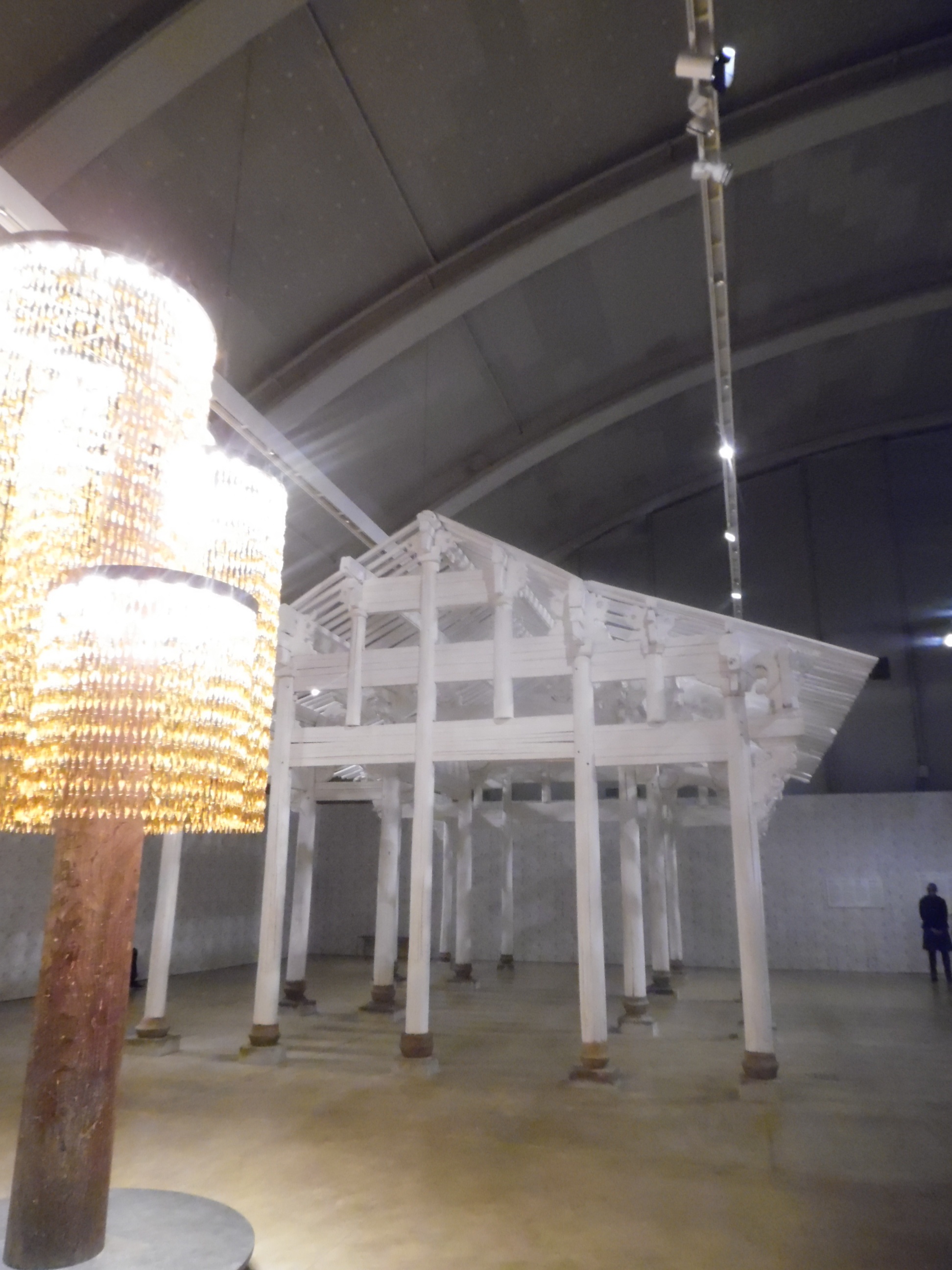
    Ai Weiwei, Traveling Light (2007) & White House (2015) installation view.

    So a question arises, how to connect historical meaning and the general meaning of the past to those issues that define a contemporary consciousness of a man, after he had to struggle with the fascist propaganda and denial? I am not proposing this question as an individualist concern, but more as a rhetorical phrase to speak of a multiple choices. The artist can mirror his personal position on the power/to shed light on the power, which one-sidedly and univocally has taken over all the other voices, eventually starting to represent masses of voices. This is where massivity arises in artistic aesthetics. And perhaps this is why there is no single narrative imposed in the exhibition, because bringing together all the objects would already be a lot. They would utter so strongly, so let them escape the definition, and let the cacophony sing its well-orchestrated noise. Needless to say, as the wood is concerned, the aesthetics is well rehearsed, well mounted, the sculptural is well organized in groups, following up the international sculptural aesthetics of the moment. Working with wood, and collecting pieces that come from a cultural place with this huge time span; say, goes far beyond our contemporary time. This makes the works epic for today. Historical load is apparent. History arrives with the same massivity, as the ancestral would drive you over.

    To be a political artist is not easy from the point of view of artistic aesthetics. Our art world needs the voices to break silences, but often the politics becomes massivity. It would perhaps be different to subtly speak without ruins taking over, as objects do have their own weight without us directly attaching them to ‘art’. In this case, the objects are not simply cultural artifacts as they appear in the art museum context, however they connotate in the form of temples, for instance. Some pieces come from temples – that is the shrine nature of a house, narrating about ancestry and patriarchal dominance. These fragments are ultimate references to the age of property, practice, and material attachments.

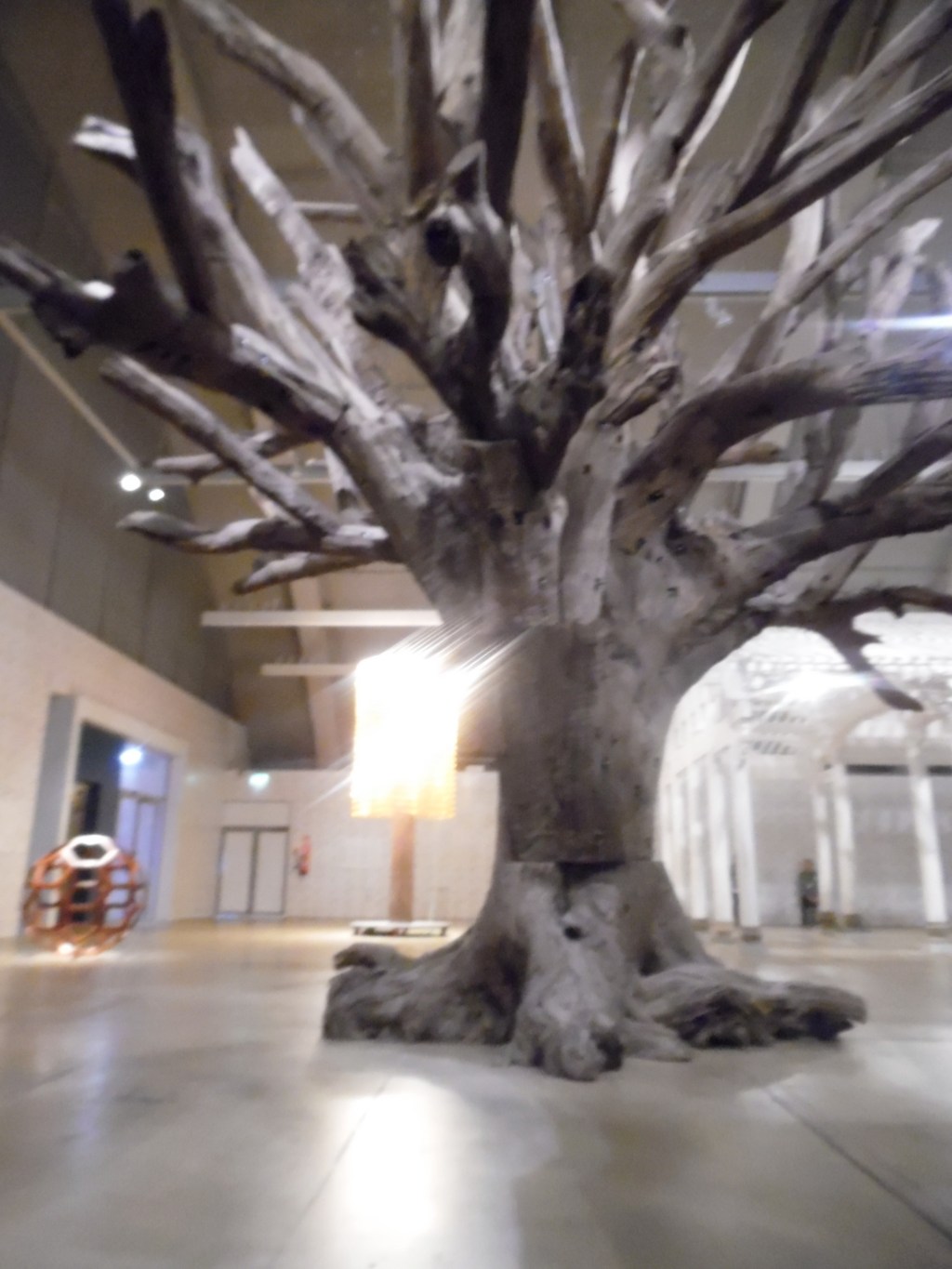
    Another sculptural work by Ai Weiwei, is called Tree (2010). It is an assemblage of different woods deriving from individual trees. The dead tree trunks were collected from various locations in the mountains of South China. Differences between components is left visible intentionally:

    ‘We assembled them (the parts) together to have all the details of a normal tree. At the same time, you’re not comfortable, there’s a strangeness there, an unfamiliarness. And it’s just like trying to imagine what the tree was like.’


    Wood as artistic material is so much about nature. Tree as a material is beyond our dominance. It exists and grows without our appropriation. But we did cut trees, we destroyed their existence, and we were cutting down entire forests. In the exhibition, the tree-sculpture is made from pieces to look like a whole tree, an original, yet at the same it is not. It is a look-alike, a not exactly, and a make believe of a tree, a form of a tree, a powerful signifier of a tree, of nature, of origin. It is quite interesting how this sculpture ended up being the center, as other objects are made of wood as well, representing crafty continuation of the artifacts as man made materiality, a continuation of time, which was before mass production.

    The modernity of artificial materials, known as the mass-production is another question. Mass production creates massivity. Perhaps the ancestral places speak in the same manner as the modernity. The history is long; we communicate and paraphrase with it. Perhaps this exhibition communicates beyond art, becoming dynamic battlefield for matter and spirit, proposing final materiality in art. Where do we stretch the line between the materials that make the essence of an artwork? We draw from culture, bringing cultural objects into museum to speak for the culture. And this takes place ultimately not in the name of individual subjectivity but for all the collective consciousnesses.

    After all, the dialogue between poetic and anti-poetic is what we are looking in the massivity. Poetry does not speak with the loudness unless it was dried out of mythological meaning and it communicates more with the naturalist approach to speak with metaphors. Metaphor can be standing for something, which is not invisible, and stands for something apparent, showing the evidence, creating presence of the political as inevitable. It is standing, yet changing?

    There is an evident need for change in the cultural. The aesthetic is more of a repetitive force that takes form in the massivity. The criticism toward west comes in the undertone of the material in consumption, as enlightening force. The materialism is our new religion?

    Traveling Light (2007), is a sculpture mounted on a temple pillar, appearing as being a gigantic table lamp or crystal chandelier. Ai Weiwei became interested in light as an object from the point of view of illumination and environment. The large sculpture stands for the idea that objects are close to human scale to be experienced physically.

    Divina Proportio (2012), is composed of huali wood, referring to the golden mean, and as mathematical proportions to geometry in the Renaissance.

    The exhibition includes two previously unseen works, White House, and Garbage Container, the former speaking of China’s developments and urbanization, the latter about five homeless boys who died tragically.

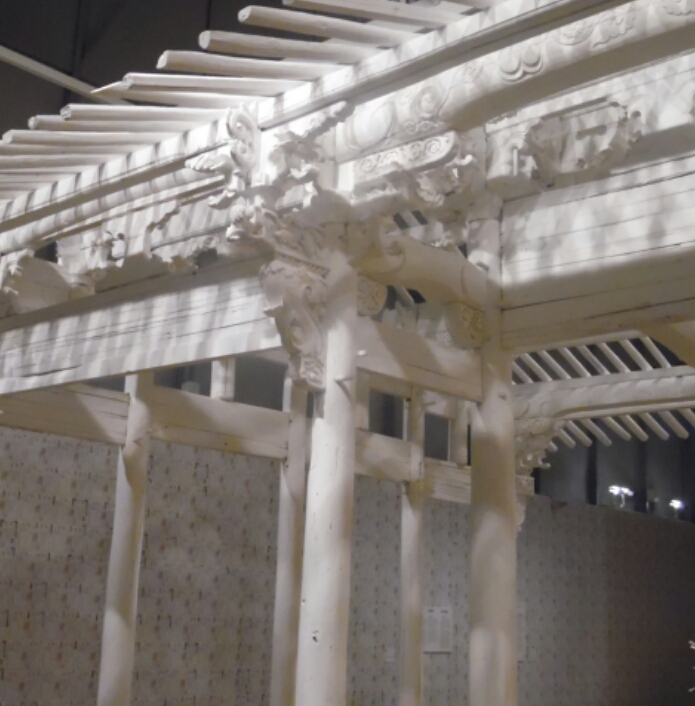
    A new piece in the exhibition titled White House (2015) is an entire residential house of the Qing dynasty. The composition includes different woods and is constructed traditionally using nail-less joints. The work stands for the heritage, as the new developments in China have pushed away the traditional. The new white paint on a wooden surface creates questions about past and present, authenticity and change.
    Ai Weiwei, White House, detail
    Ai Weiwei, White House (2015), detail.

    But cultures change slowly. The anthroposcience of human life shortly lived, continues in the legacy of a son who outlives his father (in a natural cycle). The artifacts have a longer life than we do, and this ends building the culture as fluid and as anatomically tilted. Objects lend to the patriarchal order creating legacy and interdependency. Objects echo about history, so in the name of the poetics and dialogue whenever they are on display there is an underpinning of voices that mesmerize with their presence.

    The exhibition architecture divides the show into two large rooms. On the other side there are objects, which call much of the legacy that is darker, even more personal than the first exhibition space. Ai Weiwei became a prisoner after he was arrested in 2011 at the airport in Beijing. He was sometimes handcuffed to a chair while questioned. He also kept washing his one set of clothes while in prison, drying them on a hanger.

    The art in this case becomes a historical conscience of a collective. It necessarily opens as a voice for the people whose history it is part of. The objects, their material consciousness and presence appear as inevitably non-corruptive, with presentation and physical presence, as non-poetic solidity. The substance is speaking through the stone, or the stones would shout, in this case wood objects.

    Ai Weiwei’s role as a seer or visionary, means a hard position at home in China. His work Through (2007), is composed of tieli wood once again, having fragments of old temples from Qing dynasty. The scale is massive, and piercing, the tables and pillars form an almost cage-like atmosphere.

    He says: ‘Artists are not in a position to decide the conditions imposed upon them but they can make statements about these conditions.’

    Through
    Ai Weiwei, Through (2007) & Frames (2013) in the background.

    Artists have their own life, their own existential power, their own presence and saying. When it comes to power propositions with artwork, let’s say this. It is hard to assume that the artist proposes his artwork knowing that the entire nature of the artwork would stand for the resistance of power. Cultural legacy changes in a moment, when it becomes ‘art’. The objects are in a terrain of global and international exchange of matter. When it comes to materiality in the sense or meaning, would not the objects have a saying only inside their cultural reference? Legacy or cultural speaking of the history changes with the art market. When legacy becomes art, it has become layered with different meaning; yet the objects are not entirely free of their cultural origins.

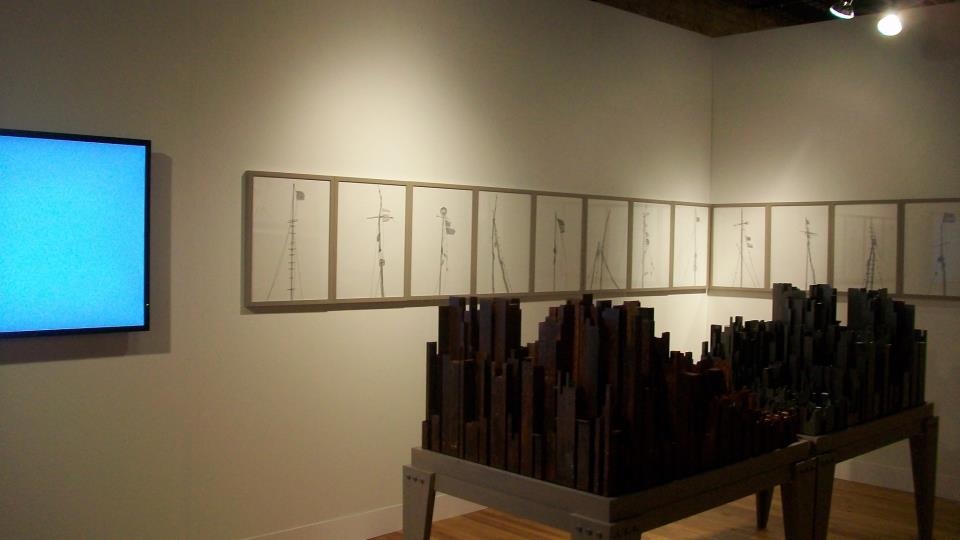
    The Garbage Container (2014), impresses as a valuable huali wood piece, reminiscing of a cupboard, and looking like a container when it turned on the side. Another impressive piece is the architectural installation titled Ordos 100 model (2011), which was built together with Swiss architect firm Herzog & De Meuron. Made of carved pinewood, an uncompleted, miniature city was planned to be build in Ordros. Treasure Box (2014), is another construction made of huali wood. interestingly, all the objects seem to highlight the wallpaper, titled as IOU Wallpaper (2011-2013), which has decorative appeal, yet a message that makes everything seem unconventional.

    Treasure box
    Ai Weiwei, Treasure Box (2014) with IOU Wallpaper on the walls (2011-2013)

    Ai Weiwei’s exhibition at HAM Helsinki in on view until February 28th, 2016.

    Artist website: http://aiweiwei.com/

    images: Firstindigo&Lifestyle
  • Eliasson’s ice revisited

    Eliasson’s ice revisited

    Ice Watch will open to the public on Thursday, 3 December 2015, in the Place du Panthéon in Paris. This artwork by Olafur Eliasson and geologist Minik Rosing is part of the occasion of COP 21 at the United Nations Conference on Climate Change.

    Olafur Eliasson is a Danish-Icelandic artist known for his large-scale installation art, which often has a site-specific component. He has also worked with sculpture. The elements, such as light, water, and air temperature are essential parts in the works to draw the viewer into experiencing them as corporeal and sensory.

    Olafur Eliasson is not a newborn to the climate change issue; neither is he using blocks of ice for the first time in his installations. He has created interconnected works that are close to environmental happenings, proposing an innate sense of activism. How to catch great attention and international visibility with earthy and conceptual works, is his niche. Perhaps Eliasson artistry sometimes implies great attention with metaphysical value, but this fact is by no means discarding the materiality and tactility of the things. Perception and comprehensibility of larger subjects, particularly that of a climate change are very much embodied in the projects.

    Taking the icebergs, which predominantly float far away from our sight in the isolated North are now taken seriously. Eliasson brings a hint of their monumental presence along with him putting them down on the marketplace of a metropolis, across the street so to speak. Let the ice melt there in front of our eyes to remind how the world is running out of time with the climate change, and how things truly are physical. We live in a physical world. In 2014, Eliasson installed the show in Copenhagen. The ice was placed in the middle of the town square, lifting the local spirits to think about the fjord water in the north. In 2013, at PS1 of MoMA in New York City, another work of this kind “Your waste of Time”, had ice pieces that arrived from the Iceland’s largest glacier, Vatnajökull. Visitors had a chance to observe and discover the melting ice.

    The project, which is installed in Paris recalls the title “Ice Watch“. The metaphorical piece has a power to speak of the ice that is speedily disappearing due to the global warming. Eliasson has stated that he is interested in giving knowledge a body, to encourage action on an everyday social level. What is sure is that everybody in the recognition of the global warming is going to be involved in the process. The artwork addresses it to the world, and thinks of it from the perspective of the future generations.

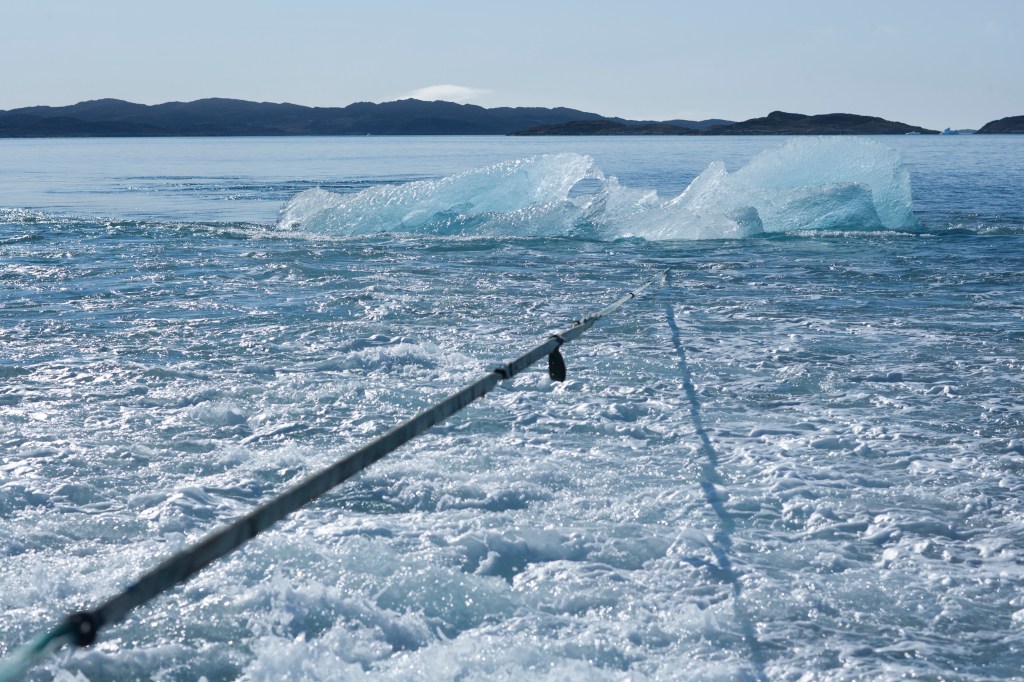
    The physicality of the ice is remarkable because it stands for the longer life spans. Ice is older than us, who dwell here. For the installation, there are twelve large blocks of ice that come from free-floating icebergs in a fjord outside Nuuk, Greenland. They are arranged in a clock formation on the Place du Panthéon. Weighting around 80 tonnes, the ice will melt away during COP21.

    … … …

    Origin: Nuup Kangerlua fjord outside Nuuk, Greenland
    Transport: Organised by Group Greenland / Greenland Glacier Ice, the ice was collected by divers and dockworkers from the Royal Arctic Line and then transported in six refrigerated containers from Nuuk to Aalborg, Denmark by container ship and to Paris by truck. Ice Watch is supported by Bloomberg Philanthropies and realised in collaboration with Julie’s Bicycle. Ice Watch is part of the initiative Artists 4 Paris Climate 2015.

  • IC-98 art duo from Finland

    IC-98 art duo from Finland

    Firstindigo&Lifestyle interviewed artist duo IC-98 from Finland, who are Patrik Söderlund and Visa Suonpää, respectively. Their recent site-specific installation ‘Hours, Years, Aeons’, was produced for the Pavilion of Finland at the 56th International Art Exhibition of the Venice Biennale. IC-98 projects scale with in-depth research; being abstract and taking form in installations and in publications. Their animation language draws from the collective history of nature and culture. As the duo says:

    Our work is post-historical, it is set in a distant future after the age of man. It’s about nature, which still has to deal with the consequences of the human era. It’s not natural nature, but a twisted one.


    Firstindigo&Lifestyle: How did IC-98 get started, what was your thesis during the first few years?

    IC-98 (artist duo Patrik Söderlund and Visa Suonpää): We met at the University of Turku, majoring in Cultural History and Art History. We wanted to broaden the scope of academic writing by bringing our “writing” into public space. This idea became our program: to make site-specific interventions in public space, be they installations or anonymously distributed booklets.

    How do your art works communicate with theoretical thinking, do you consider to be conceptual artists?

    IC-98: The works start with conceptual and/or contextual analysis. This depends on the project at hand. Site-specific works start from research; animations are amalgamations of conceptual thinking, adjusted storytelling and handcraft. But if we should characterize ourselves shortly, we’d say we are conceptualists first.

    Can you name some of the most important theoretical premises that could be your guidelines? How about your artistic influences?

    IC-98: Our theory comes mostly from the left-leaning French poststructuralism: Michel Foucault, Gilles Deleuze & Felix Guattari, Michel Serres, with an important German addition: the work of Walter Benjamin. Artistically we do not have many modern or contemporary influences. Visually we lean towards 19th Century and the history of depicting landscape: Claude Lorrain, Gianbattista Piranesi, Caspar David Friedrich, and William Turner. The important thing about 19th Century is the fact that it is often at the same time the prehistory and a mirror image of our own time: in many respects, the world was the same but the underlying processes are still more visible (think Jacquard loom vs. laptop: they share the same binary logic but where laptop is a black box, in the loom we still see how the thing actually works).

    Could you tell more about the process itself, in what ways do your concepts or visual process evolve, are there any common or repeating parameters in the making? For example, how do you choose your visual atmospheres, like create the sets, lighting, how does the process unravel itself?

    IC-98: The style is based on the fact that the animations visually start with pencil drawing. From this stems the fact that the animations are black and white. So it is a material, not a stylistic element. The different atmospheres and recurring elements, our visual vocabulary (fog, mist, stars, water) is functions of the scripts, which often deal with multi-rhythmic time and transformations of energy and matter. The script always comes first; even lighting should carry parts of the story. If we cannot justify a visual element, we omit it from the final work. Technically the “scene” is fashioned after 18th century theatre: the image is composed of flat layers and digital effects between these layers. We try to keep it simple, not to be too much carried away by the limitless possibilities of cgi (Computer-generated imagery). When we compose a scene, the pencil drawings are first scanned, then composed into layered scenes and lastly animated.

    What do you want to say about your idea of ‘Events’, and about the ‘possibilities’ that can be found in your artworks?

    IC-98: The idea of a moment being pregnant with possibilities – or situationistically speaking “constructed situations” – comes from our earlier practice. We combined situationist thinking with Deleuze’s idea of the actual and the virtual and Benjamin’s Theses on History to conceive an idea of an intervention/work as an event making the user/viewer aware of the interconnectedness of past and future possibilities. As Deleuze beautifully writes, the present moment is surrounded by a cloud of virtualities, the unactualized past events, which maybe did not take place but can still happen. This we still consider the political element of our work even when the animations might at first sights appear visually anachronistic.

    Is it relevant to always question time and space as elements in you work-in-process?

    IC-98: Coming from the background of both visual arts and history, the complex nature of time is elemental in our work. Animation enables us to show multiple temporal rhythms in one image frame. Sometimes it is about the passage of time as such, then again it might be about a certain time in history.

    What are the three things you would tell about yourself to North American audience today as an introduction?

    IC-98: We have worked over multiple media for almost 20 years now. During this time, we have developed a visual language – be it artist publications, installations or animated films –, which combines the theoretical and the political with the visual and emotional. And important element here is the combination of old school (drawing) craft and the new digital media.

    You have participated in Art Fairs in New York City, in fact at the VOLTA Art Fair couple of years ago, how was the reception from the audience and organization, how about other experiences from local scene?

    IC-98: The reception has been good, though ours are relatively difficult works in the fast paced fair circuit. You need to be able to give time to the work. Then again, even a quick glance of the “surface” communicates the classical quality of crafting the artwork – though it’s in digital form.

    IC-98 installation at VOLTA NY-2013 with Galleria Heino. photo: Firstindigo&Lifestyle

    Some time has passed since the opening of the 56th Venice Biennale, what are your most important remarks from the art biennale so far, did the location and site change the actual process? How do you feel, are you able to follow up what takes place during the art exhibition?

    IC-98: Working on site-specific projects has taught us that it’s always about communication between the site and us, the hermeneutics of place. In Venice we realized, that we had mostly done the research over the years already (the questions of territory, public space, wood and woods, the history of the Finnish welfare state, the relations of humanity, architecture and nature as a whole). The challenge then was to find the best way to tell the story in a framework of very strict regulations. We were first working on a more ephemeral and performative format, but had to recur to our most well known medium in the end: the animated film.

    During the biennale we have mostly received comments from visitors now and then. But, the perception of our own work hasn’t changed during the process. We have always done a lot of thinking and tried to take into account all the possible permutations of a given site or situation.

    It seems that ‘Hours, Years, Aeons’ has duration and layers, what does the work narrate about? It starts forming in the cave, and goes through time in history? Does it deal with today’s hot topics, such as climate change?

    IC-98: It’s very much about climate change, the much talked about questions of the Anthropocene (note: Wickipedia defines this as: proposed epoch that begins when human activities started to have a significant global impact on Earth’s ecosystems). But our work is post-historical, it is set in a distant future after the age of man. It’s about nature, which still has to deal with the consequences of the human era. It’s not natural nature, but a twisted one. The work exists both as a spatial multi-screen installation and the linear film shown in Venice. The Venice version let’s us experience long, geological stretches of time – the aeons.

    Specifically, the work has a background in the nuclear waste repositories, how something is buried deep into the ground. But as we all know, what is buried, will once surface again.

    Did you find time-based media works as your medium from the very beginning of your artistic career? How about your sculptural works, and the ways different media communicate with each other?

    IC-98: We considered our free distribution books already time-based in a sense. The installations often include an interactive element, which means that they work in space but also as a part of lived time. We have liked the idea of the viewer as a user. But formally we entered the temporal realm when we wanted to make animations. The main idea was to be able to show the chains of cause and effect and use certain cinematic techniques to speak not only to the intellect but also the senses.

    Time-based media has a different nature than other art works. What is your opinion about it, how do you see your art from the point of view of the future, what could be the time-span?

    IC-98: In all probability our works will seem as anachronistic or as nostalgic as any other cultural product of our time. The paradoxical thing is, we always try to conceal the technological or digital basis of our works. We try to make our works look like they could have been made in any era. It would be nice, if in the future it would be impossible to say from the outset when watching our work: “That’s so 2010’s!” Then again, the animations are all about the resolution, the bit-depth, the ratio, and the available digital effects…

    Finally, what are your ongoing and new propositions for the future?

    IC-98: We are in the preproduction phase of our first feature film, ‘The Kingdom of Birds. It’s loosely based on the life’s work of Finnish deep ecologist, eco-fundamentalist, ornithologist and fisherman Pentti Linkola. The film imagines an old fisherman’s last day on earth in a future where all of mankind has perished. It is time for other species.

    The 56th La Biennale di Venezia is open until November 2015, where IC-98 is represented.

    Check out the artist websites following the links below:

    IC-98 homepage: www.socialtoolbox.com

    IC-98 animations: https://vimeo.com/ic98

    IC-98 monograph: http://issuu.com/framefinland/docs/ic98_hoursyearsaeons_1_