Tag: featured

  • Patricia Chow: Pilgrimage to Gwangju

    Patricia Chow: Pilgrimage to Gwangju

    This is the story of how a trip to the 14th Gwangju Biennale in May 2023 led me to throw 10 paintings out of my second story window like Rapunzel’s hair.

    When I was doing my MFA, I led a graduate seminar on the art biennale phenomenon, and have been slowly making my way to as many of them as possible ever since. A last minute opportunity to visit Korea gave me the chance to see this year’s iteration of the Gwangju Biennale, titled “Soft and weak like water.”
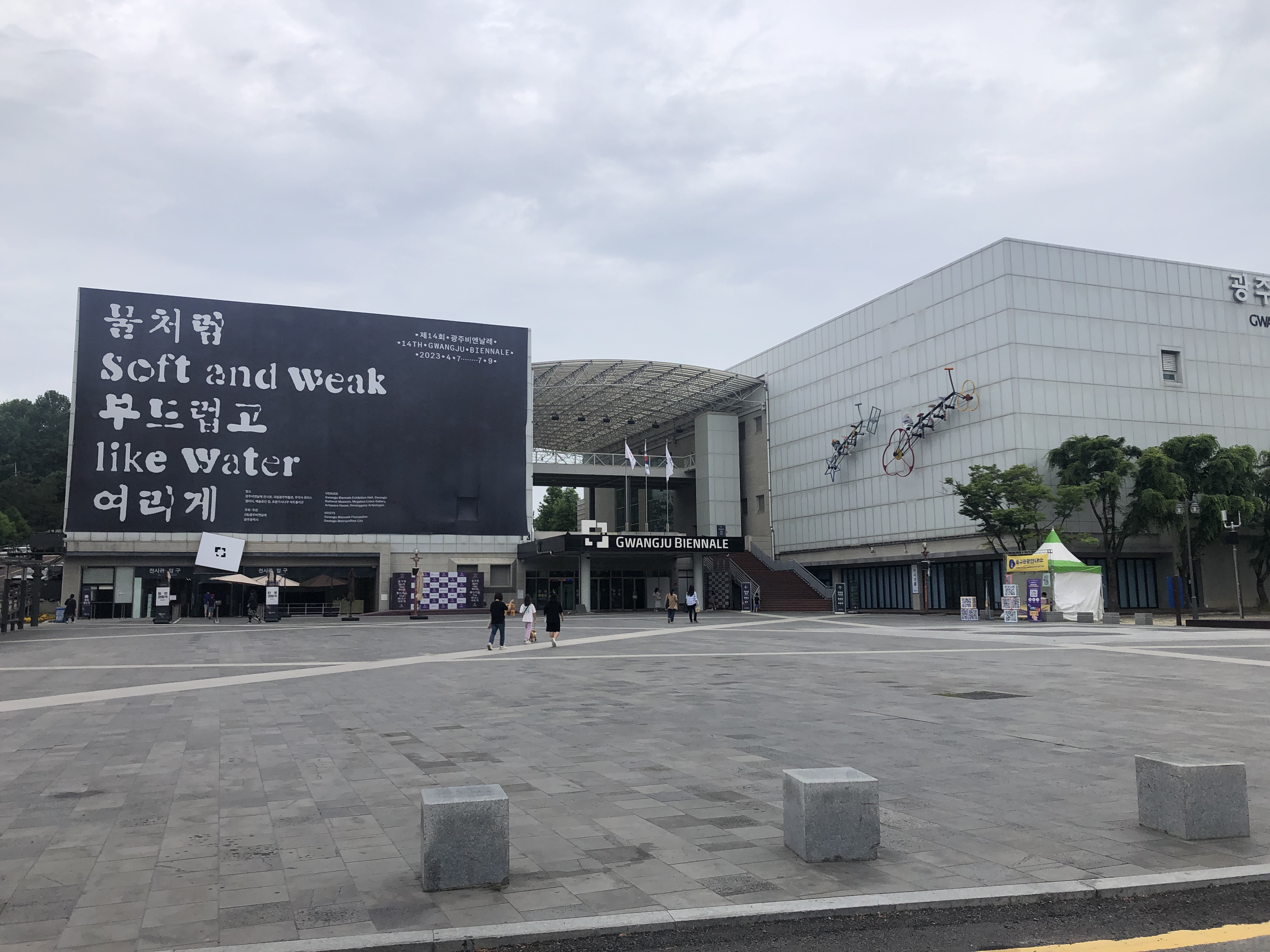
    Gwangju Biennale May 2023

    Gwangju is in southwestern South Korea, about a 2-hour train ride south of Seoul. It is considered the cradle of Korean democracy due to the 5.18 Gwangju Uprising, a pro-democracy popular uprising in May 1980 that was brutally suppressed by the military regime with the loss of up to 2,000 lives. After democracy was restored in 1987, the biennale was founded in 1995 to commemorate the spirit of the uprising and celebrate the city’s cultural heritage.


    This year’s artistic director, Sook-Kyung Lee, senior curator of international art at Tate Modern (and soon-to-be director of the Whitworth Gallery in Manchester), is the event’s first Korean artistic director since Kim Hong-hee in 2006.

    The title “Soft and weak like water” comes from the Tao Te Ching, and according to Lee, “is about the paradoxical power of seemingly weak things, referring to the transformative nature of water that could break hard things like rocks or change the course of a river over a long period of time.”

    Beyond the exhibition in main biennale hall, smaller exhibitions and country pavilions were housed in a multiple venues across town. My favorite was the Horanggasy Art Polygon, a glass pavilion located on the edge of a forest on Yangnim mountain. Walking up the winding alleys of the Yangnim-dong neighborhood felt like wandering around on the nostalgic streets of a Hayao Miyazaki film, with its mix of traditional Korean architecture and turn-of-the-century Western-style houses, now full of small galleries and tea rooms.
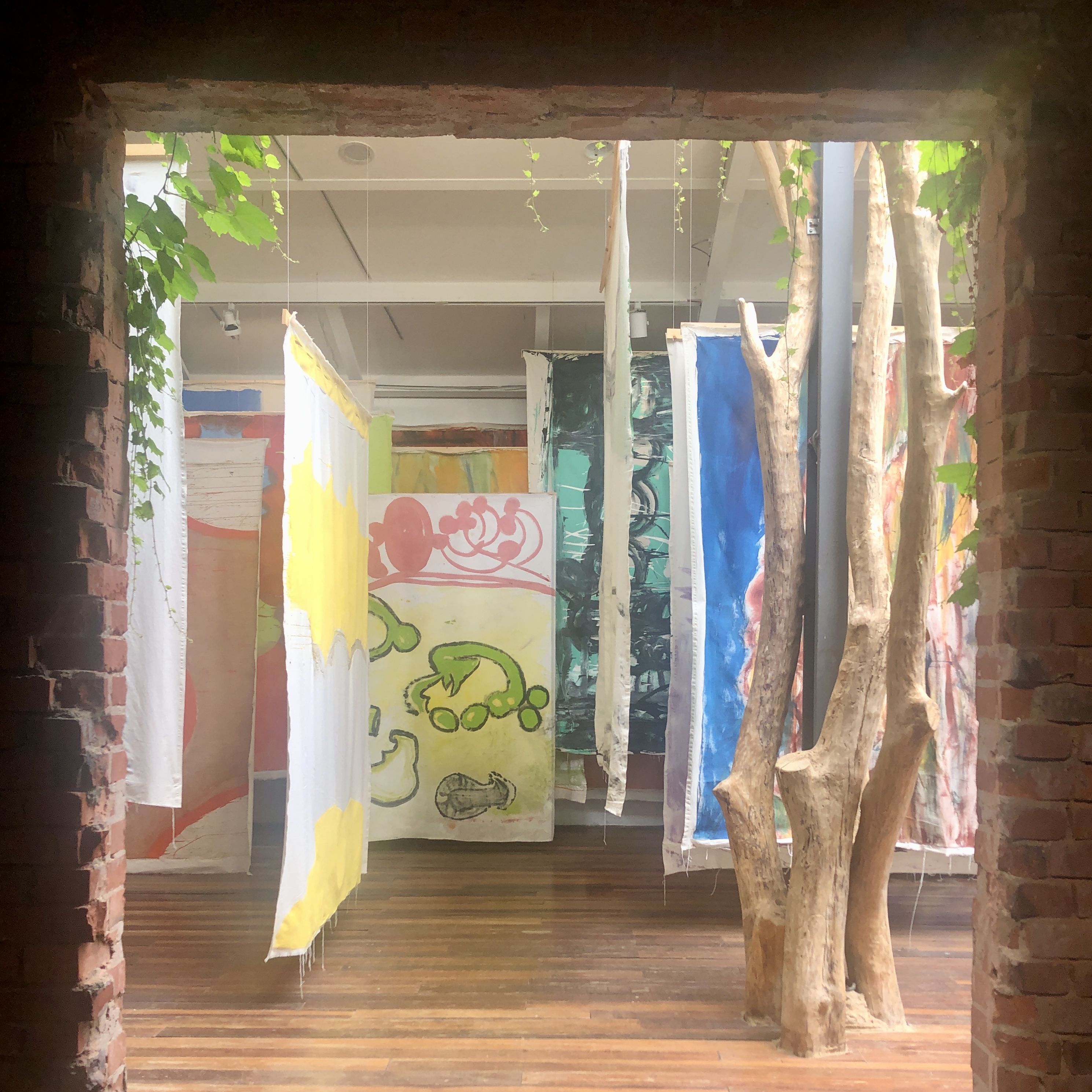
    Vivian Suter installation view.

    Inside the glass pavilion, I encountered for the first time in-person the work of Argentine-Swiss artist Vivian Suter. Suter is the subject of Rosalind Nashashibi’s 2017 short film Vivian’s Garden (one of two films that earned Nashashibi a Turner Prize nomination in 2017). The film is set in the jungle near Lake Atitlan in Guatemala, where Suter has lived and worked for four decades. A flood in her studio in 2005 caked all of her work in mud, and after recovering from the initial shock, Suter discovered that rather than destroying her paintings, nature had simply become part of them, and her practice subsequently incorporated the mud and rain and plants and insects and dog paw prints that are part of her lived environment directly into the paintings.

    What was most prominent when entering the pavilion was the smell of the paintings. This I did not expect. The enclosed space did not smell mildly of oil paint and gesso and canvas. Instead, you could breathe in the earth and rain that had seeped into the vast concentration of hanging cloth paintings. I had never experienced paintings as an olfactory sensation before.

    What I had done was experience music as painting. Specifically, the 1,027 opera broadcasts I listened to during Covid lockdown were distilled into the 18 paintings of the series I called “Synaesthesia” (2022). Synesthesia is perceiving something in one of the senses and simultaneously feeling it in another.

    Kandinsky famously dropped out of law school to study painting after attending a performance of Wagner’s opera Lohengrin, where, he later said, “I saw all my colors in spirit, before my eyes. Wild, almost crazy lines were sketched in front of me.”


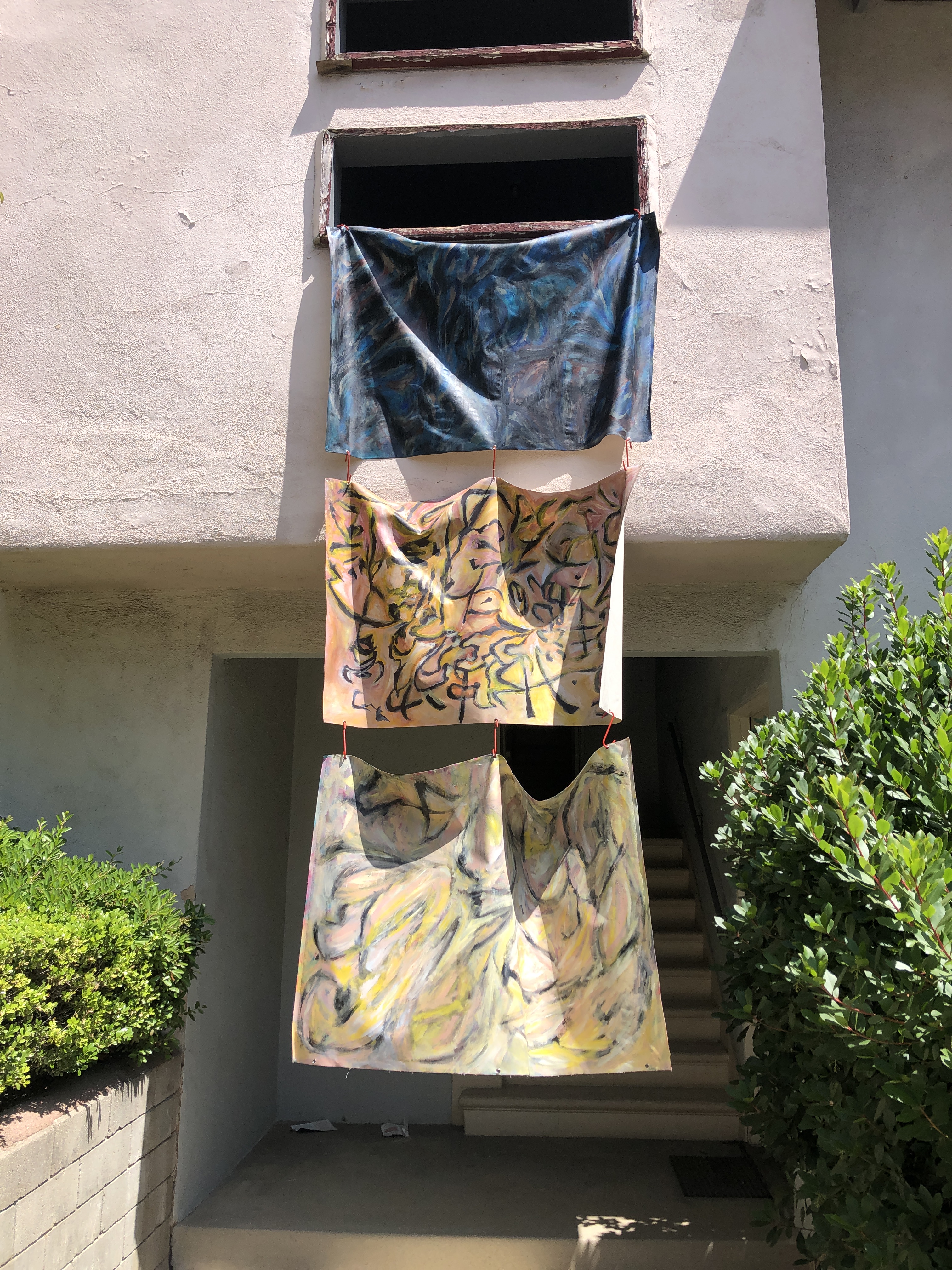
    Each of my paintings are a visual profile of the music of an opera character. In some cases, I painted specific interpreters of those roles. The paintings are acrylic on unstretched canvas, 3 to 4 feet high and about 4½ feet wide. When I got home from Korea, I decided to hang all of them up in my apartment, like in the Suter exhibition. But instead of attaching them to beams in the ceiling or to track lighting (I don’t have either), I attached them to each other, and ultimately hung them off the balconies around my split-level apartment complex. In homage to Kandinsky, I picked out the 10 Wagner opera characters to display.


    And that is how this installation came about.
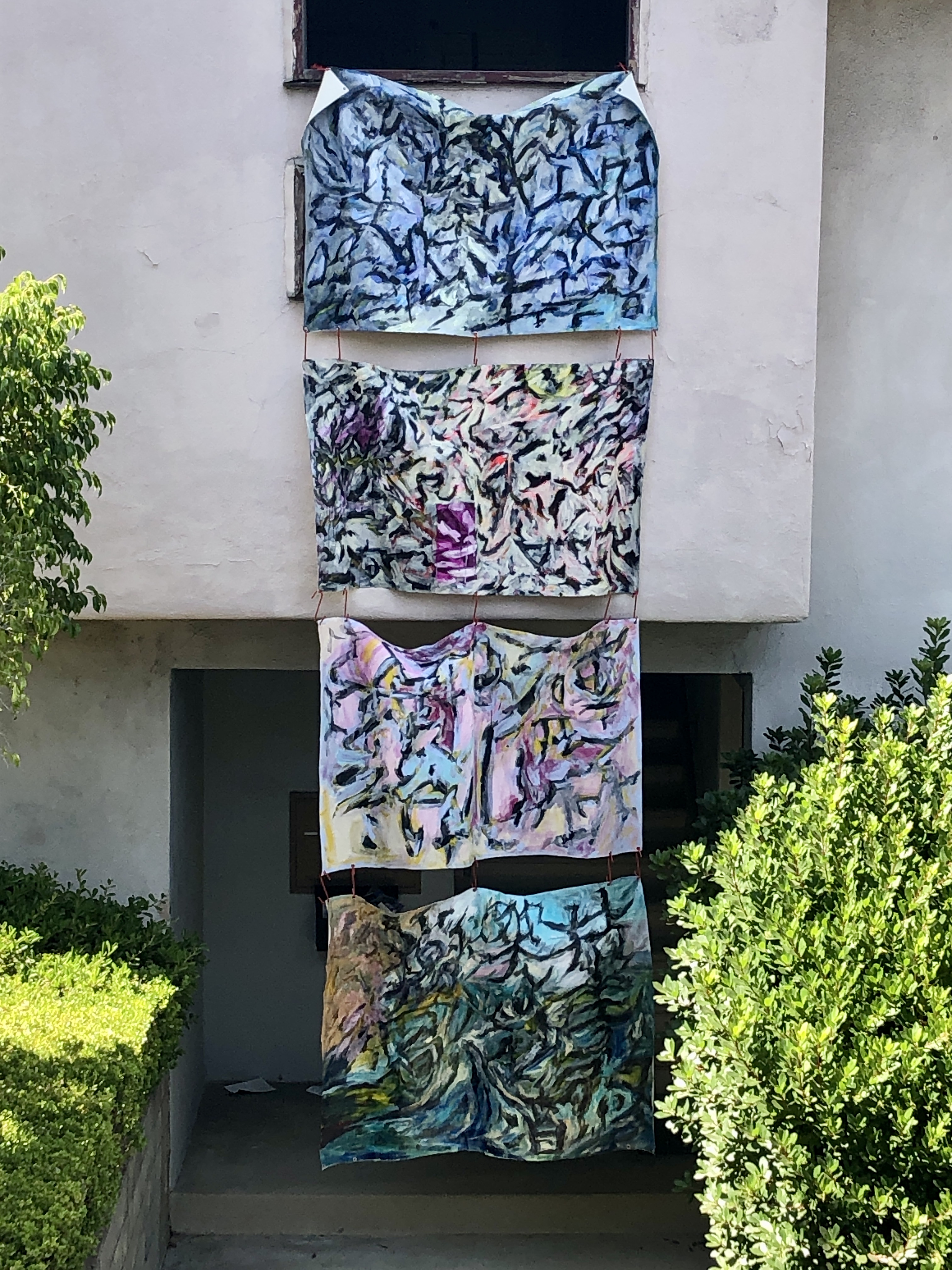
    Patricia Chow, Tristan (Ben Heppner), Kundry, Isolde, Brünnhilde_installationview
.
    Patricia Chow, Erda, Fricka, Rhinemaidens_installationview.
    Patricia Chow, Tannhäuser, Senta, Ortrud (Leonie Rysanek)_installationview.

    From top to bottom:

    1. Patricia Chow, Tristan (Ben Heppner), Kundry, Isolde, Brünnhilde
    2. Patricia Chow, Erda, Fricka, Rhinemaidens
    3. Patricia Chow, Tannhäuser, Senta, Ortrud (Leonie Rysanek)
  • Olena Jennings and Natalie the Ukrainian doll

    Olena Jennings and Natalie the Ukrainian doll

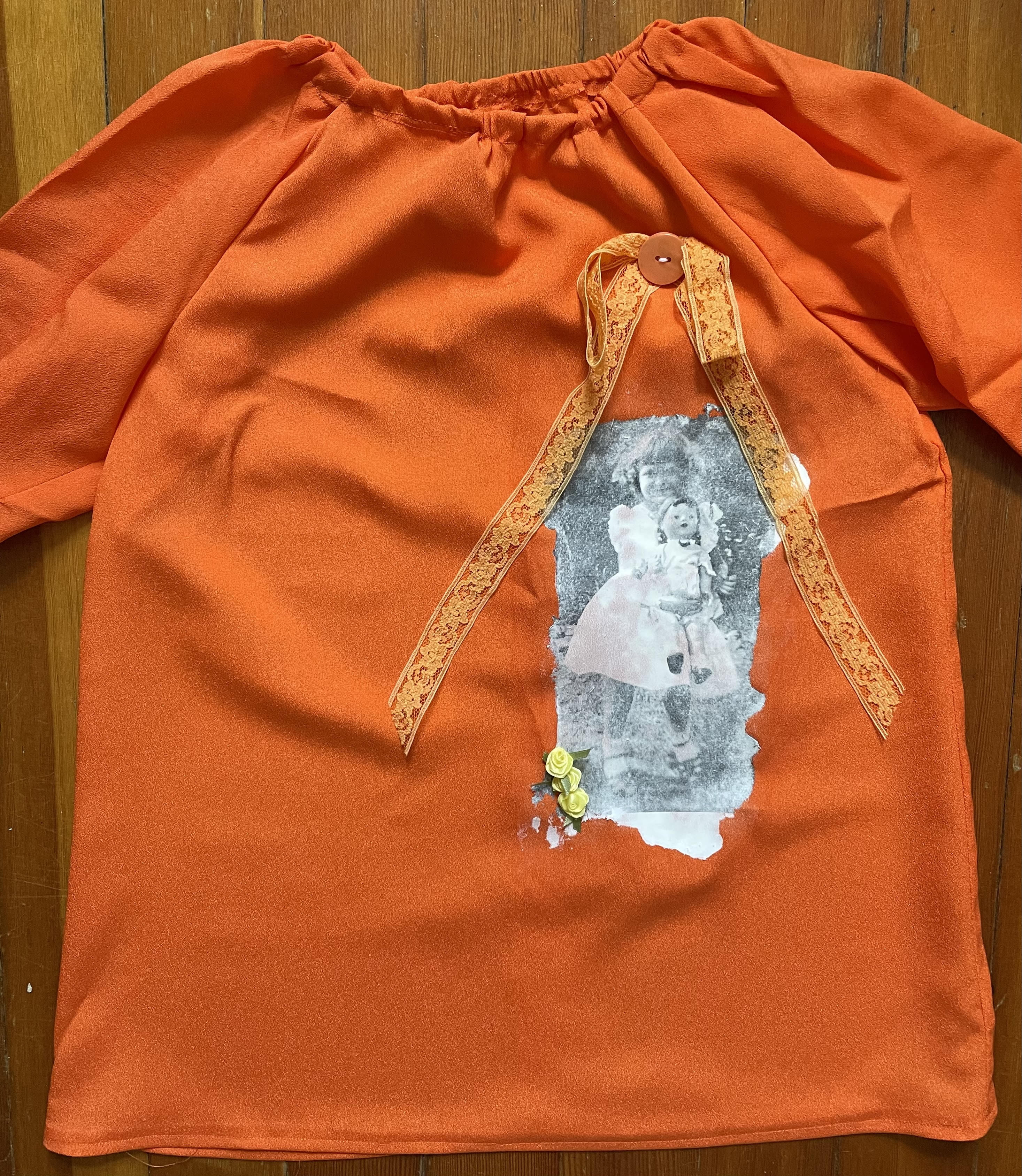
    New York based artist and poet Olena Jennings created an installation of two artworks that are based on a family photograph. These two pieces revolve around one photograph of a little girl, who is Jenning’s mother, on a swing with a doll in the 1950s. The installation includes also connected poems.

    Natalie is a character in a long poem by Jennings. She is someone beloved who goes through many transformations. The colorful wall piece of Jennings’ installation (above), includes an excerpt of a poem from the collection The Age of Secrets (Lost Horse Press, 2022) about Natalie and the doll. The poem embroidered onto the artwork’s fabric is published as, When I Moved To the City. (https://www.apofenie.com/poetry/2021/1/22/when-i-moved-to-the-city):

    Natalie was the doll.
    I worried her eyes would close
    and get stuck,
    stay that way forever.

    -Olena Jennings, 2021 (excerpt, see the whole poem through the link above)

    The family photograph is transferred also into the bright orange crepe fabric, which is a new dress made by Jennings. This orange doll’s attire as part of the art installation, is a replica of the one that the doll actually wore in the family photo. Mother of the artist still has the doll in her house.

    This orange dress is decorated with Ukrainian-patterned ribbon, reflecting my cultural background. The orange dress is the doll’s. I often work with memory, as depicted here in a moment from the past that is repeated in each piece. -Olena Jennings

    Firstindigo&lifestyle: As a Ukrainian descendant, how are you dealing with the war in Ukraine, and thinking of your family and friends? Do you connect your poems and images to the tragedy happening today with the Ukrainian children?

    I think every piece of art I create now has to do with the war in Ukraine. It’s impossible to ignore and the sadness is tangible. As part of this project, I am digging into my roots through images that were taken there or shortly after my family’s arrival in the US. I do this to work through my own emotions and to find a point of connection with my friends in Ukraine. -Olena Jennings

    Below is the new unpublished poem INTERLOCKED, which Jennings created in conjunction to her art installation.

    INTERLOCKED


    A body is bare,
    ready for the dress
    of chiffon.
    My body is bare,
    in the mirror
    where her gaze falls.
    The doll’s is made
    of plastic, her belly button
    blossoms.
    Mine is made
    of warmth, my lips
    wet and petal-like.
    I have long conversations
    with her, her eyes
    stare back.
    We talk about the girls
    who ignore me
    on the swings.
    We talk about the way
    I can almost reach the sky,
    I always want more blue.

  • Flowers on a River: The Art of Chinese Flower-and-Bird Painting 1368-1911

    Flowers on a River: The Art of Chinese Flower-and-Bird Painting 1368-1911

    On March 23, 2023 China Institute Gallery in New York is reopening to the public afer a renovation. The new exhibition in the galleries celebrates Chinese flower-and-bird paintings. On display are masterpieces of Chinese paintings that span over five centuries. The museum is the only in the United States to exclusively exhibit Chinese art, and this exhibition is the largest survey of its kind outside of China. The works are from Tianjin Museum and Changzhou Museum respectively.

    Flowers on a River: The Art of Chinese Flower-and-Bird Painting 1368-1911, includes more than 100 masterworks from 59 artists. The works were created during a 500 year time period between the Ming and Qing dynasties. Not only the individual styles of the artists are highlighted in the exhibition, but it will also detail the academic and literati aspects of the works.


    With these paintings we can escape to nature and imagine the natural world, which has inspired artists throughout centuries everywhere. The imagery of the paintings communicate a deeper meaning of art. In Chinese thinking, the humanity is resilient when it connects to the natural world, living in harmony with its diminuent details and magnificent forces.


    Yun Lanxi (dates unknown) and Zou Yigui (1686-1772) Eight Immortals in the Flower World Album of 8 leaves; ink and color on paper 12 1/8 x 19 in. (30.8 x 25.2 cm) Tianjin Museum (Leaf 3)


    “Flowers on a River will explore the natural world in the context of the human experience. revealing links that tie the genre’s imagery and the country’s everyday life and social customs.”

    Traditional Chinese painting has landscape and figure at its center. The flower-and-bird motives are in their own category. The exhibition will be presented in three parts: Precious Plums of the Palace: Academics and Court Artists; Fragrant Plums in the Wild: The Literati Art, Painters and Painting Schools; and Vitality of Nature: Flower-and-Bird Painting and Social Customs.


    What is really advanced curating in the context of this exhibition is the inclusion of so many women artists. The Ming and Qing periods saw the rise of women artists. They excelled in flower-and-bird painting. The exhibit will display works from eight women artists. Among others, there are scrolls by two of the most acclaimed, Ma Quan and Yun Bing. During Qing dynasty, they were noticed by their talent; and as was typical to those times, through the legacies of their fathers and grandfathers.


    ‘Flowers on a River’ is curated by Willow Weilan Hai, China Institute Gallery and guest co-curators Chen Zhuo, former Director of Tianjin Museum; Lin Jian, Director, Changzhou Museum; and David Ake Sensabaugh, former Ruth and Bruce Dayton Curator of Asian Art at Yale University Art Gallery. The exhibition is organized by the China Institute Gallery together with the Tianjin Museum and Changzhou Museum.

    “We are enormously excited for the reopening of China Institute Gallery and are honored to present some of Chinese art’s greatest treasures.” – Willow Weilan Hai, Lead Curator of the exhibition, Director and Chief Curator, China Institute Gallery.


    The 42-foot horizontal scroll by Zhu Da, one of the greatest artists in Chinese history, is taking the center stage. It is considered one of the masterpieces of Chinese painting. Zhu Da (1626-1705) is also commonly known as Bada Shanren. His large painting was last seen outside of China in the 2013 exhibition of Masterpieces of Chinese Painting at the Victoria & Albert Museum in London.

    “Bada Shanren pushed the expressive possibilities of monochrome ink and brush to the extreme, resulting in incredibly rich effects with an unmistakable individual character,” -Willow Weilan Hai.

    The exhibition is accompanied by illustrated bilingual catalogue featuring commissioned scholarly essays and detailed exhibition entries. China Institute Gallery is featuring a series of events including lectures, an international symposium, and other programs.

    The artists in Flowers on a River include: Lin Liang, Lü Ji, Shen Quan, Hu Mei, Yuan Jiang, Yuan Yao, Gao Qipei, Jiang Tingxi, Qian Weicheng, Miao Jiahui, Chen Lu, Chen Hongshou, Ma Shouzhen, Wen Zhengming, Tang Yin, Zhou Zhimian, Lu Zhi, Chen Chun, Wang Guxiang, Xu Wei, Xiang Shengmo, Zheng Xie, Jin Nong, Hua Yan, Li Shan, Huang Shen, Luo Pin, Gao Fenghan, Bian Shoumin, Shitao, Zhu Da, Yun Shouping, Tang Yuzhao, Ma Yuanyu, Ma Quan, Yun Bing, Yun Lanxi, Zou Yigui, Yun Guangye, Li Jue, Tang Shishu, Zhao Zhiqian, Pu Hua, Xugu, Ren Yi, Zhang Xiong, Wu Changshuo, Tang Luming, Zhu Cheng, Leng Mei, Chen Zun, Fan Qi, Wang Wu, Zhang Cining, Wang Caiping, Li Boyuan, Zhang Sheng, Sun Di, and Aisin-Gioro Yuying.