The Japanese artist Katsushika Hokusai (1760–1849) is usually recognized for a single image—Great Wave Off the Coast of Kanagawa, which is an icon in the global art world. When we recognize the work, it is as if the unpredictability of the sea holds our attention when a mighty wave breaks against the beach. We are lucky, since TheNational Museum of Asian Art has had a commitment to build its Hokusai collection. The institution is now showing an exhibition Hokusai: Mad About Painting in the museum’s Freer Gallery of Art.
In commemoration of the centennial of Charles Lang Freer’s death in 1919, the Freer Gallery presents an exploration of the prolific career of the artist Katsushika Hokusai. Freer himself recognized the richness of the artist’s works assembling the world’s largest collection of Hokusai’s paintings, sketches, and drawings.
Like the Great Wave, many of Hokusai’s paintings convey his interest in the every-chancing ocean in motion, including its fishermen and sea creatures. The artist created thousands of works throughout his long life. He worked mainly in Edo (modern Tokyo) period with a proximity to the Pacific Ocean.
Above on the left, we see one of the wave paintings Breaking Waves (Edo period, 1847), created by Hokusai. It is apparent how the rough curving motion really brings the sea to life. The artist was able to masterfully capture the ocean’s free spirit making it the focus of his works. On the right, another Japanese artist of Edo period, Utagawa Hiroshige (1797-1858) depicts Edo landspaces in his work consisting of six panels. A detail of his work Famous Sites of Edo, spreads in the screens in which each panel has a separate painting that is mounted to one panel of the screen. The coastline and sea are visible through these panels illustrating landscapes. Interestingly, during the life of the two artists, by the early nineteenth century, the city of Edo had grown to a metropolis with a population of more than one million.
Hokusai, Egret on a Bridge Post Edo period, ca. 1801-1802 Japan Ink and color on paper H x W (image): 85.8 × 25.5 cm (33 3/4 × 10 1/16 in) Gift of Charles Lang Freer Freer Gallery of Art
Hokusai showed interest in nature through many of his works. One of them, Egret on a Bridge Post, showsa white egret at night with moonlight illuminating the bird’s pale form. He illustrated the bird on top of a bridge post. Egrets are still seen in Japan’s rivers looking for food.
The works in the exhibition, including Hokusai’s humorous manga about the everyday life, activities and faces of Japan, shows the vastness and the creative mind of an artist, who thought he might achieve a true mastery in painting, if he lived to the age of 110.
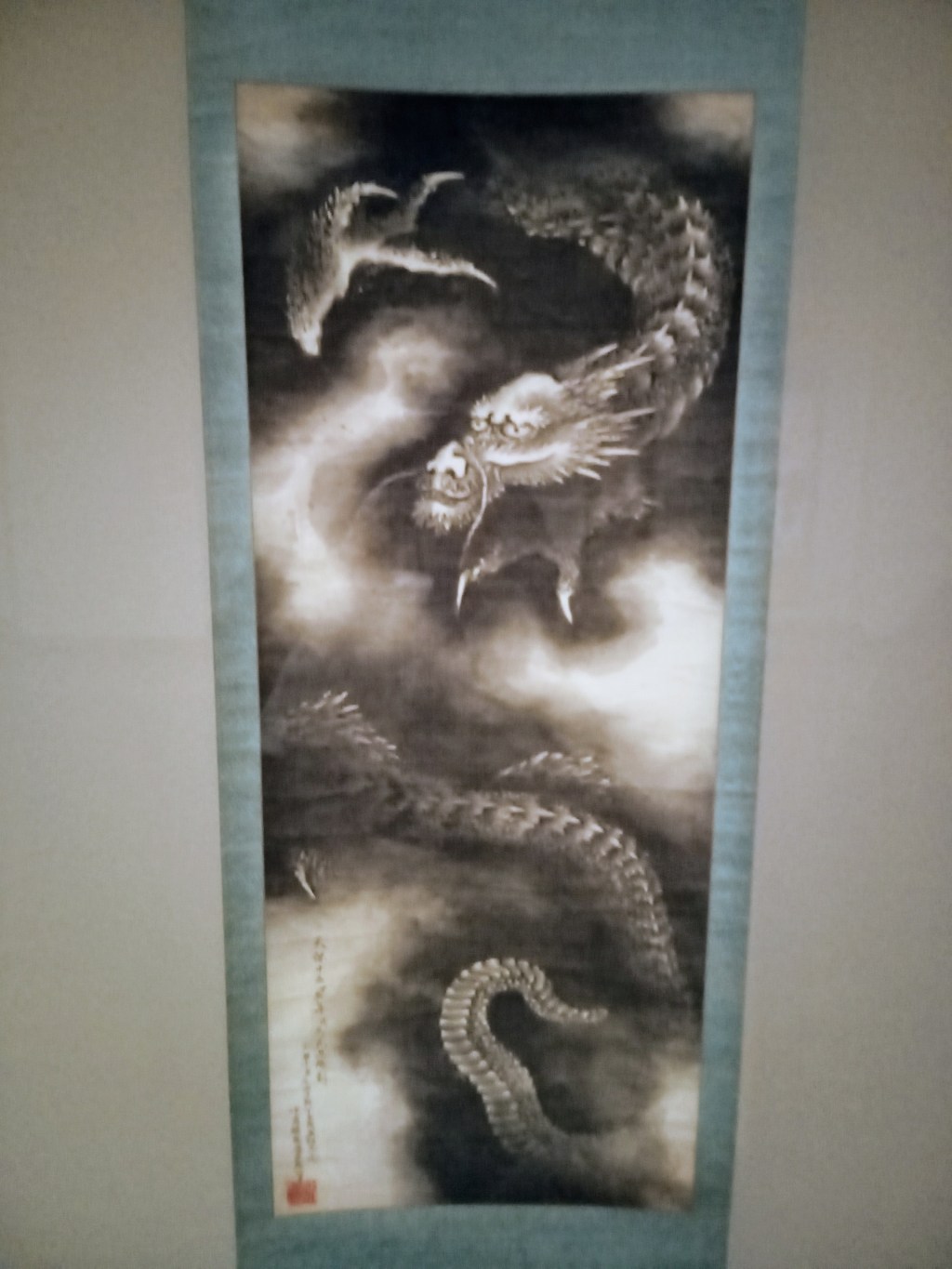
During his eighties, Hokusai painted several mythical creatures known as dragons. The ultimate interest for him might have been in the character’s energy as the artist himself was ageing.
One of these works, Dragon and Clouds (Edo period, 1844), was painted when he was at the age of eighty-five. The painting shows energy and vibrancy in the form of mighty mythical creature. The work is an important addition into documenting Hokusai’s life and art.
Hokusai, Dragon and clouds Edo period, 1760-1849 Japan Ink on paper H x W (image): 88.2 x 35.6 cm (34 3/4 x 14 in) Gift of Charles Lang Freer Freer Gallery of Art
Meditation as a practice implies self-awareness. Finding about inner strength, intuition, thought processes and wishes. Otherwise, putting things in the background while finding the inner focus to clarify and perform. All these aspects create the assurance of different levels of balance. One might believe that meditation is a pure focus, while the contrary is in fact true.
Mindfulness as a concept, a reality of nourishing the mind and soul by turning into more quiet time. Quieting one’s mind in order to listen to inner atmosphere of feelings and emotions. Why not to discover the universe that is within us? Replacing negative thoughts with appreciation of ourselves, of others and the world.
Breathing
It is not only about tuning into balancing acts, but also inspiration and self discovery. We are full of emotions and feelings, which are positive and not at all negative; and even some of the negative ones may turn into new energy and offer insight. Meditation implies a pause, opening a pathway to our inner thoughts.
A truthful path includes maintaining a certain level of anxiety and uncertainty when it comes to specific problems like climate change. If we sit back and relax, wash away our mind with calm waters of emptiness, we won’t have the energy required to fight the problem. Where our attention is needed, where frustration isn’t supposed to be solved by simply relying on our positive energy.
Collage: Firstindigo&Lifestyle @polyvore-designs
For the overachieving among us, stretching beyond our everyday selves is not the biggest question. Finding treasures in the more simplified notions of our inner powers might be. Not all progress is necessarily meaningful. But finding answers in more everyday actions, in nature, in the natural world, and in those encounters with others.
Sometimes there is time to learn compassion for ourselves, in order to better listen and pay attention to the natural world. Compassion is the key turned into caring on a deeper level about anything important. In meditation this manifests in being attentive to breathing, keeping the mind and body aware of the breathing. Step by step this awareness opens up into something deeper, reaching outside the limitations of us as humans.
Our consciousness can open up to thoughts where breathing becomes part of the universal rhythm of breathing together with this planet. The natural world requires our attention to the actual concept of breathing. We are all living, palpable things. Over consumption, unnecessary interruption of the natural course of life, creates chaos over rhythm of breathing in all living things. Planetary destruction is emblematic of bodies that have moved away from their breathing.
Meditation can be motivational, it can energize us to think more deeply about ourselves and others. This planetary home of ours calls for our attention into our breathing. Meditation is about becoming aware of how the parts can fit into the whole, and how that whole can mend the individual parts.
Between East and West
French philosopher Luce Irigaray’s literary work “Between East and West: From Singularity to Community”, investigates Eastern practices and philosophy from the point of view of the body, in which breathing has a central role. After herself practicing yoga and meditation, her research implies a personal awakening that has manifested through practice of the conscious breathing. Following ancient Eastern practices of breathing and yoga, Irigaray argues that both humans (women and men alike), nature, and the natural world including the spiritual life, are part of a bigger plan of discovering our being in here.
In this writing Irigaray examines the Western tradition through ancient Eastern disciplines. It is the meditation that teaches us to breathe. Yogic traditions, according to Irigaray can offer us a meaningful way to reconnect our human and planetary pasts with its futures.
In Jewish Kabbalah, which also is an ancient tradition, there is a lot of thought put into spirituality and our collective well being. We should gain more compassion for one another, and understand that ultimately we are all creatures essentially bound up with other creatures. All levels of the creation and the preservation of the planet is a common goal for us being here.
From this perspective, our meditative approach can lead to a child-like approach when it comes to life; the wonder that locks our inner core into things beautiful and wondrous. When we grow up, we tend to forget how things in nature put a smile on our face, how literally everything that grows out there can feel exciting and worth exploring. Nature’s mysterious part is also something that can open to one who will pause, sit back and absorb its presence. Listen to a birdsong, look at the trees behind the brick wall in the midst of urban life. We can imagine going back to nature anytime. Meditation is one key to acknowledging that this is possible.
The Natural world can lead us to believe in higher beings, in something more universal than our mundane lives. Species and subspecies come from somewhere, the universal energy and movement can lift us to have faith in the worlds that are often invisible.
Sparkles and a vessel as a thought introduced in Kabbalah. Our divine task to help ‘creation’, to correct errors in nature. To make the world a better place for all living things. There is something divine in the sun with the radiance that it wakes us up to each new day. The universe that keeps repeating the same mantra of coming back fresh every single day. We haven’t been able to stop the sun from rising, even with all our destructive human behavior. Even when sun stays in the clouds.
Climate change
It is more and more discussed how climate change can bring disturbance to our lives and shake our balance. The World Health Organization published a study about how climate change can have an impact on our overall health.
“The principal reason for the global increase in temperatures is a century and a half of industrialization, with the burning of ever-greater quantities of oil, gasoline, and coal; the cutting of forests; and use of certain farming methods.” (https://www.who.int/heli/risks/climate/climatechange/en/)
Global warming will certainly have consequences where our health may be at risk. In terms of changes in our ecosystems and as catastrophic weather phenomena, climate change can create new emergencies.
When we meditate, we can learn to appreciate each new day. And think how we can better meet the challenges. Climate Change is adding another layer that intensifies patterns and experiences that are abnormal, when the future holds more extreme rainfall, floods, tropical cyclones, droughts and heat waves, in addition to the increase in the frequency of calimas and atmospheric dust. (https://www.una-climateandoceans.org/448491047)
One of the nature’s emergencies is called calima. The calima is caused by a storm or change in weather impacting the Saharan Air Layer. Climate change will cause more of the phenomena. The hot, dry and dust filled system is located above the Sahara desert. It meets the more humid and colder system that linger over the Atlantic Ocean.
Reference: Luce Irigaray (2002): Between East and West. From Singularity to Community. Translated by Stephen Pluhácek. Columbia University Press.
New York City poet Olena Jennings created a project based on a family photograph, which depicts a story belonging to her grandmother. It inspired her to design a special dress that carries a piece of the memory itself.
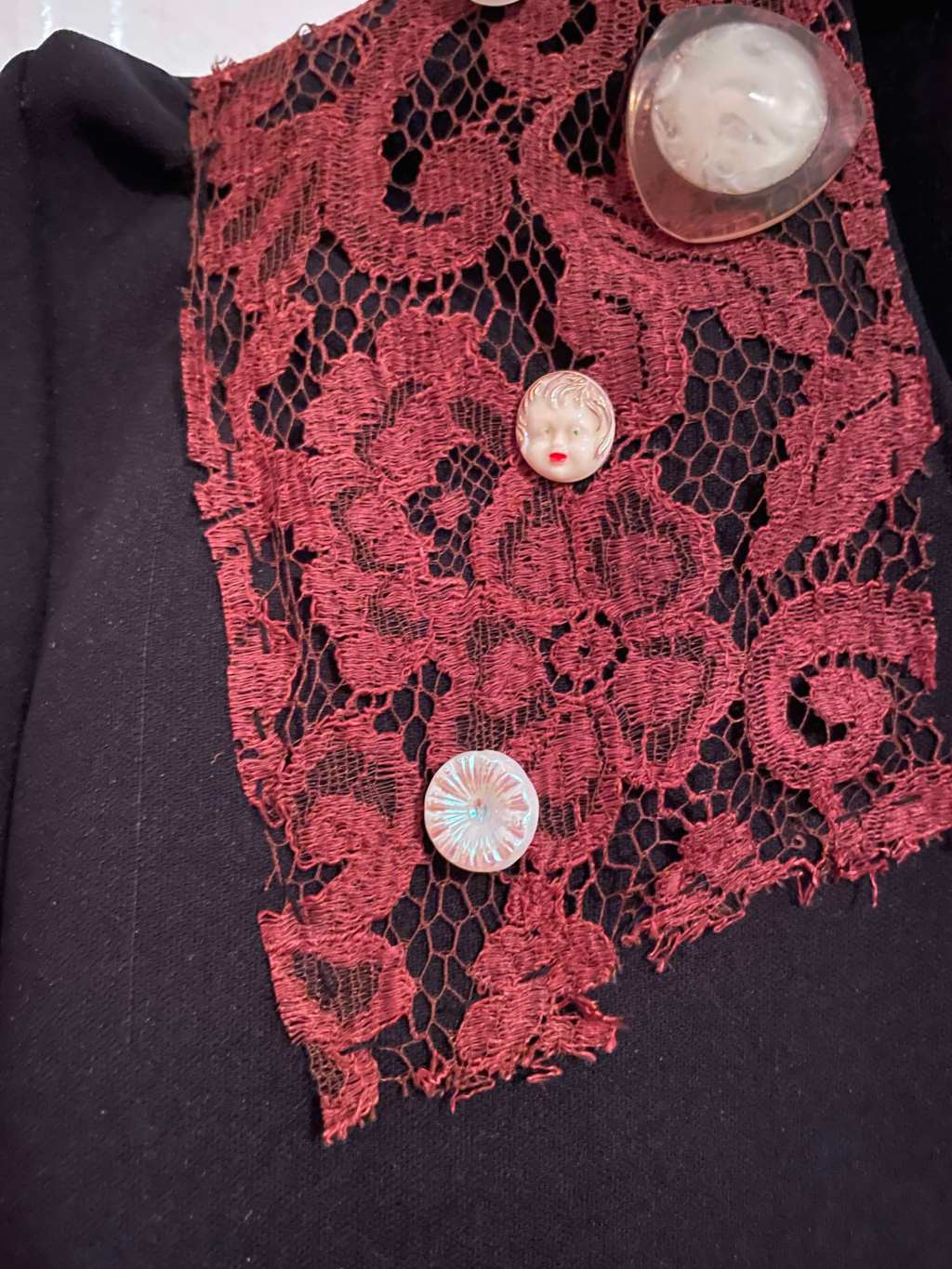
The project “What is Left Behind”, is a dress design with photo transfer and red lace. The family portrait is an intimate piece of history. Working on a concept so close is unique. It is inspiring from the point of view of the four individual women that it represents, the four sisters. Their gazes are emphasized as if belonging to an era, when smile wasn’t yet invented as a facial expression in photographs. The picture taking was a rather serious event. Yet the photograph served its purpose as a posing for the memory.
In the design, the black and white photo is surrounded by white and red stitches created with embroidery floss.
Photo transfer of great aunts as attached to the fabric with embroidery floss stitches. Olena Jennings, What is Left Behind.
The poem to accompany the dress is about Jennings’ grandmother receiving the family photograph. Like a message from the old country, They Bring The Photo is from the times that passed.
THEY BRING THE PHOTO
By Olena Jennings
She would sew the buttons that would fall from her coat, threads invisible as webs, in the light that spilled around her like milk, the warmth she remembered from the farm, the kittens circling and her hands on the udders.
The visitors gave her the photo in a weathered air mail envelope, their strange car in our driveway, his kiss leaving a mark on my cheek, letting me know I am forbidden to touch the pillow, the mark too special to rub off.
The surprise was that she could be found anywhere, that she was not alone as she believed. So, she checked beneath the beds and in the dust in the attic, for those who knew her whereabouts.
Her sisters’ faces in the photo were absent of emotion, distant. The black of their clothing reflected in their eyes. It was as if the space between them was bigger than the distance between their countries.





 Firstindigo&Lifestyle