Tag: featured

  • Color comes with music for Ellen Hackl Fagan

    Color comes with music for Ellen Hackl Fagan

    Firstindigo&Lifestyle: The color field painting created space for exploration of color as a subject matter. How did this field of abstraction influence your work in the first place?

    Ellen Hackl Fagan is an American artist working with painting, which is richly influenced by music of her generation. Starting to figure out her artistic practice in the early 80s, she found color as a strong compositional element. When looking at her paintings, one could say the ideas derive from traditions of Color Field. But it’s more than that.

    The artistic experience and the bodily encounter with the materiality of work create another layer. Music and color go together also in a more profound and ethereal way in some of Hackl Fagan’s work, appearing as if systems and science were components of the network of sound and its emerging visual pattern.

    Firstindigo&Lifestyle: Now, the cobalt is a color, which is a great conversation starter. How many times have you experienced people just being absorbed into the inviting presence of the color?

    EHF: That happens all of the time. In my studio space, which was in the back of ODETTA in Bushwick, one was surrounded by blue from my walls to the floor. I found visitors would linger there, and mentioned often that the blue made them feel really good. So, it emanated a healing resonance with visitors to my space. I think this is one reason why I’ve remained focused on the color and the surface from this particular paint, KT Color, is that it resonates, down to the individual particles, because of the matte surface and the saturated hue. 


    Firstindigo&Lifestyle: Can you tell, how did you find cobalt, and how long has this investigation been your premise?


    EHF: I have attempted to make paintings emanate sound through saturated color since 1981. At that time I was pursuing my undergrad degree, BFA in painting and photography, and was seeing a lot of live music. Punk culture was in full force, so sound and design were interchangeable. A painting I created, The Floozies vs the Force, in 1981, was a painting that was predominantly red and blue, and is oversized. I began to see that the cobalt blue used in this painting, a latex/household paint, would turn to a white hot in low-light times of day: dawn and dusk. The red of the painting would recede, and the blue would advance, which was the opposite of what we were trained to understand about color in school. This intrigued me, and I began to consider cobalt blue as a color that had a broader communicative range, and could possibly hold the key to my color/sound investigation.


    Firstindigo&Lifestyle: You say that cobalt has some mystical components, does this mean transcendental in some ways?


    EHF: Yes, I feel that this color actually connects with our spirit, and that it communicates directly to this intangible part of our being, which is why the response to blue is universally tied to the spirit. I think we all feel it.

    Firstindigo&Lifestyle: The process of painting for you is very physical, it’s almost performative how you pour the paint on canvas, and work toward the outcome. Can you explain your process with paint, water, and objects, how they all are involved in your practice and contribute to it?


    I think it’s about immersion. I want to put my full body into painting, connect physically with each aspect of the process, and finish, like a yoga deep breathing exercise, with the eyes as the final part that communicates to the color. I have a long history in dance, and feel that this visceral connection comes from this history, or muscle memory. 


    Firstindigo&Lifestyle: There seems to be an element of covering and revealing in the process?

    EHF: Yes, I call this part “blind painting.” In order to gain a full field of pattern, I have to cover the surface. I can’t know for sure what the outcome will be, which is an aspect of trust I’ve established with the materials themselves. I feel they have more to teach me than I them. I want to explore the full range of their characteristics, which means I cannot be the author of the final image, the paint is the author. I set the stage, facilitate its dynamic potential, and then I leave the room and let gravity and evaporation do their part to finish the work. If I’m not happy with the result, I tend to live with it for a while before going back into it for a second pass. I learned a lot about listening to my materials through ceramics. Often the ceramic work would come out of the group kiln at school with an unexpected result in the glazing and painting that I had put together with the underglazes and oxides. 

    When I pulled the pieces out of the kiln, at first they disappointed me due to my expectations. But, over time, they made me look at the unfamiliar with an open mind, and would convince me that they had a strength to them that I could have never controlled or forseen. This made me want to explore accident and the unexpected more in my painting.

    Firstindigo&Lifestyle: Can you tell about your background, and how did you find your calling as an artist?


    EHF: I have always called myself an artist. From a very young age, 5 or 6, I can remember identifying myself in this way. I am the sixth of eight children, and married into a family of twelve children. My husband was a twin, he passed away in 1996 from an undiagnosed cancer, leaving me to raise three very young sons by myself. The boys are all young men now, with lives of their own, but we are close. I always made drawings, played school, painted, argued, and have had a life where I maintain a space for play. 
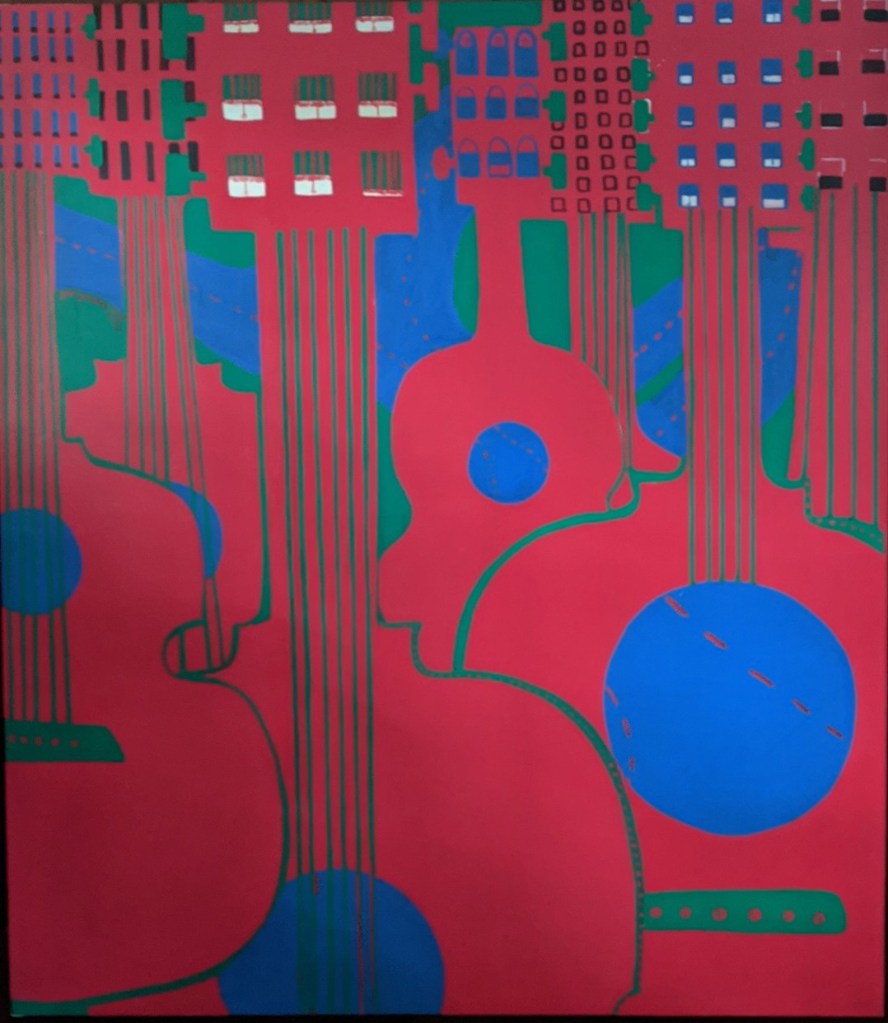
    Margaret Ellen Hackl, City Sounds, 1981, latex house paint on canvas, 60″x57″ in.

    Firstindigo&Lifestyle: What are your influences in different arts of technology, and the systems, which have an impact on your creation?

    EHF: For me, Color Field suggests an immersive experience of deep looking. Color Field has been a part of my development as a painter since 1981these paintings from 1981 are both full body size, which put me in full contact with responding to these contrasting colors when painting them, they literally would throw me off the easel as my eyes were having ocular severe reactions. I nicknamed them “retinal eye bouncers” for the punk era, these were a sympathetic relative to the music I was seeing live so colors spoke of sound, from the moment I began working in a flat, graphic style. Pop Art and Punk graphics were also a major influence at this time.

    EHF: My influences from technology all source from music since 1981. I have referenced punk music, early pioneers of abstract, electronic music like Morton Subotnik, the fluxus influences dating back as early as Dada and Schwitters to John Cage, to Frank Zappa, to Brian Eno and David Byrne. The systems tend to be based in the arts, but many have application in the sciences as well. 

    Firstindigo&Lifestyle: How about the collaborations you have created with musicians and composers?

    EHF: These collaborations have come to me since 1981 as well. Most composers/creators of music, see a relationship in my work to sound and are always eager to join me in my projects, musicians are natural collaborators, so it has been a path rich with artists to work with. 

    Firstindigo&Lifestyle: I remember you having an installation at the New York Public Library, how did this project succeed in terms of audience response?

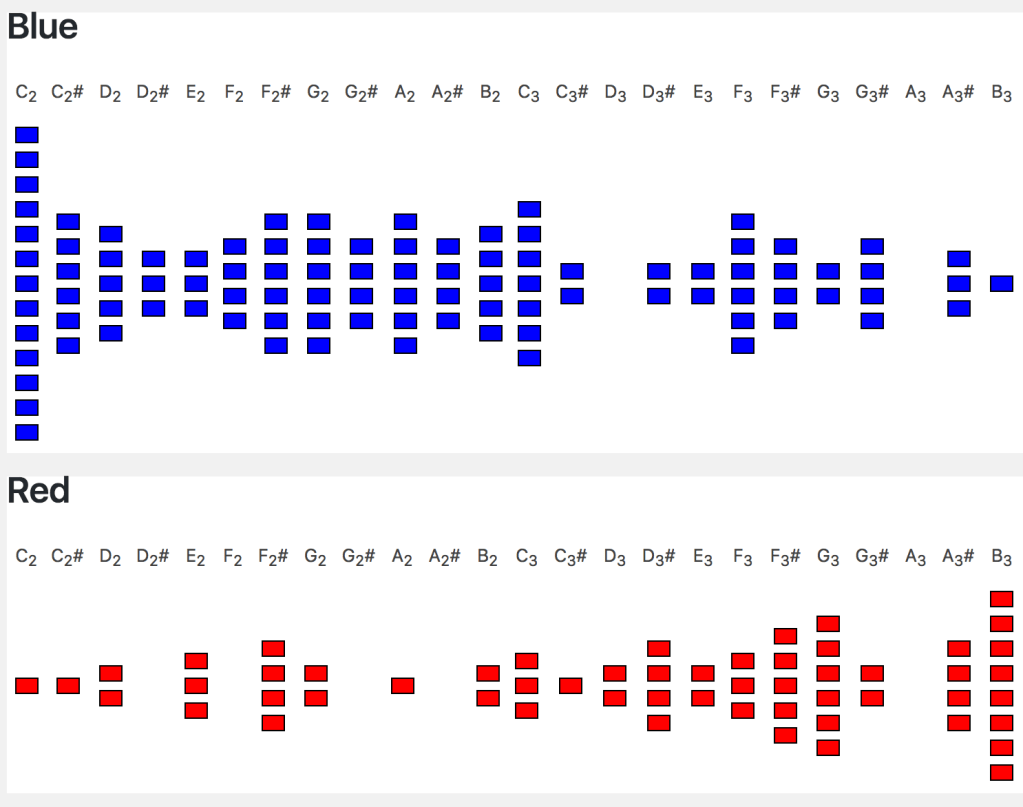
    EHF: I was invited to share a panel with two guest artists, of my choosing. As we all focused on the relationship of sound to color, and vice-versa, I asked the audience to play the Reverse Color Organ all together. We focused on blue and their responses when asked to pair a sound to the color looked like this, then I asked for red. You can see their results pretty much feels like common sense. I would like to collaborate with an institution or a person to gain a lot more viewer input  for the Reverse Color Organ

    Ellen Hackl Fagan, Riverse Color Organ.


    Firstindigo&Lifestyle: Your interest is very much also in the musical and sound aspect of the work. The blue color can have almost symphonic qualities. Do you feel this way?


    EHF: Yes, I am a product of a long history of rock and roll, punk, and some dabbling in jazz and world music especially growing up seeing punk bands and following certain bands over the past three decades. Music is a direct influence in my work.

    Firstindigo&Lifestyle: Could you tell a little more about your recent exhibition, and a project called Helpless?

    EHF: I was thrilled to be invited to create a solo exhibition for Five Points Center for the Visual Arts. I was asked a year ago. As COVID-19 took over our lives and the galleries and museums all closed, it wasn’t certain when this exhibition would open. I give them a ton of credit for staying on time with their programming during all this chaos. It has been a great experience working with them. 
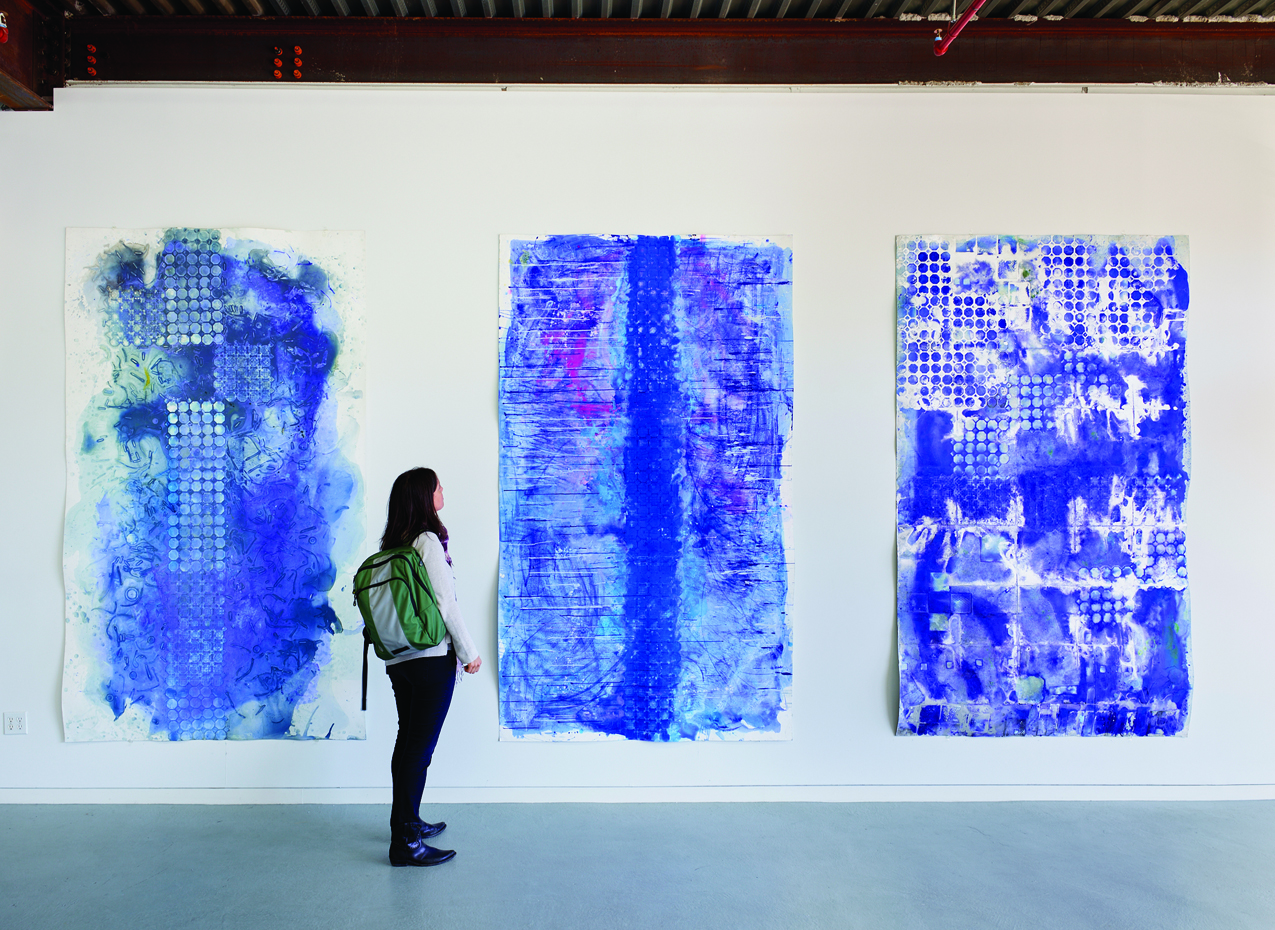

    For Helpless, I began working in the studio in early May in the early night sky there was a congruence of Jupiter, Saturn, and Mars. This was visible to me when we took a Mother’s Day hike in a local park where we were finishing up as it grew dark. We all talked about which planets these might be, etc. These burned in my visual memory as I was painting, and then the song Helpless flooded my mind as well. It became a meditation of sorts, and the title felt right for the exhibition. I’m a real fan of Neil Young’s music, since my teens, it was comforting having his voice in my head. 

    Firstindigo&Lifestyle: COVID-19 has changed a lot of the daily practices. How have you experienced this time in your life?

    EHF: I run a gallery, which has now morphed into three distinct new projects, in addition to my solo work. If given a full time assistant, I’d really get on top of my work load. Mainly, I miss having the freedom to get together with family without a litany of interview-like questions but we’re working it out. I’m finally going to see my mother, who lives in the Midwest, and I continue my work commitment in and out of our recent quarantine periods. Otherwise, I’m staying healthy and patient that we will get through this pandemic. I paint in my garage, and am happy to have carved out this work space last summer. It is my source for happiness, the studio, and I’m thankful for this.

    Ellen Hackl Fagan Studio view. Seeking the Sound of Cobalt Blue, Big Blue, 2020, pigment, acrylic, museum board, FV, 108 x 60 in.

    Featured image: Margaret Ellen Hackl, The Floozies vs the Force, 1981.
  • Jocelyn Shu on sculpture and identity

    Jocelyn Shu on sculpture and identity

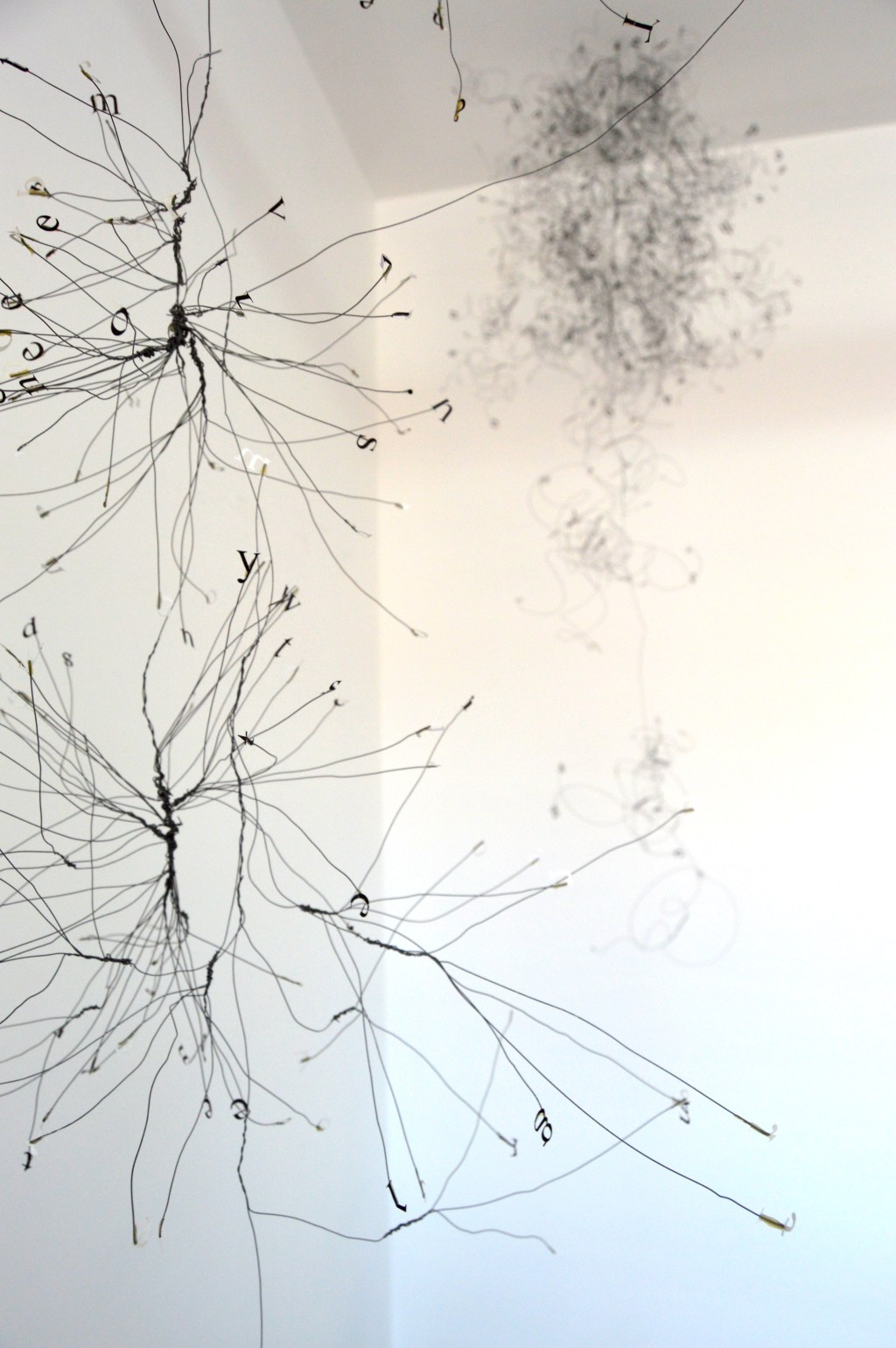
    Jocelyn Shu is an Asian American artist whose wire sculpture installations draw from the philosophical texts of the Tao Te Ching. The sculptures walk you through chapter by chapter, and the aesthetic captures the essence of language and thought through visual forms. She is also a researcher in psychology, which has inspired her interests in exploring the visual aspects of language. While self-isolating during the pandemic, she has created work responding to the changing environment.   

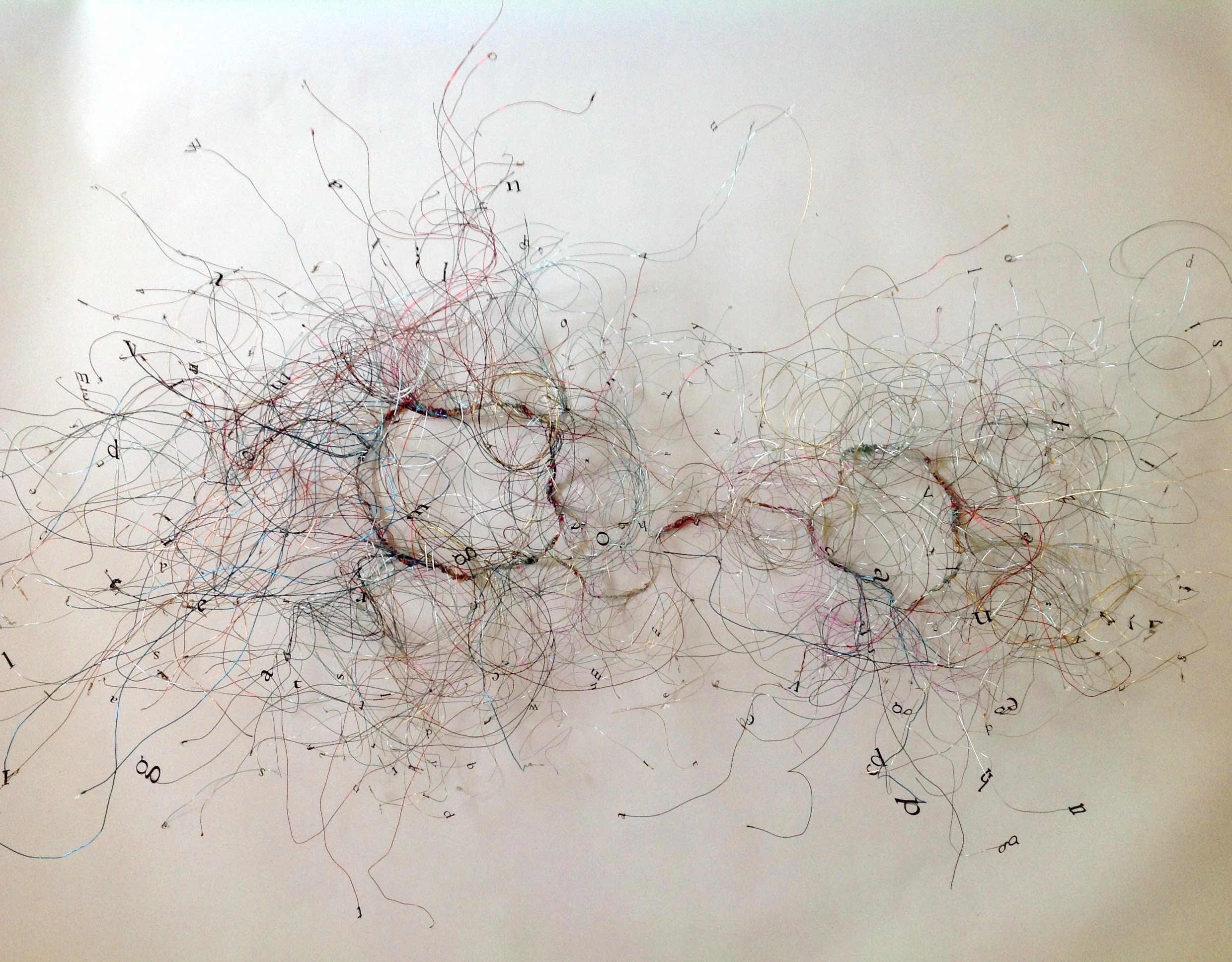
    Jocelyn Shu, Installation2(Chapt1,2)
    Chapter 1, 84 x 16 x 16 in., wire, cut text, and glue, 2012-13 (front) and Chapter 2, 60 x 24 x 24, wire, cut text, and glue, 2013-14 (back).  The first two pieces in the series 81 Chapters.

    Firstindigo&Lifestyle:  I remember meeting you at the Flux Art Fair in Harlem a few years back. This was a great event, and it was an opportunity for artists working in the Harlem area. How many years did you keep your studio there?

    Jocelyn Shu: I maintained a studio in Harlem either in a separate space, or in my home, from 2013 until I moved out of New York City in 2019.  The years I lived in Harlem encompassed a lot of growth for me.  I feel very lucky to have been part of the art community there, and to have been in an environment where I was constantly inspired by the work of Black artists and artists of color who were exploring their cultural history and spirituality.  It was also a time when I sought to further understand my own roots, which included deepening my understanding of systemic oppression in American history and culture.

    Firstindigo&Lifestyle: What was interesting to me was that you as well were doing your research at Columbia University. You were hard at work with your doctoral thesis, and then wanted to create art as a balancing act. How did that plan work out?

    JS: I don’t think I would have been able to complete my PhD without also maintaining my art practice!  It has been important for me to have both channels of work to turn to and find inspiration in.  In both research and art, one often faces hurdles that seem difficult to overcome.  It has been productive for me to be able to turn to alternate creative channels, which can provide space and inspiration during these times.

    Firstindigo&Lifestyle: Has it been hard to keep up two practices, or do you think it is actually the opposite?

    JS: While there are definitely benefits to keeping up the two practices, it is not always easy to balance the two.  It can be difficult to have the time and energy to pursue everything that I am interested in!

    Chapter 13 (30x48x20in)
    Chapter 13, 20 x 48 x 30 in., wire, cut text, and glue, 2019. A piece the artist worked on while writing her dissertation.

    Firstindigo&Lifestyle: When you started doing art, you first studied the subject in the Bay area. Do you think of the Bay Area as your home, and has the place itself influenced your artistry? 

    JS: I was born about an hour south of San Francisco.  I grew up in that region immersed in the immigrant Asian communities there.  So, a large part of figuring out my identity during that time, as is the case with many who are part of immigrant communities, involved learning how to navigate multiple cultures: that of my parents and relatives (who are from Taiwan), that of being American, and that of being Asian American.  This is an ongoing journey for me.

    I stayed in the Bay Area for college, and majored in Painting and Drawing through a joint program held at the time between the University of San Francisco and the California College of the Arts.  I had wanted very much to attend an art school for my undergrad experience.  My parents placed an incredibly high value on higher education, but were opposed to this idea.  At the time, attending this program was a way to compromise on our different values by being at both of these institutions. Reflecting back, I think this experience left a lasting influence on me by allowing me to develop intellectual interests rooted in a liberal arts tradition while also cultivating a studio practice in the creative environment of an art school.

    I am not sure that I would consider the Bay Area my home now.  I feel I am constantly in a transitory state, traveling between different cultures, geographies, and intellectual and creative traditions.  I have a sense of feeling at home in different ways, in the various places that I’ve lived and visited.  However, the drawback to this is that there isn’t any one place where I fully feel at home, at least not in the current moment.

    Firstindigo&Lifestyle: Do you think that your fine art education defines what you chose to study after graduation?

    JS: Being able to pursue my interests in the fine arts during college felt like an incredible gift.  I loved having the time to hone my interests and creativity, and to be surrounded by artists who were passionate about their craft.  The experience fostered a deep curiosity to understand the world and humanity better.  In the following few years after I graduated, I focused on my painting practice, but also became interested in psychology.  I would read about it, as well as take a course at the local community college in my spare time.  This interest eventually inspired me to pursue the field further by moving to New York City and taking post-baccalaureate courses at Columbia.  With the knowledge and research experience I gained, I eventually completed my PhD in psychology there.

    Firstindigo&Lifestyle: As we look at your identity today, how did science eventually play so important role in your life? 

    JS: I have been doing research in psychology for about 12 years now.  I’ve learned over this time that science is a process in which our knowledge of the world is built slowly through accumulated evidence.  It is not a linear or straightforward process.  What is thought of as true can later be demonstrated to be false, and sometimes vice versa.  It has been a difficult journey at times, but I’ve appreciated the various ways in which the scientific process can cultivate one’s thinking, ranging from how one observes the world to how one interprets data, from how one clarifies their writing and thinking, to how one responds to criticisms of their work.  It can take many years for a scientific project to be completed, and I’ve gained an appreciation for work that is undertaken over such timescales.

    Firstindigo&Lifestyle: What is your art about, how would you describe it?  Do you find any similarities in your artistic practice and scientific research?

    JS: For many years, I have been working on a series of wire sculptures that are meant to be displayed together and adapted to the environment that they are installed in (you had seen some of the earlier pieces in this series at the Flux Fair).  I had the idea for this series shortly before moving to New York City in 2008.  At that time, I was in Taiwan to visit family and to reacquaint myself with the culture.  The pieces in this series are each comprised of text from a chapter of the Tao Te Ching.  The process of making these pieces involves cutting the translated words and letters from each chapter, and then incorporating them into wire sculptures.  These pieces take on various forms that hang from the ceiling or wall, or sit on the ground.  Working on this series is a slow, ongoing process.  I was not raised with religion, so it has been meaningful for me to connect with text that has an ancient history from the culture of my ancestors.  Working on this series has shaped how I view and respond to change in the world and in my life.

    Outside of this series, I’ve become more and more interested in considering the visual components of language, and in exploring various ways that language and art can intersect with each other.  I think this has stemmed from having to constantly develop my writing in the research that I do.  Other than this, I don’t think the similarities between my art and research manifest in a direct way, at least not yet.  People often point out that the forms of my sculptures resemble neurons.  This has not been conscious on my end, but it would make sense that elements from the work that I do in one field find their way into work that I do in the other field.

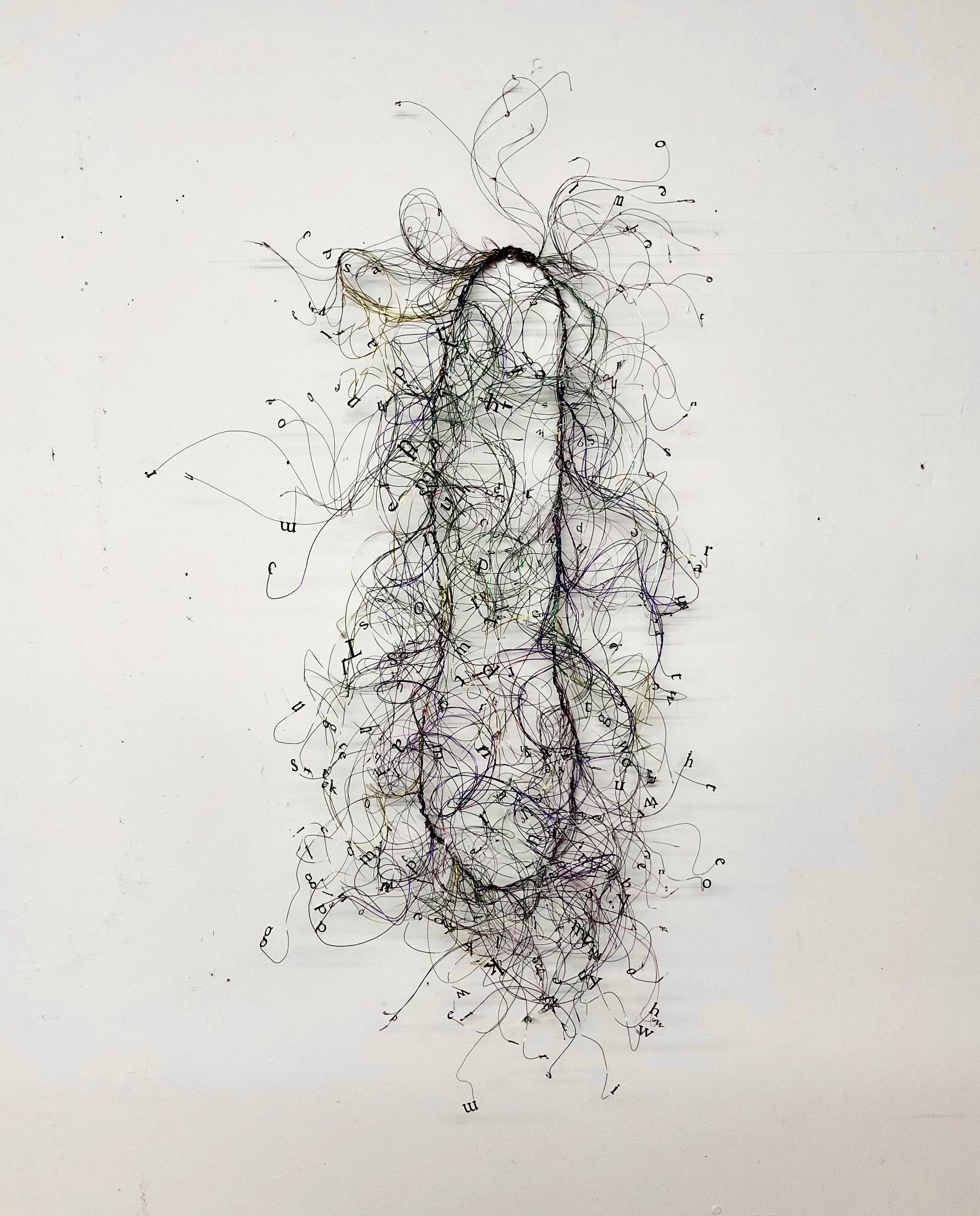
    Chapter 9 (detail 1)
    Chapter 9, 72 x 30 x 30 in., wire, cut text, and glue, 2017.

    Firstindigo&Lifestyle: You have visited and travelled in Europe, and met with artists there.  Do you have any opinions or experiences about how artists work in Europe versus in the US?

    JS: My relationship with visiting Europe, and traveling in general, started when I studied abroad in Florence, Italy, during my junior year of undergrad.  It is hard for me to make generalizations about how artists work in the US vs. Europe.  However, I do feel that art is more valued in many places in Europe, and more deeply intertwined into the fabric of society than in the US.

    Firstindigo&Lifestyle: As a postdoctoral fellow, you are currently based at the Harvard University. How is this environment different from your time in New York City? 

    JS: As I have been here for about a year, I am still processing my experiences in this new environment.  There are clear differences in that I am no longer in a big city, and the quietness of my surroundings seems to lead to a sense of having a bit more time.

    Firsindigo&Lifestyle: The current COVID-19 pandemic has changed our daily lives in so many ways. Have you found this time altering?

    JS: I have been going through different phases.  During some weeks, the isolation has allowed me to focus on my work and explore different creative paths.  During other weeks, it has been hard to concentrate on work amidst the societal upheavals we are facing.  It is understandable and necessary that attention during these times should focus on the pandemics involving COVID-19 and racism in this country.

    Firsindigo&Lifestyle: Do you think that going through self-isolating has initiated new art as well?

    JS: Yes, I have turned to drawing and making small pieces for the immediacy that working in this medium and format provides.  Doing so has allowed me to respond more rapidly to changing events from day to day.  I have also continued to work on the series of wire chapters.

    Jocelyn Shu, installation view.
    Chapter 15, 32 x 14 x 10 in., wire, cut text, and glue, 2020. A piece completed while self-isolating.

    Firsindigo&Lifestyle: Have you exhibited someplace recently?

    JS: I recently had a small drawing in an online show at Gallery 263, a non-profit art gallery in Cambridge that had put out a call for local artists in Massachusetts to submit work as a way to gather the arts community together during the pandemic.

    Firsindigo&Lifestyle: Do you have any specific plans for the future, in terms of your research and artistic practice? 

    JS: I am constantly exploring ways to combine the different interests I’ve had in my life and career.  I have a feeling it will be a lifelong pursuit!

    Firsindigo&Lifestyle: It would be nice to hear what kind of late summer and early fall ideas you have?

    JS: It is hard to say for sure in this tumultuous time!  On the research end, studies for the foreseeable future will need to be run online, in accordance with safety protocols in response to the COVID-19 pandemic.  As usual, I am looking to establish a routine with this work and my studio practice.  My current studio is located in Somerville, in Vernon Street Studios, which houses multiple floors of art studios in a large foam factory.  As I mentioned, I have been exploring new ways of combining language and art, a process that has been inspired by the literary tradition in the Cambridge area.

    While I feel very lucky to have all of this in my life, and to have been healthy and safe throughout these difficult times, I am also hoping that there will be a way to reunite with my partner, who is currently based in Germany.  As I’m sure many others are also experiencing, travel restrictions have prevented us from being together.

    Jocelyn Shu_studio_2020
    Studio view of artwork in Somerville, MA.

  • A shock of an image: Are we going backwards?

    A shock of an image: Are we going backwards?

    There is a test for a humankind, which is almost beyond measure. Health crisis with the current pandemic, too little or complete lack of solidarity for the #blacklivesmatter, environmental crisis, climate emergency: you name it, we almost seem to be moving backwards. To try to locate it in a visual-literacy sphere, it appears like a shock of an image. A complete inaccuracy of any portraiture of a situation. Yet we must.  We need to find new images, create new existence for love and peace, and keep on finding creative solutions for our planet.

    Artistic practices and curatorial interventions are still valid ways to express movement forward. They show legitimate approaches to voices speaking against structural injustice and discrimination. The power of art is that it can change our perceptions and attitudes. It can inform us. It can take a stance, which is strong, shocking, and informative at the same time, for example about refugees in the world. In the #blacklivesmatter movement, new curatorial openings can be made, and more voices will be put on center stage, so stories will be heard and seen. Not forgetting that gender equality is still a dream in the global art world.

    The environmental crisis needs more of our attention as well. How to navigate a jungle of opinions in this world and speak in a creative, artistic and curatorial manner about the climate emergency. Relying on ‘safe’ structures, and displaying ice cubes that are melting on concrete in front of our eyes. Are we running out of ways to create imagery of a crisis? ‘A shock of an image’ of something that would be a gathering of species dying, a globe that was burnt, and/or left behind without mankind, a nature that is not natural as we know it, but could be imagined as anthropocene. We did it already.

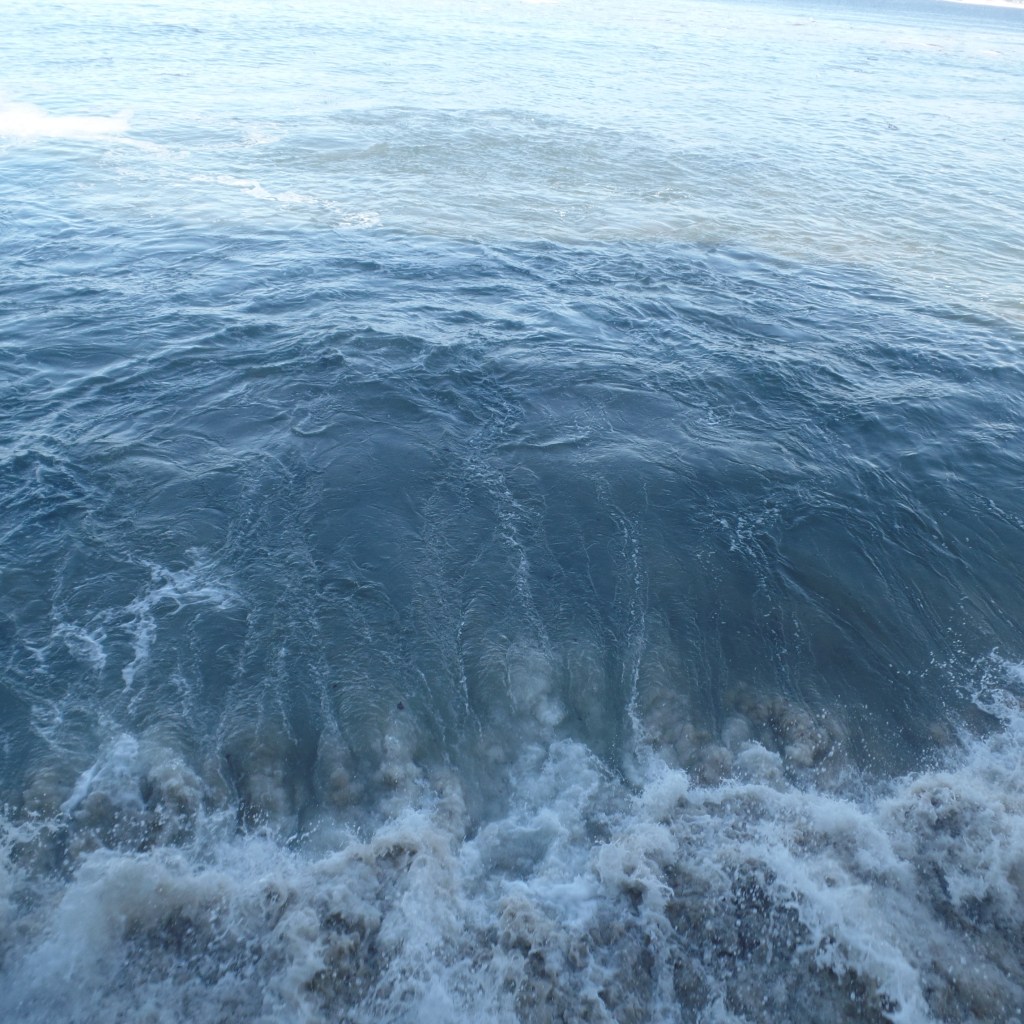
    Water crisis, a water scarcity and the inequality that it creates in the world is almost unparalleled. A Quarter of Humanity Faces Looming Water Crises, is a great article published in New York Times giving an introduction to the problem.  Climate change creates a high risk to water resources in places that have experienced enduring droughts. Water reserves are running out in hot and populated industrialized areas. For example, the clothing industry uses groundwater in Bangladesh, and creates a severe problem for its people. Mexico City is sinking after using its relied water resources. In Mexico City, the Zócalo, the main square in the historic city centre, is at a lower elevation than ancient Lake Texcoco; the city was built on its basin.

    Global fresh water scarcity can be caused by droughts, a lack of rainfall or simply pollution. Will our experience economy stop from creating more pollution in the future? ‘Backwards’ is a metaphorical attest to imply that shock doesn’t come without imagery.

    This year, World Environment Day on June 5, 2020, celebrates biodiversity. The mission is to educate people that with one million species facing possible extinction, it is now time to focus on biodiversity. Biodiversity can be imagined in the world’s forests or oceans, for example. We can safeguard the nature they provide, and prevent extinction.