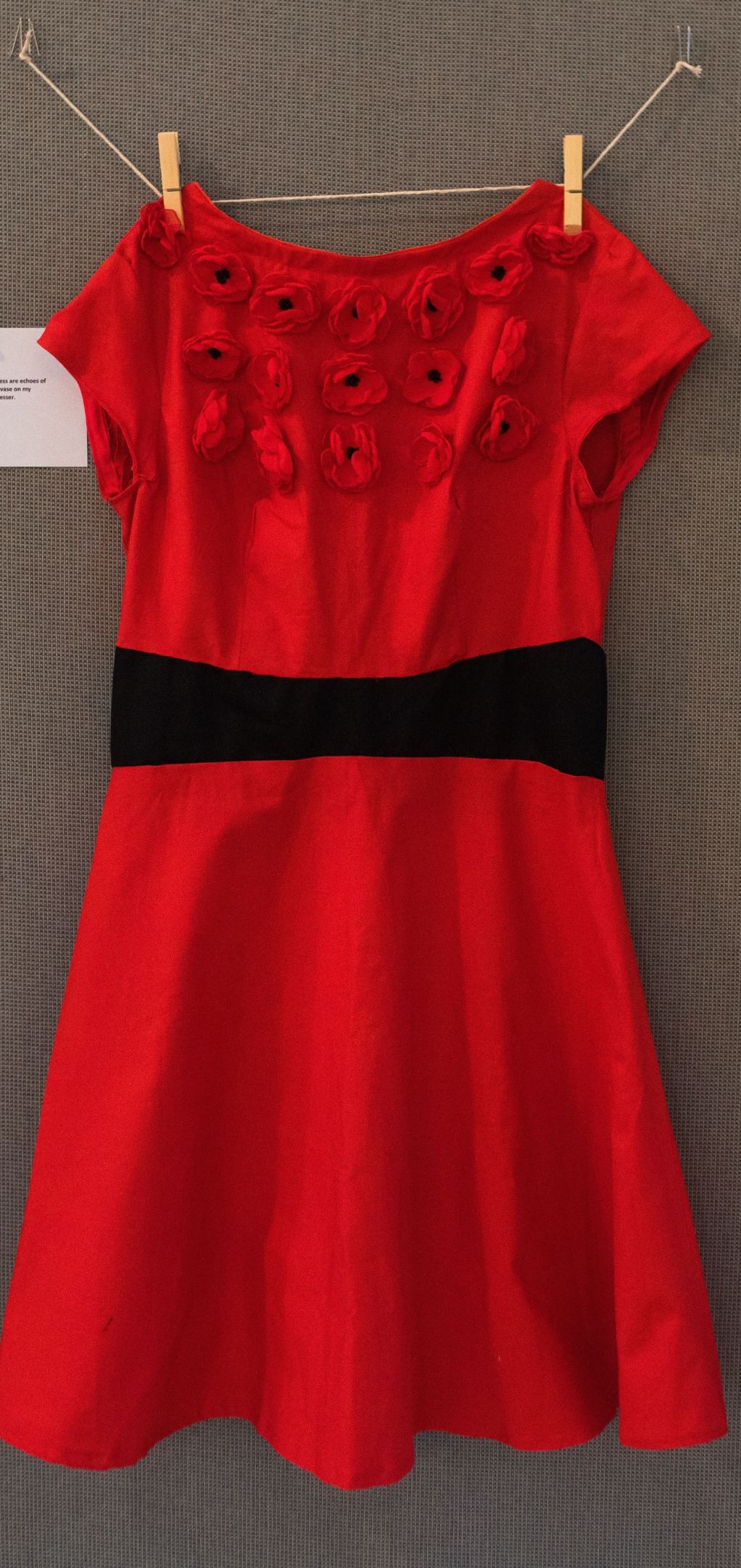
In 2018, a New York City poet Olena Jennings created poetry based on her family’s stories, attempting to visualise photography with words. The poems that resemble photography, carry them as frameworks of memory. In Olena Jenning’s THE MEMORY PROJECT:The memory comes before the poem. The poem comes before the art.
“I chose ink and paper for the poems. I chose fabric for the art. The poems are a small slice of time in which I experienced memories, many based on photographs in my grandparents’ photo album. I experienced the memories in 2018 and they were embellished by memories I was creating as I lived.”
Red and blue on the dresser,
dust in the folds,
stretching towards the dim lamp.
Click of lipstick cap,
spritz of perfume,
snap of purse,
and she will turn the light off.
The flowers will wither
into their dreams
and I will put my lips
into their centers,
ready to blow away pollen.
The yellow dust caught in my eyes,
when I see for a moment
from her perspective, I look out
onto the yard. I see myself
throwing a rubber ball into the flowers,
crushing their petals,
the place where I convinced
my little brother there was a snake,
there was something to fear.
To make up for my deception,
I gave him one of the plastic flowers,
deceiving him again, pretending
I bought it at the corner gas station
from which we had collected all
of our dishes with the points we got
from pumping gas. I want to make up
more than that now—absences
when I would become like that yellow dust,
a quiet star.
Olena Jennings, Map Dress, installation view. Photo: Elvis Krajnak.
PAPER MAPS Olena Jennings
Even flat maps have texture.
They carry with them
someone’s memory of the streets.
I will walk near the water
to draw the places off the map
on the palm of my hand.
We used to make paper
out of recycled letters,
rough, imperfect,
for a moment – wet,
on our knees
ripping
We mark our way to the castle
with the handle of a shovel.
We could live inside
our fairytale, find our way
despite the sand
in our eyes.
Poems and dresses by Olena Jennings. Photos of the dresses by Elvis Krajnak.
Finnish contemporary composer, oboist and music pedagogue Riikka Talvitie is an artist greatly influenced by her audience. She believes that the audience and community have an impact so important that there is a need for new notions of authorship and agency in music. Her compositions are brought into practice in performances, and so the discussion of the community’s role in collaboration is relevant. As a woman composer, Talvitie also wears an activist hat in society. Women are still in the margins as art music composers.
There are topics and ideas that Talvitie is ready to discuss more, and she collaborates with artists of many genres. She is currently in the process of doing her artistic doctorate in music at the Sibelius Academy, University of the Arts in Helsinki.
Firstindigo&Lifestyle: How did you pick oboe as your instrument?
Riikka Talvitie: As a child, I lived in Kerava, in a small town near Helsinki. When I was seven years old I started to play piano in a local music school which was founded in those years. (This autumn I am composing a piece for the 40-years celebration.)
When I was around 14-years old I asked our music teacher if I could start to play oboe in a school orchestra. In the orchestra, there was also an older student, oboist, who started to teach me. I didn’t know how difficult it was to start the instrument.
Later after school, I did entrance examination for Sibelius Academy with both instruments. I got in with oboe, which was a sort of coincidence. I also started to read mathematics at the University.
Firstindigo&Lifestyle: How much did your own instrument define and influence your creations in the early face of your career?
RT: I just did a video work Self-Portrait which is dealing with this question. The main thematic issue of the work is a relationship between a composer and a musician. I am performing both persons at the same time, so I am discussing with myself. I am also improvising some bodily exercises with the oboe. (See the video here https://fmq.fi/articles/composer-at-work-a-critical-self-portrait)
Firstindigo&Lifestyle: What else in your musical training and background created who you are, and what made you choose composing?
RT: I chose a high school, which was specialized in performing arts. All my friends had something to do with theatre, cinema, literature or dance. So while I was studying oboe playing I composed and improvised music to theatre plays and short movies. I was quite enthusiastic with these projects so I took composition as a secondary subject.
I was also quite interested about contemporary music in general. I played myself a lot and I was visiting many festivals.
Firstindigo&Lifestyle: How many years ago was this, and how has your career path evolved?
RT: I had my first composition lesson in 1994 in a summer course with Jouni Kaipainen and Magnus Lindberg. At that time I had lots of ideas and plans but no craftsmanship or technical skills. After the course I started to study really seriously.
The world might have been a bit different place in the 90’s because I was able to study composition quite long at the Sibelius Academy after I had graduated with oboe.
I have also been twice in Paris. First time I was studying oboe and composition at the conservatory of Paris. And the second time I was following one-year-course of music technology at Ircam.
Finally when I got my first child, in 2004, I stopped playing oboe because I didn’t have time to practise and travel anymore. In the video work I am quite strict to myself and ask: why did you stop playing? You did not think about your career? The answer is not that simple. This autumn I have some oboe performances coming so I am still dealing with the same question.
Firstindigo&Lifestyle: What words describe your music?
Firstindigo&Lifestyle: What kinds of themes do you usually develop in your compositions?
RT: Many themes and interests have changed during the years. When I was younger I got excited with mathematical ideas. Abstract world without social intrigues fascinated me in many ways. Then I have worked a lot with texts – poems, plays etc.
Nowadays, I am more into political and critical themes. I have a feeling that concert music is repeating some kind of old ritual where the most creative ideas are forbidden. Many things are not allowed, socially and aesthetically. I find this quite contradictory to the main purpose of art.
At this moment, my goals are more interactive and communal. I am preparing an artistic research about shared authorship and communality in a composer’s practice.
Firstindigo&Lifestyle: Are there ways to categorize contemporary music? Do contemporary works differ from modern music, say in tonality, and in aesthetical ways?
RT: I just read an interesting book Music After the Fall: Modern Composition and Culturesince 1989 by Tim Rutherford-Johnson. The writer argues that contemporary music is not anymore so much linked to modernism as we tend to think. instead, it should be analysed in the context of globalization, digitization and new media. He starts the new era from the year 1989. I recommend this book to all composers and musicians who are trying to define the state of contemporary music scene today.
I see some trends among composers. The growing use of video and multimedia is now very common in concerts all over. Also the question of material is changing. In modernism a composer created his/her own material on which the composition was built. Now, there is more liberal relation to musical material which can vary from different musical styles to short samples of already existing music or sound.
One of the most important changes is the effect of social media. All the composers are marketing and presenting their works openly in the internet. It gives composers freedom to find their own paths but on the other hand it feels like a global competition of recognition.
Firstindigo&Lifestyle: Does being a woman composer mean something special to you?
RT: Yes, it means a lot. I am a feminist, in a way. I strongly support equality and diversity in the society and correspondingly in the music field.
These values are unfortunately missing in the project of canonizing composers and art works. I am interested in artists who are left outside the canon. A year ago, I was presenting a work by Ethel Smith, a British composer from the beginning of 20th century. She was not mentioned in our music history classes in my youth. And how many others are there?
While doing my artistic research, I have many times wondered why the different waves of feminism haven’t left almost any imprint on art music composition. In Finnish composers society there are still only 10 % female composers. If we think about what happened in performance and video art in the 60’s and 70’s there were lots of artists participating in the happenings for sexual emancipation. At the same time, among contemporary music we just invented new composition techniques 🙂
I have also considered this question while teaching. What values do we forward to the next generation?
Firstindigo&Lifestyle: Finland has a woman composing star, Kaija Saariaho, who is also well-known in New York City music world. Do you think she has developed a way for others to follow?
RT: Kaija Saariaho has an important role in Finnish music life, for sure, and in that sense her career is a sort of example for woman composers. She is also really warm and gentle person towards colleagues, especially for young students.
On the other hand, Kaija is presenting quite traditional image of a composer. Her career is based on international reputation, large commissions, prizes and so on. This position is actually quite hierarchical, and mythical.
There are plenty of artists who don’t want an individual international status. They want to work in working groups or in a pedagogical field. We are different. In that point of view Kaija is not a role model for all Finnish female composers.
Firstindigo&Lifestyle: What are your key influences as a composer, and how do you conceptually start your works?
RT: Every project is slightly different but I still try to give some concrete examples. I start every composition by discussion with other people who are involved. I try to figure out who is playing, what skills musicians have, what are the interests of a producer, what is the schedule, what else is performed in the same concert, is there a musical theme like era or an ideological theme like protection of seas etc. For me it is really important that musicians and performers are fully engaged in the big picture.
I also collaborate quite a lot with other artists. In those situations I normally wait a moment and listen to others. I feel that I have much to learn because contemporary music has been so isolated in the abstract world for a long time. I am also curious about ideas and opinions of my audience. Also different audiences like non-musicians, children, teenagers etc.
When I start to compose I spend a lot of time looking for suitable material for each situation. I sit at the piano and try out things. I look for certain ”constraints or boundaries” for each project. Almost always, I meet the musicians and give some sketches to play. Lately, I have increased to send demos while I am working, just to open up the process and get feedback.
I consciously think composing as an ongoing collaboration.
Firstindigo&Lifestyle: What is the composition process for you like, how long do you usually develop a work?
RT: I like to work slowly and develop ideas with other people.
Firstindigo&Lifestyle: How many solo instrumental works have you composed so far, how about chamber music and orchestral works?
My works in numbers:
– 4 operas
– 1 radio-opera
– 8 works for orchestra
– 14 choir works
– 18 songs
– 12–15 chamber works
– 5 solos
– 1 radiophonic work
– pedagogical works
– theatre projects
– short movies
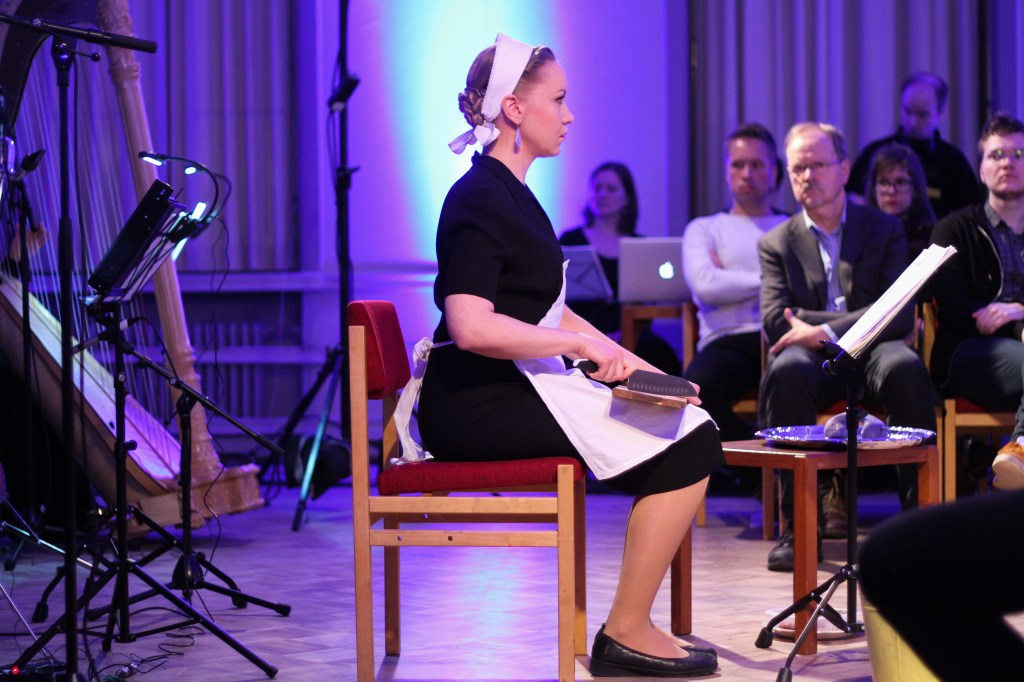
Riikka Talvitie (composer), The Judge’s Wife, Juha Uusitalo as the Judge. Photo Teemu Mäki, 2017.
Firstindigo&Lifestyle: Recently you have also worked with opera. Could you tell more about these projects?
RT: I have recently composed two operas. The first one is called The Judge’s Wife which is based on TV script written by Caryl Churchill at the time of IRA terrorist attacks 1972. The text deals with the power structures of social classes and the difference between terrorism and a revolutionary act.
The opera was carried out as a cross-art performance with some additional text and documentary video material by its director Teemu Mäki. The performance was closer to contemporary theater or live art than traditional opera. It included music, drama, videos, texts, humour and also a meal, vichyssoise soup, which is also written into the libretto (http://www.teemumaki.com/theater-judgeswife.html).
Riikka Talvitie (composer), The Judge’s Wife, Tuuli Lindeberg as Judge’s wife. Photo Teemu Mäki, 2017.
The second opera Queen of the cold land was a radio opera commissioned by Finnish Broadcasting Company (Yle-radio). The libretto is a sort of rewriting of the Kalevala – a present-day version of some abstract life situations. The aim of the working group was to look at the Kalevala from a socio-historical point of view. Kalevala is not qualified as a source of Finnish mythology because the mythical images of folk poems have been transformed and merged into new entities by Elias Lönnrot. Lönnrot’s goal was not only to collect poems and to propose them as a coherent epic, but the goals went together with the nationalist idea to create a common image of the past, customs and culture of the Finnish people.
The opera is dealing with several issues like diversity, sexual identity, nationality and naming. As a composer, I would state that the main theme of the musical narration is nationalism or rather the future of national states. This theme is presented in the musical material.
The music consists of orchestral music, chamber music, operatic and folk singing combined with radiophonic possibilities. The composition is based on a variety of materials. The most extensive material consists of national anthems by different states and people. In addition to these I use folk music, war songs, wedding anthems and lullabies.
Firstindigo&Lifestyle: In Finland, composers like Jean Sibelius are master voices in the classical music world, for their emancipatory approach of voicing national myths, and yet speaking to broad international audiences. Sibelius is a widely known European composer in the United States with his Finlandia, and Violin concerto. Has this tradition created a sense of your own status as a composer who has Finnish roots?
RT: As an answer to this question, I just tell that have composed a chamber opera called One seed, one sorrow – conversations with Aino Sibelius. Aino was a wife of Jean Sibelius. At least it was an other perspective to the question of national heroes.
Firstindigo&Lifestyle: We met in Lapland in 2007, while doing a nature piece in Pyhatunturi. Do you still get inspired while spending time in nature?
RT: I am really worried about nature and by that – also inspired. This year I work with several pieces which are processing nature and particularly climate change.
Last spring, I carried out a project called Heinä (Grass) with playwright Pipsa Lonka. It was performed in Silence Festival in Lapland. The performance contained images that a grass had drawn. I tried to read or interpret those images by composing them for bass clarinet and voice. The performance took place in an old cottage with smoke and a dog. The atmosphere was quite unique.
Riikka Talvitie at the Silence Festival, Hiljaisuus Festivaali, Day3. Photo Jouni Ihalainen, 2018.
Firstindigo&Lifestyle: Are you critical of your own work?
RT: Of course I am critical and I would like to rewrite all my compositions but I just don’t have time for that. So let them be…
As for the future composition, I have challenged myself to ask every time ”why do I do this piece”. I feel that every art project should have a reason or meaning or aim which is something more than a commission, a commission fee, reputation or a course credit. This goal can be both an internal musical idea or external starting point. It should be something that connects our work to the surrounding society.
Firstindigo&Lifestyle: Who gives you the best feedback?
RT: The best feedback comes from my children when they ask ”what on earth are you doing” or ”how awkward”.
Firstindigo&Lifestyle: What is the role of commissions in your work?
RT: The art funding is quite different here in Finland than in United States. Mostly I work with small commissions by different musicians, ensembles, choirs, orchestras or festivals. However, the main income of Finnish composers comes from the working scholarships.
Some of my works are collaborations with other musicians and artists. Then we apply funding together as a working group from different foundations and institutions.
Firstindigo&Lifestyle: Do you have specific plans for the future?
RT: I have plenty of plans for the future. In a near future I will finish my artistic doctorate that is about shared authorship and communality. For that, I still have couple of projects to compose. After that I will devote my time to activism.
Firstindigo&Lifestyle: How about dreams, perhaps international presentations and residencies?
RT: An old image of a composer with a wig is quite outdated. This image contains travelling and prestige. Luckily the world has changed – women and mothers can be composer too and they don’t need to represent ”a plaster composer”.
Mainly, I don’t travel. I work nearby. I am quite often at home in the afternoons when my children come home from school. And in the evenings they have hobbies. My plan – not a dream – is to spend time in residencies after my children are grown-ups. I just need to be patient because it will take ten years still.
I don’t dream about an international career, firstly, because I like my daily local life. And, secondly, because I am at this moment interested in subjects and working methods which are rather marginal in classical music f.e. community art, live art, performance and philosophy. These are not the themes of a grand audience.
I dream about ideological aims. I hope we will see the world where the terms of consuming, owning and competing are less valued. I also hope that there would be a turn in over-consuming that finally we are saved from dystopical eco-catastrophe. I am not that worried about my own career.
RT: I have a small activist inside me who says that we should listen to different voices. So I would recommend you some other Finnish female composers here:
Stephanie A Lindquist is a New York based artist and photographer, whose photo collages gather ideas of plants with world-wide origins. Her works bring forth anscestral memories from diasporic places, and create meaning mapping our global existence as travelers and settlers. Food has always played enormous role in peoples adaptation to new places, creating and sustaining cultures. Art can have as much to say about this subject too.
Firstindigo&Lifestyle: I have understood your recent photography art is based on your research on plants that are native, local or indigenous to areas. How did you start this art project?
Stephanie A Lindquist: I started gardening and reading about plants and how to grow them. I was especially inspired by farmer, philosopher Masanobu Fukuoka. He is the father of natural farming and a proponent of natural dieting–both of which he believed to be beneficial for the environment and human health. According to Fukuoka, a natural diet consisted of local and preferably ancient plants–something nearly impossible for any urban dweller like me to accomplish.
This sparked my interest in identifying and promoting many little-known indigenous food plants from my ancestors in Africa and Europe, to where I currently live in the Americas.
Firstindigo&Lifestyle: Where did you grow up, and live prior to New York City?
Stephanie A Lindquist: I grew up in Los Angeles. I’ve also had opportunities to travel abroad to Europe and Central America.
Stephanie Lindquist, Lablab oryza glaberrima celosia, 2017, Digital print on aluminum diode, Edition of 3, 4’ x 4’ ft.
Firstindigo&Lifestyle: As one major inspiration behind your art making are the plants, do you cultivate or grow plants yourself and have your own garden?
Stephanie A Lindquist: I garden regularly in East Harlem and the South Bronx. It is an essential part of my practice and life. Gardening allows me to cultivate, consume and appreciate some of the plants I study first-hand. It is a way to immediately begin creating a more reciprocal relationship with nature.
Stephanie A Lindquist, Okra at 103rd 2018 Photo collage, Edition of 5, 7.5″ x 10″.
Firstindigo&Lifestyle: Do you think that flowers, fruits and vegetables, etc. as subjects of art carry ideas about sustainability and environmental philosophical concepts?
Stephanie A Lindquist: Definitely. Potawatomi scientist Robin Wall Kimmerer writes about our need to listen, observe and learn from plants as our teachers–rather than only learn about plants. I truly believe that plants can teach us how to lead sustainable lives if we listen.
Cultures close to nature have the benefit of accumulating indigenous knowledge of a diverse number of plants and their uses than city-dwelling folks. To see, recognize and know thousands of local, indigenous food plants is a powerful way to live in communion with the world. By taking care of widely diverse plants within our local ecosystem, we begin to take care of ourselves too–physically and spiritually.
It is my aim to heighten our awareness and appreciation of indigenous food plants and to collectively reimagine the local cuisine of specific regions.
Firstindigo&Lifestyle: Are there other concepts and philosophies attached to your art?
Stephanie A Lindquist: My work is inspired by the work of many scientists including Mary Abukutsu-Onyango. Since the 90s she has been promoting the cultivation and sustainable consumption of African indigenous vegetables and fruits. On a continent plentiful with plants, it is surprising that most do not eat a sufficient amount of vegetables.
The promotion of these plants have commercial and cultural implications as well as physical and spiritual effects on our health. Most of these plants have been purposefully displaced by genetically engineered cash crops and changing tastes. To rekindle our relationship with the oldest, local plants is also to remember the unique history of the land and how we arrived here.
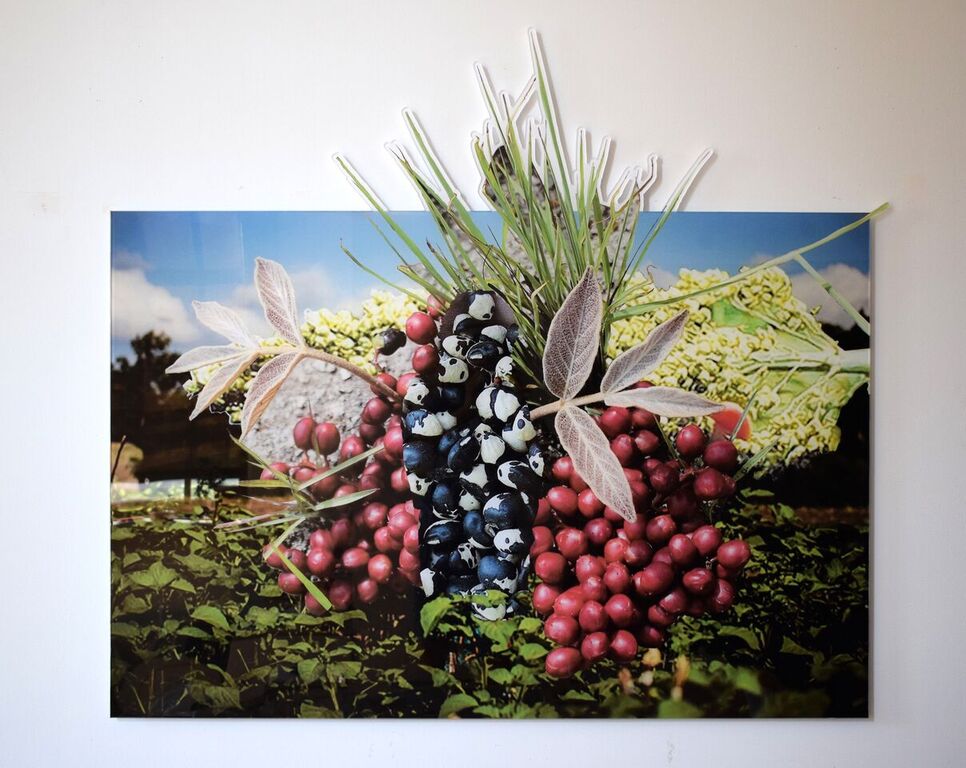
Stephanie A Lindquist, Cowpea Lannea Edulis Sorghum African Nightshade (East Africa) part of Founded series 2018 Digital print on acrylic 44“ x 50”.
Firstindigo&Lifestyle: Do people act amazed when seeing and hearing about your work?
Stephanie A Lindquist: It has been very satisfying to hear people’s reactions to my work. Even urbanites like me are full of surprising information about plants and their uses, which I happily add to my arsenal of knowledge.
As the daughter of a Liberian-American immigrant and descendant of Swedish and Irish immigrants, I have been invested in reclaiming ancestral knowledge for a long time. Conversing with others about indigenous plants has been a very satisfying way of piecing together our ancestral knowledge of the natural world around us.
Firstindigo&Lifestyle: Who inspires you to do your art?
Stephanie A Lindquist: I admire many artists including Julie Mehretu and Wangechi Mutu. I am also inspired by the authors I read and the emerging artists I meet everyday.
Firstindigo&Lifestyle: How do you design your collages and what is the process like in making photographic prints?
Stephanie A Lindquist: I begin by researching a number of indigenous plants to a specific region and learning about their history, uses, and the people who cultivate them. Next I collect images of them, and if accessible take original photographs of the plants.
I cut the prints by hand and arrange the composition on a smaller scale until satisfied. Next, I digitally produce and print the collage at a larger scale or sometimes hand-cut a larger collage on fine paper.
Firstindigo&Lifestyle: Tell a little more about yourself, where did you study art?
Stephanie A Lindquist: I have studied art since I was little. I received by BA in Urban Studies and Visual Arts from Columbia University. Since then, I’ve had the opportunity to participate in residencies in Rome, Berlin and Staten Island, and to exhibit my work in museums and alternative spaces in New York and California. I also work as an arts administrator.
Firstindigo&Lifestyle: Your objects and prints seem to carry domestic ideas in them, or it gets transmitted as a feeling with the coffee cup on a table, or with the flowers. Does this resonate with your intentions?
Stephanie A Lindquist: Yes, my previous body of work in photo collage was concerned with capturing colorful, jarring, domestic still lives. I often chose the materials used to create the stage in memory of family and friends in my life, like my mother, my partner, or a particular place like the Kitchen Floor. Through collage I bring new meanings to these objects, in this case now where an okra blossoms and fruits. Their patterns are playful, somewhat minimal, abstract, full of textile, and tactile.
Stephanie A Lindquist, Kitchen Floor 2017 Photo collage 14.5“ x 17.5”.
Firstindigo&Lifestyle: Some collages of yours are really colorful. Do you find that colors have significance and carry meaning?
Stephanie A Lindquist: The colors reflect my mother’s textiles, family photographs, and the landscape around me.
Firstindigo&Lifestyle: Do you consider yourself similar to feminist art practices in which domestic life and the everyday gives to details and form in the art?
Stephanie A Lindquist: Yes, in many ways I make my art to create space for feminism and equality among humans and all that lives in the world. I treasure these often feminized spaces of the home and garden. And I enjoy propagating this image into my viewer’s subconscious of a plentiful, sustainable earth.
Firstindigo&Lifestyle: Also your knitted objects would signify not only sculptural dimension as objects that hang on the wall, but also about art-historical connection to the women artists?
Stephanie A Lindquist: The knitted objects Needles and String and Rosary for me were living sculpture–something I could create and disassemble again and again as a public performance and private meditation.
Firstindigo&Lifestyle: How do you separate your own artistic practice from curating, and working with other artists in your work?
Stephanie A Lindquist: I make time for it. I also let it bleed into my research interests and writing. My practice gains a lot from being in such close contact with artists and curators on a daily basis. I am constantly listening to and collaborating with other visually creative minds.
Firstindigo&Lifestyle: Can you describe what art projects are you planning for the future?
Stephanie A Lindquist: I am thrilled to show recent work around indigenous food plants at Smack Mellon as a part of AFRICA’S OUT! inaugural benefit exhibition, Carry Over: New Voices from the Global African Diaspora curated by Kalia Brooks Nelson. To have my work in the context of Firelei Báez, Layo Bright, Melissa Calderón, Baseera Khan, Jasmine Murrell, Anna Parisi, Keisha Scarville, Pamela Phatsimo Sunstrum and Saya Woolfalk is a joy!
I am also looking forward to presenting work at CTRL+SHFT Collective in Oakland this summer. Other than that, I’m excited to spend part of the summer camping and learning more about plants indigenous to the eastern seaboard.
I treasure these often feminized spaces of the home and garden. And I enjoy propagating this image into my viewer’s subconscious of a plentiful, sustainable earth.





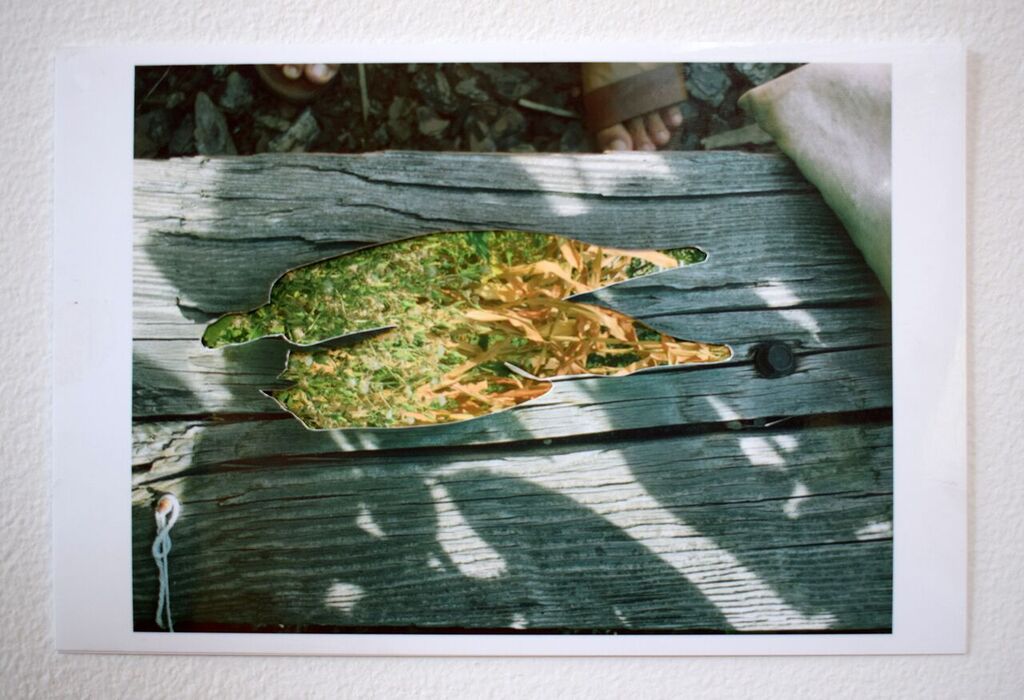

 Stephanie A Lindquist, Kitchen Floor 2017 Photo collage 14.5“ x 17.5”.
 Firstindigo&Lifestyle