Tag: fine and contemporary art

  • Linda Cunningham’s Whose Land? Whose God?

    Linda Cunningham’s Whose Land? Whose God?

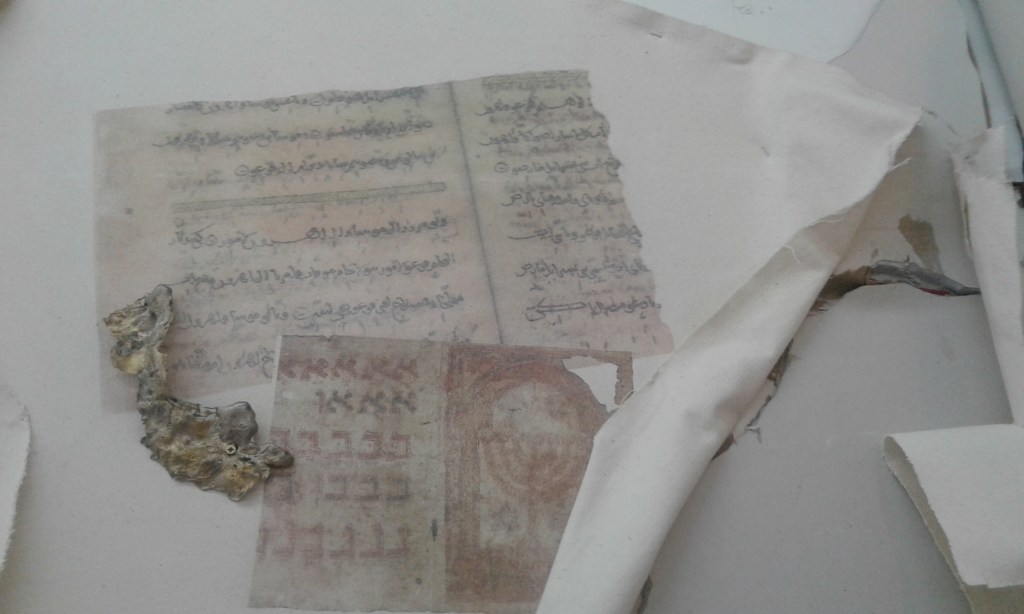
    Linda Cunningham’s sculptural installations speak many languages. Much of her recent work has been tapping into environmental specificity relating to the South Bronx waterfront. The artist has explored a topic of climate change in urban environments. Through July-August, Cunningham has her solo exhibition up in Brooklyn at the celebrated ODETTA. The current show features a large installation of her sculptural pieces well put together with drywall photo collages, both mediums that Cunningham frequently works with. This time Cunningham’s exhibition features textual patterns as mixed media works. The images display historic texts, which carry references to three monotheist World religions (Judaism, Christianity, and Islam) in earlier times when the cultures co-existed peacefully, a scenario impossible to imagine now. Many of the texts seem to be fragments that have been saved, depicting religious writings in Coptic, Hebrew and Arabic. The title of her exhibition: Whose Land? Whose God?, also includes remnants, which the artist acquired from the Berlin Wall in 1989. As the artist herself is well-traveled, behind the exhibition story is an expedition.

    Firstindigo&Lifestyle: Let’s talk a bit about the bronze as a material in the exhibition. As I understood, you were running your own bronze workshop in Pennsylvania? 

    LC: As a young professor at Franklin & Marshall College, I was challenged to create a bronze casting facility to make use of a very old oil burning furnace that a former professor had acquired for the sculpture facility. Enthusiastic art students and guest professors helped me build the facility and develop the expertise to do traditional bronze casting which I later taught in Advanced Sculpture classes. I eventually ran some women’s bronze casting weekend workshops which was wonderfully empowering for the participants who never had had such an opportunity.

    Firstindigo&Lifestyle: About the process of pouring the metal, how do you create the movement so evident in your sculptures. What is the methodology behind the pouring, and using sand in the process?

    LC: I eventually became interested in much more experimental casting methods that sculptors like Isaac Witkin were using, pouring bronze in single sided shallow molds filled with foundry sand. I developed the technique of pouring long thin forms that record the flow of the hot melted bronze. The bronze freezes the flow patterns and splatters creating the highly textured surface as it solidifies in seconds. Early on I found a way to acquire scrap military bronze and was using these lacy bronze forms to create 11 ft high shells of figures I called “War Memorial.” I thought of them of as vulnerable survivors. Five of those bronze images framed the entrance to the City University Graduate Center when it still stood for many years on 42nd St across from Bryant Park. They are now owned by Grounds for Sculpture in Hamilton, New Jersey.

    detail_panel_wire_nails.jpg
    Linda Cunningham’s innovative bronze becomes part of a drywall sculpture.

    Firstindigo&Lifestyle: Your exhibition Whose Land? Whose God? is inspired by an exhibition that you saw in Germany, when and where did this exhibition take place?

    LC: The text Images were taken from the catalog of an exhibition I saw and was deeply impressed by in Berlin, 2015 titled: ‘One God: Abraham’s descendants on the Nile. Jews, Christians and Muslims in Egypt from late Antiquity to the Early Middle Ages’ at the Staatliche Museen zu Berlin, known as the Bode Museum on the Museum island in Berlin.


    Firstindigo&Lifestyle: How many texts, including a variety of liturgical, bible & prayer books, are there included in your exhibition? 

    LC: I used 16 different examples. Many more were included in the exhibit in Berlin.
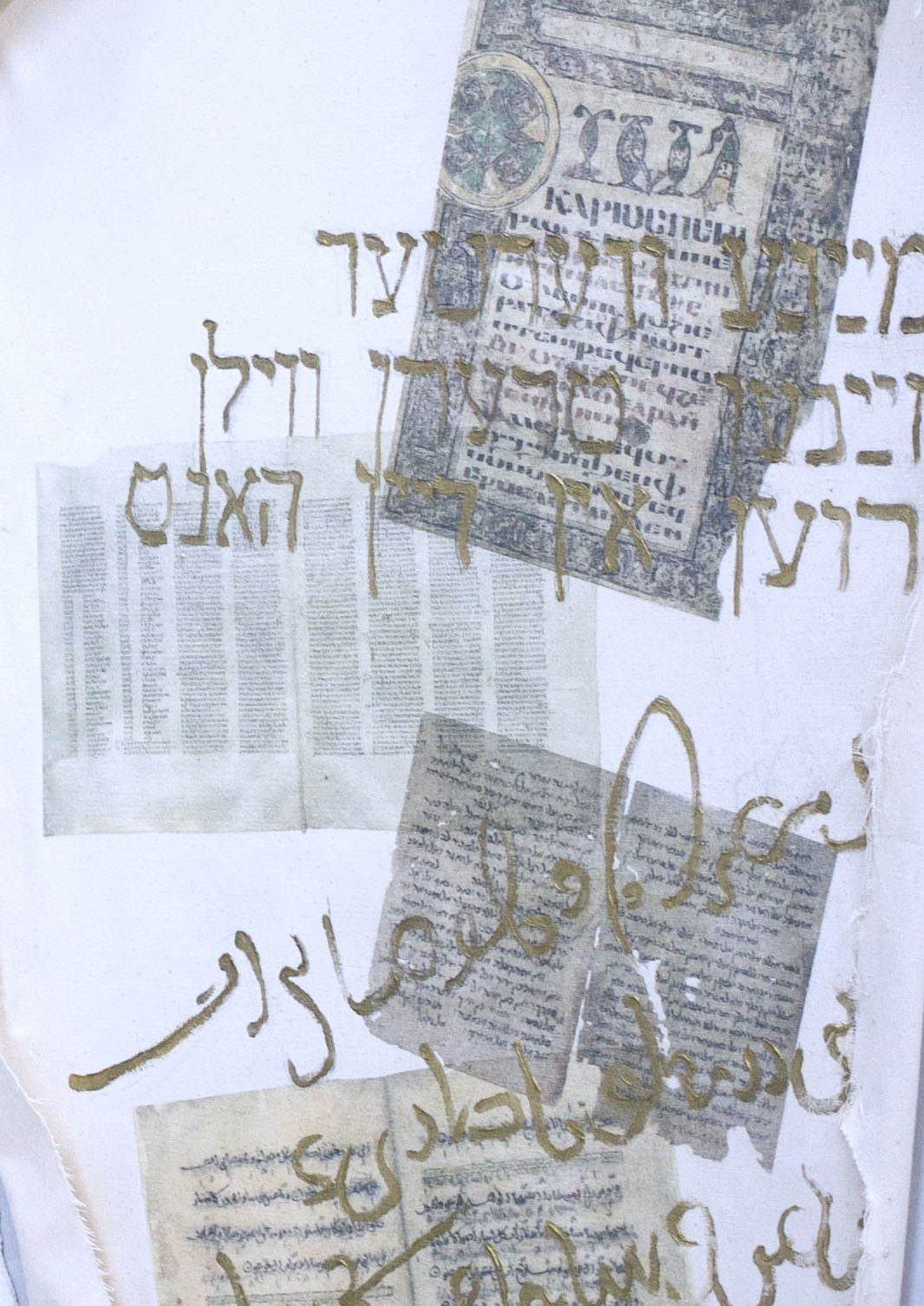
    Detail of Coptic and Hebrew.
    Linda Cunningham, installation detail at ODETTA. Textual imagery is relevant to early history of three monotheist World religions. Often saved as fragments like this.

    Firstindigo&Lifestyle: How about the pieces in the exhibition that you acquired from the Berlin Wall, what is the story behind them?

    LC: I was invited to create a sizable installation in an alternative arts factory building in Kassel as an alternative documenta exhibit in 1992 about 2 1/2 years after the wall had opened up. A man who worked in the factory that was sponsoring the project took me to the town where he lived that was just over the former border where mountains of posts, fence, electrical cable and barbed wire were assembled as they dismantled the border that reach across the entire country. They were happy to have me take what I could fit in his van and charged me 50 Deutschmarks. The elements fit perfectly into the theme of the installation I was working on at that time.

    Firstindigo&Lifestyle: How did the transportation of the wall pieces take place, literally from Germany to the US?

    LC: When the exhibition came to an end after 90 days, I couldn’t bear to throw them out and storing was also prohibitive. My German friends helped me to get crates built and one friend drove the crates to Hamburg to get them loaded on a freighter. I picked them up with a van at a New Jersey port outside Newark. I always intended to exhibit them again and they have been schlepped from one studio to the next ever since.
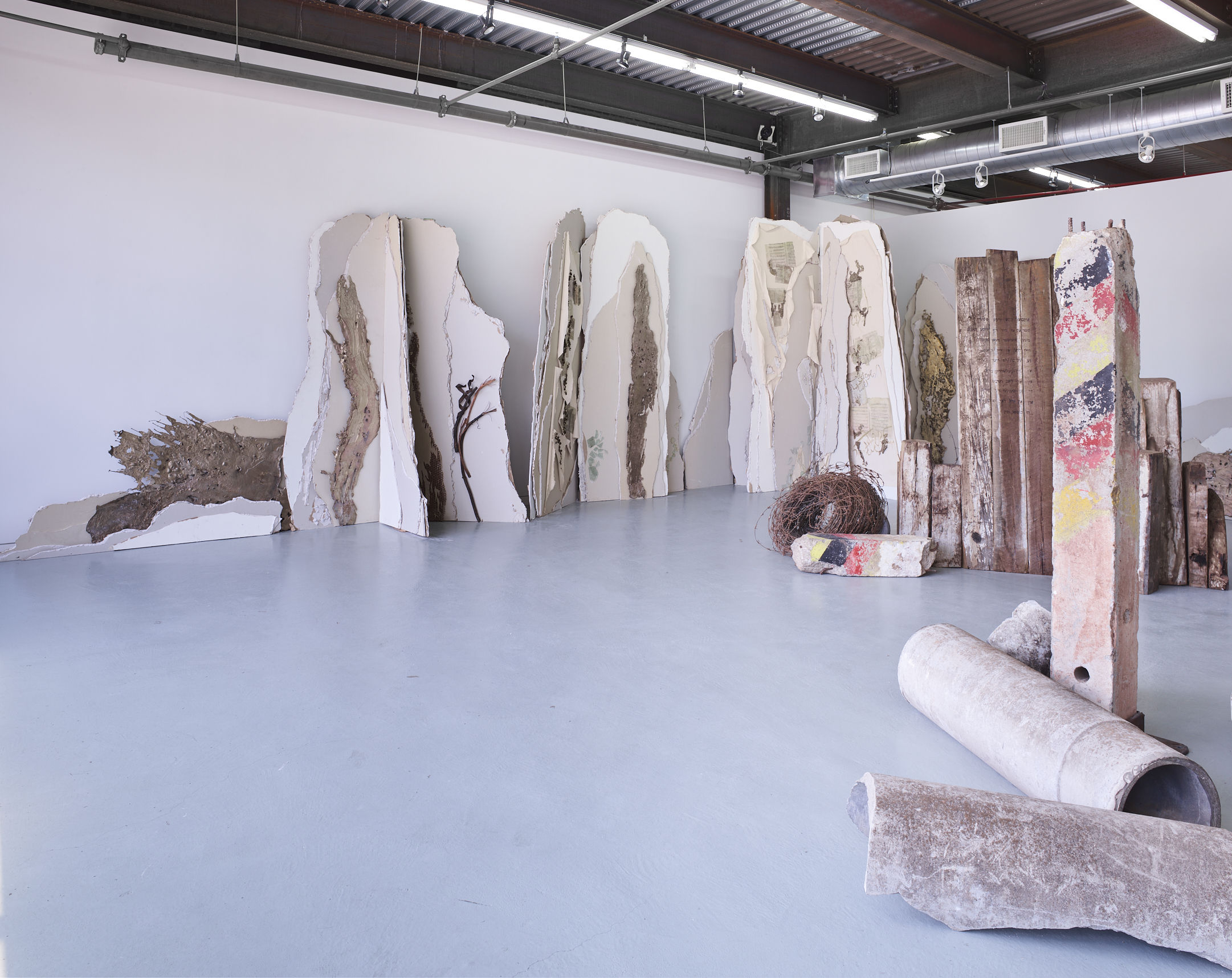
    Linda Cunningham's installation view at Odetta Gallery.
    Installation view to Linda Cunningham’s exhibition at ODETTA. Remnants of the Berlin Wall are on the right.

    ***

    More exhibition info: 

    Linda Cunningham Whose Land? Whose God? 

    July 7 – August 20, 2017

    ODETTA | 229 Cook Street, Brooklyn, NY 11206

    Artists Talk: Sunday, August 6, 3 pm

    Odetta Gallery: http://www.odettagallery.com/

    Artist website: http://www.lindalcunningham.com/

    Read about the visit to Linda Cunningham’s studio as featured in Firstindigo&Lifestyle.
     

  • Teresa Dunn: Motherload

    Teresa Dunn: Motherload

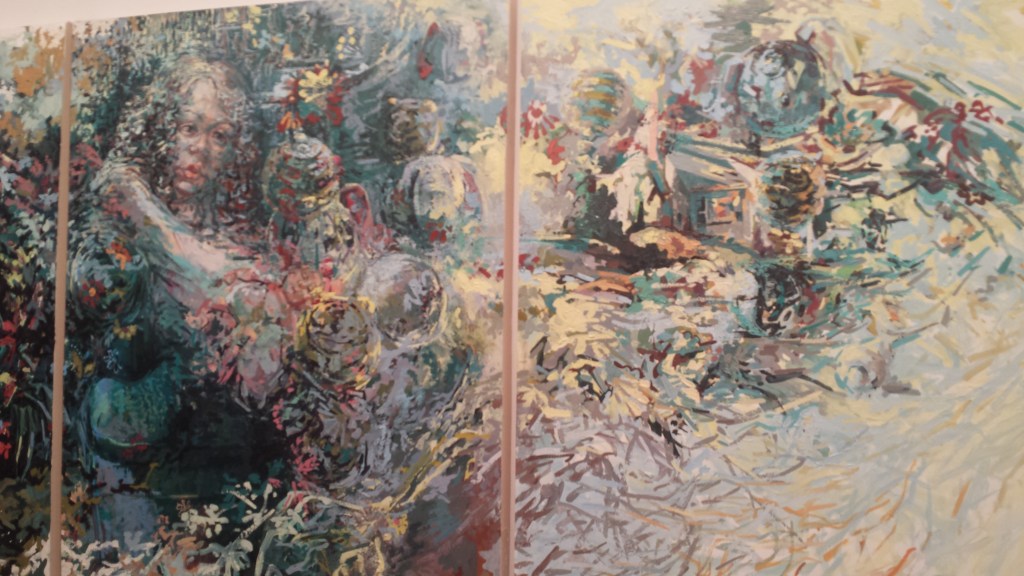
    Painter Teresa Dunn has her new exhibition Motherload on view until June 18 at the First Street Gallery in New York. Her current show depicts recent oil paintings and mixed media works on paper and canvas. For this exhibition, the artist who masters the Renaissance school of nature and human portraiture to the fullest forms has adopted new richness of palette. Her repertoire has gotten fuller, perhaps partially due to the size of the panels, paper and the use of triptychs, which allow larger developments and almost surgical dimensionality. Now the center is the body as tissues and palpable beats. In these new works, the body is joined with the amounts of vegetation, which makes the skin appear as fruitful foliage. Painter Teresa Dunn is making serious rising; she is represented by the Hooks-Epstein Galleries in Houston, Texas, and by Galerie l’Échaudé in Paris in France.

    In an action packed painting there was a pause, when Teresa Dunn imagined communities within narrative landscapes full of thick Renaissance color and light. The water rose through the images, leaving behind people on their isolated islands, together, alone, breathing air, figuring the scenes of us existing on the planet. The scenes were almost apocalyptic, borrowing from Biblical and mythological imageries of human drama and emotion. And it all made sense, as her paintings were influenced by the Venetian school, especially by the works of its great master Titian. Drama and poesia in the same theme, when color and light create unparalleled resonance.

    Now, the next pause was different. Teresa became a mother. From artistic point of view, the dreaming in her works became increasingly about the simultaneously occurring events. These happenings were seemingly not relating, but arbitrarily meeting in the same future. This time the fragments of narration made sense as islands of vegetation. The theme of water from previous paintings had changed into the vegetation. Or the water had become an overflow, which got mixed into and within the vegetation becoming moisture, as palpable like a touch of mist on the skin. An underpinning, a reflection on canvas. Like her inspiration of the magical realism, Colombian novelist Gabriel García Márquez imagined fog. Can you see distances through the fog. Or how a distant place somewhere far resonates here in this place. How everything connects and makes a reason, but not as univocality. The story is about bringing together universal fragility of existence and our mortality.

    In the new works, the colors have become evidentially subtler with more visible brushstrokes, with circular patterns of movement. The palette is lighter, and the narration seems to be settled in the background in the midst of a natural flow and overgrow of things; more than objects. The natural life and still life has found a lingering attachment inside the palette, showing that humans as actors play no longer the central role. In a triptych ‘Interlaced’ (2015), a loose tire rolls through the canvas, as if being a sign of an uncontrolled human motion. In another triptych, ‘Slippage’ (2015), a woman is growing out of a bush representing the nature herself and our origin. In this triptych, the panels together seem to be cumulating as a force, which becomes a wave. A water splash is running from one panel to the other in ‘Slippage’. Teresa Dunn’s triptych form borrows from the Renaissance art. In her paintings, the occurring shapes are creating new terms to reinvent the classic.

    Artist website: http://www.teresa-dunn.com

    FIRST STREET GALLERY: http://www.firststreetgallery.org/

    526 West 26th Street, Suite 209, New York
    Gallery hours: 11 am – 6 pm, Tuesday through Saturday

  • Discover Teresita Fernández

    Discover Teresita Fernández

    Teresita Fernández’s current solo exhibition is on view until December 31 at Lehmann Maupin’s 536 West 22nd Street location. Her seventh solo exhibit with the gallery coincide with her sculptural installation Fata Morgana, which is on view in Madison Square Park in New York. The gallery shows her latest body of work, including sculptures that are composed of intimate interior landscapes in concrete, cast bronze, and glazed ceramic. Recalling the artist’s earlier Rorschach pieces (2014) – a sculpture made of gold chroming, fused nylon, and aluminum – the new multidimensional works play with the idea of landscape and terrain. The theme of landscape in these Viñales pieces convey three-dimensional forms. The sculptures are detailed yet rough as they are somewhat fragmented, echoing of darkness and distortion, interior and exterior.

    Best known for her unique works and public projects, Fernández explores the natural world, as well as the scale, being sensitive to the act of looking, perhaps finding out about the human versus the landscape. Her conceptually-based art making includes research, and communicates with an entire world of references coming from different sources. In the exhibition, Fernández has created a series of darkened and intimately sized ink and graphite drawings, which are mounted on small-size wooden panels.

    TERESITA FERNÁNDEZ Viñales (8 Nights), 2015 mixed media on wood panel
    TERESITA FERNÁNDEZ Viñales (8 Nights), 2015, detail. mixed media on wood panel.

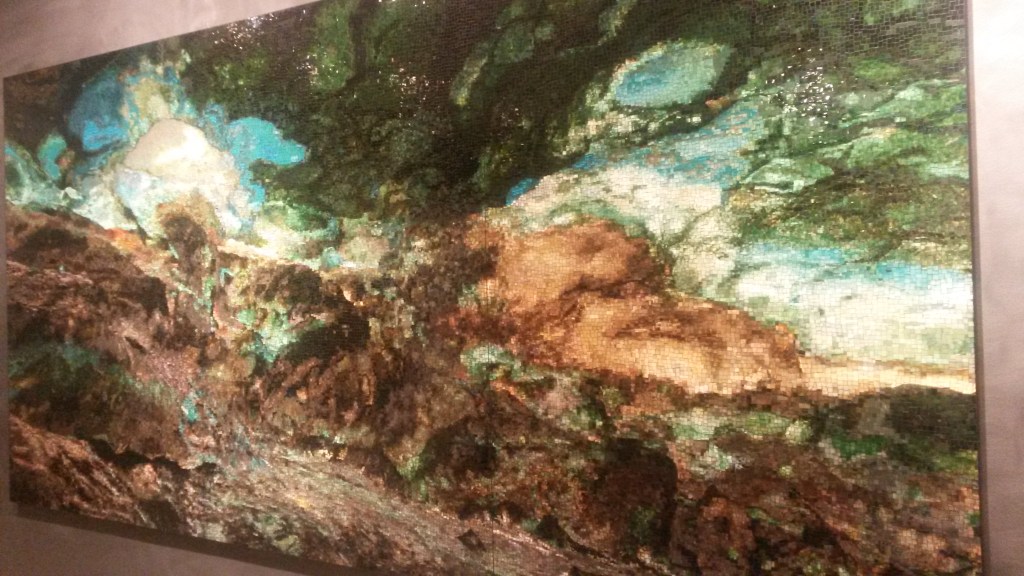
    These small pieces in sequences show her innate interest in scale. The dynamics between the immense and the intimate; the vast and the miniature; the macro and the micro are definitely part of the exploration. As the natural world as a reference is often large, the human viewpoint brings it closer; in other words we can grasp what we may or could see, if we had time and body to get to these places. Nature’s body is too vast to be created as miniatures, but this is what Fernández actually does. She has looked closely into the malachite mineral rocks and at their interiors comparing their material formula into full-sized landscape of the Viñales Valley, an iconic landscape in rural Cuba. She took up the saturated rich greens and turquoise colors from the malachite, being inspired by their clustered formations. These reminded of the aerial views of the green and lustrous landscapes of the rainforests.

    Fernández draws huge parallels between the malachite rocks and her own experience of the caves in Viñales. The whole project is tricky and fascinating. She reflects the idea of the landscapes both visually and physically, taking in both extremities of light and darkness, inside and outside, containment and amplification. In the exhibition, the Viñales landscape merges with the malachite rocks, which come from the Democratic Republic of Congo, and with the sculptural materials that of concrete, bronze, and ceramic. Fernández fuses with these materials and plays with the scale creating metaphorical “stacked landscapes”, which narrate several layers of references to a place.

    The exhibition includes three large-scale works made as glazed ceramic panels. The panels shine as saturated greens forming abstracted images. Their inspiration is the actual landscape of the Viñales Valley with its otherworldly mogotes (rare, limestone tower formations), cave interiors, and the exposed surfaces of minerals. Again, the artist is using clay, which is earthbound material. Yet the result is as if the accumulation of this material creates completely imaginary sense of the landscape itself. This is maybe the way art meets a complex surface of the natural world.

    TERESITA FERNÁNDEZ Viñales (Reclining Nude), 2015
    TERESITA FERNÁNDEZ Viñales (Reclining Nude), 2015
    TERESITA FERNÁNDEZ Viñales (Reclining Nude), 2015
    TERESITA FERNÁNDEZ Viñales (Reclining Nude), 2015

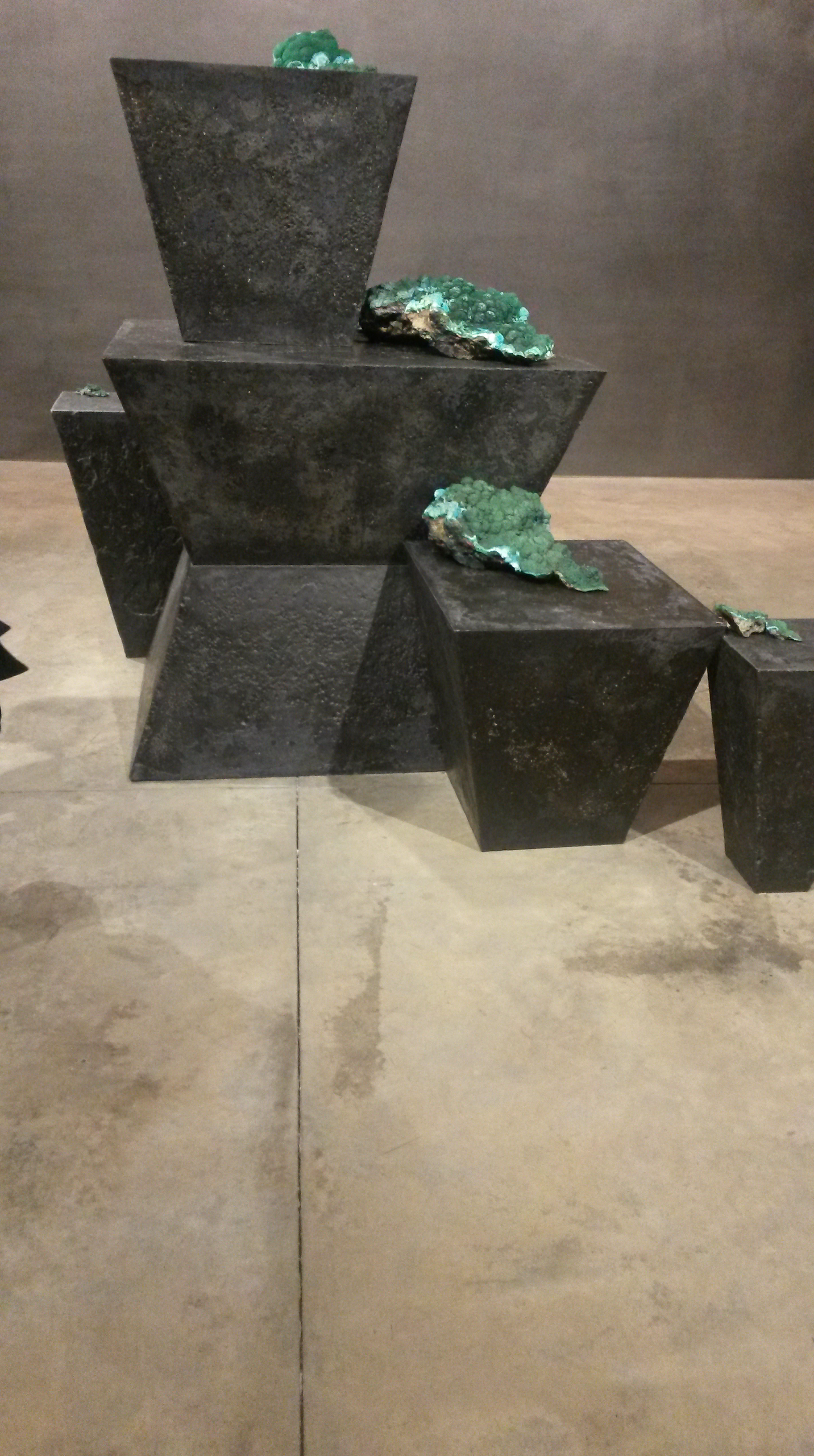
    The central sculpture in the exhibition, Viñales (Reclining Nude), is a horizontal configuration of trapezoidal cast concrete structures of various sizes and heights with descending malachite and bronze forms that evoke the sprawling, verdant landscape from distant to close-up perspectives. As viewers engage with the full-round sculpture, the suggested landscape expands and contracts, prompting viewers to visually construct the image and become the size of what they are looking at.


    Teresita Fernández have a deep rooted association for the cultural and aesthetic language of nature, as she has explored the surfaces of the landscape. She has visited the place, grasping intuitively about something unique of it. Thus the language of the place pours in richly textured forms, being poetic and narrative, echoing about rootedness, history, and different contextual phases. The forms shine through layers, ceramic bits, detailed and yet rough edges of pieces, depicting large and small fragmented knitbits of information. The old, or ancient speaks with the natural, as they have become entangled to stand for their environmental presence. Fernández uses devices like proportion and unconventional materials to draw the viewer into her works. She stands for individualized experiences that ask questions of place and us as humans. Ultimately, the essence reflected in each work could be described as tactile.

    … … …

    Teresita Fernández at Lehmann Maupin
    November 6-December 31, 2015
    536 West 22nd Street, New York

    more information: http://www.lehmannmaupin.com