Tag: Finland

  • Tamara Piilola: Painter from Finland

    Tamara Piilola: Painter from Finland

    Tamara Piilola is a young generation Finnish painter with almost enigmatic ability to capture natural processes on the canvas. Or more than a process, her images offer views with a hint of gold in them. As a painter her perception seems thoroughly personal, and therefore can touch many. Piilola started the arts as a musician, and perhaps its possible to hear music when looking in to the painter’s landscapes.

    Firstindigo&Lifestyle: Where in Finland did you grow up and study art?

    TP: I grew up in the small city in the west coast of Finland. I studied in the south, in Turku and in Helsinki in the Academy of Fine Arts. I was an exchange student for one year in Leipzig in Hochshule für Grafik Und Buchkunst and spend months in Reykjavik during my studies.

    Firstindigo&Lifestyle: What is your story of becoming an artist? 

    TP: I’m the only child, and I started to think about art first through music. I studied in a conservatory for ten years, but in classical music you don’t have the freedom to play how you like it, or if you do, people think you’re wrong. It’s much longer process, with a lot more technique involved.

    I went through every book that we had in the house. As a child, I remember I was deeply interested about the Old Masters and portraiture by Rembrandt, Holbein and Gainsborough. I was mesmerized by the use of light and the extraordinary talent itself. I wanted to do something similar.

    I got my first camera and Marie’s oil paints as a ten-year old. Around the same time I enlisted myself to a painting course with some grannies (they’re organized everywhere even in the countryside in Finland). As I got a bit older it was certain I wanted to go to art school and quit classical music.

    Firstindigo&Lifestyle: How did you choose oils and painting as your medium?

    TP: I did some photographs as well but in the end paintings have turned out to be the most flexible media for me. The texture is very important for me. Although I did photos in which I used for example liquid chocolate and velvet, the outcome was too cold and the end product had an industrial feel to it. In black and white pictures, you have the softness, but then you lose the colors. I have learned to use only the best materials in my paintings and usually paint just one layer to keep the colors pure and bright. Oils can become dull and lifeless when applied thick. Oil paint is so flexible that I can adjust what I’m doing, and because of the way the pigment is held in the oil, it is beautifully luminescent.

    Firstindigo&Lifestyle: What defines a good painting to you?

    TP: Color, light, composition – all these things make the painting interesting to look at. The eye has to wonder. I love if you are able to grab something, it has some kind of energy, or you can relate to something. Paintings have the ability to embody a series of thoughts and feeling processes, and good paintings are very personal. It’s all there on the canvas as a record.

    Firstindigo&Lifestyle: What is there in the landscape painting that fascinates you, maybe the history of it too. How about the influences?

    The heavy load that comes with the term landscape was at first turnoff for me. When I got in terms with the subject (which I felt I had to do), the whole world opened up to me. It was like a flower that was opening in front of my eyes. I felt I was completely free to do whatever I felt like with this subject. It felt like it was mine, all mine to explore, and that was beautiful. My large canvases of imaginary landscapes present viewers with startling experiences of nature. These detailed views, full of mystery and light, colour and verdancy, draw viewers to their essence and idea.


    TP: These are not recognisable landscapes but the creations of countless memories stored over time as photographs and sketches. Thin layers of paint, bold fluent brushstrokes and the use of pure pigments combined flood the paintings with light. Landscapes do not always have to be beautiful. I paint wastelands, timber stacks and dunghill, emphasising their decorativeness. I depict decaying beauty and allow natural forms to blend into almost abstract surfaces. I’m soaked with art history because I have been interested in art all my life. My favourite painter is Lucian Freud, the master of seductive and complex psychological portraits. My favourite movie directors are Kubrick and Lynch. In music it’s much harder to point out the most influential ones, I listen to music in my studio all the time from almost all genres. In literature there are many great minds that speak to me, Hesse, Nabokov, Murakami, Knausgård, Hustved, Woolf, Wilde. I don’t have a specific landscape painter that has influenced me.

    Tamara Piilola, installation view at Gallery Heino.
    Tamara Piilola, installation view at Gallery Heino.

    Firstindigo&Lifestyle: Is being a figurative painter these days a rare thing. How do you feel the genre is approached in the contemporary art world?

    TP: With suspicion – no just kidding. I think now it’s much more acceptable to be a painter. I think there is the audience and professionals who recognizes the talent and accepts it as it is: A viable art form. As an artist, you always have to be interested of what other artists do. I think there is a lot of theoretical confusion about art. Everybody thinks they have to make theoretical work and be able to explain what they do. I think if you hear this long enough, this kind of stuff gets in your way when you’re coming up with ideas, because you start thinking through a filter.
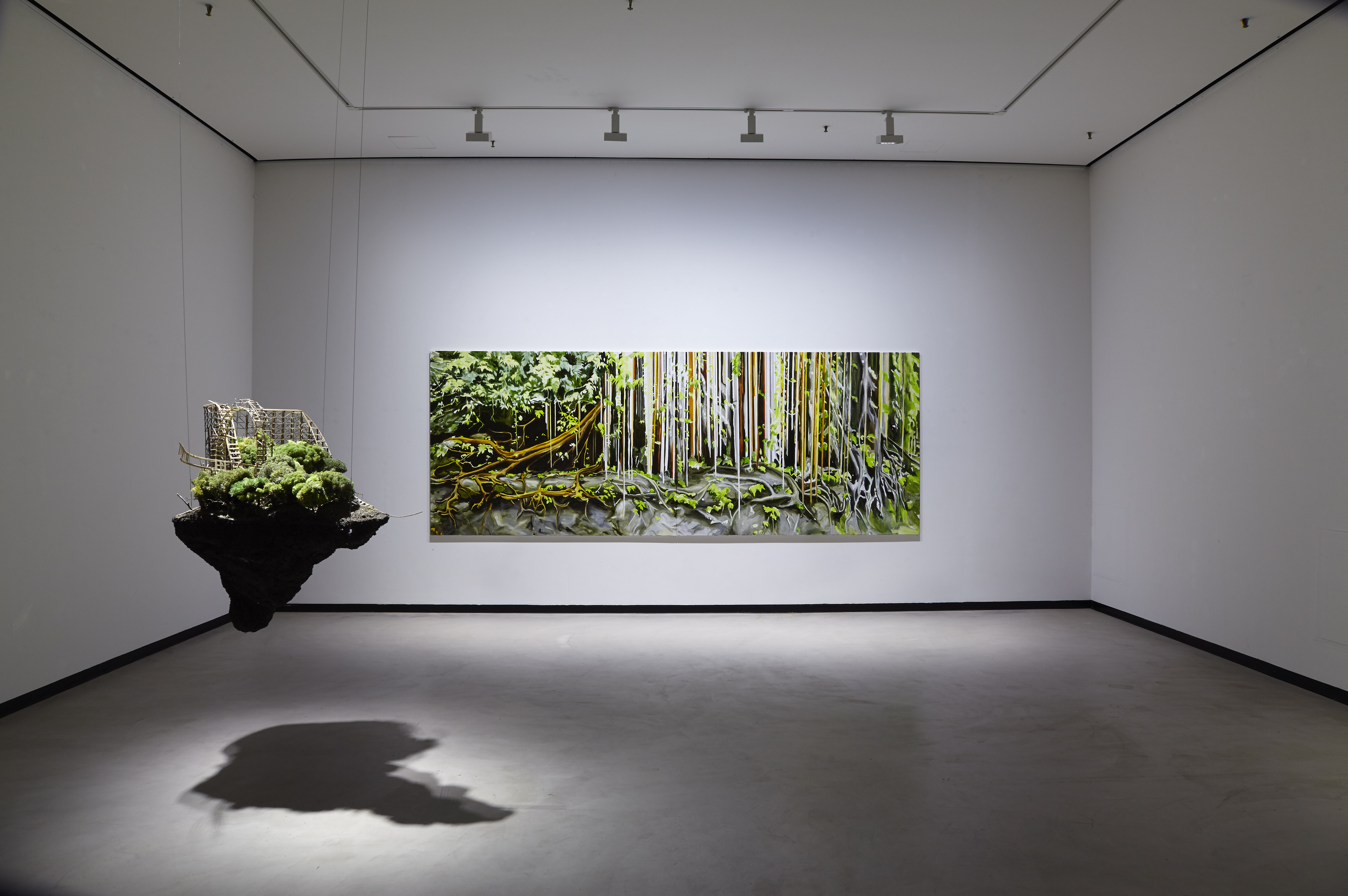
    Tamara Piilola's oil on canvas in Galleria Heino, August 2017, installation view.
    Tamara Piilola’s oil on canvas in Galleria Heino, August 2017, installation view.

    TP: I always thought that art could move more on the emotional level. You should work with your feelings, because if you’re using language to put things to action, you limit yourself. Many times things in art don’t make sense.

    Firstindigo&Lifestyle: There is almost a photographic precision to your works. Do you layer the works, plan the works with meticulous detail, and come up with the entire idea before starting to paint?

    I have photographic memory and I often work with images that have a lot of details. I start sketching by doing a collage with a computer (I used to work with paper and scissors before). At the end, there is a sketch that gives me a solid structure, the composition to work on top of. This is extremely important stage. After that I can start painting and I have quite a lot of freedom to choose which colors to use, how the brushstrokes will look, and overall how the end result will look. This structure gives me freedom to improvise. The motives have to be challenging, full of details and light to keep the painting process interesting. I love to see a big painting almost ready, I get excited about my own work.

    Firstindigo&Lifestyle: How would you describe your method or process of working?

    TP: I’m a deadline worker and I do exhibitions, not just one painting at a time. I work with about eight paintings at the same time. If I get an idea or a feeling that something should be done it usually takes years to pass through. I have a solid confidence in what I do, but that doesn’t mean I’m satisfied with everything I do. I don’t think it’s a bad thing to question your work. On the contrary – the best thing is to view the work from every angle and to be very skeptical at first if you get a “good idea”. I’m very patient to give my ideas the time they need to develop. I need to build a relationship with the motives: I want them to be familiar. When I know I can start, I go through my picture bank to fill the missing pieces in the collage. I focus on the composition and not so much on the colors.

    Firstindigo&Lifestyle: Do you have an artist motto?

    TP: Yeah, trust your intuition.

    Firstindigo&Lifestyle: Are you in love with nature as it is your playground in a way, how about the trees that come out so vividly in your works?

    TP: I think it’s not about loving though I love nature, it’s about respect. I recognize certain similarities in Finnish and Japanese cultures. We have both had our animistic past. The recognition of energy in things was very natural for me as I  was raised up by the sea, and the wilderness started right behind the fence. I think materials can be very sensual to look at and touch. In our times, it’s a luxury to have the time to look at things in peace. That’s what I do, I look and appreciate things.

    Firstindigo&Lifestyle:  Did you ever think of becoming an environmental artist?

    TP: No. I’m afraid to destroy things in the nature and I have no interest to mess with wild things. I think there is such perfection in natural order, and to show “art” in that context feels utterly fake.

    Firstindigo&Lifestyle: When looking back at your career, how have your paintings developed through the years?

    TP: I went here and there in the beginning. About ten years ago I accepted the fact that it’s OK to do what I do best: Big paintings with a lot of details.

    Firstindigo&Lifestyle:  Is there anything particularly special to you about being a ‘woman’ artist?

    TP: I don’t consider myself a woman artist, I am simply an artist. My works can be labeled feminine because they can be quite decorative. But I think it’s a drag to label things. I don’t think artist’s gender makes the work interesting unless the gender is the concept of the work. What is feminine and masculine? I’d like to go around those labels, because everyone and everything can be both depending on the culture.

    Firstindigo&Lifestyle:  You recently attended a group show in Galleria Heino in Helsinki. Have you collaborated with the gallery before?

    TP: This was the first show I did with Heino. I love to work with them because they have the courage to show artistically ambitious shows, with basically no art market to sell them in Finland. Rauli Heino is a true art lover and I consider myself to be very lucky to be in their team.

    Firstindigo&Lifestyle:  Do you work with curators or more directly with museum and gallery directors? What is your experience on building a show? 

    TP: I work with all of them, it depends on the project. I listen very carefully what people are after and it’s always a pleasure to work with professional people. The structure of the new show is in my hands and it has to be, otherwise it’s not my show. I will do the best I can to make things work. To have the atmosphere of support and trust is very rewarding. To have fun, to discover and do wonderful things together, isn’t that what life’s about?

    Firstindigo&Lifestyle:  Do you think that you have had many successful shows?

    TP: Yes, I think so. Success for me means that I am able to do the things the way I intend to. To do a good show means you must have the time to do it. It helps a lot when you learn to say no to projects that are not that beneficial to you.

    Tamara Piilola, Kruunu, oil on canvas.
    Tamara Piilola, Kruunu, oil on canvas.

    Firstindigo&Lifestyle:  How about such labels as ‘Finnish’ painter? If you consider to be one, what do you think about an international career?

    TP: The world is definitely smaller than let’s say in the beginning of the nineties. Long stays abroad, mainly in France and Germany have influenced my work. I live and work in Helsinki, and I guess nowadays the place you live defines you. It’s an interesting question. I certainly recognize my subject matter to be very Finnish, and that’s fine. Does that make me a Finnish artist?

    To be able to build an international career I need contacts to good international galleries. I would love to show my work especially in the Nordic countries, in the U.S. and in Canada. I think my work could meet some interest in these places since we have similar cultural values.

  • Camilla Vuorenmaa carves wood into paintings

    Camilla Vuorenmaa carves wood into paintings

    Camilla Vuorenmaa is a young visual artist focusing on the human experience and the everyday encountering between people. She creates portraits with full of affect that stem from an exceptional artistic medium. Her portraits appear on carved wood as vigorously painted characters. An award-winning Finnish artist had a recent museum exhibition at the EMMA – Espoo Museum of Modern Art in Finland.

    The main motive in my works is the individual experience and a sort of portrait. Effort, success and experiences of failure, the dignity of everyday life, affection, frustration and the experience of innocence and pain are subjects I reflect in my works. Mainly I portray the figures as themselves, doing some kind of a activity or being in the middle of it. Fundamentally we are all alone with our personal experiences. -Camilla Vuorenmaa


    Firstindigo&Lifestyle: How did you find your recent artistic medium, is it common that an artist combines woodcarving and painting together?

    Camilla Vuorenmaa: I started to work with wood year 2010, when I had the first opportunity to work as a full time artist for longer period of time. I had wood on my mind already before, but then I knew it was time to start with this material. My work has though always been moving between 2 and 3 dimensional form. I have felt the need to add mass and structure to my paintings, for example continue it with foam rubber stuffed canvas, or continue painting to the wall, over its material form.

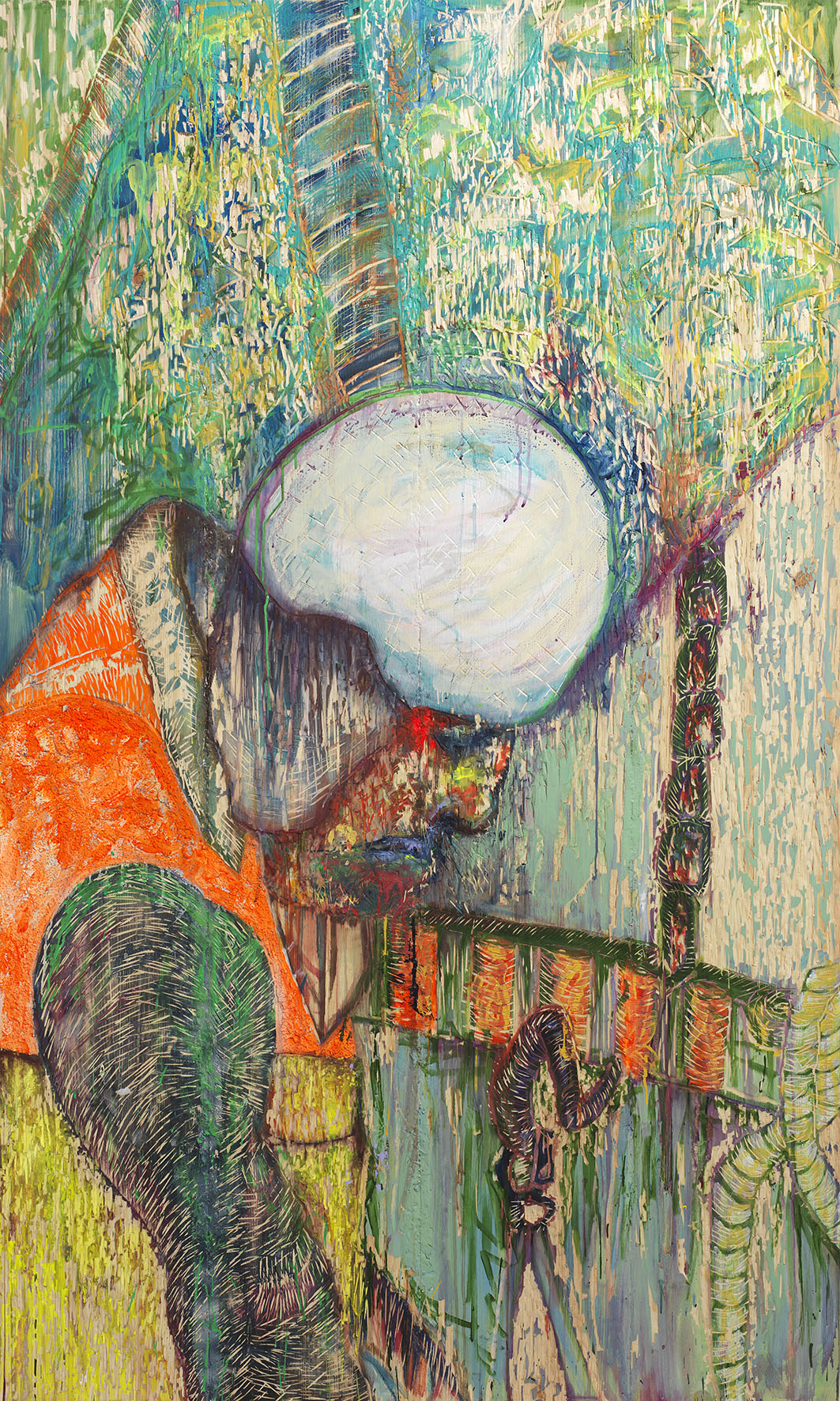
    Using wood in sculpture and even painting on the wooden sculpture is quite common. But this combination, painting and carving on wood boards is not yet very common. My working method is actually closer to the graphic boards that graphic artists make as a basis for their prints. Difference is, that I use that basis as the art piece itself, instead of making prints out of it. I call them paintings; others might call them something else.

    As an artist do you feel that you can associate with both design practices and with the fine art history?

    Camilla Vuorenmaa: Hard to say. I guess the things you grow up with, see and smell, forms, colors, light and shadow, basically everything has an effect on the visual idea. I am sure that Finnish design and especially its patterns have had influence on my visual choices. It is more unconscious than relevant though.

    Your recent exhibition at the EMMA – Espoo Museum of Modern Art, was about people working by the sea. Could you tell more about this project?

    CV: I applied to the SIM residency in Reykjavik on the winter 2014. I got the residency time to the September and October 2015 and it was perfect timing, since this project was on my mind before I knew about the prize and following exhibition at EMMA. All together, I had only nine moths to prepare EMMA exhibition, so it was good to have this idea already burning on my mind. I wanted to investigate the basis of the culture in Iceland, which is fishing. Everything in that country has basis on their fishing culture, so very simply, my aim was to go with the fishermen to the sea for some period of time, observe their working habits as an isolated community, atmosphere at the boat and individuals’ relation to the sea. I got connected to the MSC-Marine Stewardship Council representative Gisli Gislason in Iceland, and he told me a lot about the history of the fishing industry and helped me to connect with the Helga Maria ship’s crew. I went to the Atlantic Ocean with Helga Maria ship for one week on September 2016. During that time I photographed their working and used later these photos as basis of my paintings. The ship left from Reykjavik and went up until the northeast Iceland sea area. And returned. Gladly, weather was good most of the time.


    What was your experience in working with EMMA museum; did you work particularly with a curator to build the show?

    CV: Making an exhibition is usually a lonely work, but bigger shows definitely involve more people and more things to be taken care for. For EMMA exhibition I was closely working with curator Tiina Penttilä from EMMA. She came to visit me at my studio and also interviewed me for the catalogue several times during the making of the exhibition. I felt I got well supported by Tiina Penttilä and the whole museum crew during the making and building process. As an exhibition space, EMMA is wonderful and gives many possibilities to an artist. Especially I enjoyed making the wall paintings to the space. This was great experience as a whole.

    Where does your artistic process start, from the idea of a canvas, or from the wood?

    CV: Everything comes side by side, simultaneously. I choose material same time as I collect ideas. I take photos of something that interests me, like for example wrestlers. I made series of paintings based on the observation of the movement of one wrestling team in Helsinki. I do not really make sketches on paper; I see my photos as my sketches. I buy material, print photos that inspire me and spread them around the studio. Then I start to combine different sized wood panels and paint the beginning of the piece on the boards. I paint and carve, paint and carve until it is ready.

    Wood has been my main working material for the past six years, but now I start to feel working again also with other materials.

    You have worked with mixed media, how did you develop the techniques in each period of time, can you speak of artistic growth, or is it more like a seasonal thing?

    CV: I guess all the developments on my techniques have had to do with the search of some kind of layer in between a painting. Painting on canvas, plexi glass, paper, mdf-boards, wood, wall, all these have circulated in my work. I can return to a technique I tried and worked with several years later and proceed with it further. I see working as a visual artist also some kind of work of an inventor, chemist, and alchemist. All the material details and accidents with them lead in to interesting paths and can start even a new process.

    Camilla Vuorenmaa, Fisherman, 2015, painting (carving on wood), 200x120x2cm, EMMA -Espoo Museum of Modern Art. Photo: Ari Karttunen/EMMA 

    What are you inspirations for creating your art, does it usually start with observations or fieldwork?

    I used to collect inspirational pictures from old magazines. I spend hours and hours in old bookshops and went through dusty old magazines and photography books. The nostalgia and history inspires me, and also the idea that everything that happens in the world has already happened many times, they just appear in more modern form from century to century. Also my love to literature and books as objects has something to do with it. For the past years I have also started to use more my own photography as a basis of my paintings. I have become maybe more brave to confront the subject, or my curiosity has gone over my shyness.


    How would you describe the education in Finland, much did you learn from your art education?

    CV: My times in Finnish Art Academy were great. My teachers gave me a lot of freedom and opportunity to try everything. I was on the painting department but visited other departments regularly to try their material and working methods. For some, this kind of working freedom might have been too much, but for me it worked perfect. And if I needed support or comments, I could get that from the courses or ask studio visits from the teachers.

    Is there something particularly Finnish in your art making?

    CV: Well, I guess wood is pretty Finnish material. As wood industry is still so big in our country. Also I have understood from my colleagues and collaborators in Sweden, Denmark, Iceland and England that Finnish painters seem to have something peculiar and wild in their visual language. This has been of course great to hear – what a compliment to Finnish painters.

    Do people ever ask you about the nature of your practice in regards to your gender as a woman making art, and your subjects for art, does the gender play any role in your art making?

    CV: Well, I wish I could answer that “no – I have never have heard any questions that have something to do with my art making and being a woman”. But of course I have. Many people still seem to wonder how a small woman like me can handle big wood blocks, or do so big sized works. Once I even heard one man saying to me that your works are great, they look as if they are made by a man. I wonder what Louise Bourgeois must have heard! Good thing is that these comments are though not the first and the only thing I hear about my work and my working methods. Art is always political. So of course my art is too. I am more interested to hide my perspective of the roles of humans in my work, than comment it very straight in my work. But of course it is there. And I was the one who made these images.

    What expectations do you have for the future, where do you see yourself going next?

    CV: Now I am in the rare situation that I have exhibitions and plans made already until next year. Usually I have not known my ways for more than six moths. Interesting for me is to also see how this will affect on my artistic work, I have a possibility to plan and make long-term choices. My next big solo exhibition will be on January 2017 in Gallery Forum Box in Helsinki. After that I will take part to two group exhibitions in Sweden. I am more than exited and grateful for this situation. My aim has always been to make it possible to work as a visual artist without making compromises in the content. I follow that road.

    Artist website:

    http://camillavuorenmaa.com/

  • IC-98 art duo from Finland

    IC-98 art duo from Finland

    Firstindigo&Lifestyle interviewed artist duo IC-98 from Finland, who are Patrik Söderlund and Visa Suonpää, respectively. Their recent site-specific installation ‘Hours, Years, Aeons’, was produced for the Pavilion of Finland at the 56th International Art Exhibition of the Venice Biennale. IC-98 projects scale with in-depth research; being abstract and taking form in installations and in publications. Their animation language draws from the collective history of nature and culture. As the duo says:

    Our work is post-historical, it is set in a distant future after the age of man. It’s about nature, which still has to deal with the consequences of the human era. It’s not natural nature, but a twisted one.


    Firstindigo&Lifestyle: How did IC-98 get started, what was your thesis during the first few years?

    IC-98 (artist duo Patrik Söderlund and Visa Suonpää): We met at the University of Turku, majoring in Cultural History and Art History. We wanted to broaden the scope of academic writing by bringing our “writing” into public space. This idea became our program: to make site-specific interventions in public space, be they installations or anonymously distributed booklets.

    How do your art works communicate with theoretical thinking, do you consider to be conceptual artists?

    IC-98: The works start with conceptual and/or contextual analysis. This depends on the project at hand. Site-specific works start from research; animations are amalgamations of conceptual thinking, adjusted storytelling and handcraft. But if we should characterize ourselves shortly, we’d say we are conceptualists first.

    Can you name some of the most important theoretical premises that could be your guidelines? How about your artistic influences?

    IC-98: Our theory comes mostly from the left-leaning French poststructuralism: Michel Foucault, Gilles Deleuze & Felix Guattari, Michel Serres, with an important German addition: the work of Walter Benjamin. Artistically we do not have many modern or contemporary influences. Visually we lean towards 19th Century and the history of depicting landscape: Claude Lorrain, Gianbattista Piranesi, Caspar David Friedrich, and William Turner. The important thing about 19th Century is the fact that it is often at the same time the prehistory and a mirror image of our own time: in many respects, the world was the same but the underlying processes are still more visible (think Jacquard loom vs. laptop: they share the same binary logic but where laptop is a black box, in the loom we still see how the thing actually works).

    Could you tell more about the process itself, in what ways do your concepts or visual process evolve, are there any common or repeating parameters in the making? For example, how do you choose your visual atmospheres, like create the sets, lighting, how does the process unravel itself?

    IC-98: The style is based on the fact that the animations visually start with pencil drawing. From this stems the fact that the animations are black and white. So it is a material, not a stylistic element. The different atmospheres and recurring elements, our visual vocabulary (fog, mist, stars, water) is functions of the scripts, which often deal with multi-rhythmic time and transformations of energy and matter. The script always comes first; even lighting should carry parts of the story. If we cannot justify a visual element, we omit it from the final work. Technically the “scene” is fashioned after 18th century theatre: the image is composed of flat layers and digital effects between these layers. We try to keep it simple, not to be too much carried away by the limitless possibilities of cgi (Computer-generated imagery). When we compose a scene, the pencil drawings are first scanned, then composed into layered scenes and lastly animated.

    What do you want to say about your idea of ‘Events’, and about the ‘possibilities’ that can be found in your artworks?

    IC-98: The idea of a moment being pregnant with possibilities – or situationistically speaking “constructed situations” – comes from our earlier practice. We combined situationist thinking with Deleuze’s idea of the actual and the virtual and Benjamin’s Theses on History to conceive an idea of an intervention/work as an event making the user/viewer aware of the interconnectedness of past and future possibilities. As Deleuze beautifully writes, the present moment is surrounded by a cloud of virtualities, the unactualized past events, which maybe did not take place but can still happen. This we still consider the political element of our work even when the animations might at first sights appear visually anachronistic.

    Is it relevant to always question time and space as elements in you work-in-process?

    IC-98: Coming from the background of both visual arts and history, the complex nature of time is elemental in our work. Animation enables us to show multiple temporal rhythms in one image frame. Sometimes it is about the passage of time as such, then again it might be about a certain time in history.

    What are the three things you would tell about yourself to North American audience today as an introduction?

    IC-98: We have worked over multiple media for almost 20 years now. During this time, we have developed a visual language – be it artist publications, installations or animated films –, which combines the theoretical and the political with the visual and emotional. And important element here is the combination of old school (drawing) craft and the new digital media.

    You have participated in Art Fairs in New York City, in fact at the VOLTA Art Fair couple of years ago, how was the reception from the audience and organization, how about other experiences from local scene?

    IC-98: The reception has been good, though ours are relatively difficult works in the fast paced fair circuit. You need to be able to give time to the work. Then again, even a quick glance of the “surface” communicates the classical quality of crafting the artwork – though it’s in digital form.

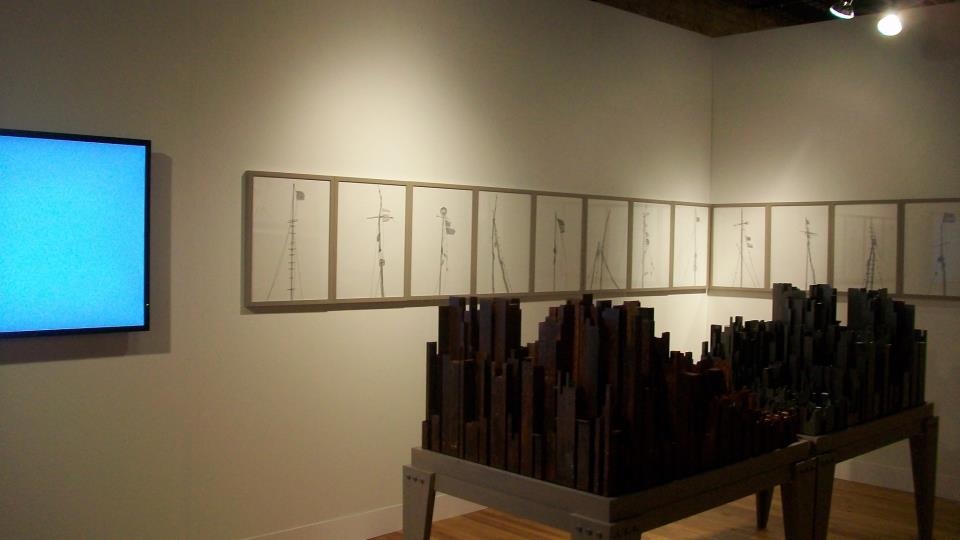
    IC-98 installation at VOLTA NY-2013 with Galleria Heino. photo: Firstindigo&Lifestyle

    Some time has passed since the opening of the 56th Venice Biennale, what are your most important remarks from the art biennale so far, did the location and site change the actual process? How do you feel, are you able to follow up what takes place during the art exhibition?

    IC-98: Working on site-specific projects has taught us that it’s always about communication between the site and us, the hermeneutics of place. In Venice we realized, that we had mostly done the research over the years already (the questions of territory, public space, wood and woods, the history of the Finnish welfare state, the relations of humanity, architecture and nature as a whole). The challenge then was to find the best way to tell the story in a framework of very strict regulations. We were first working on a more ephemeral and performative format, but had to recur to our most well known medium in the end: the animated film.

    During the biennale we have mostly received comments from visitors now and then. But, the perception of our own work hasn’t changed during the process. We have always done a lot of thinking and tried to take into account all the possible permutations of a given site or situation.

    It seems that ‘Hours, Years, Aeons’ has duration and layers, what does the work narrate about? It starts forming in the cave, and goes through time in history? Does it deal with today’s hot topics, such as climate change?

    IC-98: It’s very much about climate change, the much talked about questions of the Anthropocene (note: Wickipedia defines this as: proposed epoch that begins when human activities started to have a significant global impact on Earth’s ecosystems). But our work is post-historical, it is set in a distant future after the age of man. It’s about nature, which still has to deal with the consequences of the human era. It’s not natural nature, but a twisted one. The work exists both as a spatial multi-screen installation and the linear film shown in Venice. The Venice version let’s us experience long, geological stretches of time – the aeons.

    Specifically, the work has a background in the nuclear waste repositories, how something is buried deep into the ground. But as we all know, what is buried, will once surface again.

    Did you find time-based media works as your medium from the very beginning of your artistic career? How about your sculptural works, and the ways different media communicate with each other?

    IC-98: We considered our free distribution books already time-based in a sense. The installations often include an interactive element, which means that they work in space but also as a part of lived time. We have liked the idea of the viewer as a user. But formally we entered the temporal realm when we wanted to make animations. The main idea was to be able to show the chains of cause and effect and use certain cinematic techniques to speak not only to the intellect but also the senses.

    Time-based media has a different nature than other art works. What is your opinion about it, how do you see your art from the point of view of the future, what could be the time-span?

    IC-98: In all probability our works will seem as anachronistic or as nostalgic as any other cultural product of our time. The paradoxical thing is, we always try to conceal the technological or digital basis of our works. We try to make our works look like they could have been made in any era. It would be nice, if in the future it would be impossible to say from the outset when watching our work: “That’s so 2010’s!” Then again, the animations are all about the resolution, the bit-depth, the ratio, and the available digital effects…

    Finally, what are your ongoing and new propositions for the future?

    IC-98: We are in the preproduction phase of our first feature film, ‘The Kingdom of Birds. It’s loosely based on the life’s work of Finnish deep ecologist, eco-fundamentalist, ornithologist and fisherman Pentti Linkola. The film imagines an old fisherman’s last day on earth in a future where all of mankind has perished. It is time for other species.

    The 56th La Biennale di Venezia is open until November 2015, where IC-98 is represented.

    Check out the artist websites following the links below:

    IC-98 homepage: www.socialtoolbox.com

    IC-98 animations: https://vimeo.com/ic98

    IC-98 monograph: http://issuu.com/framefinland/docs/ic98_hoursyearsaeons_1_