Tag: galleries

  • Dance meets art at Loretta Howard Gallery

    Dance meets art at Loretta Howard Gallery

    Yvonne Rainer’s work Trio A (1966), is one of the most enchanting dance pieces of dance history that paved the way to contemporary and postmodern dance practices. It is an interesting choreographic work, not least because it is exhilarating from pure performance and performer points of view. How many times do contemporary performers get immersed in new projects, where choreographers and directors inquire effortless, non-virtuous task-oriented movements and behavior to use them as backbones for their pieces. This in fact is not so easy to accomplish at all. As what performer goes through is not so much about ‘performing’ from a merely audience seduction point of view, but follows more a neutral way of not-doing too much. This might sound complicated, but makes all sense when in dance the performers start tapping the space, letting their bodies organize the way through the space. The inheritance of this type of movement in dance, a meticulous way of appearing happens sometimes simultaneously in conjunction to things and objects. In sculptural and spatial terms, the dancer is like a living and moving human sculpture. But more than that, the art of dancing in this case is shaped also around imaginary objects, or spatial lines that cut through the architecture of space. In Trio A, it seems that the space and objects were a great source of inspiration for Rainer, acting as inner elements, and shaping the movement sequences. There are, of course, noticeable tricky movements and balancing included in the work, even when the dancer (herself in the original Trio A, which was part of a larger work The Mind Is a Muscle) would not make a full sequence of complicated turns, for example. In 1966, Trio A changed the dance scene by examining the possibilities of human movement. Rainer had learned from Merce Cunningham and John Cage to have different approach to the her audience or spectators in general. She also started to experiment with film using the same methods as in choreography.

    When watching the composition of Trio A evolve on the video, it comes to mind that perhaps the biggest challenge is to maintain a calm steady movement flow. The work became a classic not only because it still makes powerful statements of what a composition and a performance is about; but stating a strong performer making the composition. It changed so much in the Western dance history.

    Dance does not always get noticed among contemporary art forms, or is quite rarely placed in the art history like visual arts. When it appears to be paired together with and being a component of the visual arts as a performance art, or in conjunction of musical composition, it gets a different approach. The so-called post-modern dance era brought in new curiosities in terms of artistic collaborations that stretched beyond boundaries of different art forms and genres.

    Loretta Howard Gallery opens on September 10 with a new exhibition entitled “Where Sculpture and Dance Meet: Minimalism from 1961 to 1979.” The gallery curates annually an historical exhibition, and this truly interesting archival exploration showcases videos of historic performances and sculptures associated with minimalism both in art and dance. The exhibit is timely as it is doing homage to ideas that are still in a dialogue setting current trends in visual arts and performance. The exhibition shows that choreographers and sculptors, for instance, used methods of composition that were known as subjective. Yvonne Rainer belongs to these artists who brought minimalism to dance. She did not eventually wish to include her Trio A showing into the gallery exhibition, but her historic rehearsal recording from Conneticut with a group of performers works as a good intro to her style.

    In the exhibit, there is also a video of sculptor Robert Morris’ work,  in which a masked male performer performs with a sculpture created by Morris. In the 1960s, he built his early sculptures in Yoko Ono’s loft that also involved unique performance elements. Choreographer Simone Forti’s archival video of her piece Slantboard (1961), is an important addition to the exhibition. The work includes a platform in its center for performers to attach to and play with. The exhibit culminates around a piece Dance created by Lucinda Childs (original from 1979). The video is a double performance in a sense that Childs’ company performs in the background video when the Dance is recreated for stage. The choreography gathers an architectural sculpture from Sol LeWitt around it. Childs collaborated with the artist in set designs, and used music from composer Philip Glass.

    Andy Warhol’s installation of helium filled pillows, Silver Clouds, adds an interesting story to the exhibition. Warhol created the pillows which then functioned as a set in Merce Cunningham’s dance work Rainforest (1968). Performers in this choreography encountered the clouds when they were floating across the stage. Cunningham often explored dancers and objects to create ‘random’ encounters, so it is great that the exhibition’s shows a performance video and the sets in the gallery space to make the central point come across.

    In addition to the artists and collaborations mentioned, Loretta Howard Gallery displays Trisha Brown’s video Group Primary Accumulation (1973) as part of this archival display. The choreography explored altered understanding of the beauty and power with simple repetitive movements. Brown used principles of mathematics, modularity and repetition when composing the dance. Next to this video, there are minimalistic sculptures on the walls from Donald Judd, who created designs for some of Brown’s choreography. Then, a strong sculptural work is on display from Ronald Bladen.

    The exhibition “Where Sculpture and Dance Meet: Minimalism from 1961 to 1979”, is curated by Wendy Perron, who is the author of “Through the Eyes of a Dancer” and former editor in chief of Dance Magazine. It is co-curated by Julie Martin, who is an independent scholar and currently Director of Experiments in Art and Technology (EAT). The exhibit is on display from September 10 until October 31st, 2015 at Loretta Howard Gallery, 525-531 West 26th Street, New York.


  • Leah Oates in spotlight: artist, curator, gallerist

    Leah Oates in spotlight: artist, curator, gallerist

    A woman to watch now in the art world is an artist with multiple roles. Leah Oates runs her own art gallery Station Independent Projects in New York’s Lower East Side. In the interview she sheds light on how she found her path. 

    Firstindigo&Lifestyle: Your photography reflects multiple textures, showing light, contrast, opening up to magical worlds, how did you find your own medium?

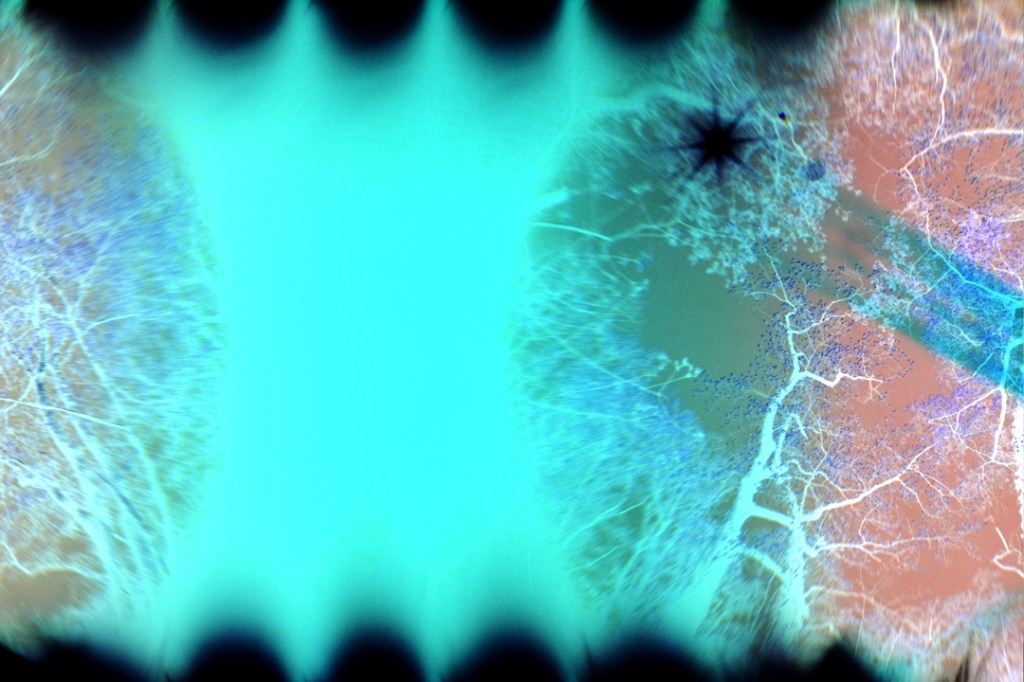
    Leah Oates: I started as a painter and printmaker, and I still see the influence of both in my current work with the layering and density of color and light. The common thread with my past work in other medias was always photography as I painted and printed from photographs but in the past I saw the photos I took at support materials or documentation. At some point I realized that the photography was the main and most continuous thread in my work so transitioned to how I work now.

    Firstindigo&Lifestyle: Do you feel that memories, or where you come from resonates in your art?  Your works have been also exhibited overseas, how was the experience in China, for instance?

    LO: Where I was raised and my specific family definitely connects to my current work. My grandmother is a biologist who studied at Harvard and one of my uncles worked for the Environmental Protection Agency (he is now a private consultant on environmental issues) and another worked for the Army Corp of Engineers. Thus there was a lot of dialogue about the environment, nature, human rights and politics.

    My mom, brother and grandmother are painters and my grandfather was a painter and photographer who ran a photo studio when he was young taking family, wedding and baby photos. He later became a real estate lawyer with a big Irish Catholic brood of six kids including my dad Danny who was a writer and carpenter. I have an uncle who is a successful ceramic artist in Maine and an aunt who is a glass artist in Massachusetts.

    This mix very much informed my work as well as growing up in the city of Cambridge, Massachusetts and in rural town in Sanford, Maine where my family goes back in both states to the 1600s.

    Being and working in China was amazing. We all absolutely loved it there from the street culture to the food to the parks to the incredible energy there. It was wonderful to photograph there and yes its polluted and yes it can be messy but the light is wonderful and the people are friendly, sweet and almost old fashioned. We would go back in a heartbeat.

    With China I had a lot of reverence for their history beyond Mao and the revolution etc. China is an ancient place and much older than the US or Europe with so much amazing history. China is a work in progress and like all places has things to work on but it’s a really vibrant, alive and interesting place.

    My work there dealt with the changes happening in the culture related to climate change, random urban planning that is erasing local culture and customs and how nature reacts to all of this within a rapidly expanding urban setting.

    This slideshow requires JavaScript.

    Firstindigo&Lifestyle: Could you describe in few words how did your road lead to New York?

    LO: My husband Pierre traveled to NYC on a few business trips and instantly loved the NYC. We where living in Chicago at the time and liked it but NYC is closer to both our families in New England and Canada and it has a thriving and large art community so we moved here when I finished up my MFA.  At first I was not sure about living in NYC for that long but gave it a try.

    I began ironically to love NYC after September 11th as the city just melted ones heart. I saw how the city came together in a way I would not have imagined as you know normally is like ‘get outta my way’, or ‘move it fast’, on a daily basis here.  But the thing about New Yorkers is that in a crisis situation they have your back and this is what I learned about NYC that made me really fall for this city.

    And the art community is the best I’ve experienced. People are energetic, they work hard and like to do so, are open to new things and they make things happen and quickly. It’s a hopping, creative, and no nonsense art city. Yes there is the regular nonsense you have in any city but things really get done here and in high volume and at top quality too.  You see the best here and yes the worst too but here we move so fast that there is no time for that stuff. It’s a very discerning crowd here.


    I’ll give an example. Pierre, my husband has shot films in other cities and it always move so much slower than in NYC and he often hits walls initially either from unions or agents etc. In NYC it’s the total opposite where he finds what he needs easily and hears yes a lot! It gets done here without the baloney. Here it’s a YES lets do it mentality which I really like, and opens things potentially for innovation, creativity and hybrids. I now cannot conceive of living anywhere else, and I’m now head over heals in love with this city.

    Firstindigo&Lifestyle: It’s quite easy to imagine that last few years have been truly busy in leading your own art space. How do you feel the transition has been in terms of becoming a gallerist?

    LO: I love running a gallery, and working with my artists to plan their shows.  I’m really happy about the quality of the shows, level of press and number of curator visits and attention that the gallery shows have received and sales have been good.

    It’s been an amazing experience all around. The first few months when I initially opened where very exciting and there was a bit of anxiety about how it would impact our family. Mainly it was our son Max who wanted his mom to be around 24/7 but he really got behind the gallery when he saw the space and saw that it made me happy. He even wanted to serve drinks and where a suit which was so cute! There has been a good balance between family, the gallery and my studio practice for quite some time now so it all good.

    Firstindigo&Lifestyle> What is your secret in balancing between different roles in the art world?

    LO: Most artists or art professionals have jobs so it’s the norm in most cases unless you’re very rich.

    A quote I like is ‘A good artist studies art and a great artist studies everything’. My dream is to be an artist, curator and gallerist, so I’ve followed this to see where it leads. It’s an interesting and rich journey that is worth taking. What I’ve learned too is to plan out the week and get the work done. Just do it and don’t think too much about it. Get your self into studio and get working as through the work interesting stuff happens and if your not there it’s less likely to happen. The same goes for running the gallery.

    Additionally, trust yourself and go for it, plan strategically and it’s ok to say no, rest when needed and spend time with those that make you feel good and even better loved.

    Firstindigo&Lifestyle: You have also featured artists in the art fairs; do you find attending art fairs rewarding?

    LO: The gallery participated in Pulse NY last year and it went really well with sales and press, work placed in a corporate collection and several private collections and so much great feedback and contacts. It was a complete buzz and reinforced that the gallery artists and program was as good as I thought it was. People who visited our booth loved it and where so positive. But with all of this great stuff we only broke even and fairs are expensive to do. But they are now so much a part of the art world that it’s a must to do them as a gallery and again I think it best to be strategic with this and keep to a budget. I have only good thing to say about Pulse from a gallery perspective. This fair is run very professionally and everyone is super nice and efficient. Everything they promised they delivered on.

    As an artist I’m not a huge fan of fairs overall but I do love Pulse, Spring Break and The Independent art fairs. They are so different as fairs but seem to push the dialogue forward and are visually interesting.

    As an artist at fairs I like running into so many people and taking about art but think that fairs can be too formulaic and favor art that is easy to process with too much surface and not enough depth.  As an artist I think fairs are a survey of trends, are about status and art world hierarchy and not so much about art or pushing the dialogue ahead. But again as a gallerist, curator or as an artist participating in a fair you have to do it as it’s for the potential for so much attention in a short period of time and in a condensed fashion.


    Firstindigo&Lifestyle: It is very delighting that Station Independent features Finnish artists. Could you tell in few words about the Finnish collaborations that are coming up this summer?

    LO: Yes I’m pleased that the gallery will be hosting two guest curated shows this summer by Ilari Laamanen and Leena-Maija Rossi both from Finnish Cultural Institute.

    Ilari has curated a group show of Finnish artists called  ‘The Powers That Be’ which is on view from July 17-August 9th. This show is part of FCINY’s 25th Anniversary year’s program on Urban Nature and explores human’s relationship to the environment.

    Rossi has curated a two person show that explores shifting ideas on dwellings in urban space called  ‘(Un)livable’ with work by Kari Soinio and Janet Biggs which opens August 13th and is on view through September 6th.

    Firstindigo&Lifestyle: How would you define your own curatorial motto?

    LO: My curatorial motto is to not follow trends but to follow art and artists. I’ve been following the gallery artists from between 5-25 years. Also, it’s important to love the work your showing and to choose work based on its merits and not on if it’s easy to sell. It’s all about the artwork itself and about dialogues about art within a larger context of the past, present and future.

    ***

    The gallery and artist websites:

    www.stationindependent.com
    www.leahoates.com

  • Subodh Gupta’s Seven Billion Light Years

    Subodh Gupta’s Seven Billion Light Years

    Subodh Gupta, Seven Billion Light Year V, 2014
    Subodh Gupta, Seven Billion Light Years V, 2014. Oil on canvas, found utensil, resin, 241.3 x 226.1 x 10.2 cm / 95 x 89 x 4 in

    Subodh Gupta’s new exhibition ‘Seven Billion Light Years’ opens with multiple content, showing his performative sculptures, installations, films and a body of new paintings at Hauser & Wirth starting on February 10th. The exhibition takes root in the life in India which is his native country, addressing the local life where mundane and sacred exist side by side. Gupta is known for utilizing found everyday objects in his artworks, resonating meaning with utensils used in making and cooking food, as well as larger vessels such as a bicycle, on which smaller everyday objects are stacked. His works narrate about the culture of accumulation, where the people, food, and the daily exchange gets fused, appearing both chaotic and ritualistic. As a centerpiece of the gallery’s current exhibition is a series of new paintings called ‘Seven Billion Light Years’. These belong to Gupta’s signature subject of using basic kitchen utensils that are familiar to every Indian. Gupta’s art works raise questions, addressing what it means if the world’s people are not anonymous, but have identity and a bit of infinity. In the level of the paintings, the artist uses three-dimensional objects that are fixed to canvas with resin. These paintings carry the exhibition’s title, but there is more behind the meaning.  The title refers to the seven billion inhabitants on the earth echoing about the materiality and the material fragility of our human lives. It displays the idea of intrinsic marks that we leave on the earth’s surface throughout the years. The objects speak about the human marks in the cosmos as well; the distance between our mortal lives and the cosmos appears as unfathomable.

    Anthropologist and writer Bhrigupati Singh has written about Gupta’s work. The artist reminds us that what is near is

    ‘no less cosmic or mysterious – on the surfaces of our ordinary domestic vessels that journey with us, sometimes for years. What we discover in the process are intricately crafted pieces of the cosmos.’

    Gupta’s film ‘I go home every single day’ (2004/2014), narrates his commute between New Delhi and his native home in Patna. The journey in the film poetically tells about the changing landscape of the urban cityscape and the more traditional Indian home. The home is a place, where the camera lens repeatedly comes back to focusing on outdoor areas interpreting smaller details, in which the white wall becomes a surface of nuances. It acts as a backdrop for objects, ropes, plants and canvas totes. The yard itself as entrance stands as a sign for the domestic; water pipe carry a meaning that water is a sustenance, without it there would be nothing. Everything in-between the train and the home is in evolving chaos, where progress lives as  traditional life changes and even disappears.

    Pure (1), 1999-2014, Mixed media, Dimensions variable, installation view, 'Subodh Gupta, Everything is inside', Museum für Moderne Kunst Frankfurt am Main, Germany, 2014. Photo: Axel Schneider
    Pure (1), 1999-2014, Mixed media, Dimensions variable, installation view, ‘Subodh Gupta, Everything is inside’, Museum fur Moderne Kunst Frankfurt am Main, Germany, 2014. Photo: Axel Schneider

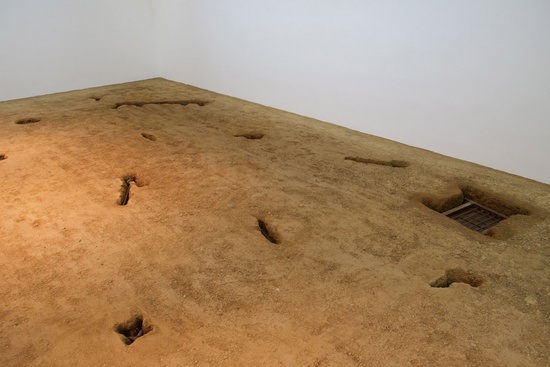
    As a counterpoint to Gupta’s recent paintings called ‘Seven Billion Light Years’, Hauser & Wirth also presents an installation  ‘Pure (I)’ (1999 / 2014), which is a variation of a piece exhibited last year at the Museum fur Moderne Kunst in  Frankfurt am Main, Germany. Gupta’s early work ‘Pure (1)’ originates back to 1999, and it was first presented at the Khoj workshop in Modinagar, India. This initiated the ongoing project on the everyday objects as vessels of larger cosmic power. The artist started collecting household utensils around New Delhi, including a hookah an a plough, sinking them into a field which was composed of a paste of mud and cow dung.  He also covered himself with the same paste laying at the center of the field in a yoga posture of shavasana (the corpse).  This, according to the artist, resulted in the state of ‘meditative blankness’.

    At Hauser & Wirth, ‘Pure (I)’ has become a new work, in which Gupta is revisiting his own artistic process that took place 15 years ago. At the gallery, he presents a group of household objects that are partially buried in pure earth, along with a group of black and white photographs which stand for the neighbors from whom he borrowed the original objects for the earlier piece in 1999. These photographic portraits hang opposite of the earthy field, where gallery visitors can also walk, and hence experience its entity. The group of photographs present the people as de facto collaborators from the artist’s time of making his art.

    Another big piece of art is an installation ‘This is not a fountain’ (2011-2013), that comprises of a large number of timeworn aluminum utensils that the artist collected. In the midst of it are water pipes, which while dripping ‘keep washing’ the surface of the installation. The artist states that he has been interested in the uniform of the mass-produced dishes. Yet, what comes out is the water as an essential element that pours as a ritualistic connotation for purity, showing the basis of things themselves. Meanwhile, the other art works at the gallery exhibition also reflect about Gupta’s own biographical attachment to his subject. His own middle-class background allows him to show the contrastive realities of the deprived and poor versus the richer classes. His use of everyday vessels made of various materials, where the socially humble turns into a shiny bronze, displays a sharp division between different social classes, whilst in the global exhibition space the meaning gets circulated into other levels as well, perhaps becoming a subtle divider between east and west. Additionally, the short film playing with the same title ‘Seven Billion Light Years’ (2014/2015, film, 2. min), meditates a Hindu philosophical idea of the cosmos as leela, which means play and dance in the traditional philosophy. The daily bread-baking becomes a metaphor with cosmic turns, where bread flies lightly like moments in life.

    ‘Seven Billion Light Years’ will be on view 10 February 2015 at the Hauser & Wirth’s downtown gallery location at 511 West 18th Street, and be on view through 25 April. The exhibition coincides with the debut of a major work by Subodh Gupta in the exhibition ‘After Midnight: Indian Modernism to Contemporary India 1947/1997’, which opens 8 March 2015, at the Queens Museum in New York NY.

    More info: Hauser & Wirth: http://www.hauserwirth.com/

    To map Gupta’s work a little more in its context, the following video presented on New Delhi TV (NDTV) along with his short interview, is a good start: