Tag: galleries

  • Teresa Dunn’s Event Horizon at First Street Gallery

    Teresa Dunn’s Event Horizon at First Street Gallery

    Teresa Dunn is a Michigan-based artist whose narrative paintings on panel explore worlds with texture and complexity. Her recent paintings, now on view at First Street Gallery in New York City, are full of figures who are confronting points of no return. The strong exhibition title Event Horizon displays works full of ‘tightrope walkers’, burning boats, exposed flesh and rising waters; all this as if the settings create dreamlike atmospheres.

    This slideshow requires JavaScript.

    The narratives put the characters and their motivations in tests when they look into the incongruous landscapes around them. The works are full of story, where mothers and fathers, animals and children, friends and strangers interact in tightly woven communities. The paintings depict absurdity and metaphorical allusions. Together the works link into each other, and so rearrange the reality in a new order. As the artist states:

    Peculiar reality becomes normal, as in dreams or memory. Amidst bizarre sequences of events, dreams are believable when we are immersed in them. Memories distort, dissolve, and rearrange themselves until we are unable to discern fact from invention.

    Dunn’s paintings seem to connect to a stronger sense of reality than what would perhaps be without the symbolic hindrance and delay. Her tactics of ’disconnect in perception’ shows the underlying ideas telling about identity and interaction. ’’Seasons, relationships, jobs, and cities attempt to define us. Peculiar occurrences, symbolism, and metaphor tie together some loose ends and fray others.’’ (Teresa Dunn).

    FIRSTINDIGO&LIFESTYLE: Your new exhibition Event Horizon is now on view in New York’s City and has gained attention. How would you describe the gallery?

    TERESA DUNN: I appreciate that First Street Gallery has given me the opportunity to show my work in New York. Being a resident of the Midwest it is more difficult to put my work into the world. Being in a community of supportive artists in a major art center is critical to keeping me in the conversation.

    Your works narrate multiple events which perhaps relate to natural disasters, as the burning boats, floods or risen water show. What does this vision mean to you?

    TD: The element of natural disaster is new in my work just appearing in this body of paintings. I am interested in the combination of the fire and the water events because the characters in my narratives seem to have to choose between two negatives–fire or water; precarious balance on the tightrope or falling to an unknown abyss; frigid wintery environment or blazing car fire. But not all of the people fear about the disasters some look with awe or indifference. Is the flaming horizon reddish from the setting sun or from a fiery disaster just out of sight? It is the ambiguity that life presents us that both makes it invigorating and terrifying.

    In one of the works there is in fact this chilly atmosphere, with two people, perhaps a couple, and the face in the background has a scull written on it. What kinds of representation do you relate to this particular image (titled: Because I could not stop for Death)?

    TD: In the painting to which you refer with the winter environment and the skull “Because I could not stop for Death” the title is borrowed from an Edna St. Vincent Millay poem. In this painting there are elements of my Mexican background from my mother’s side. In Mexico, images of skulls, death, and skeletons are traditionally not representative of an existential anxiety in they way we see them in American culture. Instead the skull represents the tie between those who come before and those who come after. I like presenting the seasonal metaphor of death as dormancy alongside the skeletons and the chicken protecting its egg in anticipation of the season turning to spring. The painting talks about life as cyclical as opposed to being simply linear. In fact all of the narratives intend to provide a non-linear approach to story telling in format and/or content.

    How did you become a storyteller, it is fascinating, also because we don’t that often see contemporary artists really entangle themselves into stories that much. What do you wish to say about it?

    TD: I have always been interested in story telling and from childhood drew pictures of people in unusual environments with dramatic events occurring. I enjoy observing life as it unfolds and am very compelled by people’s personal stories. My love of the story also carries into literature and film. In many ways I see the cinema as having the closest relationship to my work in the way that it deals with narrative in terms of time, space, and content. This is why I am currently drawn to more cinematic horizontal canvases. The Italian Renaissance is a huge influence on my work as well with the story being a critical part of image interpretation–in additional this period of paintings deals with time and space in a way that I find addresses a more circular or non-linear perspective in story telling. Where it is through multi-panel works; recurring characters; strange use of scale, space, or color, and complex composing.

    How about a conflict between nature and culture, between humans and their living habitats? Our future with environment, and climate change problem are timely topics now and so is a question how we as people face them; does this resonate to what you do?

    TD: My work is less directly about the current environmental problems we as a society face. Although they do present a very relevant and accessible metaphor to be interpreted in ways that are meaningful to the viewer.  In the conflict you suggest between humans, nature, environment, and culture these are exciting analogies to be used to deal with the way in which we interact with our communities, ourselves, and our trials and tribulations.

    Tell in few words how do you work as an artist, and balance between your university-teaching and painting?

    TD: Regarding teaching and painting: Painting always must come first. Understanding the issues at hand in my field feeds my teaching in the same way that I view life experience as feeding my artwork. It is a bit more difficult these days being a mother to a 2 year old to balance the three-painting, family, and teaching. However I am fortunate to teach at Michigan State University, an institution that highly values my creative research. This body of work was created during a sabbatical leave in the first half of 2014 and I currently have a research leave funded through a university grant which is allowing me to further probe these new ideas.
    Teresa Dunn’s Event Horizon is on view until October 4, 2014 at First Street Gallery – 526 West 26th Street, Suite 209, Hours: Tuesday-Saturday, 11 am-6 pm.

    See the artist website: www.teresadunnpaintings.com


  • The Thing Itself -photography exhibit at Yancey Richardson

    The Thing Itself -photography exhibit at Yancey Richardson

    The Thing Itself is a summer group exhibition currently on view at Yancey Richardson Gallery in New York City.  Photography is explored as a medium and a subject matter in this show that runs from July 10 until August 22, 2014. As a medium, photography has gone through multiple changes. A change with technological advances occurs whilst there is an ever-increasing movement towards digitization and democratization of our visual cultures. The culture of images, social media’s advancement in the digitization of our social practices, and the media communication has lead to a state where ”there remains almost no materiality to the medium as film, darkrooms, and paper”, they technically recede into obsolescence. Naturally, the artistic response can be many whilst our visual cultures stand for self-reflexivity. But the photographic practices also vary. In The Thing Itselfexhibit, there are works from 16 artists: Mary Ellen Bartley, Anne Collier, Sara Cwyner, Roe Ethridge, Bryan Graf, Bill Jacobson, Kenneth Josephson, Laura Letinsky, Matt Lipps, Vik Muniz, Paul Mpagi Sepuya, Alyson Shotz, Laurie Simmons, Wolfgang Tillmans, Bertien van Manen, and Christopher Williams. When the social conceptions about the images constantly change, artists can now ask what makes something a photograph, what are its new definitions and the practices that define its new physical boundaries. Photography as a subject matter challenges the notion of materiality of photographic prints amongst the digital. The artists have chosen tools and materials of photography including cameras, paper, and scanners, to family snapshots or media images. Self-reflexivity makes the red thread of the show.

    Josephson_Matthew_LR
    Kenneth Josephson, Matthew, 1965, Image 7 x 12 inches / paper 11 x 14 inches, Gelatin silver print, Edition of 50

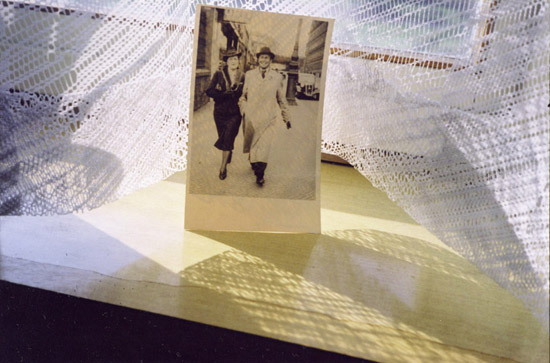
    Kenneth Josephsonʼs 1965 portrait, Matthew, (above), shows technology used in Polaroid where images can be seen/touched immediately. In the photograph, Josephsonʼs son holds a Polaroid image of himself in front of his face, depicting as though holding a camera. Bertien van Manen’s photograph from 2004, Prague (Couple holding hands) (below) is part of the series Give Me Your Image, where the artist photographed valued family photos in the homes of European immigrants. The waning practice of taking, developing and displaying family snapshots is part of the value of the prints, which as such are both tangible objects and vessels of image and meaning.

    Bertien van Manen, Prague (Couple holding hands), 2004, 16 x 20 inches, Chromogenic print Edition of 10
    Bertien van Manen,
    Prague (Couple holding hands), 2004,
    16 x 20 inches,
    Chromogenic print
    Edition of 10
  • Bortolami gallery’s exhibit shows 3 x minimalist encounters

    Bortolami gallery’s exhibit shows 3 x minimalist encounters

    Bortolami Gallery is one of the most innovative galleries in Chelsea’s vibrant art district. Currently it is hosting an exhibit for three artists who share an approach of minimalism. An exhibition is curated by Christine Messineo, and is titled in a punctuating manner: ”ANN VERONICA JANSSENS, KITTY KRAUS DANIEL STEEGMANN MANGRANÉ First lines, like first dates, or the first bite of dessert, can be deceptive.” Even if the works would not seduce you at the first glance, spending some time with the installation and connecting pieces, might make you fall in love. Stepping into the space, which itself is a constellation of whiteness, concrete floors and strong ceiling lights, puts you into a certain mood. The space tunes to receive the immaterial lightness of some works. On the other hand, some pieces makes you investigate your own perception.

    This slideshow requires JavaScript.

    The exhibition title is taken from a text by Ann Beattie. She handles a theme of difficult of beginnings, asking where to start. If the beginnings can remain elliptical, the encounters may be unstable. A curatorial choice thereof has been to follow this principle, and create the exhibition around three artists with above question in mind. Ann Veronica Janssens, Kitty Kraus and Daniel Steegmann Mangrané present works all share experience which do not reveal, as ”First looks cannot be relied upon.

    Ann Veronica Janssen’s career has been full of experiments with form and perception, testing our reflections into familiar forms and to spatiality. Also in this exhibition her pieces invite to reflect. Magic Mirror Pink holds a possibility for a mirror-effect. Disque Vert holds magical presence being placed on the back wall, immediately popping out from the white walls. It reminds of a musical instrument, but instead of making sound it whispers with deeper than surface reflection. All the miracle that Janssen’s three works play within the exhibition tell about ”scientific phenomenon or physical property of light—its ability to bend, to refract, to remain encased within a prism-like volume.” The artist’s sculpture IPE 130 is the center piece of the large installation room. This sculpture is a steel I-beam lying on the ground of the gallery. The top of the sculpture has been polished so it reflects your image, or the objects in the room that touch upon the surface. The purpose is to communicate with the architecture, as all Janssen’s works ultimately do.

    The exhibit starts right when entering the gallery. First room with windows to the street is a small one. One immediately encounters Steegmann Mangrané’s sound installation. He has worked with sound that comes from seven speakers that are placed throughout the gallery; taking two rooms. The sound is composed as prolonged note played on the flute. ”The duration of each note corresponds to the lung capacity and stamina of the flautist, Joana Saraiva. As one note comes to its end, another note begins to play from different speaker in the gallery.” In this area, there is a need to find the source of the sound, which does not resonate clearly from the speakers. The art objects in the exhibition carry so much, so perhaps sound gets confused or finds ways to attach to different bodies. Mangrané has worked with notion of immateriality. The lightness of breath which is present in the musical notes creates meaning in conjunction to his sculptural works as well.  He has created several metal chains that hang from the ceiling that reach the floor intending to alter the viewer’s ability to negotiate the space. Additionally, a group of small cardboard sculptures appear as the most ethereal part of the show – which overall seems slightly prismic, metallic, or technologically referential. These are like masks made of sycamore tree bark. Their curved altered face-like shapes absorb the light creating shadows on the wall, ”seemingly lending mass to the immaterial.”

    Kitty Kraus’s piece Untitled (Light Box) which, although it is situated in the small room in the back, has especially strong presence. ”Taking the form of a large pedestal, the sculpture casts a strong light from only a thin horizontal aperture that runs around the middle of the dark, rectangular volume.” As you go around the sculpture you can see it upon yourself thus becoming part of its field. The sculpture leaves out an emitted light line that draws the perimeter of the room. When people enter the room the light from outside communicates with the darkness of the sculpture and its surrounding space. White lines of the exterior space meet with the dark hollowing entity of the box, creating magical installation that eats up the space, almost disturbing the perception, and pointing to the trivial?

    The exhibition will run until April 26, 2014

    www.bortolamigallery.com