Climate Change brings to mind emissions, which require solutions, such as futures with bikes and more car free highways. The planet Earth is calling us to bring nature to the negotiation table. These are the verses for the new year.
"Nature's rhythm is different from the pace of the contemporary society."
What we don’t seem to realize is that nature is in fact offering space without asking us to limit our dreams. Two years into the pandemic has changed our everyday perspectives; we have voluntarily moved our lives more outdoors. We suddenly pay attention to dear little details that we see in nature, and think about the future livelihood and living on this planet.
Nature’s rhythm is different from the pace of the contemporary society. This is also something that this pandemic has taught us oh so well. Did we ever imagine that we would be capable to pause, and start dreaming of a different future? Some of us did dream, at least.
Looking at the birds in winter, as they descend to a freezing environment.
"Looking at the birds in winter, as they descend to a freezing environment."
Let’s take birds in the winter as an example. What is it in their circumstances, the birds in suburban environments, that is causing us to pause and consider if the animals have enough food.
Cars, parking lots, people going shopping in their vehicles, trains, commercial projects surrounding geese habitat. What is so special about these animals living next to human habitation, geese in our urban and suburban parks. They make us think changes in season, and how the big birds used to migrate someplace warmer.
Humans are responsible for destroying wilderness, wetlands, populations, to name a few. With geese, as their extinction was more evident due to destruction of the species natural habitat – the birds were brought into urban areas where they had never been living before. The natural migration cycle stopped and the geese stayed in their new settings. Humans have since then found that the birds’ new existence is perhaps too close, birds taking over parks and parking lots.
"We can be thankful that they still have some wilderness to roam and be birds."
A question of food for geese is a problematic one, since feeding and making them accustomed to vacate human habitat eventually means that nature’s own cycle is being interrupted. Not because geese themselves were opting for these new environments. We can be thankful that they still have some wilderness to roam and be birds.
"Future perspectives do imply stricter and more compassionate approaches, when it comes to ever busy air and street spaces."
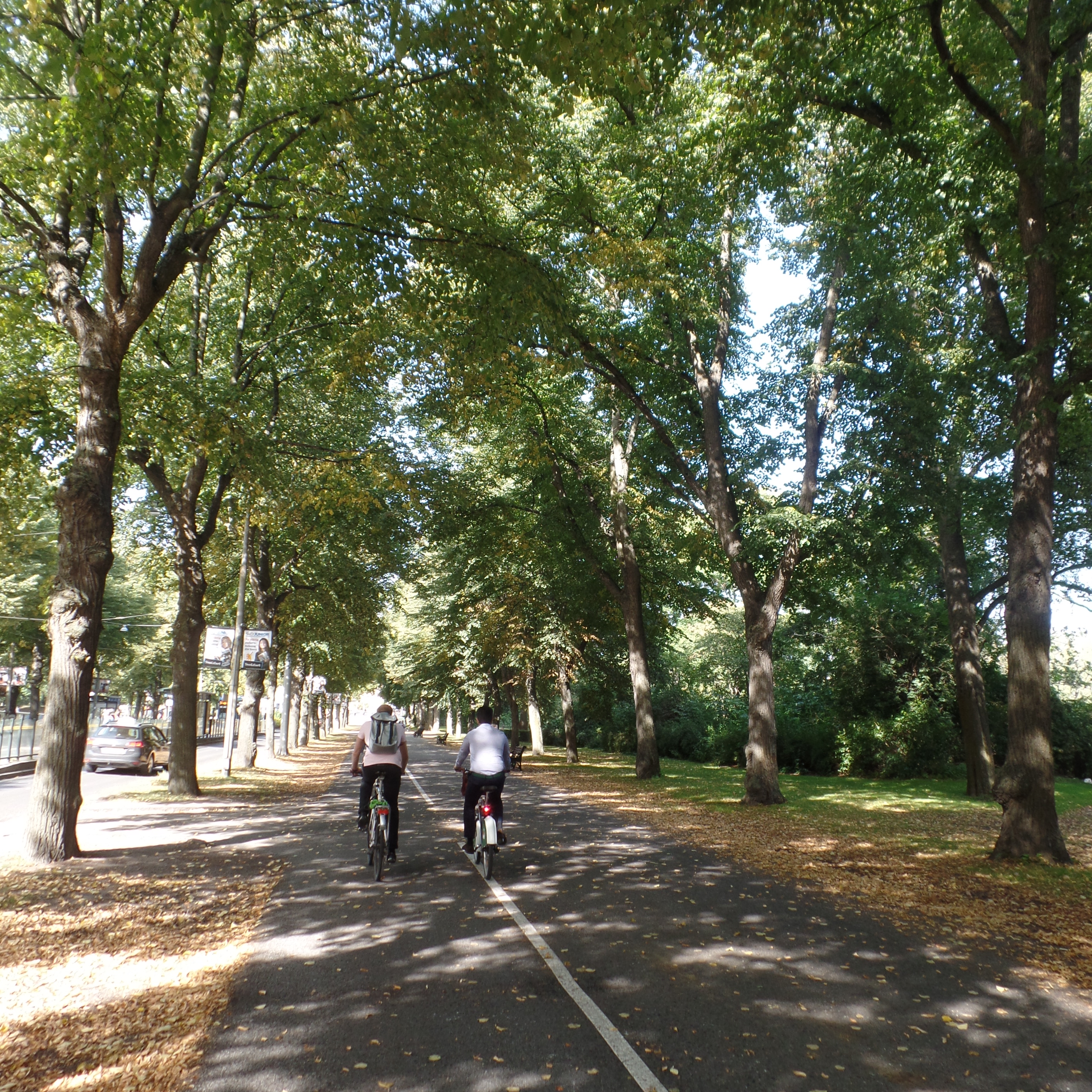
Biking is an old fashioned green new deal. It also goes together with the nature’s rhythm. The pace is one of wondrous.
"Biking is an old fashioned green new deal. It also goes together with the nature's rhythm. The pace is one of wondrous."
To participate in a green new deal, cutting back emissions is of course not just an act of love for many of us who like to travel and seek far away adventures. Yet, future perspectives do imply stricter and more compassionate approaches, when it comes to ever busy air and street spaces. Cutting down greenhouse gas emissions is easily a foreign language concept or theory that stay away from the realities of modern individuals, who can count cars in the garage. Everybody needs their own car just to get around. How to explain this in simple terms, how to change this pattern?
"The awakening is bringing nature closer to our communication, forming new communities."
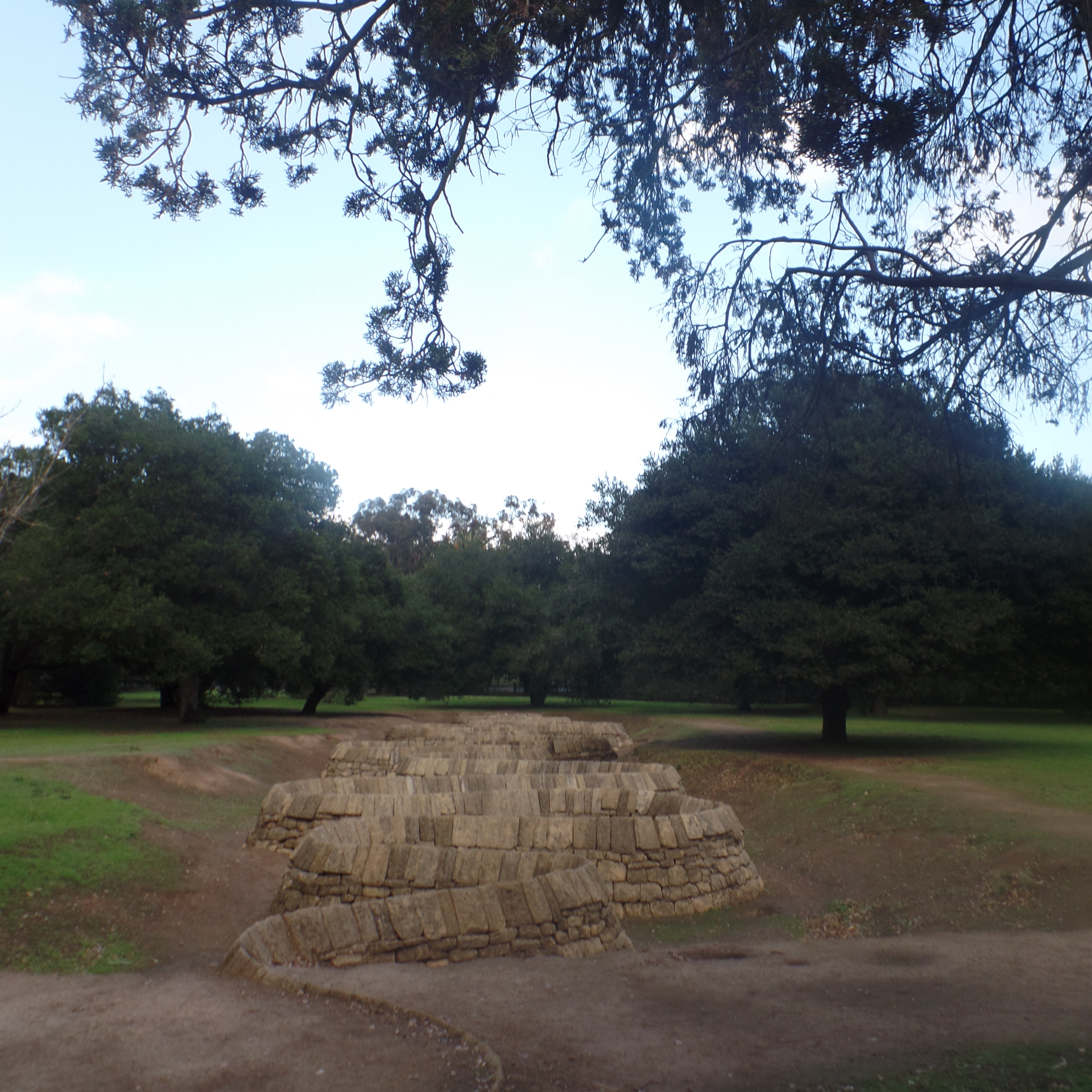
Stone River by Andy Goldsworthy outside the Stanford University Cantor Center for Visual Arts.
Futures hold promises for the world in the form of awakenings. Climate coalitions and awakenings for earthy subjects are thankfully becoming one kind of new normal.
"World, in which constant profit is a standard, and where sustainability and co-creation are like dialects of foreign languages."
When it comes to art, fundraising is meeting with auction house practices to make equity and ethical planetary standards meet in the productions. How much sustainability can we create with these methodologies, is yet to be discovered – not just in the form of capital, but as acts of recycling, repurposing, and meeting circular economy standards.
World, in which constant profit is a standard, and where sustainability and co-creation are like dialects of foreign languages. Co-creation implies a communal aspect of creating together. As such it is somewhat strange to Western notions, which rather highlight the success of ego-driven selves.
At its best, the awakening is bringing nature closer to our communication, forming new communities. Community and art can meet in various ways. The art works that take over public spaces are a great example.
Outside the Stanford University’sCantor Center for Visual Arts is a Stone River, a large wall created of sand stones. A sculptural serpentine project created by artist Andy Goldsworthy (2002), is blending with its campus environment, growing naturally in the landscape of trees and meadow, bringing joy for people working and visiting the campus and the Art Center. These stones are remnants of campus buildings. The stones had fallen during two earthquakes that hit the bay area in 1906 and 1989.
Stone River is composed of rumble that was left behind after two earthquakes.
The Stone River was inaugurated in 2002 at the campus. Goldsworthy found out that the campus had remnants of historic earthquakes that shook the area, in 1906 and 1989 respectively, forming stone rumble that had fallen off the buildings. He instantly gained a feeling that stones could organically return back to earth, forming a flow which almost seemed that it had archeological origins. As if the stones had been there for a long long time.
Goldsworthy is referencing rural Scotland, where there is archeological presence of people layering stones, layer after layer like this.
In Stone River, the stacked stones in the sculpture, set in a nearly 3 1/2-foot trough dug in the earth, rise from a 4-foot wide base to an almost impossibly precise undulating line. “I call it a river, but it’s not a river,” Goldsworthy said. The sculpture is “about the flow. There’s a sense of movement in the material, through the individual stones, so you just see this line.” –Barbara Palmer, Stanford Report
Patricia Chow, an LA-based abstract painter who creates place-specific sensory works, returned from her artist residency in France.
Firstindigo&Lifestyle: You have been living mostly in LA during the Covid. I imagine everyday life experiences have changed for you as well.
Patricia Chow: I was used to frequent international travel prior to Covid, so it was definitely an adjustment during lockdown. My art practice had been centered around translating place-specific sensory and mental lived experiences into abstract paintings, and needless to say, this failed utterly when the only place I experienced for 16 months was the inside of my apartment. My goal for 2021 was to re-acclimate to life in the world, including rebuilding my place-based art practice.
Firstindigo&Lifestyle: Why Vallauris, France, how did you find about this place and art residency?
PC: While the world began to reopen for travel in summer 2021, Covid infection rates continued to surge, so I used my skills from my day job as a data analyst to track international infection rates and identify regions where it would actually be safer for me to stay than Los Angeles, where I currently live. The other piece of the puzzle was to identify residencies in those areas that were still operating and had places for late 2021. Prior to omicron, France had been doing well.
I had wanted to spend some time in Collioure, France, to investigate the origins of fauvism, so this became a starting point for my search. I ended up 300 miles to the east in the town of Vallauris (val-o-REES), where Picasso did his ceramic work in the 1950s. I was very lucky – the A.I.R. Vallauris residency lasted five weeks, and soon after I left, France’s infection rate skyrocketed to 50,000 new daily cases.
Firstindigo&Lifestyle: The landscape and atmosphere are probably very different from West Coast of the United States. Can you explain what is special about this residency, regarding of art history?
PC: The Côte d’Azur region has beautiful light and dramatic scenery which have drawn artists for hundreds of years, as well as many museums dedicated to these artists (Chagall, Cocteau, Matisse, Picasso-who has two museums), and museums located in the former homes of the artists (Bonnard, Fragonard, Léger, Renoir), not to mention the fabulous Fondation Maeght. All of this was definitely a draw.
Another draw was the residency’s self-contained format. The six cohort artists live in the same historic building and work in the same studios, essentially forming our own Covid pod, which helps limit exposure for everyone. While the living arrangements were quite spartan, I felt very lucky with my cohort – we had a lot of synergy in terms of both artistic and intellectual interests, and the final exhibition turned out to be quite cohesive.
Firstindigo&Lifestyle: How did the new work get exhibited?
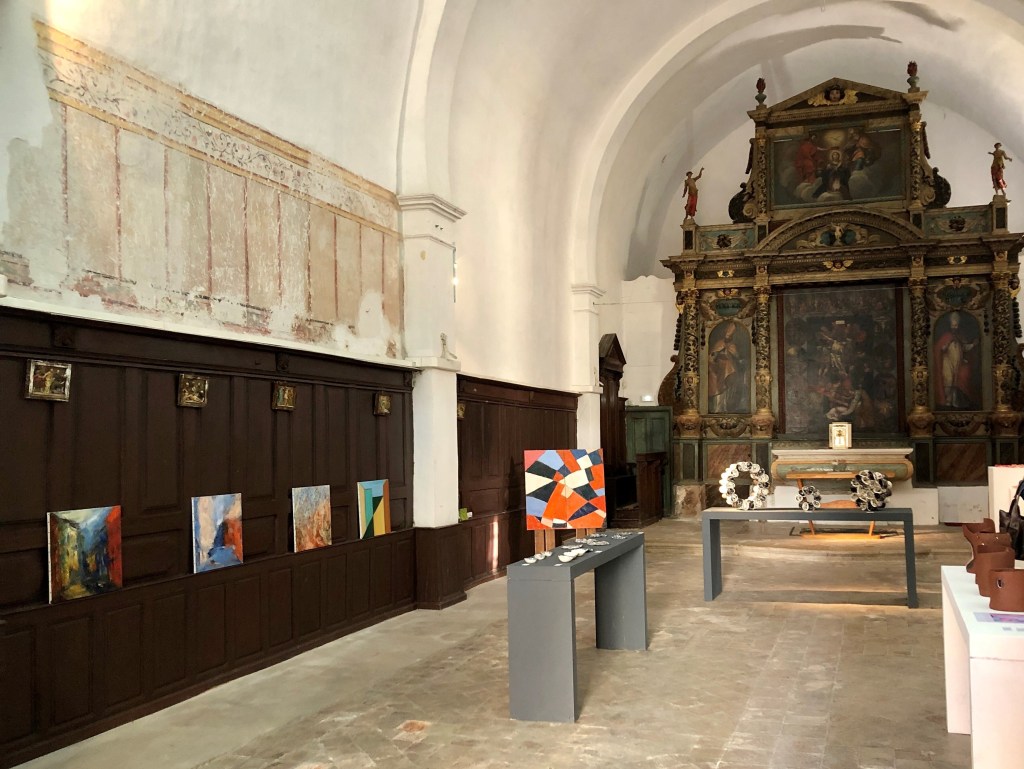
PC: Another interesting aspect of this residency was the exhibition space for the final show: the Chapelle de la Miséricorde, built in 1664, and housing an enormous Baroque altarpiece from 1724. Of course, this could be both a blessing and a curse – small works might feel overshadowed by the space, and censorship could be a problem for some artists since it is, after all, inside a church.
Firstindigo&Lifestyle: How would you think this location impacted your creative process, creating new sort of place-specific works?
PC: I created a series of five mental landscape paintings of Place Lisnard: four 50x50cm studies and one larger painting, a 100x100cm diptych. I call them site-specific paintings because they are the most location-specific paintings I have ever done.
Place Lisnard is an address, a pin on a map, rather than the conceptual space or idea of a city or place, and the paintings were made specifically for the exhibition space. The series explores different ways of translating the town square in paint, influenced by the many artists who came before me to the region.
They are unified by a common color palette, which is ubiquitous in the area – found on everything from building exteriors and tromp l’oeil window shutters to bus tickets. The final diptych remains in the collection of the Chapelle de la Miséricorde, where it was first displayed.
Firstindigo&Lifestyle: What do you feel you were able to take with youfrom this experience?
PC: It is so important to stay flexible. Things have a strange way of working themselves out. I had wanted to do a deep dive into André Derain’s fauvist paintings in Collioure, but ended up in Vallauris submerging myself in the landscape paintings of Russian-French painter Nicolas de Staël who had spent some time in the area. One of his paintings from Agrigento is here in L.A., but there is very little written on him in English, and the books in French are hard to obtain in the U.S. But in France, I could just walk into the bookstore at FNAC and pick up a couple of monographs right off the shelf.
Firstindigo&Lifestyle: During Covid, the material details of our everyday life have also been unusual. Did you experiencesome hardship during your five week residency, any obstacles and locally specific solutions for overcoming them?
PC: The availability of materials turned out to be a challenge – the R&F oil sticks I usually use are sold in only two stores in France – and both are in Paris, 900km away. I even wrote to the founder of R&F about it, and he recommended ordering them on Amazon. I ended up pivoting to locally available materials that I had not seen before – Cobra Artist water-mixable oil paint. I had only ever seen the student grade of these in the U.S. The artist grade was much nicer – actually like oil paint, without the complicated cleanup. And since the materials will always dictate to some extent the work that you can do, I ended up painting in thick impasto with a knife, like the de Staël master copies I was doing, while incorporating the specific characteristics of Place Lisnard, the town square where the exhibition space, studio and accommodations were all located.
The Eye of the Beholder: Julia Pastrana’s Long Journey Home is a new book edited by Laura Anderson Barbata and Donna Wingate. The essay collection sheds light on the life of historic sensation, Mexican international performer Julia Pastrana, expanding the storyfrom anthropological and art historical perspectives. The book can also be viewed as a personal story of discovery. Artist and writer Laura Anderson Barbata remembers her own process of starting the project that eventually led to this book. How she got engaged in the controversial subject propels ideas of activism, and a passion to rewrite Pastrana’s history from new humanitarian and feminist points of view.
Firstindigo&Lifestyle: How did you originally get interested in Pastrana’s life?
Laura Anderson Barbata: In 2003, Amphibian Stage Productions, a theater company directed by my sister Kathleen Culebro, invited me to collaborate with designs for a play that they were about to premiere in New York: The True History of the Tragic Life and the Triumphant Death of Julia Pastrana, the Ugliest Woman in the World, by Shaun Prendergast. This is how I learned about Julia Pastrana. The story, unfolding in complete darkness, details the life of Julia as she traveled through Europe, a performer in a freak show, until her death in Moscow. It also briefly recounts the fate of her mummified body, and that of her baby, until they were added to the Schreiner Collection of human remains in the anatomy department of the University of Oslo. Upon hearing her story, I felt that my duty as a Mexican artist, and as a human being, was to do everything possible to have Pastrana removed from the anatomy collection and returned to Mexico, her place of birth—where she was at the time practically unknown—to receive a proper burial.
After nearly ten years of effort, Julia Pastrana was finally transferred to Mexican officials in Norway; I represented Mexico. After more than 150 years of being exhibited for her unique physical condition, Ms. Pastrana (1834–1860) was repatriated to Mexico and buried in Sinaloa, Mexico in 2013.
Firstindigo&Lifestyle: It’s been really a longitudinal project for you personally. How did you get others to get involved?
I was not the first person to request the burial of Julia Pastrana and have often asked myself, why was I able to succeed? Why did other efforts fail? What did I do differently? I think the answer lies in the fact that I am an artist and therefore my methodology was radically different from all others from the start. My extensive collaborative artistic experiences in Mexico, Venezuela, and Trinidad prepared me for a project of this magnitude that ultimately involved international institutions, government officials, various organizations, and scientists.
LAB: The ten-year plight for Julia’s return for burial began with letters I wrote to the National Research Ethics Committee for the Social Sciences and Humanities, the National Committee for Ethical Evaluation of Research on Human Remains of Norway, the Governor of Sinaloa in Mexico, the Foreign Affairs Department of Mexico, the University of Oslo, journalists, artists, anthropologists, individuals, and various institutions that I reached out to for their professional opinion, advice, and guidance. During this process, they became deeply involved and invested in the outcome. Each one was fundamental for the success of the repatriation and I consider them to be my collaborators.
Firstindigo&Lifestyle: How many authors are participating in the publication that is coming out now, and what perspectives do they cover from visual and historic perspectives?
LAB: I edited the book with Donna Wingate, and it includes texts by Jan Bondeson, Rosemarie Garland-Thomson, Grant Kester, Nicolas Márquez-Grant, Bess Lovejoy, and myself. Donna and I researched and selected more than fifty illustrations from the public domain, library collections, archival materials, and works commissioned especially for the project.
The Eye of the Beholder: Julia Pastrana’s Long Journey Home, book cover.
The authors are as follows:
Dr. Jan Bondeson is a Swedish-born rheumatologist, scientist and author, working as a senior lecturer and consultant rheumatologist at the Cardiff University School of Medicine. Outside of his career in medicine, he has written several nonfiction books on a variety of topics, such as medical anomalies and unsolved murder mysteries.
As an expert on Julia Pastrana, Bondeson contributed two chapters to the book; the first is a general introduction to the story of Julia Pastrana, and the second recounts how he found her remains in the basement of the Forensic Institute of Oslo in 1988, and how his extensive research established that she suffered from hypertrichosis terminalis rather than hypertrichosis lanuguinosa, as previously believed.
Dr. Nicholas Márquez-Grant is a Specialist Forensic Practitioner in Anthropology and Archaeology at Cellmark Forensic Services, Abingdon, UK. He is also a Research Associate of the Institute of Human Sciences, University of Oxford.
His text addresses the history of collections and the anthropological framework of the nineteenth century; the ethics surrounding human remains; the case of Julia Pastrana’s repatriation and its significance; witnessing Pastrana’s body in the chapel during the repatriation process.
Rosemarie Garland-Thomson is Professor of Women’s Studies and English at Emory University. Her fields of study are feminist theory, American literature, and disability studies. Her work develops the field of disability studies in the humanities and women’s and gender studies.
Dr. Garland-Thomson’s essay considers the ways that the public display of Julia Pastrana both reinforces and challenges the lines between the self and other, human and non-human, ordinary and extraordinary, that such spectacles rely upon. By analyzing how Pastrana’s display and recent repatriation and burial in Sinaloa invest her body with different meanings, it traces the processes that socially mark human bodies in order to reveal and explicate the inner workings of representational systems, such as race, gender, ethnicity, and disability.
Grant Kester is Professor of Art History, and Director of the University Art Gallery at the University of California, San Diego. Kester is one of the leading figures in the emerging critical dialogue around “relational” or “dialogical” art practices.
Dr. Kester’s text discusses how European colonizers were unable to attach specific meaning to the objects they acquired through colonization and thus developed larger meanings for art more generally. Recovering Pastrana’s remains becomes an act of restitution that encourages a confrontation with the historical status of “stolen” objects and encourages a renegotiation of and reconnection to the understanding of the past.
Bess Lovejoy is a Brooklyn-based writer and editor. Ms. Lovejoy’s essay contextualizes Julia Pastrana’s afterlife by considering a number of other notable individuals whose bodies have been preserved in museums. Like Pastrana, many of these individuals possessed bodies that differed from the European norm, either because they were born with physical abnormalities or because they were of non-European ethnicities. Her chapter considers how scientific and ethical considerations complicate the collection and display of such bodies, and how some of these bodies have been the focal point of successful repatriation campaigns, while others have not.
Laura Anderson Barbata
My essay describes my own journey: the process, challenges, and partnerships that were formed as I worked for ten years for the repatriation of Julia Pastrana.
Books by Laura Anderson Barbata. Images by Firstindigo&Lifestyle.
Laura Anderson Barbata in her studio.
Firstindigo&Lifestyle: Your own artistic research work on Pastrana has included performative phases, how are you implementing this approach on the book?
LAB: While Julia Pastrana was billed as “The Ugliest Woman in the World,” what is most important to mention is that she was a gifted mezzo-soprano and dancer—she was a very successful performer during her lifetime. Julia Pastrana’s life story and the fate of her body after her death (including her successful repatriation) brings to light issues that remain deeply relevant: beauty, ownership, science and racism, commercialization, objectification, exploitation, human rights, public versus private, international law, colonialism, sexism, respect, responsibility, indigenous rights, memory, sensitivity, the physical body, and the spiritual body.
In order to unpack all of these subjects, I felt that they must be addressed through different mediums. First, it was important to create a publication to gather the most significant material concerning her life with critical essays from different scholars. Donna Wingate and I worked on this book for over four years—researching archives and discussing the various lenses through which we could gain a deeper understanding of Julia Pastrana. At the same time, our goal was to present a full account of Pastrana as a person, a woman, and an artist, with the dignity she had been denied during her life and after her death. The book includes images of my artworks—works on paper and performances—based on the story of Julia Pastrana.
Firstindigo&Lifestyle:How would you describe the cultural life in Mexico at the time of Julia over hundred years ago? Also, what was the context that she was surrounded by that addressed her as a celebratory oddity?
LAB:Julia only lived in Mexico for the first twenty years of her life. She was born in 1834 in the State of Sinaloa, and according to popular legend, was born in the indigenous village of Ocoroni—or thereabout—in 1834. Today Ocoroni belongs to the municipality of Sinaloa, in the state of the same name, and is located in the foothills of the Sierra Madre Occidental.
In the decades of the first half of the nineteenth century, Mexico was searching for its own destiny and independence. Since the establishment of the first settlements by European Hispanics in the sixteenth century until the early nineteenth century, the territory of Sinaloa was mainly a mining state. The population, therefore, settled in the mountains and in the valleys. Mining camps and towns were established throughout Sinaloa for the search and exploitation of metallic resources that were coveted by the monarch of Spain.
Nothing is known about Julia’s parents or siblings, and there are no documents of her birth or baptism. It should be noted that the Office of Public Records (Registro Público) had not yet been created in Mexico; it was legally established on January 27, 1857. Little is known about her childhood, although it is said that an uncle took charge of her after the death of her mother, and in an effort to make a quick buck, sold to her to a small traveling circus—the kind that occasionally passes through these remote villages. Sometime around 1836 until April 1854, Julia was a maid in the residence of Mr.Pedro Sánchez, who had been in charge of the government of Sinaloa from September 28, 1836 to June 3rd, 1837. It is possible that he purchased Julia from the circus that had exhibited her throughout the northwest of the country.
We believe that her training as a mezzo-soprano and dancer began when she lived at the governor’s house, and he likely presented her before audiences. She spoke four languages: English, French, Spanish, and Cahita, her native tongue. She was taken to Guadalajara to perform in 1854, and news of her reached the United States, as we found in an article in the New York Post. This must have been what sparked the interest of the American Theodore Lent, who worked for Barnum and Bailey and later became Julia’s husband. He traveled to Mexico to meet with Pedro Sánchez and Francisco Sepulveda to discuss a business venture that involved the sale and purchase of Julia Pastrana.
Firstindigo&Lifestyle: As a phenomenon she became extremely internationalized so to speak. How would you explain this to contemporary audiences, from the perspectives of art, science, and women’s history?
When Julia Pastrana left Mexico and traveled to the United States with Francisco Sepulveda to meet Theodore Lent to complete a business transaction between Sepulveda and Lent, Theodore Lent secretly convinced Julia Pastrana to marry him, and he immediately became her manager. He presented her to audiences and billed her as the Bear-woman, the Nondescript, the Ape Woman, the Female Hybrid, the Wonderful Hybrid, and Baboon Lady, among other sobriquets.
LAB: Julia Pastrana was taken to perform in Boston, Philadelphia, Cleveland, and New York, among other cities. After a number of presentations in the US and Canada, Lent decided to take his show to Europe. They traveled to London, and extensively throughout Germany, Poland, and Russia. Julia Pastrana’s shows were very successful, and newspapers throughout Europe wrote about her.
Julia Pastrana’s story is a reminder that what happened to her is not an experience exclusively from the past—today there are far too many cases of exploitation, abuse, neglect, cruelty, human trafficking, and discrimination. Julia Pastrana is a reminder that we urgently need to forward women’s rights, indigenous rights, children’s rights, and eliminate human traffic to start. We must end gender discrimination, defend the rights of people with differences, protect religious choices and end the voracious dehumanization of people in the name of political, commercial, religious, and scientific purposes. For me, it means that I continue working on the topics related to her, the injustices she lived and how they are still relevant today.
LAB: Among the works are: a performance piece that is continually evolving, a series of zines that address different topics related to Julia Pastrana such as: repatriation of human remains, museum ethics, exhibition practices, the objectification of people and women, human traffic, beauty and the commercialization of women’s bodies, feminism, animal rights, love, circus arts, among others; in addition, we are working towards an Opera about Julia Pastrana in collaboration with the artist collective Apparatjik, Concha Buika, and Void Design.
Firstindigo&Lifestyle:Do you think she is appreciated in Mexico today, and how will the book contribute to that?
LAB: The repatriation of Julia Pastrana sparked a great interest worldwide and in Mexico. Since Julia Pastrana’s repatriation there have been at least three plays written and performed in Mexico about her, and I understand there is a feature film in development by a Mexican director. I have also learned about a woman’s health center that opened recently in Argentina that is named after Julia Pastrana. Because of my work on the repatriation of Julia Pastrana, I recently received an award by the Instituto de Administración Pública of the State of Tabasco, Mexico for the Defense of Human Rights.
It is clear to me that all of these responses show that Mexico is embracing Julia Pastrana and is working towards restorative actions for her memory, for the promotion of dignity and justice, and in humanitarian efforts to defend the rights of all.





 Firstindigo&Lifestyle