Olena Jennings’s recent poetry narrates travel to Georgia in the summer of 2017. Her lyric lingers between urbanness and coupling, remembering moments, and capturing an essence of absurdity.
September 2, 2017, NYC
Stray cats begged at our table, as our faces
grew moist, looking up at the sun.
Enclosures followed: the tight
space on the plane and then the cubicle.
I ignored the eclipse, the way the shadows
on the pavement repeated themselves
like the words that fall in steady drops,
overpowering the notations on calendars
and to-do lists. We wake beneath
the blanket from the market
near the dry bridge. Once we drove
towards the light, the tires against
cobblestones, the shape of the moon
calling us to the rows of jewelry,
the repetition of desire for translucent beads
around your neck.
September 13, 2017, NYC
You gave me the key. There is a trick
you didn’t teach me, though there were often lessons:
the way to peel a carrot, to cut an onion without
crying, and to buy carnations instead of roses.
You spun daily life like the plot
of one of your romance novels. Your dress is always
caught in the wind even when there is only the breeze
from the window. You invite the men over who leave
their newspapers on the table, so that you are subject
to the nightly violence. Sometimes
there is even a hand against your cheek emphasizing
the glow. The street signs shine green, creating a map
of our memories. Together we lived in this house
until you started filling the walls with other peoples’
portraits.
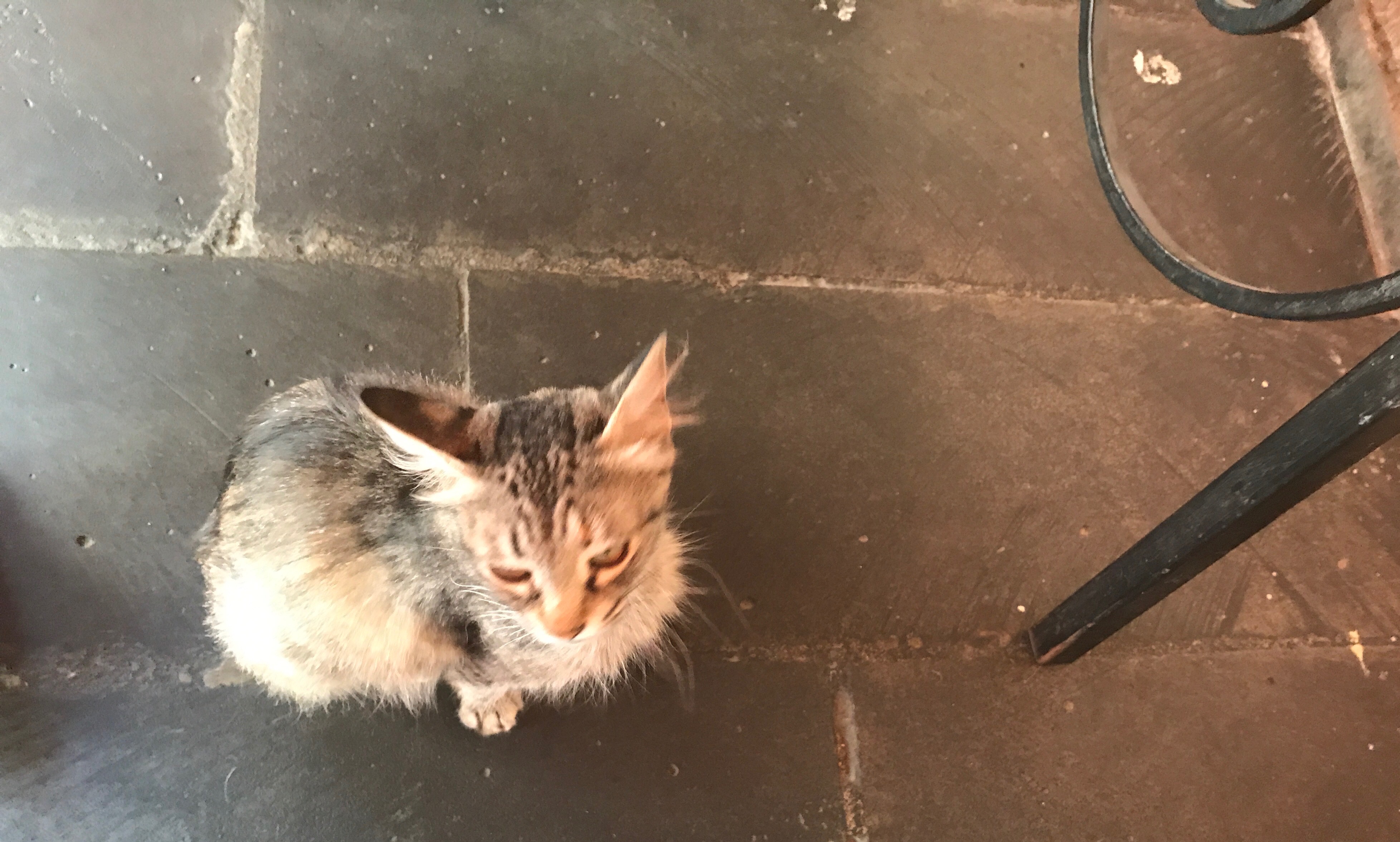
Olena Jennings, Georgia Kitten, 2017.
GHOSTS OF CATS
They prance down
 the hall to the studio
 where scent
 is outlawed.
 Making it even easier
 to forget
 the view of the lake
 from my window.
 I’m always working
 on the same translation,
 anarchy in my head
 and cancelled European
 adventures, my body
 already halfway there.
 He is shocked by
 the connection with his
 words, as if they are mine:
 the moment he looked up
 at the hall light
 on his way to borrow stamps
 and saw the world. I wake up
 early to caress his heart,
 but I know in this studio
 when we finally meet
 everything is too real to exist
 the way we dreamed it. There
 is the blue door, the water boiling for
 the French press, and my bare feet
 against the soft rug.
Olena Jennings’s collection of poetry “Songs from an Apartment” was released in 2017 by Underground Books. Her translations of poetry from Ukrainian can be found in Chelsea, Poetry International, and Wolf. She has published fiction in Joyland, Pioneertown, and Projecttile. Her novel Shut Mouth will be published in 2018. She completed her MFA in writing at Columbia and her MA focusing in Ukrainian literature at the University of Alberta.
Bettina Pousttchi is a Berlin-based artist working in photography, video, and sculpture. German-Iranian artist studied at the Kunstackademie Düsseldorf, and participated in the Independent Study Program at the Whitney Museum of American Art in New York from 1999–2000. Pousttchi has exhibited throughout Europe, including Amsterdam, Berlin, Köln, and London, and participated in the Venice Biennale in 2003 and 2009. She held her first U.S. solo exhibition in 2014 at the Nasher Sculpture Center in Dallas, Texas.
Through photography and sculpture, BettinaPousttchi is interested in altering architectural buildings and monuments as indicators of the past and media of remembrance. Currently, the artist exhibits in two different museum spaces in Washington D.C. First exhibition titled Bettina Pousttchi: World Time Clock is on view until May 29, 2017, at the Smithsonian’s Hirshhorn Museum and Sculpture Garden filling the museum’s third-level inner-ring galleries. Concurrently with the World Time Clock series, The Phillips Collection presents her second D.C. appearance with the works titled Double Monuments. This exhibition by Bettina Pousttchi ison view until October 2, 2016.
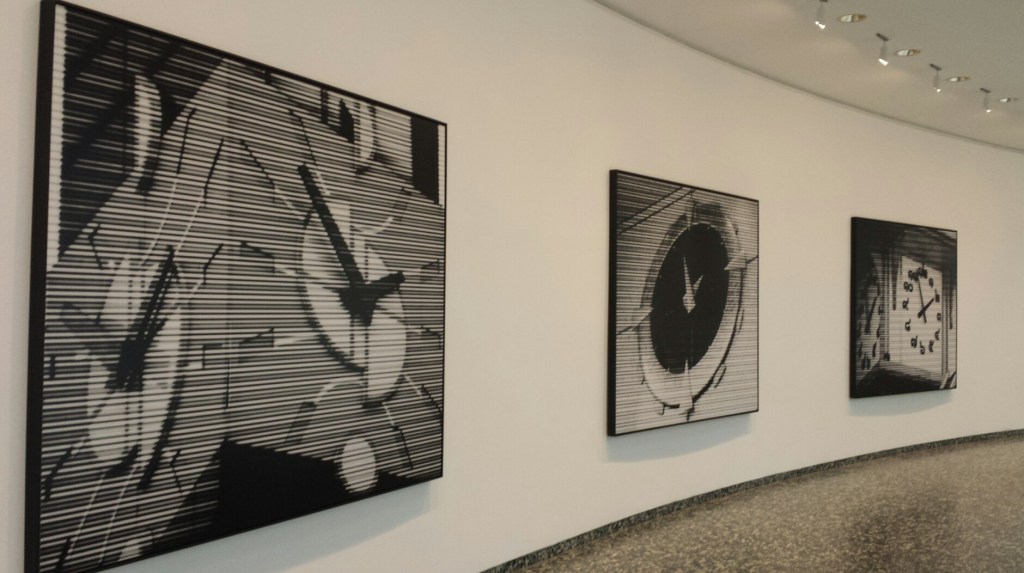
Pousttchi’s exhibition at the Hirshorn is a premiere of her World Time Clock series, a project the artist began in 2008 and recently completed. The installation consists of a group of photographs that she created in 24 time zones around the globe over the last eight years. The artist has often contemplated systems of time and space in her art. To accomplish the World Time Clock photography, she traveled the globe capturing a portrait of a public clock in each time zones. In the final production, represented are locales far apart from each other, such as Bangkok, Moscow, Los Angeles and Tashkent, Uzbekistan. The circular format of the Hirshhorn’sinner-ring galleries on third floor works well with the theme of this exhibition.
Bettina Pousttchi’s World Time Clock at the Hirshorn’s third floor is on view until May 29, 2017.
Bettina Pousttchi’s World Time Clock.
Bettina Pousttchi’s clocks come from 24 different time zones.
The photographs each show a clock displaying the same local time: five minutes before two. Together the images suggest a sense of suspended time and what the artist calls “imaginary synchronism.” Seen in close-up, the clocks are united in a single scheme that calls to mind the historic role of Washington as the site of the International Meridian Conference in 1884. It was here that the Greenwich Meridian was adopted as a universal standard, determining a zero point for the measurement of both longitude and time.
Bettina Pousttchi’s second display, on view at the Phillips Collection until October 2, takes on from the notion of history and memory of architecture. The exhibition is part of the Phillips’s ongoing series Intersections, which interestingly highlights contemporary art and artists in conjunction to the museum’s permanent collection, history, and architecture. With her works Double Monuments for Flavin and Tatlin (2013), Pousttchi is in conversation with art and architectural histories, addressing the historic works of Russian Constructivist sculptor and architect Vladimir Tatlin from the 1920s, and American minimalist artist Dan Flavin from the 1960s. Pousttchi’s sculptural installation is composed of materials deriving from street barricades, and metal crowd barriers, which the artist transformed into sculptural forms. The objects create contrast and volume with neon that grows inside the powder-coated abstract forms. The sculptures include spiraling neon light tubes reminiscing those fluorescent light works created by Dan Flavin. The five sculptures range from 5 to 12 feet creating dramatic presence and enhancing both sculptural form and architectural setting at the Phillips. Their tower-like shape is a homage to Tatlin’s sculptural works, yet they have a theme and form of their own. Pousttchi’s works carry an idea of mystery of bringing in outdoor elements into the white gallery space. The white paint creates sophistication out of the raw urban elements while neon makes them settle somewhere in between the indoors-outdoors -scale.
Bettina Pousttchi with Double Monuments on view at the Phillips Collection.
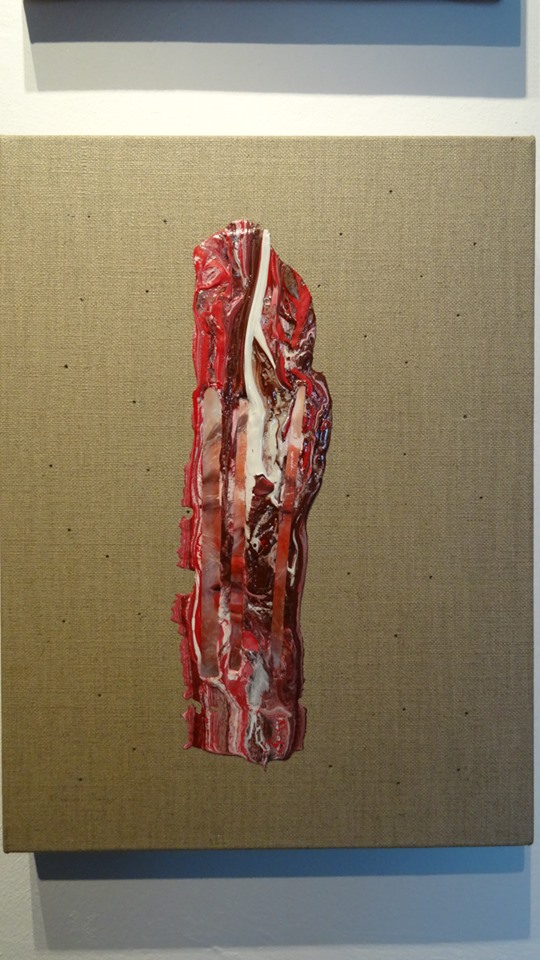
French artist Eric Decastro is known for his large-sized paintings that he constructs using the dripping technique. He is focused on creating a balance of color and light by applying thick impasto into canvas. Since 2008, Decastro has been running an art space Kunstraum Dreieich | Artspace Frankfurt in Germany that promotes artists with the motto of welcoming them back. The artist himself has a solo exhibition A Whiter Shade of Pale, Level 2 in New York City atThe Bronx Art Space, until April 30. Decastro is also showing as part of the DOPPELGÄNGER -exhibition, which is currently at Torrance Art Museumin California,and runsuntil May 28. The group show is a dialogue between German and US artists, and is curated by Dr. Julia-Constance Dissel and Sandra Mann from Germany together with Los Angeles-based curators Ichiro Irie and Max Presneill. The exhibition explores similarities of practices within globally expansive and hyper-connected art production.
In the solo exhibition at the Bronx Art Space, the visitor encounters a poetic cosmos, ‘which is intentionally designed to allow the illusion of landscapes or outer spaces.’ The theme of the Whiter Shade of Pale, Level 2 -exhibition is to explore issues of fugacity.
Eric Decastro, A Whiter Shade of Pale, 2016
Eric DeCastro, from the series of The Whiter Shade of Pale, acrylic on canvas.
Eric Decastro, exhibition at the Bronx Art Space, Until April 30, 2016
Firstindigo&Lifestyle: How did you decide to become a painter?
EricD: I already knew as a child that I wanted to be an artist. When I was 5 years old I was able to paint in my mothers atelier. It was something I was destined to do and I finally fulfilled my dream.
So what did you learn from your mother, who is the painter Mirei de Castro? How about your other influencers?
EricD: I learned the basics from my mother. Painters like Richard Poussette Dart, Lee Krasner but also Cecily Brown, Fabienne Verdier, Paul Rebeyrolle, Gerhard Richter and Sigmar Polke, have all also influenced me.
There is installation and performance development mixed with your paintings. In one installation you used, or it looks like, fake grass in the gallery as part of the show?
EricD: The installation Prevenue d’avance (Warned in advance) from the performance artist Mike Hentz (USA) and myself at a Kunstverein near Heidelberg 2012 has been furthering me a lot. Through Mike I was able to get a perspective for what one can call art. The lawn was actually real and has been tended and watered for a week in Kunstraum-Dreieich. After the event, it was fully removed. Then, the over dimensional “Dejeuner sur l’herbe” was a parody of the famous works of Edouard Manet.
Eric Decastro, Dejeuner sur l’herbe, installation view.
You have also painted tsunami?
EricD: After the Fukushima Tsunami, I did a complete series of works that looked like aerial shots of Tsunamis.
Some of the dripping technique paintings come out with natural confrontations, what do you see yourself in the works, are there reoccurring themes that come out?
EricD: One topic has been on my heart since 2008. My near death experiences have been both positive and negative for me, and I’ve been trying to depict this experience on canvases through a dripping technique in a meditative state. That’s how those paintings mostly have been created.
A really interesting one is the point when you washed some of the acrylic painting out of the canvas, and went on the real action forward method of making art. Tell about the work, in which the canvas and you are hanging from the tree?
EricD: This artwork was actually not created in the woods. I was walking with my dogs and saw this tree who looked like it could be a perfect frame for a canvas. I called a good friend of mine, a renowned Art-photographer Sandra Mann. We decided to do a photoshoot with one of my green paintings and put it in the natural frame of the tree.
How does the performance aspect work with the painting, are they part of the same discipline for you?
EricD: Of course the performance on a canvas in a natural state is my art. The work is being created, the performance oftentimes is the beginning of an idea that develops through painting.
For example, in “suffocating performance” the artist wrapped cellophane around his head to represent a type of suffocation. He was filmed and was also supervised (Don’t try at home). Afterwards I painted his performance “Suffocating Performance” for the exhibition “CARNAL DESIRE” in Museum Villa Rot. Theother artists were Wim Delevoye, Hermann Nitsch, and Fischli and Weiss. It’s a hommage to a boy from Kosovo who was suffocated and skewed and grilled all while his father was watching. I tried to depict the cruelty of this war.
Eric Decastro, Suffocating Performance, Acrylic on canvas.
Then, few questions about identity, how do you criss-cross between different countries, locations, and even continents?
EricD: I’ve been traveling my whole life. I really enjoy it and have been able to visit over 110 countries in this world. I’m getting my inspiration and positive energy from exceptional places. In the next time I’ll be traveling to Tibet, Nepal, Buthan and North India.
You have recently been exhibiting in Peru, and one of your galleries is in France, how are these art cultures different from each other?
My gallerist Mathias Bloch from Gallery Younique is French and my last exhibition was in “Alliance Française de Lima” so it was a home match for me as a French man myself. My abstract art is established in South America. A subsidiary of Coca-Cola (Inca-Cola) has recently bought one of my works.
You must feel that you are dealing with a variety of roles, a gallerist being one, and then a painter, is there a difference that is significant?
EricD: I’m not a traditional gallerist. I don’t participate in the art fairs. Kunstraum Dreieich is an Artspace with the motto “Rendes-Vous des Artistes.” It’s supposed to be an opportunity for artists to be displayed in the circles of art collectors that I have tended. This concept works well in Europe and especially in a city like Frankfurt the art will sell really quickly.
Art world is a phenomenon for its own sake yet many artists are involved in societal practice, mending the world so to speak. What do you wish to say about that?
EricD: Jonathan Meese said at Art-Basel in Miami in 2012 „Art is the new currency.“ He’s right, art is seen more like an investment nowadays. Never have people previously in history spent so much money on art as it is done today. Independently from whatever the artist wanted to reach with his art, whether a political message, improving the world, to amuse someone or as a wakeup call, art is and will be a good that can be traded in stock. Most buyers, buy art because they have a mindset to leverage the art.
Eric Decastro uses dripping technique to create acrylic color patterns on canvas
As April is the Earth Month, could you say something about, how does art and preserving our planet correlate, or meet thematically?
EricD: To preserve the planet and to make it better for our children is more vital than to collect art and display it in museums. What kind of benefit comes from a world that has been destroyed when museums are full of artworks, and there are no humans to enjoy the art, because then all of humankind will be too busy to focus on survival than to look at art. Politics don’t react to the signs of mother earth, the glaciers have been melting, global warming is unstoppable, and still there is no change of mind or thinking. One should replace the democracy through Geniocracy.
Tell a little bit about the project in Nepal, how long has it been in progress, and how did it start?
EricD: My wife is buddhist, and through her Master Lopen Tensing Namdak Rinpoche we got the idea to build a boarding school for children from Nepal in Tibet through fundraising and even some profit from selling my paintings. Since then it was possible to finance the first step of the project. We have already built a hospice in Katmandu in 2012. I myself volunteer as a hospice worker in a hospice in Frankfurt for about 4 years now. The experiences I have made there have helped me to stay grounded and to be confronted with the topic of death and what happens after death. This has been something I have been processing for years.






 Firstindigo&Lifestyle