
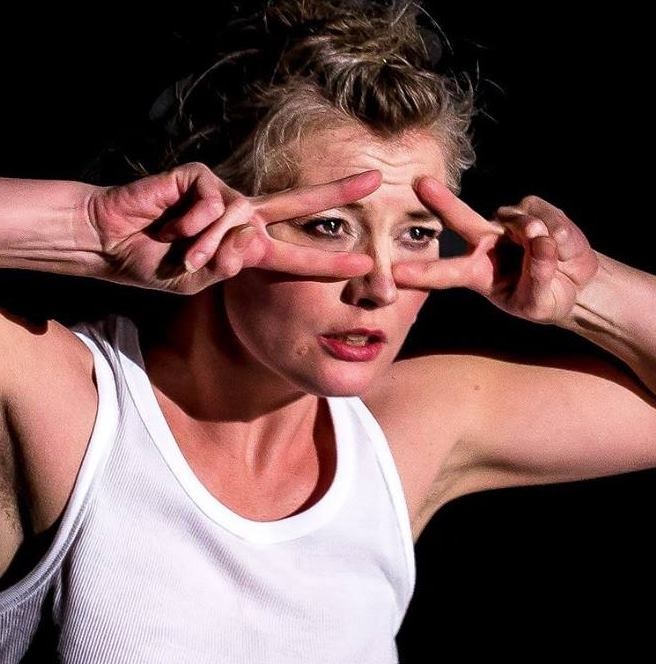
Riikka Theresa Innanen: After I had decided to stop dancing at the age of 6, (I was to dance a duet with a boy, and I got too embarrassed and offended to go on), I totally got swept away with Break dancing at the age of 12, and had to start again. For a girl in 1980’s in a small town in Finland it wasn’t too easy to develop my passion, but I was equally inspired by the Fame that was on TV. I though I could support my street dancing with jazz dance classes. This developed further to ballet and modern dance until I stopped again. After a year of dancing flamenco as a hobby and trying to find a “real profession”, I realized that the only thing I really love and know to do is dancing. I studied dance and choreography 4 years in Amsterdam at SNDO (1993-1997). SNDO together with working a year in a residency at Daghdha Dance Company in Ireland has possibly left the biggest imprint on me as an artist. In both these places I was lucky enough to study there when it still was very mixed with varying trainings and aesthetics. The students came from the world continents and from different walks of life. Then I could also learn how to use my passion in visual arts, music and computers as an asset for my dance work and artistic thinking. I taught at the Theatre school for 4 years before moving back to Finland in 2001. In Finland, working with Side Step Festivalhas been important as well as connecting with various “off ” groups such as Reality Research Center, and z-score. After 8 year in Finland, I felt more supported abroad and left for Daghdha Dance Company. The structure (now sadly finished) of daily commitment, small salary and a workspace (even if open and shared) together with the support of the fellow resident artists and staff, made a big change in how I see my work placed, and how I want to continue developing my work.
YOUR STORY IS VERY INTERESTING, YOU HAD AN INTERNATIONAL CAREER, AND THEN YOU CAME BACK TO FINLAND. YOU DESCRIBE THAT WORKING WITH ‘OFF’ SCENES FITS YOU BETTER. IN ANY EVENT, YOU ARE A MULTIPLE DANCE ARTIST.
R-T: Well, in a nutshell my career is a weave made of many different lines varying from improvising to creating choreographies to working as a dancer to teaching dance for camera for professionals to creating work with immigrant youth in Finland. I guess I’m mostly looking from outside-in: I grew up between cultures and still live in mix of different languages, social statuses and religions, I studied abroad and then moved back yet never stopped working abroad, so it’s just how life has made me. My aim as a maker is to take the audience to/through situations of reflection and enable subtle, personal experiences that can people move from within. To provoke non-violently but consciously. In my soul I’m a lonely nomad yet I work best in collaborations and groups. I truly get inspired by difference and excellence, despite of the discipline, of which working with the Irish mathematician Alex Clancy on Number is a good example. I tend to go for cross pollination rather than for purity. I’m interested how to choreograph beneath the surface rather than shapes and how systems or Minds grow from that mix of different elements into “self sustained intelligent systems” and surprise me. Keeping control over the work becomes besides the point when you can instead be watching creation happen. Probably my early attempts to program on my first Commandore 64 computer left it’s traces. This together with starting dancing on the street during the first wave of hip hop mixes with the later dance education during the 90’s at SNDO has create my attitude. I’m passionate about composition and systems, of improvisation and danger and about dancing, purely and plainly. The brain needs to be be busy with science, philosophy and understanding life and structures but it’s pretty amazing to be “just taken” by dance and be led to unknown, unthought territories as well.
TELL ABOUT YOUR RECENT PERFORMANCE PROJECT AT FULL MOON DANCE FESTIVAL IN FINLAND, WHAT WAS THE EXPERIENCE LIKE, HOW ABOUT THE CONCEPT AND AUDIENCE PARTICIPATION? DO YOU HAVE OTHER REMARKS FROM THE FESTIVAL?
R-T: The project is about Happiness with a version called Tree of Happiness. The work is fundamentally a choreographed interface to make people move, think and interact on one level with me but also collectively through actions in a civic spaces and by being emotionally moved in a way which can ripple into their own lives. Practically it is a durational piece: for 3 days I meet with people, discuss and propose to answer 3 questions about Happiness on a peace of paper, which they then can hang on a tree as a leaf. The individual actions are multiplied, and make a visible installation grow, which anyone interact with. It is a very simple structure but as always, the human factor is multiplied with many participants, and creates complexity and variation, and depth. This work is very much based on a source code- choreographing approach, and the participants do not need to see or understand the structure, which happens beneath the surface to engage with and contribute to the work.
At the Full Moon Dance Festival, I also wanted to extend the movement into the social media as well, as I’m convinced Internet has radically changed how we interact, think and construct social relations and realities. Additionally I wanted to involve locals, and so through during 3 pop up events we could experience something unique, a shared personal experience of Happiness. We had a silent walk in the nature with local wilderness guide, a session to learn how to play ukulele with the local Uke-guru and a “How to be your own Tree of Happiness in 15 min” – of course led by myself.
YOU ALSO DID A PROJECT WITH DEBORAH HAY, WHO IS SUCH LEGEND IN THE FIELD. WAS THIS EXPERIENCE A KIND OF LANDMARK IN YOUR CAREER? HOW DID YOU DECIDE TO JOIN THE PROJECT, WHERE DID YOU PERFORM, AND WHAT DID YOUR LEARN?
R-T: Yes and no. Deborah Hay has been landmarking my career on regular 10 year intervals since I 1st saw her perform in 1993 during my 1st year at SNDO. She was such an odd appearance which stayed with. Ten years later we invited her to Helsinki for Side Step festival. I followed closely and filmed the process as she worked with a group of soloists adapt her work. Even if I read her books, listen to her closely I did not feel dancing her work was something for me. Only in 2012, 19 years after I first saw her, did I finally feel ready to dance the Dance. It came along at period with many changes in all aspects of my life including learning the solo while still relearning how to walk after an operation on both of my knees, so I Think Not (the choreography I learned with Deborah Hay), fitted to that perfectly. So she has been landmarking my life on regular intervals, always in different ways. I’m very attached to dancing the solo adaptation, even if I will ever totally “get it”, or Deborah but somehow realizing the impossibility of theconundrum (that there is nothing to “get”) will keep me engaged with the dance for the rest of my life. And Deborah might keep landmarking my career even the next 10 and 20 years with new inputs.
WHAT IS YOUR FAVORITE CITY IN AMERICA, AND WHY?
R-T: That’s a really hard question to answer. The country is so wast and varied. I did fall in love with San Francisco, but I might have been most surprised with Austin, TX. Never expected it to be so lovely, lively and arts-friendly place, good to live and work in. Also I felt a strong spiritual connection to the land and its native history, which touched me deeply.
THERE IS SO MUCH GOING ON IN YOUR OWN CAREER. HOW WOULD YOU DESCRIBE THE FINNISH CONTEMPORARY DANCE AT THE MOMENT?
R-T: That is the toughest question. I’ve been so much away and I don’t really follow what is being programmed as I’m not a great consumer of dance but I know most of the makes as friends and colleagues, so hard to get an objective perspective. I guess the main stream Finnish dance scene struggles with being relevant. In a social and political climate, which is very anti-art, the big work to be done is to make art and dance a vital and essential part of the society. From the US we have learned the new independent funding methods are possible together with the old, which in very short time has created a stronger footing of freelance dancers. They are joining forces creating collectives and sharing spaces more courageously than before. This is great as in the end of the day 80% of all dance performances in Finland are created not by big institutions but by freelancers. The existing Funding structures are also looking for new ways to support the field but I’m not to optimistic in their abilities to truly change. But after the Full Moon Dance Festival, I’m hopeful. The new generation of makers is wild. They are totally renegotiating the premises and aesthetics of Finnish dance, which is really not easy to reinvent: Thanks to the strong heritage of Finnish architecture and design, and the lack of social struggle, the works tend to be more visual than topic oriented and that is what audience and funding sources are accustomed to go for. The really cool side of Finnish art is that we really don’t belong to neither Western nor the Slavic culture. Our heritage and mentality is strongly connected to Nature and our shamanistic heritage lurking just beneath our modern surface. We have a knack in being potentially totally bizarre and unique, if we only allow it to come out.
WHAT ARE YOUR PLANS FOR THE FUTURE?
R-T: I hope to keep up with the mosaic. The big process brewing inside is the aftermath of spending last winter in residency in West Africa. My research there was into how we create realities, how art is a part of the daily and social life, and to observe and finally live the difference. Living the difference made something very deep inside of me change. To live in the world were art, dreamworld, work life, family life and big and small rituals are totally integrated together, was striking in Africa. Returning back to a reality where everything is divided in to factions has been interesting but not easy: art being a separate part of an institutionalized system of money, power and consumption feels very violating and unsustainable for me right now. I don’t feel out of tune with my work but rather the structures and my relation to funding and producing. Luckily projects like Tree of Happiness, helps me ponder through my work how things could be differently supported to grow. In any case this kind of reassessment seems to happen regularly through out my career. I seem to need to push myself of the beaten track to find substance and interest. In the end of the day, I see my career as a long path, based on an ongoing search with the daily practices, bringing out the “branches”, which develop into specific manifestations and can be shared with the public/audience. Ever branch is different and unique but connected to the core trunk. I will keep developing further the Happiness project and the Tree of Happiness piece, and working on developing new choreographic systems. Hopefully my adaptation of Hay’s solo will follow me the rest of my life. This autumn I’ll mostly work as a dancer and maybe in the future I will return to curating and organizing, after the experience of Side Step and Daghdha there are interesting structures to keep developing further.
I’m very happy to be able to stay in Finland this autumn and work as a dancer for other makers: first for the Danish Hello!Earth group and then with Liisa Pentti+Co in Liisa’s work Space Particles. Playing music and drawing seems to occupy more of my time so I’m curious to see how it will seep into my works. I will keep teaching and traveling with residencies, hopefully returning to Africa but at least there will be working in Island next January with Hello!Earth continuing our Kedja Wilderness residency there.
FOLLOW Riikka Theresa Innanen’s website here.
SEE HER VIMEO here..

 Firstindigo&Lifestyle