
If fashion is now promoted with both ecological values and celebrity cultures, a question of who is wearing what and whose designs, includes a new kind of conceptual thinking. Historically, fashion is the clothes that we are wearing. Then, a questions of social class plays an important role, since we are making the clothes our own by wearing them. Traditionally, women have been thought to be the ideal consumers of fashion, so fashion magazines have also created platforms where to discuss and make fashion as part of the women’s lives. In the circulation of fashion, clothes become fashionable again when the trends come back as new combination, and also next to new concepts and ideas. The historical, futuristic, and the near-past fashion are re-produced together with popular cultural icons. The cultural references of fashion keep also changing so that they are able to maintain the ‘hype’ status attached to classical designs. New technologies used in the fabrics, as well as green values are important factors, which also reflect the moment. More importantly, ecological aspects that promote global awareness and respect the local traditions are now a necessity.
When in previous decades, the fashion products (and other products) did not take into consideration the ecological dimension of production, today’s processes are very different. The economics behind the change is pricing, as the prices in materials have been rising. Then, today’s consumers cannot be entirely responsible for paying the high cost, so the companies and designers have to be able to reduce the amount in production, and reconsider the materials, which they use.
When we are making our choices as consumers of fashion, more important to us than who is showing up in the shows is to be a conscious consumer. We should be asking, what is the ecological dimension behind the clothes that we buy. In addition, a cultural and geographical referent can become a conscious factor in our decision making; when in the making of the products this means emphasizing the local craftsmanship. One example of this type of local fashioning is a collective Contept Korea that has utilized an idea of Korean fashion culture in their global marketing. Designers who are participating in the collective aim at making Korean cultural image and national competitiveness as their goal. The Korean fashion, which has been promoted overseas has been sponsored by the Korean Ministry of Culture. With that governmental aspect, Concept Korea has been looking for new forums to promote Korean fashion and culture together, and to interact with new technologies. I participated in their showing in Mercedes-Benz Fashion Week in New York in February 2011.
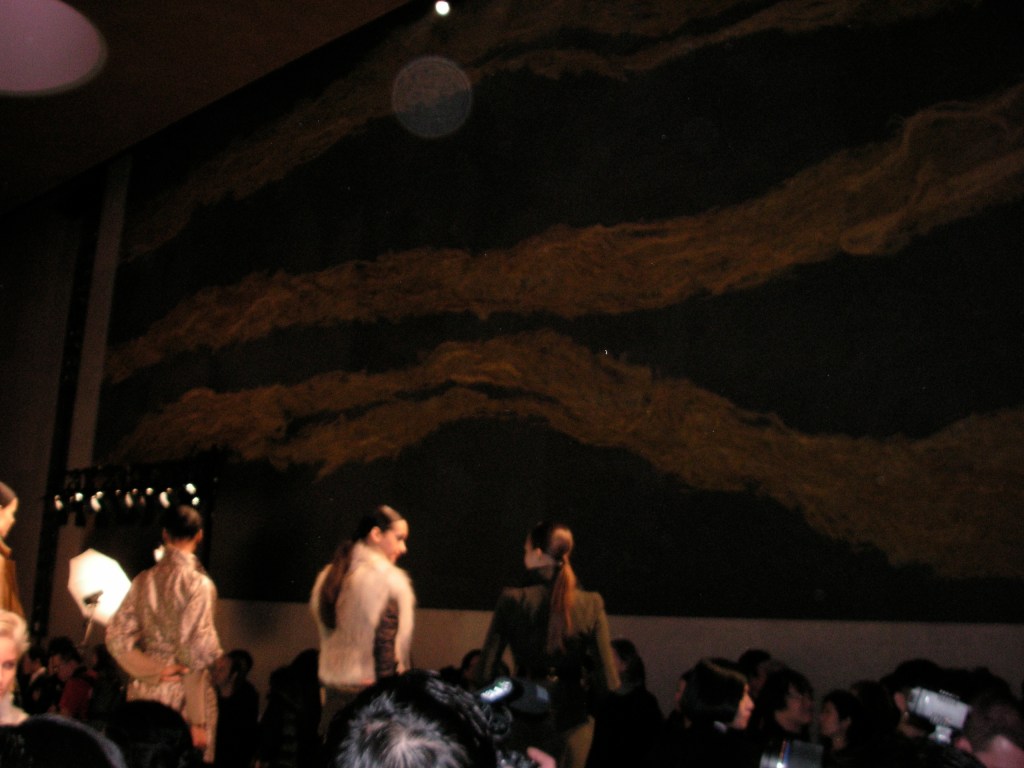
One of the designers Lie Sang Bong (based in Paris), has been drawing inspiration from Korean folk painting, from the black and white graphic designs which have drops of bright color like red in them. He has also created fashion sculpture and a bauhaus-architecture inspired collection, which both show sculptural dimensionality in clothing. Then, a Korean woman designer Doho impresses with work that has a feminine and flowy touch (see picture from Mercedes-Benz Fashion Week in February 2011). Concept Korea perhaps comes as a continuation of the collective creativity that started with Seoul being the World Design Capital in 2010.
In today’s economical climate, the design world is thinking alternative solutions. When European countries struggle with economical difficulties, a good news could be that the countries are re-thinking the carbon limits in the production processes. Only a few decades ago, environmental problems were thought to be part of the policy making of the governments. Now the industrial processes are considering the environmental questions as part of their designing of products.

 Firstindigo&Lifestyle